Updated August 6, 2026 9:24 pm
In short
Klaviyo is buying Agency to accelerate its AI agents, bringing founder Elias Torres back alongside Andrew Bialecki in a reunion shaped by the company’s public-market push and a fresh bet on business automation.
- Klaviyo is acquiring Agency to accelerate its AI agents strategy.
- Elias Torres will join Klaviyo as chief product officer after the deal closes.
- Agency had raised $32 million from top venture firms before the acquisition.
- Klaviyo believes its customer data gives it an edge over AI competitors.
- The move reunites Torres and Klaviyo CEO Andrew Bialecki after years of shared startup history.
Update — August 6, 2026 9:24 pm
Klaviyo disclosed that it went public in September 2023 at a $9.2 billion valuation, and that its shares have since declined along with the broader SaaS sector.
Bialecki also offered a sharper view of why he sees the deal as timely, calling agents the next major tech wave and saying the acquisition is a chance to “get the band back together” with Torres.
Update — August 6, 2026 12:24 am
TechCrunch’s updated version adds that Klaviyo went public in September 2023 at a $9.2 billion valuation, and notes that its stock has since fallen along with other SaaS names.
It also includes a fresh quote from Andrew Bialecki framing agents as the next major tech wave and describing the deal as a chance to “get the band back together.”
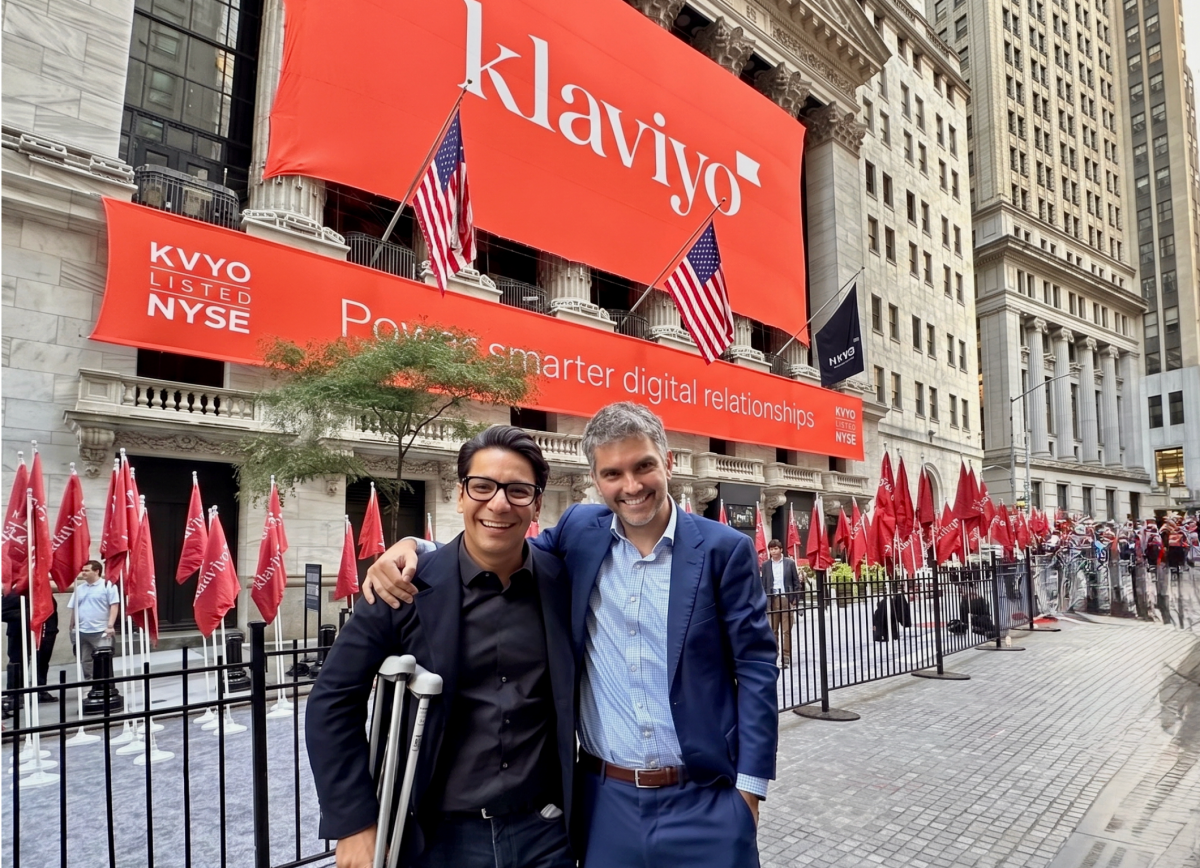
Klaviyo has agreed to buy Agency, the AI customer success startup founded by serial entrepreneur Elias Torres, in a deal that reunites two longtime collaborators and gives the public company a bigger bet on AI agents. The acquisition, announced on August 5, 2026, will bring Torres into Klaviyo as chief product officer and fold Agency’s 25-person team into Klaviyo’s product organization.
The purchase price was not disclosed, but the move is strategically important: Klaviyo is trying to expand its AI agent lineup for its large base of ecommerce customers, while Torres is returning to work with Andrew Bialecki, the co-founder and CEO he once mentored early in Bialecki’s career.
Klaviyo says the acquisition will help speed up development of two of its agent products: Composer, which creates marketing campaigns, and Customer Agent, which handles tasks such as post-purchase support, returns and order tracking. The company believes that combining Agency’s product with its customer data and scale could help it compete more aggressively in a fast-forming market for business-facing AI assistants.
What Klaviyo is buying and why it matters
Klaviyo is not just buying a startup. It is buying product talent, technical know-how and a team that has already built AI software for customer support workflows.
Agency, founded in 2023, had already raised $32 million before the acquisition, with backing from Sequoia, Menlo Ventures and Felicis. Those investors helped validate the startup’s direction in a crowded market where businesses are racing to automate more customer interactions without losing quality.
For Klaviyo, the deal gives it a shortcut into a category that has become central to enterprise software: AI agents that can complete practical tasks rather than simply answer questions. That includes work across marketing, support and post-sale customer engagement, which are all areas where ecommerce businesses spend significant time and money.
The acquisition also signals that Klaviyo sees AI agents as more than a feature add-on. By bringing Torres inside the company and assigning him a senior product role, Klaviyo is treating the move as a broader product strategy rather than a simple tuck-in purchase.
How did Elias Torres and Andrew Bialecki get here?
They got here through a relationship that began long before either of their companies became well known. Torres hired Bialecki back in 2010 at Performable, where Bialecki was one of the startup’s earliest engineers after graduating from Harvard two years earlier.
Torres said he mentored Bialecki during those early days, helping shape his understanding of how startups operate and how products evolve under pressure. Bialecki later went on to co-found Klaviyo after leaving Performable.
When Klaviyo raised its first outside funding in 2015, Bialecki invited Torres to participate as an angel investor. That early financial support turned into a long-running professional relationship that now circles back in the form of an acquisition.
This is the kind of founder story that Silicon Valley likes to tell about timing, trust and unfinished business. But in this case, the reunion is happening in a market where execution matters even more than narrative. Klaviyo wants to use that trust to move faster.
“Elias and the team built a great product with Agency,” Bialecki said, adding that Klaviyo plans to combine Agency’s technology with its own agent products and reach 200,000 businesses now, with the goal of serving millions more in the coming years.
Why Klaviyo is betting on AI agents now
Klaviyo is betting on AI agents now because the company believes customer data can make automation more useful, more specific and harder to copy. That matters in a market where many AI tools can draft text, but fewer can act reliably on a business’s actual operating data.
The company has spent years building infrastructure around ecommerce brands, giving it a detailed view of purchase histories, order flow, support tickets and lifecycle marketing patterns. In theory, that data depth should help its agents do more than generate generic responses.
That is also why Klaviyo thinks it has an edge over newer AI-native customer support startups such as Decagon and Sierra. Those companies have drawn attention for building polished, business-facing AI systems, but Klaviyo believes its existing customer relationships and data richness give it a meaningful head start.
In other words, the company is making a classic platform argument: the more useful the underlying data, the better the AI experience can become. For ecommerce brands, the promise is a single system that can both market to customers and help support them after a purchase.
Composer and Customer Agent explained
Composer and Customer Agent represent two sides of the same business conversation. Composer helps create marketing campaigns, while Customer Agent focuses on customer service and post-sale support.
That distinction matters because it shows how Klaviyo is trying to connect the full customer journey. Instead of treating marketing and support as separate workflows, the company is positioning AI agents as a layer that can operate across both.
- Composer: builds marketing campaigns and helps teams generate outreach faster.
- Customer Agent: assists with post-sale questions such as returns and order tracking.
- Agency team: adds product and engineering talent focused on AI-driven service workflows.
How much did Agency raise before the deal?
Agency raised $32 million before being acquired by Klaviyo. That capital came from a strong list of venture backers, including Sequoia, Menlo Ventures and Felicis.
While the valuation was not made public, the funding history suggests Agency had enough momentum to attract top-tier investors. It also indicates that Klaviyo was not buying a distressed asset. Instead, it is bringing in a young company with credibility, a focused product and an experienced founder.
The startup was only three years old, but it was already part of a broader pattern in enterprise software: small, well-funded AI companies build around a specific workflow, then larger platforms acquire them to accelerate distribution.
| Company | Founded | Core focus | Funding / valuation | Deal status |
|---|---|---|---|---|
| Agency | 2023 | AI-powered customer success | $32 million raised | Acquired by Klaviyo |
| Klaviyo | 2012 | Ecommerce marketing automation | IPO at $9.2 billion valuation in 2023 | Public company acquiring Agency |
| Performable | 2009 | Marketing software | Acquired by HubSpot in 2011 | Historical link between founders |
| Drift | 2015 | Sales and marketing software | Sold to Vista Equity for $1.2 billion in 2021 | Torres exit prior to Agency |
What does this mean for Klaviyo’s product roadmap?
It likely means Klaviyo will move faster on agent design, deployment and customer-facing automation. The company has already started framing AI as a key product pillar, and Agency’s team gives it more firepower to ship.
Torres will join as chief product officer, which is a strong indication that Klaviyo wants his experience to shape not only the acquired product, but also the company’s broader direction. With 25 Agency employees coming over, Klaviyo gains a team small enough to be integrated but experienced enough to influence how the product works in practice.
That integration could matter across several fronts:
- Faster rollout of customer-facing AI tools.
- Better alignment between marketing automation and support workflows.
- More emphasis on product-led AI adoption inside Klaviyo’s existing platform.
- Potential expansion from ecommerce brands into larger enterprise use cases over time.
There is also a timing element. Klaviyo’s stock has been under pressure, along with much of the software sector, which makes growth narratives especially important. AI agents are one of the clearest ways for software companies to signal future relevance, and this acquisition gives Klaviyo a concrete story to tell investors.
Why this reunion stands out in the AI market
This reunion stands out because it links two founders whose careers have already crossed multiple startup cycles. Torres and Bialecki are not strangers combining companies for the first time; they are former colleagues with a shared history stretching back more than a decade.
Torres has also already lived through two major exits. Performable was acquired by HubSpot in 2011, and Drift, where he was CTO for eight years, was sold to Vista Equity in a $1.2 billion transaction in 2021. That experience gives him a track record in building, scaling and exiting software businesses.
Bialecki, meanwhile, took Klaviyo from a bootstrap start to a public listing in September 2023, when the company debuted at a $9.2 billion valuation. The acquisition suggests he is now using the company’s public-market position to buy speed in a competitive AI race.
Together, their histories suggest a mix of familiarity and urgency. The market is moving fast, and Klaviyo appears to believe that one of the best ways to stay ahead is to bring in someone who understands both the company’s roots and the next wave of software change.
“It’s the next big tech revolution: agents,” Bialecki said, describing the acquisition as a chance to “get the band back together” and build the category at scale.
Who are the companies competing with Klaviyo?
Klaviyo is competing with both incumbent marketing platforms and newer AI-native startups. On the AI side, the most relevant names mentioned by the company include Decagon and Sierra, which are building business automation and customer support tools.
That competitive landscape matters because the market for AI agents is still forming. Companies are trying to define what an agent should do, how autonomous it should be and where it fits in existing workflows.
For Klaviyo, the advantage may come from specialization. Its core audience is ecommerce businesses, which tend to have recurring customer interactions, large amounts of transactional data and clear post-sale support needs. Those are ideal conditions for practical AI automation.
The challenge is that large software platforms are not the only ones chasing the opportunity. Smaller companies can move quickly, and well-funded startups often build around AI use cases from the ground up. Klaviyo’s bet is that distribution plus data will outweigh startup speed.
How the deal reflects a broader AI acquisition trend
The deal reflects a broader trend of established software companies buying AI startups to accelerate product development. Rather than build every feature internally, public companies increasingly want teams that already know how to deliver AI workflows at production scale.
This approach can save time, reduce execution risk and help companies present a clearer narrative to customers and investors. It can also be a way to secure talent in a market where experienced AI product builders are in high demand.
At the same time, acquisitions like this often reveal how quickly AI categories are maturing. Just a few years ago, many startups were still proving that businesses would pay for AI assistance at all. Today, the debate has moved to which companies can make those systems reliable, useful and deeply integrated into revenue-generating workflows.
Klaviyo’s purchase of Agency suggests that customer success and marketing automation are now among the most attractive areas for that next phase.
Timeline of the Klaviyo and Torres relationship
The history between the two founders helps explain why this transaction feels less like a random merger and more like a long-awaited convergence.
| Year | Event | Why it matters |
|---|---|---|
| 2010 | Torres hires Bialecki at Performable | Bialecki gets early startup experience under Torres |
| 2011 | HubSpot acquires Performable | Torres and Bialecki move on to new ventures |
| 2015 | Klaviyo raises its first outside funding | Torres joins as an angel investor |
| 2021 | Vista Equity buys Drift | Torres completes another major exit |
| 2023 | Klaviyo goes public | The company gains capital and scale for larger bets |
| 2023 | Torres founds Agency | He builds a new AI customer success product |
| 2026 | Klaviyo acquires Agency | The founders reunite inside one company |
What happens next?
What happens next is likely a period of integration, product alignment and faster iteration on AI features. Klaviyo will need to fold Agency’s team into its operating structure while preserving the product instincts that made the startup valuable in the first place.
For customers, the most visible changes may come in the form of more capable AI tools tied to ecommerce workflows. For investors, the key question will be whether Klaviyo can turn the acquisition into measurable product momentum and revenue growth.
For Torres, the move appears to be both a strategic next step and a personal one. After building and selling companies across multiple waves of software evolution, he is now returning to a founder relationship that began before Klaviyo existed.
And for Klaviyo, the message is clear: the company wants to compete in the AI agents market not as a follower, but as a platform with data, distribution and now acquired product expertise on its side.
Whether that proves enough to dominate the category remains to be seen. But the acquisition makes one thing obvious: Klaviyo is no longer treating AI agents as experimental side projects. It is treating them as a central part of the company’s next chapter.
Frequently asked questions
What did Klaviyo acquire from Agency?
Klaviyo acquired Agency, the AI-powered customer success startup founded by Elias Torres. The deal also brings Agency’s 25-person team into Klaviyo, along with Torres himself, who will serve as chief product officer and help guide Klaviyo’s AI agent products.
How much did Agency raise before being acquired?
Agency raised $32 million before Klaviyo bought the company. Its backers included Sequoia, Menlo Ventures and Felicis, which helped establish the startup as a credible player in AI customer support and service automation.
Why is Klaviyo interested in AI agents?
Klaviyo is interested in AI agents because it believes its customer data can make automation more useful for ecommerce businesses. The company wants agents that can both generate marketing campaigns and handle support tasks like returns and order tracking.
Who is Elias Torres and why does this reunion matter?
Elias Torres is a serial entrepreneur who co-founded Performable and later Drift before founding Agency in 2023. The reunion matters because he once hired and mentored Klaviyo CEO Andrew Bialecki at Performable, and now they are working together again.
What products will Agency help Klaviyo improve?
Agency is expected to help Klaviyo improve Composer, which creates marketing campaigns, and Customer Agent, which handles post-sale support such as order tracking and returns. Klaviyo says the combined teams will accelerate development of both products.