In short
Apple’s trade secrets lawsuit against OpenAI goes beyond a hiring dispute and threatens the company’s push into AI hardware. The case could become a costly, years-long battle that tests OpenAI’s finances, strategy and ability to compete with Apple on consumer devices.
- Apple says former employees and OpenAI-linked hardware efforts may have exposed trade secrets.
- The case could delay or complicate OpenAI’s push into consumer AI devices.
- OpenAI is already under pressure to prove a clear path to profitability.
- Legal experts expect a long, expensive fight unless the companies settle.
- The dispute highlights the growing battle over who controls the next computing interface.
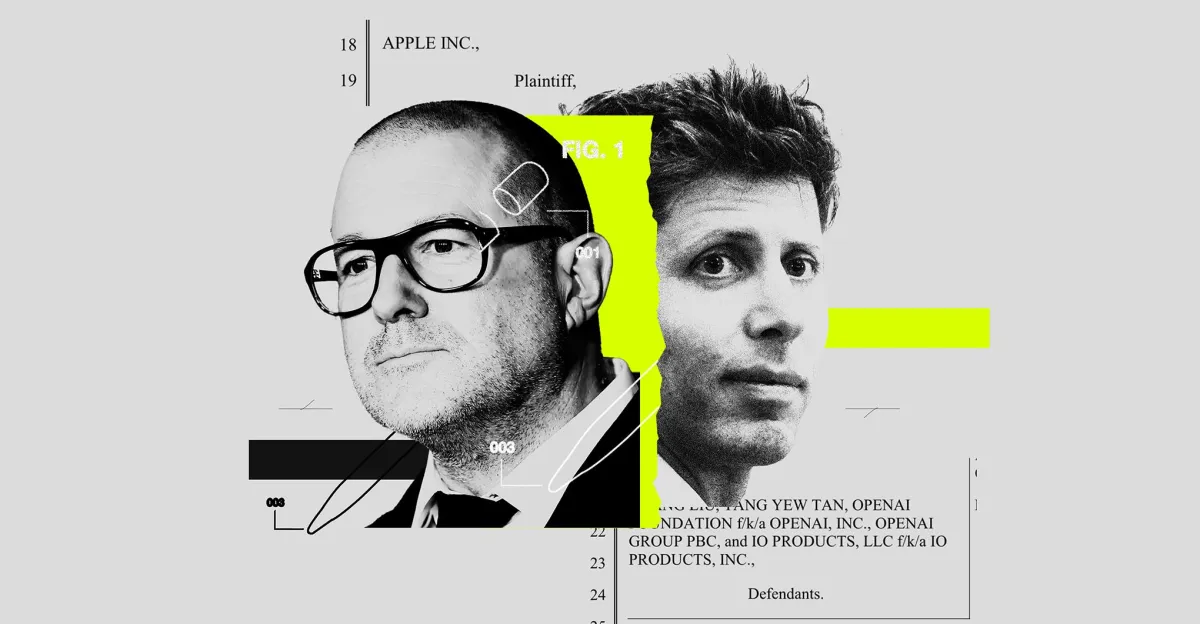
Apple’s trade secrets lawsuit against OpenAI is about much more than a few allegedly improper job interviews. The case puts OpenAI’s hardware ambitions, its reliance on former Apple talent, and its ability to survive another costly legal fight under a harsh spotlight.
Filed in the middle of OpenAI’s push into consumer devices and coming just a year after its expensive acquisition of Jony Ive’s io Products, the dispute matters because it could slow the company’s next big strategic move and drain attention from a business still trying to prove it can turn growth into profit.
Apple says former employees who moved to OpenAI helped pry loose confidential information tied to product development and manufacturing. OpenAI denies wrongdoing, but legal experts say the complaint is serious enough to become a drawn-out, high-stakes battle between one of the world’s richest tech companies and a younger AI leader that is still financially and strategically vulnerable.
Why this lawsuit matters now
The timing is what makes this case especially significant. OpenAI is already under pressure to show it can build a durable business, not just dominate headlines. It has spent heavily, changed direction repeatedly and expanded from software into hardware at the exact moment Apple is accusing it of crossing the line into trade secret theft.
For Apple, the lawsuit is another chance to use the courts aggressively against a rival it believes has benefited from access to its internal know-how. For OpenAI, it is a reminder that the company’s push beyond chatbots and enterprise tools into the device market comes with legal, operational and reputational risk.
That combination makes the dispute bigger than a standard employee-defection fight. It is shaping up as a test of whether OpenAI can keep moving fast while being dragged into a legal conflict with a company known for patience, resources and a willingness to litigate for years.
What Apple is alleging
Apple’s complaint centers on claims that former employees allegedly used their access and interviews to gather confidential information about Apple products and processes. The company says some of the conduct involved asking candidates to reveal what they knew about unreleased devices, internal code names and manufacturing practices.
According to the allegations discussed in the source material, the complaint also describes instances where employees were allegedly encouraged to bring hardware components or other materials outside Apple’s offices for informal review. One cited message reportedly captured a person joking that they could access confidential information, which Apple treats as evidence of deliberate misconduct.
OpenAI has publicly denied the accusations, and the company has not yet fully laid out its legal defense. Even so, the claims are serious enough to suggest the case could become a broad discovery fight over who knew what, when they knew it and how much of Apple’s internal information may have followed talent out the door.
How unusual is this kind of case?
It is not unusual in the abstract, but it is unusual in scale. Intellectual property lawyers say the allegations resemble patterns they see in trade secret disputes all the time: employees switch companies, confidential knowledge walks with them, and one side later argues that the line between experience and stolen information was crossed.
What makes this dispute stand out is the combination of the parties involved. Apple is a tech giant with a long history of hard-edged legal strategy. OpenAI is a much newer company that has become indispensable to the AI boom, but still appears to be balancing huge ambitions with unstable economics.
That mismatch matters because lawsuits of this kind often become endurance contests. Older, richer companies can afford to press a claim. Younger companies can be forced to spend money, energy and executive time defending themselves while trying to build products, keep investors satisfied and avoid bad headlines.
Apple has been here before
Apple’s legal history helps explain why this case is being taken seriously. Over the decades, the company has used intellectual property law as a strategic tool in fights over the look, feel and functionality of its products. It has gone after Microsoft, Samsung and others in major disputes that were part business rivalry, part legal theater and part effort to shape industry norms.
The company did not always win in the sense of wiping out competitors. But it did often force adversaries into expensive, distracting and lengthy litigation. The point was sometimes as much about leverage as victory.
OpenAI is not Microsoft or Samsung
The key difference is that OpenAI does not yet have the same financial cushion or operating maturity as those past Apple targets. It has become one of the most influential names in artificial intelligence, but it is still under pressure to show a path to sustainable returns, especially as it expands from software into hardware and enterprise sales.
That leaves the company exposed. A lawsuit can be settled, fought or dragged out, but all three outcomes carry costs. The risk is not just a payout. It is the possibility that OpenAI’s management spends months or years dealing with a legal problem that distracts from product strategy and investor expectations.
Who is Tang Tan and why is he central?
Tang Tan is central because Apple’s allegations appear to place him at the heart of the hiring and information-gathering activity described in the complaint. He worked at Apple for roughly 24 years and later became a key hardware executive in OpenAI’s orbit after helping launch io Products, the startup associated with Jony Ive.
OpenAI later made Tan its chief hardware officer, giving him a major role in the company’s physical-device ambitions. Apple says he played an outsized part in interview conversations and in discussions that may have encouraged candidates to reveal sensitive details about Apple projects.
Those allegations matter because they go to intent. If a senior executive with long Apple experience used his position to mine knowledge from job candidates, Apple can argue the conduct was not accidental or incidental. It would suggest a structured effort to tap inside expertise in a way that may have crossed legal lines.
Hayden Field, the Verge reporter cited in the source conversation, described the accusations as unusually serious on their face, while noting that trade secret lawyers often recognize the broader pattern. The unusual part, she said in effect, is not the existence of employee mobility, but the concentration of so many allegations in one fight between two major companies.
What role does Jony Ive play?
Jony Ive is the most famous name connected to OpenAI’s hardware ambitions, but he is not named in the Apple lawsuit discussed here. That omission is notable because Ive is the symbolic bridge between Apple’s design legacy and OpenAI’s attempt to build the next consumer device category.
OpenAI bought io Products for $6.5 billion in 2025, effectively bringing Ive’s startup into its orbit as it looked to move beyond software. Ive’s public messaging with Sam Altman framed conventional phones and laptops as legacy products, a clear signal that OpenAI wants to build something that feels like a successor rather than an accessory.
Apple’s complaint, at least as described in the source, instead focuses on other former Apple personnel and the methods they allegedly used. That choice may reflect legal strategy, incomplete evidence or caution around the optics of naming one of the most influential designers in modern consumer tech.
Why leaving Ive out may matter
Leaving Ive out of the complaint could signal that Apple does not yet believe it has direct evidence tying him to the alleged trade secret conduct. It could also mean the company is reserving its strongest accusations for later, if the case reveals more during discovery.
Either way, the omission matters because Ive is the public face of OpenAI’s hardware credibility. If the company wants to convince consumers and investors that it can launch a breakthrough device, his involvement helps. If the case turns into a long-running dispute over Apple know-how, that same connection becomes a liability.
Why would OpenAI want Apple talent so badly?
OpenAI would want Apple talent because hardware is unforgiving, and Apple has spent decades learning how to ship consumer products at global scale. Building a credible AI device requires industrial design, manufacturing discipline, supply-chain knowledge and an understanding of how to avoid the embarrassing failures that have plagued recent AI gadgets.
In the source conversation, Hayden Field argued that OpenAI’s hardware push should not be surprising, because the company and its rivals need experienced product people if they want to avoid becoming another cautionary tale. The problem is that there is a fine line between hiring expertise and importing protected information.
That line becomes especially thin when a startup is trying to make the leap from software to physical devices. Software can be updated after launch; hardware usually cannot. Once a device is built, manufactured and shipped, mistakes are expensive and public.
Hardware is a different game
Hardware success depends on decisions made long before a product reaches consumers. Industrial design, component selection, reliability testing and manufacturing execution all have to come together at once. That means companies often recruit aggressively from experienced rivals to reduce the odds of failure.
OpenAI’s interest in Apple veterans therefore looks rational from a business perspective. But what is rational in business can still create legal exposure if executives or recruits are seen as using that hiring process to harvest confidential information.
How does this fit OpenAI’s shifting strategy?
OpenAI’s strategy has been changing repeatedly as it tries to reconcile consumer appeal, enterprise demand and hardware ambition. In recent months, the company has emphasized enterprise services and coding-related products as its clearest revenue engines, even as it has cut back or folded in other experiments.
The result is a company that keeps revising its own story. At different times, OpenAI has been cast as the consumer AI app that would challenge Google, the platform that would own the AI interface layer and the future hardware company that could reshape how people interact with devices.
That flexibility has helped OpenAI move quickly, but it has also made the company look strategically restless. The lawsuit lands in the middle of that uncertainty, just as OpenAI needs to show investors and partners that its next phase is more than a collection of ambitious ideas.
| Key issue | What Apple alleges | Why it matters |
|---|---|---|
| Employee interviews | Questions about Apple projects and confidential details | Could show deliberate efforts to extract trade secrets |
| Hardware access | Alleged requests to bring components or materials outside Apple | Suggests possible misuse of physical and technical knowledge |
| Former Apple staff | Several ex-Apple employees joined OpenAI or related ventures | Raises concerns about information transfer during hiring |
| OpenAI hardware push | Investment in io Products and new device plans | Shows why Apple’s know-how would be especially valuable |
| Legal stakes | Possible trial, settlement or prolonged litigation | Could drain cash, attention and strategic focus |
What happens if the case goes to trial?
If the case goes to trial, it could become one of the most closely watched tech-IP disputes in years. Trials over trade secrets tend to be document-heavy, technical and slow, especially when the evidence includes email records, chat messages, hiring conversations and manufacturing materials.
A trial would also force both companies to reveal more about their internal plans than they likely want. Apple could be pushed to show how sensitive its allegations really are. OpenAI would have to defend its hiring practices and explain how it separates outside expertise from any alleged misuse of confidential information.
For a company already under pressure to deliver commercially, that is not a trivial burden. OpenAI’s leaders would likely prefer a resolution that limits damage and keeps the hardware roadmap moving. But whether Apple wants that is another question entirely.
Could they settle?
They could settle, but only if the money and the terms are acceptable to Apple. A settlement would likely involve some combination of payments, restrictions, admissions or internal safeguards designed to reassure Apple that its information will not be used.
The obstacle is that Apple may want more than compensation. It may want to make a point. If the company believes OpenAI’s conduct was especially brazen, it may decide the message of a public fight is worth the time and expense.
How serious is the financial risk for OpenAI?
The financial risk is meaningful because OpenAI is still in a phase where large unexpected liabilities can complicate a delicate business transition. The company is reportedly moving toward an IPO and is under intense scrutiny over whether its growth can eventually translate into profits.
Any major legal settlement or judgment would land on top of those concerns. Even if the final cost is manageable, the process of defending the case will consume money and executive bandwidth. In a company that is still changing shape, that is its own form of damage.
There is also the broader cost of distraction. OpenAI is trying to build products, court enterprise customers, reassure investors, manage turnover and define its position in a crowded AI market. A prolonged lawsuit with Apple risks pulling the company in yet another direction.
Why the case could reshape AI hardware competition
This dispute could shape the AI hardware market by making companies more cautious about how they hire, how they interview and how they transfer knowledge across employers. If Apple presses hard and OpenAI suffers, other startups may think twice before leaning so heavily on experienced employees from a rival.
That would be especially relevant in AI hardware, where the talent pool is small and many of the most experienced operators learned their craft at a handful of established companies. Startups want that expertise, but they also need to avoid litigation that slows them down before they ever ship a product.
The case may also reveal whether the AI hardware wave is more fragile than it looks. If the market already depends on a few iconic names and borrowed expertise from legacy giants, then its future may be less about disruption and more about whether the old guard can be outmaneuvered without crossing legal boundaries.
What the bigger Apple-OpenAI rivalry says about the industry
The rivalry reflects a larger shift in tech power. Apple still owns the most valuable consumer hardware ecosystem in the world, while OpenAI has become one of the most powerful software platforms of the AI era. Their collision is not accidental. Both companies want to control the next interface people use every day.
Apple’s model is centered on devices, services and tight control over the user experience. OpenAI’s model is built around intelligence as a layer across software and hardware. If OpenAI succeeds in building a mainstream AI device, it would threaten not only Apple’s product strategy but also the premise that the smartphone is the last indispensable consumer interface.
That is why this lawsuit has wider implications than a single accusation of misused information. It is a fight over where the next computing era begins and who gets to define it.
Timeline of the dispute and related moves
The following timeline summarizes the key developments surrounding the case and OpenAI’s hardware push.
| Year | Event | Why it matters |
|---|---|---|
| 2024 | Tang Tan leaves Apple after a long career and later becomes linked to Jony Ive’s hardware venture | Marks the start of a major talent transfer from Apple to OpenAI’s orbit |
| 2025 | OpenAI acquires io Products for $6.5 billion | Signals that hardware is becoming central to OpenAI’s strategy |
| 2025-2026 | OpenAI continues pivoting between consumer, enterprise and coding-focused products | Shows uncertainty about which business model will dominate |
| 2026 | Apple files a trade secrets lawsuit against OpenAI | Creates a major legal threat and a new obstacle for OpenAI’s hardware plans |
What happens next?
The next phase will likely be shaped by OpenAI’s formal response, the pace of discovery and whether either side decides that a public trial helps more than it hurts. Apple will try to prove that the alleged conduct went beyond ordinary recruiting. OpenAI will try to show that its hiring was legitimate and that any overlap in knowledge is part of normal industry movement.
What is already clear is that OpenAI does not need another distraction. Between strategic pivots, investor scrutiny, product shifts and now a legal threat from Apple, the company is being asked to prove that it can operate like a mature platform business while still acting like an aggressive startup.
That is a difficult balance even in calm times. With Apple involved, it becomes much harder.
For now, the lawsuit is less a verdict than a warning: OpenAI’s ambition to build the next great AI device may depend on whether it can survive the legal consequences of trying to outgrow the company that defined the modern smartphone.
Frequently asked questions
What is Apple accusing OpenAI of in the lawsuit?
Apple is accusing OpenAI of obtaining trade secrets through former employees, interviews and access to confidential product and manufacturing information. The complaint, as described in the source, suggests the alleged conduct went beyond ordinary hiring and may have involved deliberate attempts to gather sensitive details.
Why does this lawsuit matter for OpenAI’s business?
It matters because OpenAI is trying to expand into hardware while also proving it can build a profitable business. A major legal fight with Apple could drain money, distract executives and complicate the company’s effort to sell itself as the future of consumer AI.
Who is Tang Tan and why is he important?
Tang Tan is a former long-time Apple executive who later became OpenAI’s chief hardware officer after working with Jony Ive’s hardware startup. Apple’s allegations place him near the center of the case, making him a key figure in the dispute over how information may have moved between companies.
Could Apple and OpenAI settle the case?
Yes, they could settle if both sides find the terms acceptable. A settlement would likely require money, safeguards or restrictions, but Apple may also want to send a strong message. If that happens, the dispute could still be prolonged and expensive before any agreement is reached.
How could this affect AI hardware competition?
It could make companies more cautious about hiring from rivals and sharing product knowledge across organizations. The case may also show how difficult it is for AI startups to build consumer devices without leaning heavily on talent from established hardware leaders like Apple.