Updated July 22, 2026 9:24 pm
In short
Yope says its private, algorithm-free social app now has nearly 15 million registered users, strong weekly engagement, and growing family use as it prepares to expand in the U.S.
- Yope raised $12.3 million in a seed round led by Northzone, bringing total funding to $20 million.
- The app is built around private micro communities, with no algorithmic feed and no advertising.
- Yope says it has nearly 15 million registered users and strong weekly engagement.
- The startup plans to add AI-powered mini-games and tools that help users meet in real life.
- The company will use the new capital to grow its team and open a U.S. office.
Update — July 22, 2026 9:24 pm
Yope now says it has nearly 15 million registered users, with people sharing between 10 million and 20 million pieces of content each week. The company also says more than half of its users open the app at least five days a week.
Usage is broadening beyond younger users, too: Yope says about 20% of active users have invited an older family member to join them.
The startup also says it will use the new funding to expand its team, which is now around 35 people, and open a U.S. office.
Yope has raised $12.3 million to expand a private social network built around small friend groups, no recommendation algorithm, and no advertising. The seed round, led by Northzone on July 22, 2026, gives the startup fresh capital to push a consumer app that aims to challenge the attention-driven model used by Facebook, Instagram, TikTok and Snapchat.
The funding is notable because Yope is not trying to win by imitating creator-first feeds or viral entertainment. Instead, it is positioning itself as a private, subscription-oriented social platform for “micro communities” where users share photos, videos, messages and soon games with people they actually know.
What Yope is building and why it matters
Yope is building a social network that strips out some of the most influential mechanics in modern social media: public posting, algorithmic ranking and ad-supported engagement loops. That puts the company in a small but persistent camp of startups trying to reclaim social networking as a communication tool rather than an entertainment feed.
The company says its thesis is simple: many people, especially younger users, still want to express themselves online, but they do not necessarily want to do it in front of strangers or compete for attention. Yope argues that the next wave of social products will be centered less on creators and more on tightly knit circles of friends and family.
That idea is not new, but execution has always been difficult. Social apps built around private sharing often struggle to keep people engaged without the addictive pull of public virality. Yope’s bet is that its mix of messaging, photo-sharing, customization and planned AI features can solve that problem.
How does Yope differ from mainstream social platforms?
Yope differs from mainstream social platforms by making privacy the default and removing the recommendation engine that usually decides what users see first. There is no public feed designed to maximize time spent scrolling, and the company says it does not rely on advertising.
Instead of pushing users toward a mass audience, Yope encourages smaller, real-world social circles. The company describes these circles as micro communities: close friends, classmates, siblings, parents and other people who already know each other offline.
Key product differences at a glance
| Feature | Yope’s approach | Typical big social platform |
|---|---|---|
| Content visibility | Private by default | Often public or broadly discoverable |
| Feed ranking | No algorithmic feed | Algorithm-driven recommendations |
| Revenue model | Subscription-focused | Advertising-led |
| Core audience | Small circles of friends and family | Large public audiences and creators |
| Planned expansion | Games and real-world meetup tools | Discovery, shopping, creator tools |
Why are investors interested now?
Investors are interested because Yope has already shown signs of frequent use at scale, and because the company appears to have found a consumer wedge that resonates with younger users. Northzone did not have to persuade the startup to raise; according to the company, the firm approached Yope after seeing strong traction.
Yope’s backers include Northzone, Inovo, Redseed and Geek Ventures. The new money lifts the company’s total funding to $20 million, giving it more room to hire, product-test and expand internationally.
The round also matters because it suggests there is still venture appetite for consumer social products, even after years of skepticism about whether any startup can break through the dominance of Meta-owned apps and TikTok. The difference here is that Yope is not presenting itself as a next-generation viral network. It is aiming to be a private utility with social features.
Northzone said in a statement that Yope offers a safer, more user-controlled take on social media, contrasting it with what the firm described as the predatory dynamics of the largest platforms. The investor said it wants to help the startup grow beyond its current user base and expand the number of moments shared on the app.
What the startup learned from 100,000 interviews
Yope’s co-founder and chief executive, Bahram Ismailau, says the company’s product direction came from extensive research with young users around the world. The team used AI tools to help conduct and analyze more than 100,000 interviews, looking for patterns in how people actually use social apps.
One of the most important findings was that roughly 30% of users were already relying on what many call “photo dump” or “spam” accounts — smaller, less polished spaces where people share candid images with close friends rather than post for the public at large.
The interviews also showed that a large share of people do not want to publish publicly at all. Instead, they use messaging as their main way to stay in touch. Yope believes that behavior reveals an opening for a new kind of platform: one that combines the ease of a social feed with the intimacy of private chat.
What users want, according to Yope
- A place to share without becoming an influencer
- More privacy than a public social network
- Tools that help them interact with close friends
- Ways to express personality without oversharing
- Features that feel social, not purely performative
How is Yope using AI?
Yope is using AI as an infrastructure tool rather than as a content generator. That distinction matters, because the company says it does not want artificial intelligence to flood the platform with synthetic posts or replace human expression.
Instead, Yope wants AI to improve the social experience. One planned use is mini-games that friends can play together inside the app. Another is helping users make real-world plans, such as finding a place to watch a football match, locating a restaurant or bar, or even buying tickets to an event.
The company says the first of those AI-supported mini-games should arrive in about a month. If successful, that could give Yope a reason for users to return beyond simple photo sharing and direct messages.
What does the app actually look and feel like?
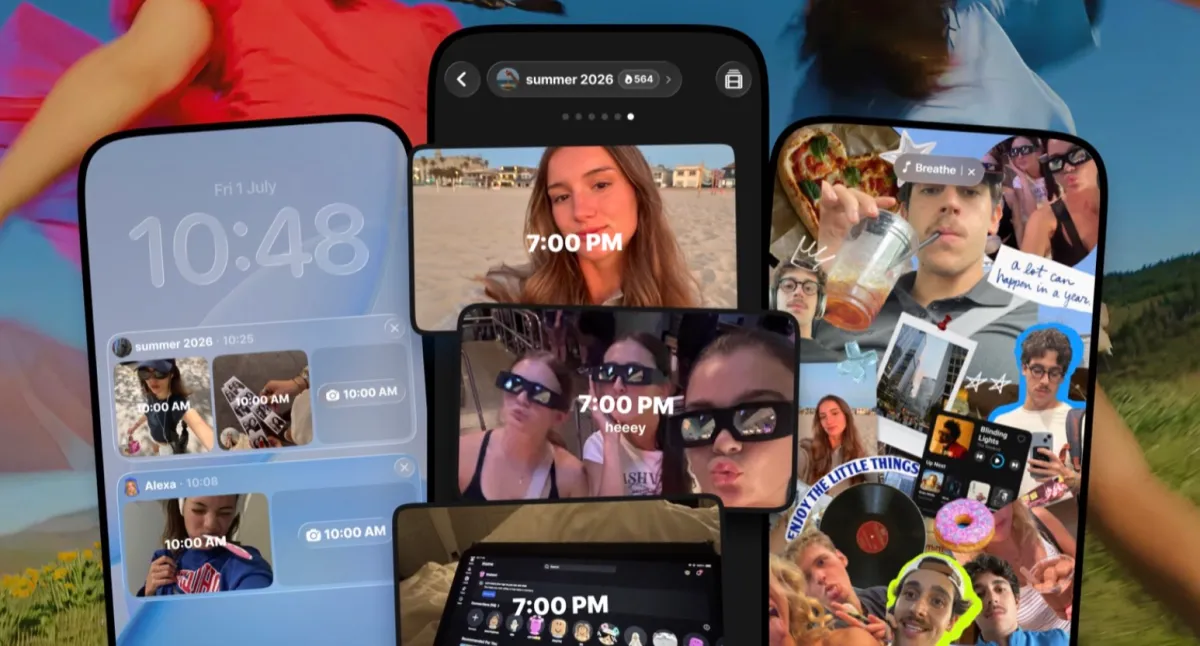
Yope’s design borrows some of the nostalgia of older social platforms while adding more contemporary messaging features. Users build profiles by uploading photos that can be converted into cut-out stickers. Rather than neatly arranged albums, the images appear in a collage-like wall that is intentionally messy and personal.
The company is also preparing more customization options, including ways for users to display interests, favorite music and the mini-games they play with friends. It also plans to let users change the colors and wallpapers of their personal spaces.
That approach evokes the highly personalized web of the MySpace era, when users could shape the look and feel of their profiles. Yope appears to be reviving that spirit for a generation that grew up on mobile apps and short-form video.
Existing features and planned additions
- Private profile creation through photo uploads
- Sticker creation from user photos
- Private messaging
- Recaps of top moments
- Lock screen widgets showing friends’ photos
- Mini-games for groups of friends, coming soon
- Interest, music and wallpaper customization
- AI-assisted meetup suggestions
Why are users spending time on the app?
Yope says its engagement numbers suggest the app is becoming part of users’ routines. The company says it has nearly 15 million registered users and that they collectively share between 10 million and 20 million pieces of content every day, including photos, videos and stickers.
That volume suggests the service has moved beyond casual experimentation for a meaningful subset of its audience. Yope says more than half of its users open the app at least five days a week, a sign that it is attracting repeated use rather than one-off downloads.
The company also says the network effect is not limited to teenagers and young adults. Around 20% of active users have invited an older family member to join, according to Ismailau. That detail is important because it hints at a broader use case: not just peer-to-peer socializing, but family coordination and cross-generational sharing.
Ismailau said the company sees a large opportunity because many young people want to self-express online but do not want the pressure of becoming a public-facing creator. In his view, the next generation still wants social media — just not the old version of it.
How did Yope get here?
Yope is the result of two earlier pivots, and its current version has been in development for about two years. TechCrunch previously covered one of the company’s earlier iterations, underscoring how long the team has been searching for the right product-market fit.
The startup is based in London and now has a team of roughly 35 people. The latest financing will help it keep building the product, hiring talent and opening an office in the United States, a common next step for consumer startups seeking scale.
The company’s evolution mirrors a broader pattern in consumer tech: a lot of promising apps do not succeed on their first concept. Instead, they slowly discover where user behavior, product design and monetization can line up.
What the funding means for the private social web
Yope’s raise highlights a renewed interest in private social experiences at a time when many users have grown wary of public posting and algorithmic feeds. Across the industry, there has been a steady move toward smaller groups, direct sharing and communication-first products.
That trend does not necessarily mean that giant public networks are fading. But it does suggest a split in how people want to use social apps: public performance on one side, and private connection on the other. Yope is betting that the second category can still produce a sizable consumer company.
Its challenge is significant. The company must keep the experience fresh enough that users do not drift away once the novelty wears off. It also must prove that a subscription model can support a consumer app in a market trained by years of free, ad-backed services.
Still, the company has one advantage many startups lack: a clear thesis. Yope is not trying to be everything for everyone. It is trying to become the private place people open when they want to share with friends, not perform for an audience.
Timeline of Yope’s latest growth story
| Date / period | Milestone | Why it matters |
|---|---|---|
| About two years ago | Current version of the app begins development | Marks the start of the product Yope is now scaling |
| Recent months | Company reports strong user activity and daily sharing | Shows traction before the funding announcement |
| July 22, 2026 | Yope announces $12.3 million seed round led by Northzone | Provides capital for hiring, U.S. expansion and product development |
| Next month | Planned launch of AI-powered mini-games | Could deepen engagement and differentiate the app further |
Who is Yope for?
Yope is primarily aimed at young people, but its product cues suggest it could appeal to anyone who wants a lighter, more private alternative to mainstream social networks. The app’s focus on family sharing, casual updates and personal customization makes it more flexible than a typical teen-focused platform.
Its strongest audience may be users who are socially active but not publicly performative — people who want to share life updates, inside jokes, favorite music and everyday moments with a small circle. That could include teenagers, college students, young professionals and families spread across different cities.
The broader market question is whether that behavior is a niche or a durable category. Yope is betting it is the latter.
What happens next?
In the near term, Yope will use the new funding to keep refining the product and adding features that make private social networking feel more complete. The company’s next test will be whether its planned mini-games and AI-assisted social tools increase retention without making the app feel bloated.
Longer term, Yope must prove that private social networking can become a meaningful business, not just a well-liked product. That means building enough value that users will either pay for premium features or remain engaged often enough to justify the app’s continued expansion.
If Yope succeeds, it could become one of the clearest examples yet of a consumer startup tapping into a post-feed social era. If it stalls, it will join a long list of apps that correctly diagnosed dissatisfaction with mainstream social media but failed to translate that insight into durable scale.
For now, the company has something many rivals want: users, momentum and fresh capital. The next phase will determine whether private social networking is merely a countertrend or the start of a new mainstream pattern.
Frequently asked questions
What is Yope?
Yope is a private social networking app built for small groups of friends and family. It focuses on photo sharing, messaging and personalization, while avoiding public content, advertising and algorithmic feeds.
How much funding did Yope raise?
Yope raised $12.3 million in seed funding. The round was led by Northzone and also included participation from Inovo, Redseed and Geek Ventures, bringing the company’s total funding to $20 million.
Why is Yope different from Instagram or TikTok?
Yope is different because it does not use an algorithmic feed, does not support itself with ads and keeps accounts private by default. The app is designed around small, real-life social circles rather than public broadcasting or creator competition.
How many users does Yope have?
Yope says it has nearly 15 million registered users. The company also claims users share between 10 million and 20 million pieces of content each day, and that more than half open the app at least five days a week.
What will Yope do with the new money?
Yope plans to use the funding to develop the product further, expand its team and open a U.S. office. It also expects to roll out AI-powered mini-games and other features that help friends interact more naturally.