Updated July 22, 2026 10:56 am
In short
Gritt has exited stealth with $32 million to use AI-driven robots for solar construction first, then expand into broader labor-intensive building tasks.
- Gritt exited stealth with $34 million in total funding.
- The startup uses off-the-shelf hardware paired with AI software for solar installation.
- It claims its systems can boost panel installation from 800 to 3,000-4,000 per day.
- The company has two systems in the field and targets 48 within six months.
- Gritt wants to expand from solar work into rebar tying, rack building, and other construction tasks.
Update — July 22, 2026 10:56 am
Gritt now says its total funding is $32 million, not $34 million, after its $26 million Series A and earlier seed round.
The startup also told TechCrunch it expects to have 48 systems running in the field within six months, and says a customer interview suggests the robots could help reduce injuries on remote sites by limiting the need to lift heavy panels overhead.
Gritt’s longer-term roadmap is broader than panel placement: it wants its system to fasten panels, drill posts, build racks, and eventually take on other construction work such as tying rebar. The company also says its software could help spot site issues like open trenches before weather causes damage.
Update — July 21, 2026 1:54 pm
Gritt says it is now contracted to help install 2.8 gigawatts of solar panels over the next 18 months, and it counts three of the top 10 U.S. power construction companies among its customers.
The startup also says it expects to have 48 of its systems operating within six months, up from two currently deployed in the field.
Beyond panel placement, Gritt says it wants to expand into additional construction chores such as fastening panels, drilling posts, building racks, and eventually tying rebar.
Gritt has emerged from stealth with $34 million in funding to deploy AI-powered robots that speed up solar farm construction, starting with panel installation and eventually expanding into other labor-heavy building tasks. The startup says its systems can multiply installation output at a time when the clean-energy sector is struggling to find enough workers for a rapidly expanding pipeline of projects.
The company announced Tuesday that it closed a $26 million Series A led by Obvious Ventures, with participation from Union Square Ventures and Active Impact Investment. That brings Gritt’s total funding to $34 million after an earlier seed round backed by First Round Capital, Climactic, Congruent Ventures, and VSC Ventures.
Founded by Carnegie Mellon-trained roboticists Puneet Puri, who is chief executive, and Vishal Dugar, who is chief technology officer, Gritt is betting that recent advances in AI have finally made it practical to automate work in messy outdoor construction sites that traditional industrial robots have often struggled to handle.
Why solar construction is becoming a robotics problem
The company’s pitch is tied to one of the biggest industrial build-outs on the planet: solar power. Governments and private developers are racing to install solar arrays and battery systems to improve energy security and reduce emissions, but the industry is bumping into a familiar bottleneck — labor.
Solar projects are growing faster than the available pool of workers who can physically place, align, and secure thousands of heavy panels in open-air conditions. That shortage is especially painful for remote job sites, where contractors often struggle to recruit enough crews for repetitive, physically punishing work.
Gritt argues that robots can fill the gap, but not the way automation has traditionally been deployed in factories. Outdoor construction sites are unpredictable: terrain changes, weather shifts, and materials arrive in irregular stacks and orientations. Those conditions have historically made full automation difficult.
According to the startup, newer AI models have changed that equation by making robotic systems more adaptable across different environments and tasks.
Puri says the company’s central idea is that faster construction requires an intelligence layer capable of operating in chaotic outdoor settings and generalizing across a wide range of worksites.
How does Gritt’s system work?
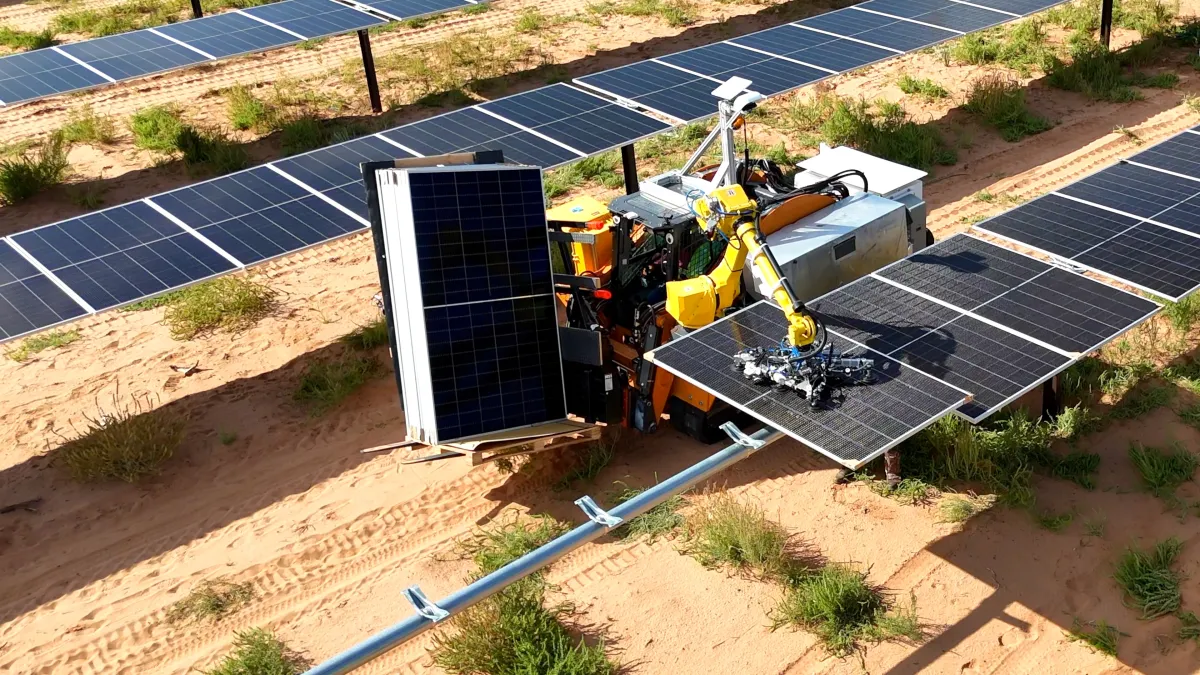
Gritt’s answer is to combine AI software with commercially available hardware rather than build a proprietary robot from the ground up. The company has so far used rented skidders and robotic arms from manufacturers such as Kawasaki, then layered its own control systems, sensing, and machine intelligence on top.
The first use case is panel handling. Gritt’s systems unload large glass solar panels, transport them to the mounting structure, and position them with enough precision that human workers can fasten them into place.
The precision is important. Solar modules are large and fragile, and installation demands alignment tight enough to reduce rework and avoid delays. Gritt says its robots place the panels with sub-millimeter accuracy.
What the startup is automating first
The company is beginning with the most repetitive and physically demanding parts of the process, including:
- Unloading solar panels from stacks
- Moving panels to the frame
- Positioning panels for fastening
- Collecting operational data to improve performance over time
That strategy lets workers stay involved in the final fastening and oversight while the robots handle the heavy lifting and placement tasks. Gritt says the systems improve as they operate, using data gathered in the field to refine their behavior.
What kind of performance gains is Gritt claiming?
Gritt says a typical eight-person crew can install about 800 solar panels a day without its system, but can install 3,000 to 4,000 panels a day with the robots assisting on site. If those figures hold at scale, they would represent a major productivity jump for solar developers racing to complete projects on tight schedules.
The company says it already has two systems deployed in the field and is working through real job-site data to improve the machines’ reliability and usefulness. It also says it has signed contracts covering 2.8 gigawatts of solar panel installation over the next 18 months, and that its customers include three of the top 10 power construction companies in the United States.
| Metric | Gritt’s current status | Company target or claim |
|---|---|---|
| Total funding | $34 million | $26 million Series A plus earlier seed funding |
| Systems deployed | 2 | 48 systems within six months |
| Daily panel installation | 800 panels per day for an eight-person crew | 3,000 to 4,000 panels per day with Gritt |
| Contracted work | 2.8 gigawatts over 18 months | Expansion across major U.S. power construction customers |
Why investors are backing the company
Obvious Ventures partner Andrew Beebe led the Series A and described Gritt as the kind of startup that takes on physically difficult, dirty, and hazardous work rather than aiming only at polished tech demonstrations. He said the founders combine deep robotics expertise with the machine-vision and AI skills needed to turn that expertise into a deployable product.
Beebe said the team belongs to a category of founder that understands how to scale work that many people would rather avoid — the kind of job that is repetitive, harsh, and hard to staff — and can do so with serious technical depth.
The investor appeal is straightforward. If Gritt can reduce labor constraints on solar sites, it could help developers build faster, lower downtime, and potentially cut costs. Just as important, the company is using hardware it does not have to manufacture itself, which could make it easier to expand without carrying the complexity of a full robotics hardware stack.
That design choice may prove strategic in a crowded market. Building custom robots can allow for tighter integration, but it also increases capital requirements, manufacturing risk, and time to deployment. Gritt’s hardware-agnostic approach may let it scale more quickly if its software performs consistently across different machines and worksites.
Who is Gritt competing against?
Gritt is entering a field that is beginning to attract serious robotics competition. Rival companies including Luminous Robotics, Cosmic, and China’s Trinabot are also working on machines designed to install solar panels.
The key difference is architectural. Those companies are building their own robots, while Gritt is concentrating on AI control software and using third-party equipment such as skid steers and robotic arms. That distinction could matter as demand rises, because it affects manufacturing costs, deployment speed, and the ability to adapt to different project types.
In practice, the market may reward whichever model can prove more reliable under real construction conditions. Solar installation is not a lab environment; it is a field job shaped by dust, weather, terrain, and the uneven pace of materials delivery. Any robotics company seeking a foothold in the space will need to show that it can operate safely and consistently amid those variables.
How do AI models change the economics of construction robotics?
They make it easier to reuse the same software pipeline across multiple tasks, according to Gritt’s founders. In earlier generations of robotics, a machine often had to be carefully engineered for a single purpose and environment. Training or reprogramming it for a different task could require major redevelopment.
Puri says modern AI makes that process far more generalizable. The same foundation can be adapted to new jobs faster, which reduces the time and cost needed to move from a single demonstration to a deployable system.
He offered a practical comparison: one task, stacking cinder blocks, took the team weeks to train, while a related demo involving rebar tying was developed in just a day using the same software base. That kind of transfer learning is crucial if construction robotics is to move beyond one-off prototypes and into a product that can be deployed across many job sites.
Why generalization matters in construction
Generalization is what allows a robot to cope with variability. A solar site in one state may have different ground conditions, work rhythms, and material layouts than a site elsewhere. A useful system cannot require a fresh engineering effort every time it moves.
That is also why Gritt is emphasizing data collection. Every deployed machine becomes both a worker and a training platform, potentially improving future versions of the system with more real-world experience.
What comes after solar panels?
Solar assembly is only the starting point. Gritt says it wants its systems to take on more manipulation tasks, including fastening the panels, drilling posts, and building the racks that support them.
Longer term, the founders envision the technology spreading into other repetitive construction workflows, such as tying rebar before concrete is poured. Those tasks are common across infrastructure and building projects, which means success in one domain could open opportunities in several others.
That broader ambition explains the company’s self-description as more than a solar robotics startup. Gritt wants to be a general physical-AI platform for construction, with a focus on labor-intensive chores that are difficult to staff and expensive to perform manually.
Puri says the company ultimately wants its systems to do more than manipulate materials; it wants them to serve as a site intelligence layer that helps crews make better decisions while work is underway.
How could these robots help manage a job site?
They could function as both workers and sensors, giving construction managers better visibility into site conditions. Gritt imagines its systems noticing hazards or operational problems and alerting crews before those issues turn into delays or damage.
Examples include spotting an open trench before a storm arrives, flagging missing inventory, or identifying other logistical problems that can be costly if missed. In that sense, the company is pitching a future in which robots are not only performing physical labor but also gathering data that helps run the site more efficiently.
That vision fits a broader trend in industrial AI: the same systems that automate tasks can also improve planning, coordination, and supervision. In a sector where delays can be expensive, that dual role may be especially valuable.
Why workers and contractors may care
The most immediate impact could be on labor conditions and job-site safety. One customer who spoke to TechCrunch on condition of anonymity said the system should be especially useful at remote locations where hiring is difficult and crews are thin. The customer also expects fewer injuries because workers would not need to repeatedly hoist heavy panels overhead.
That is a meaningful point for an industry that depends on physical labor and often operates under harsh weather and time pressure. Even partial automation of lifting and positioning tasks could reduce strain, lower accident risk, and make it easier for contractors to staff difficult projects.
At the same time, the technology is not positioned as a replacement for humans. Gritt’s current model still relies on workers to complete the installation process and manage the broader worksite. The robots are intended to handle the tasks that are hardest to recruit for and most physically taxing.
Gritt’s growth roadmap
The company has laid out an aggressive near-term rollout. It says it expects to have 48 systems operating within six months, which would mark a sharp scale-up from its current two deployed systems.
If Gritt reaches that target, it would gain a much larger data set from field operations and likely more credibility with contractors evaluating whether the robots can perform reliably in everyday use. That expansion will also test whether the company’s hardware-light strategy can support fast deployment across multiple sites.
The next 18 months may therefore be decisive. The company is already committed to a substantial amount of installation work, and the quality of those deployments could shape whether it becomes a niche solar automation vendor or a broader construction robotics platform.
Timeline of Gritt’s rise
Below is a simplified look at the company’s progress so far.
| Period | Event | Why it matters |
|---|---|---|
| Seed stage | Raised early funding from First Round Capital, Climactic, Congruent Ventures, and VSC Ventures | Gave the company room to build its first systems |
| Stealth period | Developed AI-driven construction robotics and began field deployment | Allowed the company to test in real job-site conditions |
| July 2026 | Exited stealth with a $26 million Series A led by Obvious Ventures | Signaled investor confidence and readiness to scale |
| Next six months | Aim to reach 48 deployed systems | Would substantially widen the company’s footprint and data collection |
| Next 18 months | Contracted to install 2.8 gigawatts of solar | Represents a major commercial test of the platform |
What this means for the broader AI and energy markets
Gritt’s debut is another sign that AI investment is moving beyond chatbots and software tools into the physical world. Construction, logistics, manufacturing, and energy infrastructure are all becoming test beds for systems that combine machine vision, robotics, and adaptive AI.
The solar sector is an especially compelling proving ground because demand is high, the work is repetitive, and the economics of faster deployment are easy to measure. If robotics can increase throughput while easing labor shortages, developers could complete projects faster and possibly more profitably.
But the opportunity comes with execution risk. Construction robotics has long been difficult because the real world is unpredictable. The companies that win will need not only strong models but also durable hardware integration, dependable operations, and a clear path to commercial value.
For Gritt, the next phase is about proving that its mix of off-the-shelf machines and general-purpose AI can do more than impress in demos. It must show that the system can hold up across sites, crews, weather conditions, and changing project requirements. If it can, solar installation may be only the first chapter in a much larger robotics business.
Frequently asked questions
What is Gritt and what does it do?
Gritt is a construction robotics startup that uses AI software to control off-the-shelf machines for solar panel installation. The company’s first system unloads, moves, and places panels on mounting frames so human crews can fasten them faster and with less physical strain.
How much funding has Gritt raised?
Gritt has raised $34 million in total. That includes a $26 million Series A round led by Obvious Ventures, plus an earlier seed round supported by First Round Capital, Climactic, Congruent Ventures, and VSC Ventures.
How much faster does Gritt say its system is?
Gritt says an eight-person crew normally installs about 800 panels a day, but with its system that number can rise to 3,000 to 4,000 panels daily. Those figures are the company’s own claims and will be tested as deployment expands.
What other jobs could Gritt’s robots do in the future?
Gritt says it wants to expand into fastening solar panels, drilling posts, building racks, and eventually other construction tasks such as tying rebar before concrete is poured. The company is aiming to become a broader physical-AI platform for job sites.
Who are Gritt’s competitors?
Gritt faces competition from robotics companies including Luminous Robotics, Cosmic, and China’s Trinabot. The main difference is that Gritt uses third-party hardware rather than building its own robots from scratch, which could affect speed and cost as the market grows.