In short
Superhuman has updated its auto-draft tool with more advanced AI models, producing email replies that sound more natural and are often usable with little editing. The feature is promising, but it still needs human review to avoid awkward or inappropriate replies.
- Superhuman’s new auto-draft uses frontier models from Anthropic and OpenAI.
- The feature generates multiple reply options and adapts to user behavior over time.
- Early testing suggests many drafts are now usable with minimal edits.
- The tool still makes judgment errors, including overly positive or badly timed replies.
- Superhuman is extending its AI ambition through the cross-app assistant Superhuman Go.
Superhuman has rolled out a redesigned auto-draft feature that uses larger frontier AI models to write email replies that are noticeably more natural and often good enough to send with little editing. The update matters because it could make AI-assisted inbox management far more practical for professionals who are overwhelmed by repetitive email work.
The company says the new system can identify which messages deserve a response, infer the right tone from prior exchanges, and generate multiple reply options rather than a single canned suggestion. In early use, the feature appears to be a meaningful step forward from earlier AI email tools, though it still makes judgment errors that show why human oversight remains essential.
For years, email vendors have promised that AI would tame inbox overload by summarizing messages and drafting responses in a user’s voice. In practice, many of those tools sounded generic, overly cheerful, or awkwardly detached from context. Superhuman’s latest version is trying to change that by leaning on more capable models and more personal signals from the user’s own email history.
What changed in Superhuman’s newest auto-draft?
The biggest change is that Superhuman is no longer relying on the kind of lightweight model stack that powered earlier reply features. Instead, the company says the new draft engine uses frontier models from both Anthropic and OpenAI, along with additional context from the user’s account and conversation history.
That shift is important because email drafting is not just a language exercise. To be genuinely useful, the system has to understand whether a message is a sales pitch, a meeting request, a follow-up, an embargo question, or a time-sensitive note from someone already in a long-running thread. It also has to avoid producing a response that is polite in the abstract but wrong in the situation.
In testing, the update appears to have crossed that threshold more often than previous versions. The drafts are designed to sound closer to the user’s natural communication style, which reduces the uncanny, salesy tone that often gives AI away immediately.
How does the feature decide what to write?
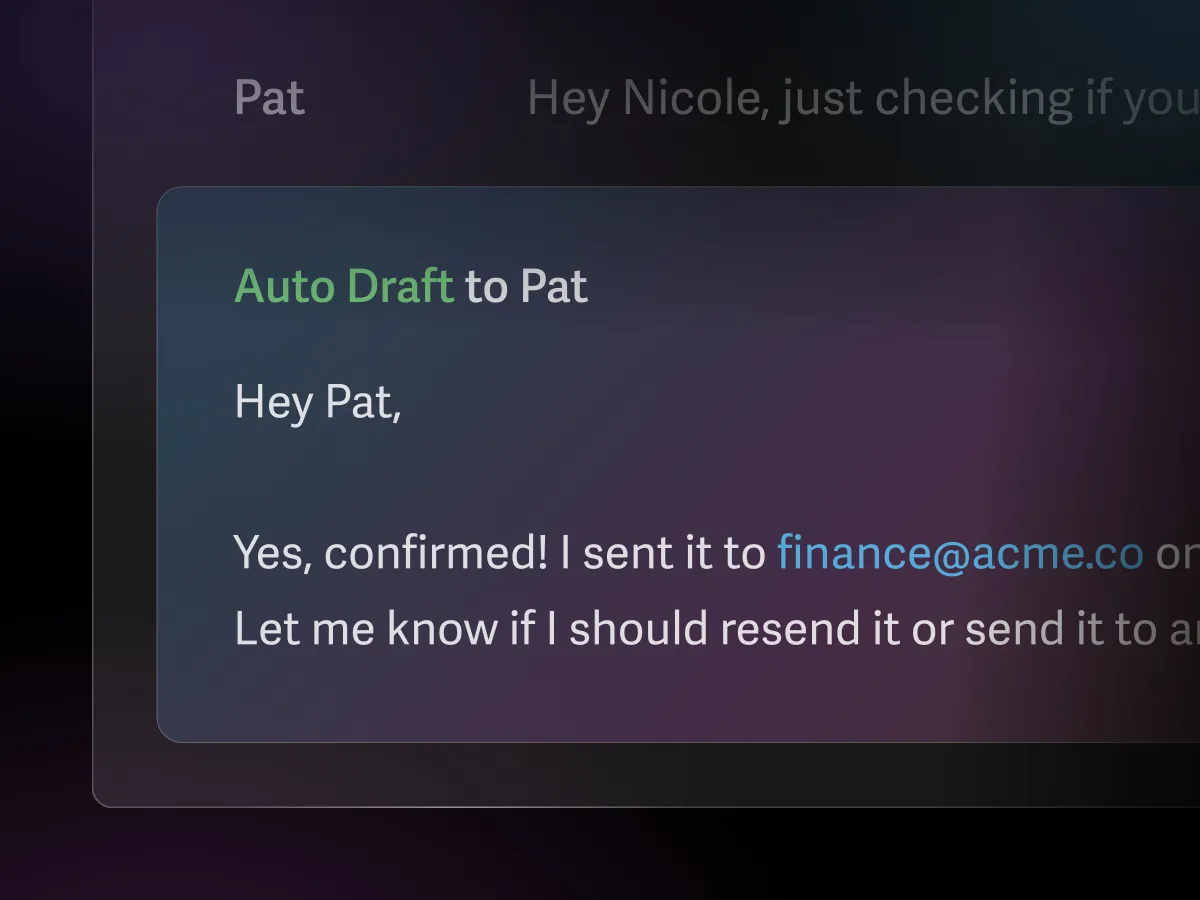
It starts by deciding whether a message likely deserves a reply at all, then it drafts responses based on the tone and patterns it has observed in previous emails. Superhuman also generates two alternate versions so users can quickly pick a better option when the first one misses the mark.
That multi-option approach is a practical design choice. Instead of asking users to accept or reject a single AI answer, it turns the drafting process into a quick selection problem, which is usually less burdensome than starting from scratch.
Superhuman says users can improve results by adding personal and professional context inside the app’s settings, including details about their role and links or files that help explain their work. The more context the system has, the more likely it is to produce a reply that feels appropriate for the recipient and the situation.
Why this version feels better than earlier AI replies
The improvement comes down to context, model quality, and training from user behavior. Earlier features, according to Superhuman co-founder Rahul Vohra, were built on older systems such as GPT-3.5, which had weaker reasoning and smaller context windows. Those limitations mattered because email threads often require the model to juggle names, commitments, prior discussions, and subtle professional boundaries.
By contrast, the new implementation is being written by more capable models from Anthropic and OpenAI. That gives the system a better shot at handling nuanced correspondence without sounding stiff or generic.
Vohra said the company is now using a blend of models rather than relying on a single engine, with the writing itself handled by frontier systems from Anthropic and OpenAI so the product can use as much intelligence and context as possible.
That strategy reflects a broader shift across workplace software. Rather than treating AI as a novelty layer, companies are increasingly wiring it into the exact workflows users repeat every day. Email is one of the clearest examples because so much of it is predictable, time-consuming, and repetitive.
In Superhuman’s case, the goal is not to replace the inbox but to reduce the friction of responding to it. If the draft is good enough, the user can finish the task in seconds instead of minutes.
How well does it work in real use?
In day-to-day testing, the answer seems to be: often well enough, but not always safely enough to trust blindly. The feature can produce replies that are useful for routine professional exchanges, such as confirming meeting times, acknowledging embargoes, or declining requests that fall outside a user’s responsibilities.
That last use case is especially telling. The system can draft a courteous refusal to an incoming request, but only if it correctly understands what the user does and does not handle. When it does, the result can save time while preserving professional tone.
At the same time, the tool can still overestimate what the user wants. In some cases it generated responses that leaned too positively toward a pitch or suggested impractical meeting times, including one after midnight. Those failures are not trivial because they show how easily an AI reply can create a social or scheduling problem if sent without review.
Still, the iteration loop appears to matter. After the model produced an unrealistic late-night meeting suggestion once, it later adapted and generated a better response when a similar time came up again. That kind of feedback-driven improvement is one of the clearest signs that the system is learning from actual use rather than merely generating generic text.
What kinds of emails does it handle best?
It handles routine, low-stakes business messages best. Those include meeting confirmations, timing questions, straightforward follow-ups, and short replies to pitches where the user’s position is already fairly standard.
It is less reliable when the email requires delicate judgment, unusual context, or a nuanced decision the model cannot infer on its own. In those cases, the output may still be a helpful draft, but not something to send untouched.
Who is using this, and why now?
Superhuman is pitching the feature at professionals who receive large volumes of email and want faster triage without losing the personal voice that can matter in business communication. That audience includes founders, operators, investors, communications staff, and anyone else whose day is interrupted by a constant stream of messages.
The timing is no accident. The flood of AI-generated emails has made inboxes noisier, not quieter. As automated outreach becomes more common, recipients have to deal with more first-contact pitches, more follow-ups, and more repetitive messages that all demand some kind of response. A better reply assistant is one way to keep up.
Superhuman’s case is also notable because the company itself has gone through a major identity shift. Grammarly acquired it last year and later unified the branding under Superhuman. The business is now building a broader assistant called Superhuman Go, which is intended to work across apps rather than just inside the inbox.
That broader ambition gives the auto-draft feature strategic value. If the company can prove that it understands context in email, it has a stronger case for extending that intelligence into calendars, documents, task management, and other workplace surfaces where users spend time switching between tools.
What makes AI email replies hard to get right?
Email is deceptively difficult for AI because the correct response is rarely just about grammar or tone. The system has to infer relationship dynamics, urgency, history, intent, and the user’s willingness to commit to something. A polite reply can still be the wrong reply if it accidentally confirms a meeting, signals interest in a bad lead, or overpromises on behalf of the user.
There is also the problem of style. People often write differently depending on whether they are talking to a colleague, a journalist, an investor, a client, or a stranger. A good AI reply has to reflect those shifts without making the voice sound copied or artificially polished.
Superhuman’s update suggests that the industry is moving toward a more realistic standard: not fully autonomous inbox management, but high-quality first drafts that reduce effort while leaving the final judgment to the human sender.
What users still need to watch for
Users should still check for four common problems before sending AI-generated replies:
- Over-enthusiasm: the model may agree to something it should politely decline.
- Scheduling errors: suggested times can be impractical or outside normal work hours.
- Tone mismatch: the reply may sound too formal, too casual, or too eager.
- Context gaps: the system may miss a key detail in a thread or attachment.
Those risks do not make the feature useless. They simply define the boundary between assistance and automation. For now, the best use case is as a smart first-draft engine, not a substitute for reading and thinking.
How does Superhuman compare with other AI inbox tools?
Superhuman is competing in a crowded space where nearly every productivity platform is trying to add some form of AI triage or drafting. What differentiates this version is the company’s emphasis on making the output feel like the user, not just an AI response that happens to be attached to their inbox.
That focus on personalization is significant. Many email tools can summarize a thread or draft a generic “Thanks, sounds good” message. Far fewer can generate a reply that fits the user’s habits closely enough to be usable without rewriting.
| Feature | Earlier Superhuman drafts | New auto-draft feature |
|---|---|---|
| Model generation | Older, smaller models such as GPT-3.5 | Frontier models from Anthropic and OpenAI |
| Output style | Often sounded robotic or overly eager | More natural and closer to the user’s voice |
| Reply options | Limited or less flexible | Multiple draft variations |
| Context use | More limited | Draws on user history, settings, and added context |
| Practical use | Rarely used by the reporter | Can be sent with little editing in many cases |
The table above captures the core product change: the feature is less about flashy AI and more about usable, context-aware writing help. That may sound incremental, but in productivity software, incremental improvements often determine whether a tool becomes part of a daily workflow or gets ignored.
Why the company’s model strategy matters
Using multiple frontier models rather than one internal system suggests Superhuman is prioritizing output quality over technical simplicity. That can make the product more expensive to run, but it also gives the company access to a stronger underlying reasoning and generation stack.
From a user perspective, what matters is whether the model can do three things at once: understand context, respect tone, and make a safe judgment call. If it can do those consistently, the feature can shave meaningful time off communication-heavy work.
There is also a broader industry lesson here. AI features often fail not because the technology is incapable in principle, but because companies deploy them with too little context or too little tolerance for nuance. Superhuman’s approach suggests that better data and better models together may be the difference between a gimmick and a useful assistant.
What comes next for Superhuman Go?
Superhuman Go appears to be the company’s larger bet on cross-app assistance. The idea is to move beyond the inbox and create an assistant that can carry context from one application to another, which could make it more useful than a standalone email tool.
If Superhuman can maintain accuracy while widening its scope, it may eventually position itself as a broader productivity layer rather than simply a premium email client. That is a far harder product challenge, but also a much bigger market opportunity.
For now, the auto-draft update is a useful proof point. It shows that more advanced models can materially improve a common workplace task when the product is designed carefully enough to expose the right controls and the right amount of context.
It also shows the limit of current AI assistants. Even when the system writes in a convincing voice, it still needs supervision. That may frustrate users who want full automation, but it is probably the right tradeoff for something as socially sensitive as email.
Bottom line
Superhuman’s new auto-draft feature is not a perfect autonomous email writer, but it is a substantial step toward AI that can actually help rather than annoy. By combining stronger models, multiple draft options, and user-specific context, the company has made a feature that feels more practical for real-world inbox work.
The result is a tool many professionals may finally use, even if only as a fast way to get from a cluttered inbox to a sensible reply. And that may be the clearest sign yet that AI email assistants are becoming useful in practice, not just impressive in demos.
Key timeline shows how Superhuman’s AI drafting has evolved:
| Period | Development | Significance |
|---|---|---|
| Earlier versions | Instant replies and follow-up auto-drafts launched | Introduced the idea, but outputs often felt unnatural |
| Testing phase | Users began sending a high share of AI drafts within a day | Early evidence that the new version is actually usable |
| Current launch | Frontier-model-powered auto-draft rolls out in beta | Marks a major quality jump in tone and context handling |
| Next stage | Superhuman Go expands assistance across apps | Could turn email AI into a broader productivity platform |
Frequently asked questions
What is Superhuman’s new AI auto-draft feature?
Superhuman’s new AI auto-draft feature is an email assistant that identifies messages likely to need a reply and generates personalized draft responses. It uses more advanced models and user context to produce replies that sound more natural than earlier versions.
How good are Superhuman AI email replies?
Superhuman AI email replies appear to be much better than previous versions and can often be sent with little editing. However, the drafts still make mistakes on tone, timing, and judgment, so users should review them before sending.
Which AI models power Superhuman’s auto-draft?
Superhuman says the writing is handled by frontier models from both Anthropic and OpenAI. The company says it is using a mix of models so the feature can benefit from more intelligence and more context during reply generation.
Can Superhuman’s AI learn from my email style?
Yes, Superhuman’s AI can learn from your usage patterns and previous conversations. Users can also add more personal and professional context in settings, which should help the system write replies that better reflect their role and communication style.
Is Superhuman replacing email with AI?
No, Superhuman is not replacing email with AI. The company is using AI to reduce the work of replying, triaging, and managing inboxes, while still leaving the final sending decision to the user.