Updated October 14, 2026 5:24 pm
In short
Epic’s preview launcher is now available on Windows, Mac and Linux, with Epic saying AI helped speed development, the old version will stay up for now, and Fortnite is also headed to Linux through the app.
- Epic has released a preview of its rebuilt PC Games Launcher.
- The company says AI helped with coding, testing and code review.
- The new launcher adds Linux support and a faster interface.
- Epic says the older launcher will remain available for now.
- The update reflects a wider company shift toward AI-accelerated development.
Update — October 14, 2026 5:24 pm
Epic says the new launcher has been in development for most of this year, and that its AI-assisted workflow helped speed up the rebuild. The company says agents wrote and reviewed the code, but the team still supervised the process end to end.
Keely also said the preview will eventually go live only once it is stable and matches the current launcher in the areas Epic needs. Epic still has no fixed date for forcing everyone onto the new version.
Alongside the Linux launch, Epic says it now plans to bring Fortnite to Linux through the launcher.
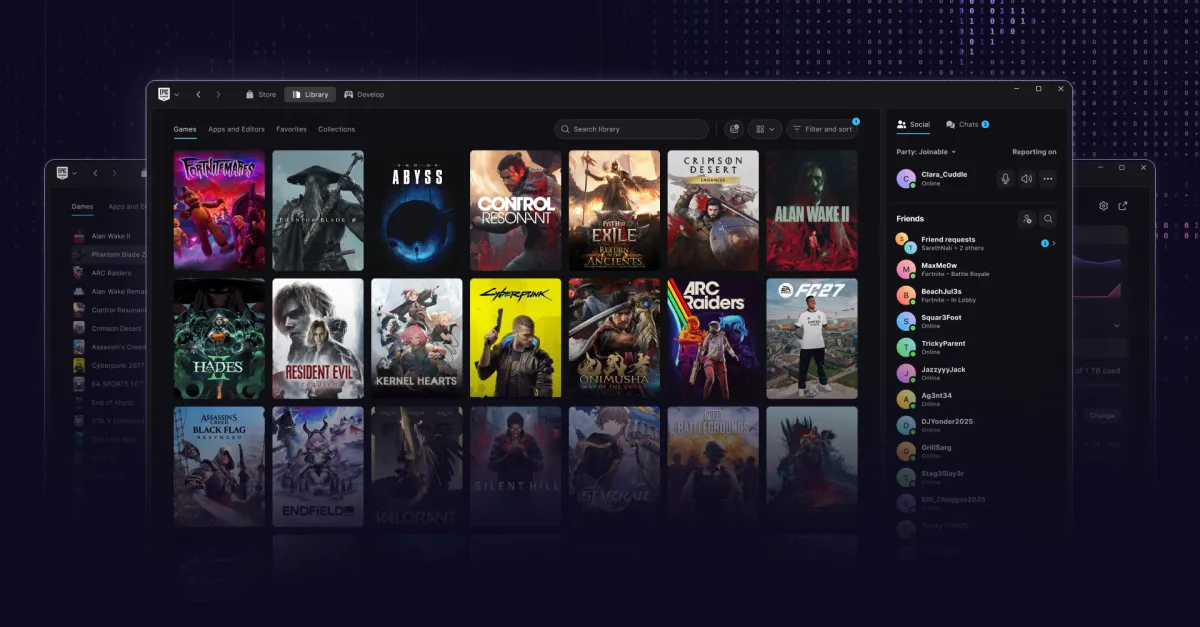
Epic Games has unveiled a rebuilt version of its PC Games Launcher in preview, and the company says the new app is faster, more responsive and now available on Linux. The update matters because it shows how aggressively Epic is adopting AI-assisted development across its business, using automated coding tools not just for experiments but for shipping consumer software.
The company says the launcher refresh was developed with AI assistance and even describes the work, in its own words, as “vibe coded.” Epic is presenting the project as a practical example of how AI tools can accelerate software delivery, while still keeping engineers in control of the final product.
For Epic, the launcher is more than a storefront utility. It is a visible signal that the company’s broader shift toward AI-accelerated development is moving from internal strategy into real products that players can download and use.
What Epic launched and why it matters
Epic’s new Games Launcher is a preview release that replaces the company’s older PC launcher with a faster interface, a redesigned look and support for Linux. The old version will remain available for now, and Epic has not yet announced a date when all users will be required to move over.
The update is significant because it is one of the clearest public examples of Epic applying AI tools to a mainstream consumer application. That makes the launcher a test case for the company’s wider push into AI-assisted engineering, especially after chief executive Tim Sweeney said the company is in the middle of a “huge pivot” toward retooling teams for “maximum AI acceleration.”
Epic’s message is not that AI replaces development teams. Instead, the company is arguing that AI can help engineers ship software more quickly and with fewer bottlenecks, especially when the goal is to rebuild existing functionality in a new package.
How did Epic use AI to build the launcher?
Epic says AI was used as a development tool throughout the project, from testing to recreating the launcher’s core features. In a briefing, Martin Keely, Epic’s vice president and general manager of the Epic Games Store and Epic Online Services, said AI helped the team move faster and was especially useful when replicating the functionality of the older launcher.
“We used AI as a tool for this,” Keely said, describing the work as part of Epic’s shift toward using AI in more areas of the company. He added that AI was “super helpful” for testing and for reproducing the launcher’s basic behavior.
Keely also said the team used agents to draft and review code, but emphasized that humans remained in charge. In his account, the developers supervised the process closely and managed the full workflow rather than handing over the project entirely to automation.
That distinction is important. Epic is not portraying the launcher as a fully autonomous AI project. Instead, it is showing how AI tools can slot into conventional development pipelines, speeding up work without removing human review, design decisions or final responsibility.
What does “vibe coded” mean in this context?
In Epic’s case, “vibe coded” is a tongue-in-cheek way of saying the launcher was built with significant help from AI coding tools rather than written entirely in a traditional manual workflow. The phrase signals speed and experimentation, but Epic’s own description makes clear that the project still went through normal oversight and testing.
The company’s blog post framed the point bluntly: programming is difficult, so Epic used AI to help build a new launcher that is more responsive than the current one. The wording is playful, but the underlying strategy is serious. Epic wants AI to become a routine part of software production, including tools that millions of users may rely on.
Why is Linux support such a big part of the launch?
Linux support is a notable addition because Epic is expanding the launcher beyond the traditional Windows-and-Mac footprint. The new preview will be available on Windows, Mac and Linux from the start, and Epic says the Linux version also creates a path toward bringing Fortnite to Linux through the app.
For many players, Linux compatibility has long been a demand rather than a default feature. Gaming support on the platform has improved in recent years, but major storefronts and launchers still tend to prioritize other operating systems. By adding Linux support, Epic is making a deliberate statement that the platform is part of its future plans, not an afterthought.
Keely said AI helped make that expansion possible by accelerating development. In practical terms, that suggests AI tools helped the team adapt the launcher for an additional operating system without starting from scratch on every component.
What Tim Sweeney’s AI push means for Epic
Epic’s launcher announcement arrives alongside a wider corporate shift. On Monday, Sweeney said the company is undergoing a major reorganization to prepare employees and teams for more AI-centric development. He said the goal is not simply to cut labor costs, but to increase output and improve the quality of what Epic builds.
Sweeney said Epic’s focus is to help teams “build MORE and BETTER stuff” and to spread the benefits of AI-enabled development across the company, including Unreal Engine teams.
That framing is important because it reflects a broader industry debate. Some technology companies present AI as a way to reduce headcount, while others describe it as a productivity multiplier. Epic is clearly trying to position itself in the second camp, though the practical effects can still reshape job roles, workflows and expectations inside the company.
Bloomberg also reported this week that an Epic director working on an unannounced Disney game told employees there would be “no more hand-written code,” a comment that underscored just how radical the company’s shift may be in some internal teams. Epic has not described the launcher team’s process in those terms, but the project still fits within the same strategic direction.
How the new launcher compares with the old one
Epic says the preview version is faster and more responsive than the current launcher, and it comes with a refreshed interface. The company has not published a full technical breakdown of what changed under the hood, but the emphasis is on speed, stability and cross-platform compatibility.
| Feature | Older Launcher | New Preview Launcher |
|---|---|---|
| Performance | Existing baseline | Epic says it is faster and more responsive |
| Platforms | Windows and Mac | Windows, Mac and Linux |
| Development approach | Traditional engineering workflow | AI-assisted coding, testing and code review |
| Availability | Still available | Rolling out today in preview |
| Replacement timeline | Current production version | No fixed migration date yet |
Epic has been careful not to force the switch immediately. Keely said the old launcher will remain accessible, and the company will wait until the new version feels stable and has feature parity in the areas it needs before making it the default for everyone.
That cautious rollout matters. Preview launches allow companies to collect feedback, catch bugs and verify compatibility before a broader release. In Epic’s case, it is also a way to prove that AI-assisted development can produce a consumer product reliable enough for everyday use.
What role did AI play in testing and code review?
AI appears to have done more than just generate snippets of code. According to Epic, it helped with testing, reviewed code and supported the effort to reproduce the launcher’s existing core features. That suggests AI was embedded in multiple stages of the workflow rather than confined to one isolated task.
Using AI for testing can help teams identify edge cases more quickly, while AI-assisted review can catch patterns or inconsistencies that might slow human engineers down. The trade-off is that such systems still require careful supervision, especially when a product must work consistently across operating systems and hardware configurations.
Epic’s description indicates it tried to keep that balance. The company says its developers managed the process, supervised the entire project and did not simply accept AI output without review. In other words, the launcher was AI-assisted, not AI-driven in a hands-off sense.
Why the timing matters after Epic’s layoffs
The launcher debut comes several months after Epic laid off more than 1,000 employees in March. When that happened, Sweeney said the cuts were not caused by AI and insisted the company still wanted to keep as many developers as possible building products and technology if productivity gains allowed it.
That backdrop gives the new launcher additional significance. Even though Epic is saying the AI push is about efficiency and more ambitious output, critics and employees across the tech sector are likely to see these developments through the lens of workforce reduction, restructuring and automation pressure.
Epic is trying to separate the two narratives: the layoffs, it says, were not an AI strategy, while the launcher and other projects show how AI can improve what remaining teams produce. But in practice, those stories are difficult to fully disentangle, especially as more companies adopt similar language around acceleration, productivity and reinvention.
What this launch says about AI in gaming
Epic’s launcher is important not just as a product update but as a marker of where AI is headed in game development and distribution. The gaming industry has long adopted automation in production pipelines, from procedural tools to performance optimization, but AI coding assistants introduce a different layer of change.
Instead of only helping artists, designers or analysts, these tools can shape the software foundations that support an entire ecosystem. That includes game clients, storefronts, backend services and engine tooling. If Epic is successful, other large gaming companies may feel pressure to adopt similar methods, especially if the results are visibly faster product cycles and lower friction across teams.
There are also broader implications for platform strategy. A launcher that works on Linux, for example, could make it easier for Epic to support a wider player base and build goodwill with users who want more cross-platform freedom. If the same AI-assisted workflow can shorten development time, Epic may see this as a model for future tools and services.
What happens next?
For now, the new Epic Games Launcher is only in preview, and the company has not committed to a specific date when the old app will be retired. The next stage will likely depend on real-world feedback, bug reports and whether the new version can match all the functionality users expect from the current one.
Epic has said the full launch will happen once the software is stable and aligned with the necessary features. Until then, the preview will serve as a public demonstration of the company’s AI-first development strategy — and as a practical test of whether that strategy can improve a tool that millions of players may eventually use every day.
Key milestones in Epic’s launcher rollout
The timeline below shows how the launcher update fits into Epic’s broader AI push.
| Date | Event | Why it matters |
|---|---|---|
| March 2026 | Epic lays off more than 1,000 employees | Raises questions about the company’s staffing and efficiency goals |
| This week | Sweeney says Epic is moving toward “maximum AI acceleration” | Signals a company-wide strategy shift |
| October 14, 2026 | New Epic Games Launcher enters preview | Public proof point for AI-assisted development and Linux support |
Bottom line
Epic is using its new games launcher to do more than refresh a piece of software. It is showing how AI-assisted development can be applied to a real, user-facing product, while also advancing the company’s broader shift toward AI-centered engineering. The launcher’s Linux support, speed improvements and preview rollout make it a meaningful milestone in Epic’s evolving strategy.
Whether the approach becomes a model for the rest of the gaming industry will depend on how well the launcher performs in the real world. For now, Epic is betting that AI can help it build faster, ship more broadly and keep control of the process at the same time.
Frequently asked questions
What is new about Epic’s launcher preview?
Epic’s launcher preview is a rebuilt version of its PC Games Launcher that the company says is faster, more responsive and redesigned. It also adds Linux support, which expands the launcher beyond the platforms Epic previously emphasized.
Did Epic really use AI to build the launcher?
Yes. Epic says AI was used as a development tool for the launcher, including code generation, testing and review. The company says human engineers still supervised the process and managed the project from start to finish.
Will the new Epic Games Launcher replace the old one right away?
No. Epic says the new launcher is only in preview for now, and the old version will stay available. The company has not set a final migration date and says it will wait until the new app is stable and feature-complete enough to replace the current one.
Why is Linux support important for Epic’s launcher?
Linux support matters because it broadens Epic’s reach and could help the company bring Fortnite to Linux through the same app. It also signals that Epic is willing to support a platform that many major gaming launchers still treat as secondary.