In short
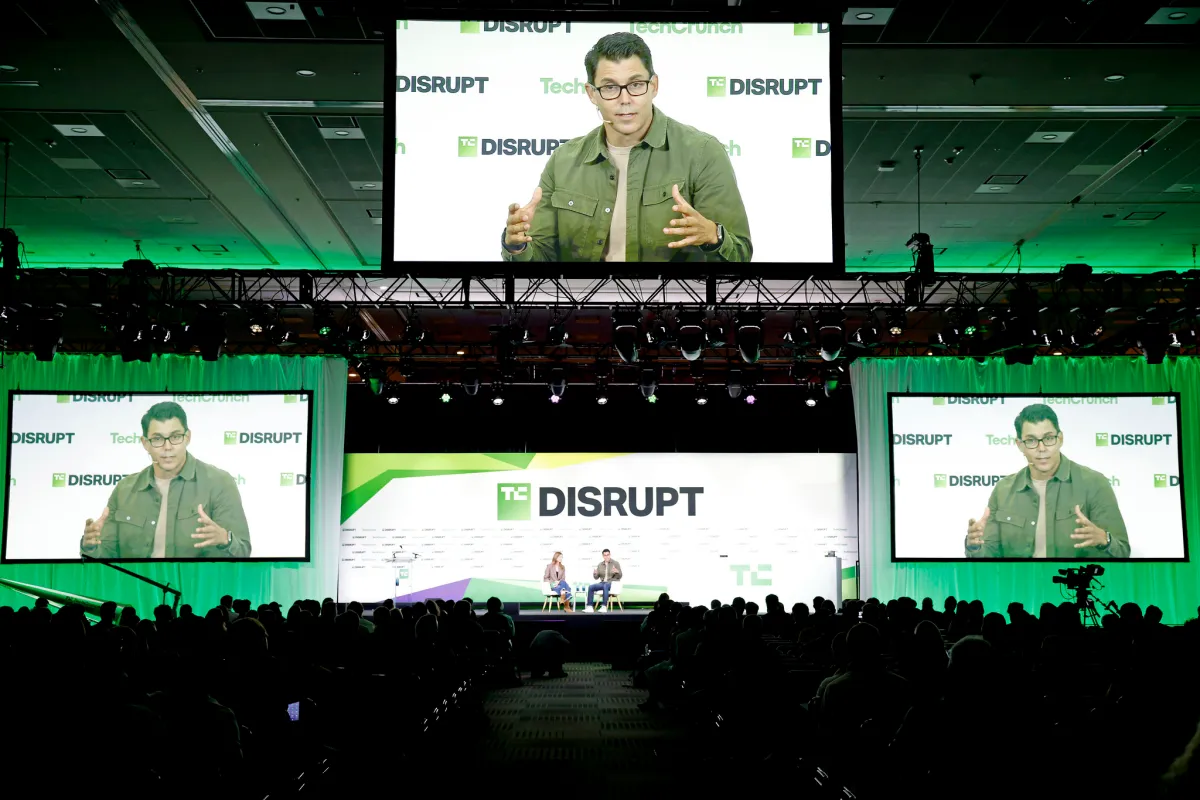
TechCrunch Disrupt 2026 Day 2 in San Francisco centered on AI, robotics, startup pitches and investor networking at Moscone West. The program featured 300+ startups, major industry speakers and sessions on the next wave of AI deployment and venture strategy.
- Day 2 of Disrupt 2026 centered on AI, robotics, venture funding and startup discovery.
- The Expo Hall featured 300+ startups, solution providers and live fast pitches.
- Conference tracks focused on practical AI topics such as security, hardware, agents and real-world deployment.
- Networking tools, investor-only sessions and side events were designed to turn attendance into deals and relationships.
TechCrunch Disrupt 2026 entered its second day in San Francisco with AI, robotics, venture capital and startup networking driving the agenda at Moscone West on October 14, 2026. The event matters because it brings together more than 10,000 founders, investors, operators and technology leaders around the latest product launches, funding conversations and emerging AI use cases.
Day 2 focuses on the practical side of the AI boom: how startups are building with frontier models, how robotics is moving out of demos and into real-world deployment, and how investors are thinking about the next wave of companies. The program also includes live pitches, one-on-one networking, investor-only sessions and side events designed to keep deal flow moving after the stage sessions end.
Across the Expo Hall and multiple conference tracks, attendees can meet more than 300 startups and solution providers, watch founders pitch for attention and capital, and hear from speakers representing Nvidia, Waabi, Flock Safety, Ricursive Intelligence, Anthropic, OpenAI and Benchmark, among others. For founders and investors, the day is as much about discovering what is next as it is about comparing notes on what the startup market already believes.
What Day 2 is trying to accomplish
Day 2 of Disrupt is built to help attendees discover companies, compare ideas and make high-value connections without wasting time. The conference positions itself as both an ideas forum and a marketplace, combining stage programming with structured networking and product discovery.
For founders, that means visibility. For investors, it means exposure to emerging categories before they become crowded. For enterprise buyers, it means a concentrated look at tools that might solve growth, security or deployment problems. And for startup teams, it offers a chance to study how others are presenting products, refining narratives and winning attention.
The event schedule reflects a broader shift in the tech industry: AI is no longer treated as a standalone topic. Instead, it is being discussed as infrastructure, product strategy, security risk, hardware challenge and operational necessity. Robotics, space systems, public safety and enterprise software all appear through that lens.
How the conference is structured
Disrupt 2026 Day 2 is organized around several overlapping experiences, each aimed at a different part of the startup ecosystem. The Expo Hall is the most open-ended area, while the stage sessions are built for deeper learning, and the networking spaces are designed to turn introductions into meetings.
| Area | Hours | What attendees can do | Why it matters |
|---|---|---|---|
| Registration / badge pickup | 8 a.m. to 5 p.m. | Check in and collect badges in the Level 1 lobby | Enables access to the conference and scheduled meetings |
| Expo Hall | 8 a.m. to 5 p.m. | Explore 300+ startups, partners and solution providers | Offers direct product discovery and lead generation |
| Stage sessions | Throughout the day | Attend talks, Q&A breakout sessions and roundtables | Highlights trends in AI, robotics, venture and enterprise growth |
| Networking lounge | 9 a.m. to 5 p.m. | Use matchmaking tools and schedule meetings | Turns broad attendance into targeted introductions |
| StrictlyVC | Afternoon program | Investor-only sessions on IPOs, family offices and LP expectations | Targets venture capital decision-makers and fund strategy |
| Side events | Evening | Attend hosted mixers and informal meetups across San Francisco | Extends networking beyond the conference floor |
Why AI dominates the Day 2 agenda
AI dominates because it is now reshaping nearly every part of the startup stack, from model development and deployment to security and hardware design. The conference’s speakers and sessions show just how broad the category has become.
On the Disrupt Stage, attendees hear from Flock Safety on public safety and surveillance, Benchmark partners on what the firm believes about the market now, and Ricursive Intelligence on the possibility of AI systems helping design their own hardware. Startup Battlefield also continues with healthtech, life sciences, enterprise and security contenders competing for a spot in the final round and $100,000 in equity-free funding.
The AI Stage adds another layer, with sessions examining agent security, SaaS business-model disruption, model evaluation, enterprise adoption, storage demand and what comes after the chatbot era. Taken together, the schedule shows a market moving from broad enthusiasm toward harder questions: What actually works? What scales? And what is worth funding?
What’s changing in AI investment?
The answer is that investors are increasingly looking past generic chatbot products and toward infrastructure, vertical workflows, agentic systems and physically deployed AI. Several sessions are aimed directly at the venture side of the market, including discussions about the next generation of AI companies, the cost of competing in the space and the role of multi-model strategies.
That shift matters because the first wave of AI startups often won attention by wrapping existing models in simple interfaces. The next wave is under pressure to show durable differentiation through data, distribution, workflow ownership or specialized performance.
Benchmark’s full partnership appears on the program as a signal that top-tier investors are not just watching AI from the sidelines; they are actively debating where value will accrue next, from product strategy to market structure.
What the Expo Hall offers startups and buyers
The Expo Hall is one of the most practical parts of the conference. More than 300 startups, technology partners and solution providers are on display, giving attendees a chance to inspect products directly rather than only hearing about them on stage.
For startup founders, this is where first impressions can become customer conversations, recruiting leads or investor meetings. For corporate attendees, it is a chance to benchmark vendors and compare solutions across categories. For investors, it is an efficient way to scan the market for new companies worth following.
Unlike keynote-only events, Disrupt’s expo format rewards time and curiosity. The schedule encourages attendees to look beyond their normal focus areas and speak with companies that might not yet be on their radar. That matters in an AI market where the most interesting products are often buried inside very specific operational problems.
How do the startup pitches fit in?
The answer is that the fast pitches function as an early signal system for the market. They let founders compress their value proposition into a few minutes while giving attendees a quick read on product clarity, category positioning and storytelling ability.
In a crowded funding environment, those skills matter. The pitches help surface not only promising products but also the companies best at framing why they exist. For many attendees, that makes the pitch sessions one of the most valuable parts of the day.
Which sessions matter most for AI watchers?
The most relevant AI sessions are the ones that show the industry moving from theory into deployment. That includes the Real World AI track, which emphasizes physical systems, and the AI Stage, which covers commercialization, security and product-market fit.
Several sessions stand out because they address the hard problems facing enterprise buyers and founders alike. These include how to build AI systems when failure is not acceptable, how to secure agent-based systems, how to prove AI can actually do the job, and how to make businesses work in a multi-model world.
The conference also gives substantial attention to hardware and robotics, reflecting the idea that the next major wave of AI value creation may not be limited to software interfaces. Robots, edge systems, orbital infrastructure and custom hardware all appear on the agenda.
Real World AI Stage: the move beyond software
The Real World AI Stage is focused on how AI behaves when it leaves the cloud and enters physical settings. That includes robotics demonstrations and discussions about real deployment challenges in factories, vehicles, edge environments and even space infrastructure.
Sessions in this track cover topics such as safety-critical AI systems, humanoid robots, the limits of cloud connectivity, orbital systems and the scaling challenge from prototype to production. The programming suggests that AI’s next chapter may be measured as much by reliability and embodiment as by model size.
AI Stage: product, security and scale
The AI Stage is where product and business questions take center stage. Attendees can hear about the security risks introduced by agents, the pressure AI places on legacy SaaS models, and the infrastructure demands created by larger model usage.
This track also includes discussions of how top startups create value from AI adoption, what comes after chatbot interfaces, and how companies can evaluate whether AI really performs before they hand over critical workflows. The emphasis is on practical adoption rather than hype.
How is robotics featured at Disrupt 2026?
Robotics is featured as a core part of the AI story, not a separate side topic. The event includes live demonstrations and panels on humanoid robots, general-purpose robotics, and the challenges of moving machines from lab prototypes to reliable products.
That approach reflects a broader industry reality: software-only AI has attracted most of the attention, but the largest economic opportunities may emerge when AI controls physical systems. Warehouses, vehicles, construction, logistics, defense and industrial operations all depend on the ability to make machines behave predictably in the real world.
Among the questions the conference raises are whether robots are nearing their own breakout consumer or industrial moment, what is still blocking wider adoption, and how companies can design systems that function when there is no margin for error.
Speakers from companies such as Hello Robot, Agility Robotics, Shield AI, Waabi and NVIDIA are expected to frame robotics less as a futuristic novelty and more as a hard engineering and deployment problem.
How founders can use the Builders Stage
The Builders Stage is aimed at founders, operators and investors who want to understand how companies actually grow. Its sessions focus on fundraising, product expansion, customer acquisition and the increasingly difficult economics of building in an AI-heavy market.
Topics include how the next Series A market may look, how to win without building AI directly, how to move from zero to one, and how to acquire the first 1,000 customers without a marketing budget. There are also sessions on why some companies can repeat success while others stall after a hit product.
That mix reflects a central challenge in startup building: technical progress is not the same as business traction. The Builders Stage pushes attendees to think about capital efficiency, growth channels, repeatability and the changing expectations of investors.
What are investors listening for?
Investors are listening for evidence of differentiation and disciplined execution. In a market flush with AI companies, a strong pitch is no longer enough. Funds are looking for signs that a team understands unit economics, product distribution, customer pain and the competitive environment.
Sessions on fundraises, institutional checks and overcapitalization point to a market that is more selective than it was during the peak liquidity years. Founders who attend are likely to hear the same message repeatedly: build a durable business, not just a compelling demo.
Why networking is as important as the main stage
Networking is built into Disrupt 2026 as a core feature, not a side benefit. The conference uses AI-powered matchmaking through its events app to connect attendees with potential customers, investors, collaborators and peers.
The Networking Lounge is open from 9 a.m. to 5 p.m., while the Deal Flow Cafe is reserved for Founder Pass and Investor Pass holders who want more focused meetings. That design turns the event into a practical business environment rather than just a content summit.
For many attendees, the real value of a conference like this is what happens between sessions: the introductions, follow-up conversations and informal comparisons of notes with other people in the same market. The conference’s organizers clearly want to make those moments easier to schedule and harder to miss.
What is StrictlyVC and why does it matter?
StrictlyVC is the investor-only portion of the Day 2 schedule, and it matters because it gives capital allocators a dedicated space to discuss market structure, public markets and fundraising behavior. The sessions are framed around IPO strategy, family offices and what limited partners want from venture funds.
For investors, those topics are increasingly important as the venture landscape adjusts to slower exits, greater scrutiny and higher expectations for returns. Family offices are playing a larger role in venture, while limited partners are asking harder questions about performance and risk.
Because these conversations happen away from the main crowd, they tend to be more candid and more useful for people managing capital. In a year when investors are being asked to justify their theses with greater precision, that matters.
Table: Key Day 2 themes and speakers
| Theme | Representative session | Notable participants | Takeaway |
|---|---|---|---|
| Public safety and surveillance | AI, Surveillance, and the Future of Public Safety | Garrett Langley, Flock Safety | AI is increasingly shaping security and civic infrastructure |
| Hardware and model design | When AI Starts Designing Its Own Hardware | Anna Goldie, Azalia Mirhoseini, Ricursive Intelligence | Frontier systems may influence the chips and devices they run on |
| Robotics deployment | Humanoid Robots Have Arrived | Jonathan Hurst, Agility Robotics; Digit | Robotics is moving from demos toward operational use |
| Enterprise AI security | The Agent Security Problem Nobody Is Talking About | Gavriel Cohen, NanoCo; Ric Smith, Okta | Agentic systems introduce new access and prompt risks |
| Startup growth | The Zero-to-1K Playbook | Crystal Huang, Grant Lee, Elia Wallen | Early customer acquisition remains a make-or-break challenge |
| Venture strategy | The $100 Billion Entry Fee | Harrison Rolfes, PitchBook | Competing in AI is becoming more capital-intensive |
What the broader program says about the startup market
The Day 2 agenda reads like a diagnosis of the current startup economy. AI is everywhere, but so are the questions that follow hype: Who gets the margins? Which products are defensible? How do companies protect themselves from security and infrastructure costs? And which businesses can scale without raising endless capital?
The inclusion of healthtech, life sciences, enterprise software, security, robotics and space infrastructure suggests that investors are still willing to back specialized categories. But the connective tissue is AI, which now touches nearly all of them.
The conference also underscores how much the startup market depends on ecosystems. In-person events still matter because they compress what would otherwise take months of outreach into a single day of conversations. The value is not just in the talks, but in the density of the room.
Why Disrupt still matters in 2026
Disrupt remains relevant because it combines discovery, deal-making and reporting on the state of the startup market in one place. Even in an era of digital networking and remote pitch meetings, the ability to see products, meet founders and compare viewpoints in person still carries weight.
This year’s Day 2 programming shows that the conference is trying to serve multiple audiences at once: founders seeking customers or funding, investors looking for the next opportunity, and operators trying to understand which technologies are ready for deployment. The result is a program that mirrors the startup ecosystem itself: crowded, ambitious and increasingly shaped by AI.
For anyone trying to understand where the sector is headed next, Day 2 offers a useful snapshot. It is not just a conference schedule; it is a map of the conversations now defining startup strategy, venture capital and the future of intelligent systems.
Editor’s note: This article is based on TechCrunch’s Disrupt 2026 Day 2 program and related event information for October 14, 2026.
Frequently asked questions
What is TechCrunch Disrupt 2026 Day 2 about?
TechCrunch Disrupt 2026 Day 2 is about startup discovery, AI, robotics and venture networking at Moscone West in San Francisco. The schedule combines Expo Hall product demos, pitch sessions, panel talks and investor meetings to help founders, buyers and investors connect.
Who is speaking at Disrupt 2026 Day 2?
Disrupt 2026 Day 2 features speakers from Nvidia, Waabi, Flock Safety, Ricursive Intelligence, Benchmark, Anthropic, OpenAI, Okta and others. The agenda spans public safety, robotics, AI hardware, enterprise software and venture capital.
How many startups are at Disrupt 2026 Day 2?
More than 300 startups, technology partners and solution providers are represented in the Expo Hall. The event is designed to give attendees a broad view of the market, from early-stage companies to established vendors and infrastructure players.
Why does Disrupt 2026 focus so much on AI?
Disrupt 2026 focuses on AI because the technology now affects product design, hardware, security, robotics and venture strategy across the startup ecosystem. The program reflects a market moving from novelty toward implementation, reliability and business model pressure.
Can attendees still get into Disrupt 2026 Day 2?
Yes, attendees can still join Disrupt 2026 Day 2 by purchasing a pass, with the event promoting discounts from the walk-up rate. Access depends on the pass type, especially for conference sessions, roundtables and investor-only programming.