In short
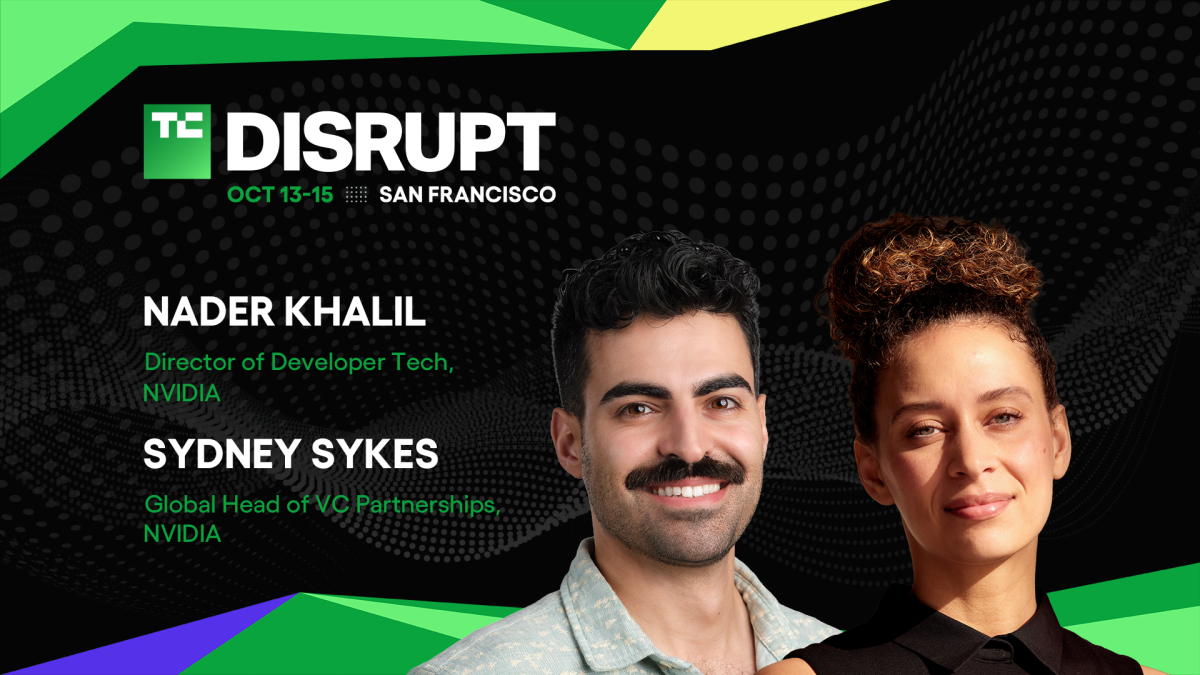
Nvidia executives Nader Khalil and Sydney Sykes will lead a TechCrunch Disrupt 2026 session on the open vs. closed AI debate. The discussion will focus on how startup model choices affect cost, control, speed, and defensibility.
- Nvidia’s Nader Khalil and Sydney Sykes will speak at TechCrunch Disrupt 2026 in San Francisco.
- The session will focus on how founders should choose between open, proprietary, or hybrid AI models.
- The decision affects startup costs, infrastructure, margins, control, and product differentiation.
- Nvidia is backing both open-model research and practical deployment strategies.
- Many startups are likely to end up using a hybrid stack rather than a single model strategy.
Nvidia executives Nader Khalil and Sydney Sykes will put one of the most consequential startup decisions in artificial intelligence under the spotlight at TechCrunch Disrupt 2026 in San Francisco on October 13-15: whether founders should build on open models, proprietary models, or a hybrid of both. The debate matters because the choice can shape a company’s costs, infrastructure, product speed, data control and long-term defensibility.
The session, titled “The Open vs. Closed AI Debate Is Just Getting Started,” will take place on the Builders Stage and is designed less as an ideology contest than as a practical roadmap for founders, investors and technical teams trying to decide how to ship AI products in a rapidly shifting market.
What makes the discussion timely is that the gap between open and closed systems is narrowing even as the commercial stakes grow. Open-weight models are improving fast, proprietary frontier models continue to advance, and many companies are already mixing the two. For startups, that leaves no easy answer—only trade-offs.
Why the open vs. closed AI choice matters now
The basic decision a startup faces is simple to state but difficult to answer: should it build on a model it can control more directly, or one it can access quickly through a vendor?
In practice, the answer influences everything from monthly compute spend to security posture. It also affects whether a company can change providers later, how much of its product is tied to a third-party API, and where it can claim a real advantage over competitors.
That’s why the issue has become more than a technical preference. It has turned into a core business strategy question for AI-native startups and for incumbents adding AI to existing products.
What founders are really deciding
Founders are not only choosing between open and closed model families. They are deciding whether to fine-tune a model, run one locally, use several providers at once, or build a layered system that can swap models as costs and capabilities change.
Those decisions can be revisited, but not without expense. Each switch can force teams to rework infrastructure, rewrite prompts, re-evaluate safety controls and rethink pricing.
- Speed: proprietary APIs can help teams launch faster.
- Control: open models can offer more flexibility over deployment and data handling.
- Cost: economics change depending on scale and workload.
- Defensibility: a model choice is rarely a moat on its own.
- Portability: using multiple models can reduce lock-in.
How the AI landscape is changing the debate
The conversation has shifted because open models are no longer fringe alternatives. Nvidia said in July that 145 papers accepted at ICML 2026 cited its Nemotron open models and datasets, alongside other Nvidia open-model work spanning robotics, autonomous vehicles and biomedical research.
At the same time, leading proprietary labs continue to push the frontier of model capability. The result is a market where neither side can be dismissed outright and where product teams must think more carefully about what they actually need from the model layer.
For many builders, that means the old framing—open versus closed—has become too simplistic. The real question is where each option creates the best commercial outcome.
Why the gap is closing
The narrowing gap is partly the result of faster open-model progress and partly the result of intense competition among closed-model providers. As both sides improve, it becomes harder to argue that one path is automatically superior for every use case.
That does not mean the choices are interchangeable. Open systems may offer more control, while proprietary systems can offer immediate access to frontier capabilities. But the balance is shifting often enough that startups cannot assume today’s best setup will still be optimal next year.
Nvidia CEO Jensen Huang has described the future of AI as a world where proprietary and open models coexist, rather than a binary winner-take-all contest.
That view may sound straightforward at a keynote, but it becomes much more complicated when a startup has to choose a stack, a budget and a product strategy.
Who are the speakers and why do they matter?
Nader Khalil and Sydney Sykes bring two different but complementary perspectives to the session. Khalil comes from the builder and infrastructure side, while Sykes represents the venture and startup financing ecosystem.
Together, they can address not only what developers need to ship a product, but also what investors want to see when evaluating whether a company has a durable business.
Nader Khalil’s builder background
Khalil is Nvidia’s director of developer tech, where he leads work related to open source and local AI. Before joining Nvidia in that role, he co-founded Brev.dev, an AI infrastructure startup Nvidia acquired in July 2024.
Brev.dev focused on simplifying GPU access across deployment environments, helping teams run AI software in public cloud, private cloud and on-premises settings without being tied to a single compute source. That background makes Khalil especially relevant to a session about model choice, because model strategy and infrastructure strategy are increasingly linked.
Sydney Sykes’ venture perspective
Sykes is Nvidia’s global head of VC partnerships, giving her a front-row view of how investors assess AI startups. From that vantage point, the model question is not only about engineering elegance, but also about whether a startup can preserve margins, control risk and evolve without rebuilding its stack every time the market shifts.
That combination should make the conversation especially useful for founders trying to reconcile product ambition with investor expectations.
What does open AI really buy startups?
Open models can deliver flexibility, more direct control and in some cases lower long-term costs. They may also make it easier to deploy on-premises, tune for specialized tasks or design systems that keep sensitive data closer to the customer.
But open does not automatically mean simple or cheap. Teams still need to manage hosting, optimization, reliability, inference performance and maintenance. In other words, the model may be open, but the operational burden is not free.
Where open models can help
For some startups, open models are attractive because they reduce dependence on a single vendor. That can matter for compliance-heavy industries, enterprise buyers with strict procurement requirements, and teams that want to move quickly across different deployment environments.
Open models can also help companies experiment more aggressively. If a startup wants to customize behavior, control prompts, or run locally for privacy reasons, open-weight systems can be a better fit than a black-box API.
Where open models can hurt
The downside is that more control often means more responsibility. A company using open models may need more internal expertise to handle deployment, tuning, observability and safety checks. That can increase technical overhead just when a startup is trying to stay lean.
There is also no guarantee that an open model will remain cheaper over time once infrastructure, staffing and maintenance are included. The economics depend heavily on workload patterns and scale.
Why proprietary models still appeal to founders
Proprietary frontier models remain attractive because they can accelerate product development. A startup can often begin building immediately, using a vendor’s latest capabilities without assembling as much internal infrastructure.
That speed can be decisive for early-stage teams trying to reach product-market fit. It can also help companies offer a polished experience while the underlying AI landscape remains in flux.
The advantages of closed systems
Closed models can reduce the time between an idea and a live product. For many founders, that matters more than full control in the early months of a company’s life.
They may also simplify procurement and support. A vendor-managed system can offload much of the operational burden, allowing teams to focus on product design, go-to-market strategy and customer feedback.
Still, the trade-off is clear: if a competitor uses the same model provider, differentiation must come from elsewhere.
Where proprietary models create risk
When a startup relies heavily on a vendor API, it can inherit that vendor’s pricing, limitations and strategic priorities. That creates exposure if prices rise, usage policies change or better options emerge elsewhere.
It can also make a product look thinner from an investor’s perspective if too much of the value is merely a wrapper around someone else’s model.
Startups that build entirely on third-party AI systems may move faster, but they also have to prove that their own product, data or workflow layer is what makes them valuable.
Can a model choice create a moat?
Not by itself. The model is usually only one part of a company’s competitive advantage, and sometimes not the strongest part at all.
If competitors can buy the same underlying capability from the same API provider, then defensibility often comes from proprietary data, workflow integration, user relationships, distribution or domain-specific expertise. Open models can improve flexibility, but they do not automatically create a moat either.
The deeper issue is whether the startup owns something hard to copy once the model layer is stripped away.
Common sources of defensibility
- Proprietary data: unique training or inference data that improves performance.
- Workflow integration: embedding AI into business processes customers rely on.
- Distribution: direct access to users, channels or enterprise buyers.
- Product experience: a better interface or end-to-end workflow.
- Specialized technology: systems that outperform generic model wrappers.
That is why the open-versus-closed debate is often really a discussion about what layer of the stack a company intends to own.
How Nvidia is positioning itself in the middle
Nvidia is not presenting the issue as a battle it expects to win on one side alone. Instead, the company is building infrastructure and model support that can serve a mixed ecosystem.
Its Nemotron 3 Super model, introduced in March, is an open 120-billion-parameter model aimed at agentic workloads. Nvidia has also highlighted research and development activity around its open model families across multiple fields, signaling that it sees substantial value in the open ecosystem.
Why the hybrid model may be the real story
In practice, many companies are not choosing one camp forever. They are blending open and proprietary models depending on the task, cost, latency, privacy and accuracy requirements.
A startup might use one model for customer-facing interactions, another for internal automation and a locally run open model for sensitive workflows. That kind of hybrid setup can reduce dependence on any single vendor while still allowing teams to tap frontier capabilities where they matter most.
This approach may be less elegant as a slogan, but it is often more realistic as a business plan.
What founders, investors and operators can learn from the session
The Builders Stage discussion is likely to appeal beyond core AI engineers because the model choice affects multiple stakeholders inside and outside a company.
For founders
Founders need to know whether they are optimizing for speed, flexibility, margin, control or all of the above. That decision will influence fundraising narratives and determine how much rebuilding may be required later.
For investors
Investors want to know whether a startup is building durable value or simply packaging a third-party model in a new interface. The answer can change how they judge the company’s scale potential and pricing power.
For enterprise buyers
Enterprise customers often care most about security, data handling, deployment options and vendor lock-in. For them, the open-versus-closed question is also a procurement and risk-management issue.
For developers and students
Developers and students can use the session to understand how technical architecture affects business strategy. The lesson is that model selection is no longer just a code-level choice; it is a strategic one.
What should AI builders ask before choosing a model?
They should start by identifying the real constraint. Is the priority time-to-market, data control, cost efficiency, reliability, compliance or customization?
From there, teams can decide whether a single model provider is enough or whether a multi-model setup makes more sense. They should also ask how quickly their product could adapt if a better model appears in six months.
The most important question may be the simplest one: what part of the stack will actually be hard to copy?
- What does the product need the model to do today?
- How much control over data and deployment is required?
- How sensitive is the startup to pricing changes?
- Can the company switch models without major rework?
- Where does the company’s moat really live?
Event snapshot: TechCrunch Disrupt 2026
For readers tracking the event itself, the open-versus-closed session is one of the Builders Stage conversations scheduled for the conference in San Francisco. TechCrunch is also encouraging early registration by offering a discount before prices rise later in September.
| Item | Details |
|---|---|
| Event | TechCrunch Disrupt 2026 |
| Dates | October 13-15, 2026 |
| Location | San Francisco |
| Session title | The Open vs. Closed AI Debate Is Just Getting Started |
| Speakers | Nader Khalil and Sydney Sykes |
| Stage | Builders Stage |
| Early registration | Save up to $200 before September 25 at 11:59 p.m. PT |
Why this debate is likely to persist
The open-versus-closed question is not going away because the market itself keeps changing. Model quality improves, prices fluctuate, and startups mature into different needs as they move from prototype to production.
That means a decision that looks obvious for a seed-stage company may look wrong at Series B or Series C. What starts as a speed decision can become an infrastructure burden; what starts as a control decision can become a product slowdown.
The best answer may therefore be less about ideology and more about timing. Different companies, in different phases, will likely need different approaches.
Bottom line
TechCrunch Disrupt 2026 is turning one of AI’s most practical questions into a live business conversation. With Nvidia executives Nader Khalil and Sydney Sykes on stage, the event will examine how founders should think about model choice in a market where open and closed systems are both improving quickly.
For startups, the stakes are real: the decision can affect costs, speed, flexibility, investor confidence and long-term control. And as the AI stack evolves, the smartest answer may be the one that leaves room to change.
Frequently asked questions
What is Nvidia discussing at TechCrunch Disrupt 2026?
Nvidia is discussing the open vs. closed AI decision for startups at TechCrunch Disrupt 2026. The session will examine how founders choose between proprietary frontier models, open models, or hybrid approaches, and why that choice affects product strategy and business fundamentals.
Who are the speakers for the Disrupt 2026 AI session?
The speakers are Nader Khalil, Nvidia’s director of developer tech, and Sydney Sykes, Nvidia’s global head of VC partnerships. Khalil brings an infrastructure and builder perspective, while Sykes offers insight from the venture and startup investment side.
Why does the open vs. closed AI choice matter for startups?
It matters because the model choice can affect cost, control, deployment flexibility, speed to market, security, and long-term defensibility. Startups that choose poorly may face higher infrastructure burdens, weaker margins, or more dependence on a single vendor.
Is Nvidia arguing for open AI or closed AI?
Nvidia is not backing one side exclusively. The company has signaled support for both open and proprietary approaches, and CEO Jensen Huang has framed the future as one where the two coexist rather than compete in a simple winner-take-all battle.
When and where is TechCrunch Disrupt 2026?
TechCrunch Disrupt 2026 takes place in San Francisco from October 13 to October 15, 2026. The open vs. closed AI session will appear on the Builders Stage during the conference.