In short
Destro AI has raised $8 million and emerged from stealth with a warehouse automation platform that coordinates robots and human workers instead of building its own robot. The startup is expanding pilots at Yusen Logistics, where its software is being used to streamline cross-dock operations.
- Destro raised an $8 million seed round led by Base10 Partners and Bonfire Ventures.
- The startup’s software coordinates robots, carts, workers and trucks in logistics facilities.
- Yusen Logistics is expanding an early pilot from 3 robots to 26 robots, with another 17-robot pilot underway.
- Destro is targeting cross-dock workflows it says can be replicated across thousands of warehouses.
- The company’s strategy is to win by orchestrating operations, not by building the robot hardware itself.
Destro AI has emerged from stealth with an $8 million seed round and a sharply different bet on warehouse automation: instead of trying to build the most advanced robot, it is selling the software that coordinates robots and human workers so logistics sites can run more efficiently. The startup is already expanding pilots at Yusen Logistics, where its system is being used to manage cross-dock operations across multiple facilities.
The company’s pitch matters because logistics operators have spent years testing robotics that can move cartons, unload trailers, or shuttle carts, yet many deployments stall when they cannot fit neatly into the messier reality of warehouse labor. Destro says it is tackling that problem by acting as the intelligence layer that directs the whole workflow, not just the machine.
Why Destro is betting on software, not hardware
Destro’s central argument is straightforward: in logistics, the most valuable layer may be the orchestration software rather than the robot body itself. Founder Manthan Pawar says the company deliberately avoids being framed as a robotics manufacturer and instead focuses on the operational problems warehouse operators already understand.
That distinction is important in a field crowded with startups chasing humanoids, dexterous hands, or general-purpose robots. Destro is positioning itself around a more immediate commercial opportunity: coordinating existing equipment, human labor, and machine actions in environments where speed, consistency, and labor efficiency matter most.
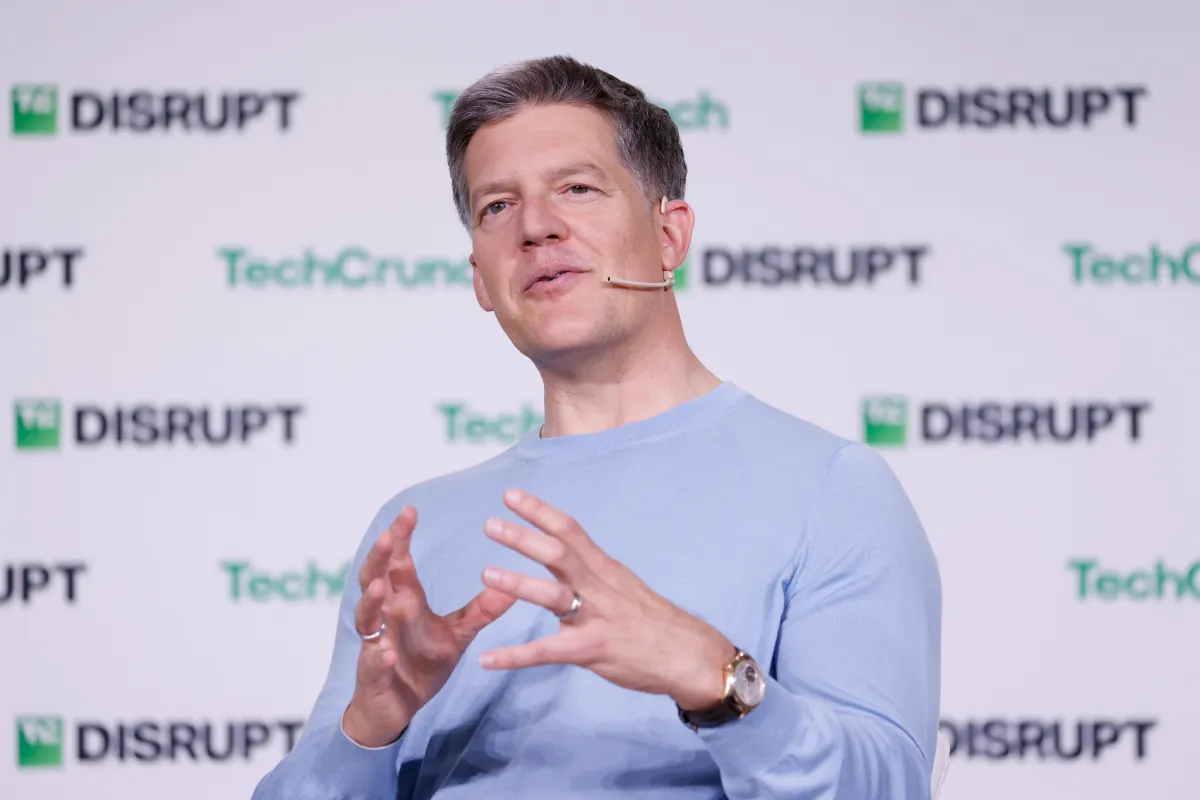
Manthan Pawar, Destro’s founder, said the company has been winning customers in part because it does not think like a typical robotics maker, but like an operator that knows the customer’s pain points in detail.
Pawar brings that perspective from years in the U.S. supply chain and robotics sector, along with a master’s degree in robotics from NYU Tandon. He says the startup is on track to reach cash-flow positivity by the end of the year, an ambitious target for an early-stage company in a capital-intensive industry.
How Destro’s system works in a warehouse
Destro’s software stack is built around two products: Vision, an operating system that uses open-weight vision-language-action models to guide robot movement, and Mothership, a higher-level orchestration layer that coordinates carts, people, and trucks during a warehouse workflow.
In practice, that means the system does more than tell a robot where to go. It helps determine how goods move through a facility, how human workers interact with carts, and how the entire loading process is managed from one step to the next.
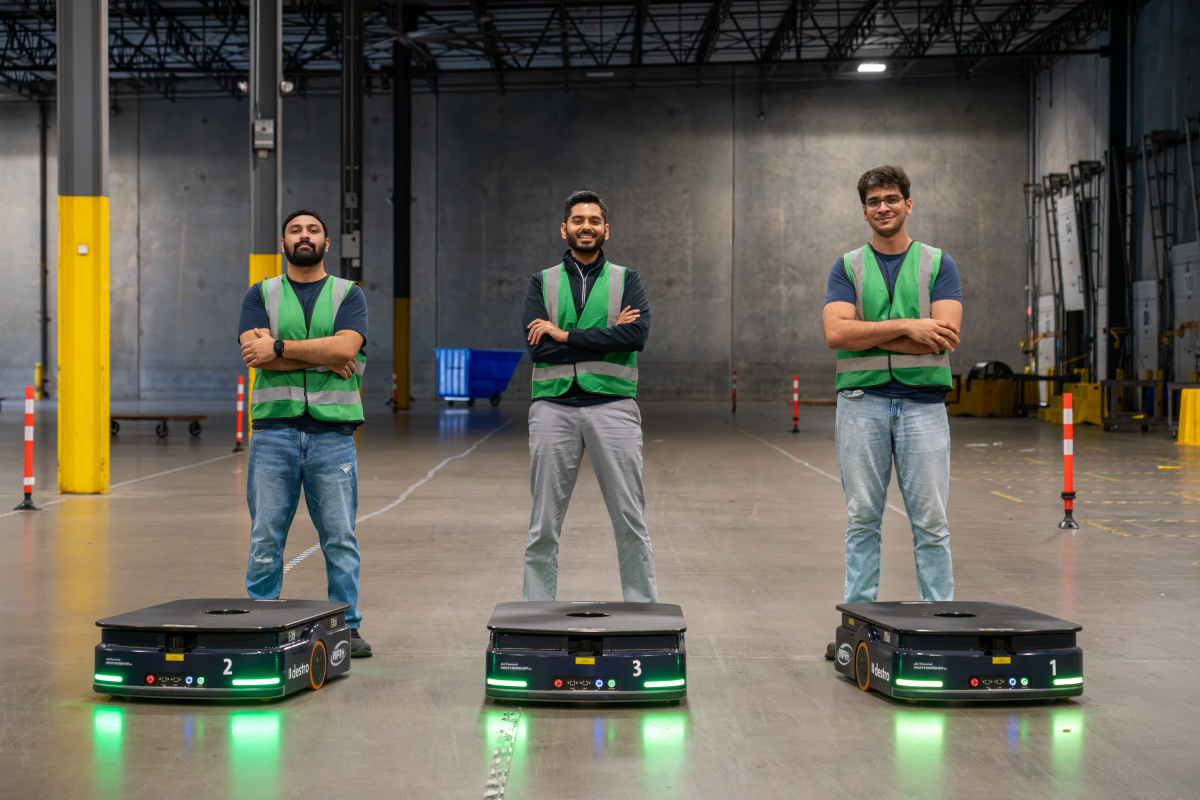
At Yusen Logistics, Destro began with a pilot at a facility in the Pacific Northwest using three cart-moving robots made by Miva Robotics. The robots were deployed to support cross-docking, a process in which incoming freight is unloaded from one truck and sorted into outbound loads for other trucks bound for final delivery.
According to Destro and Yusen, that arrangement reduced paperwork and made the workflow more systematic. Human workers unload freight into carts, the robots identify full loads, and the system sends those carts to the right destination without requiring the same amount of manual coordination.
What is cross-docking and why does it matter?
Cross-docking is a logistics method in which products are transferred from inbound trucks to outbound vehicles with minimal storage time. It matters because it can speed deliveries, reduce warehouse handling, and lower the need for long-term inventory storage.
For automation companies, cross-docking is also attractive because it is operationally complex but highly repeatable. That makes it a strong candidate for software-guided robotics if the system can handle both machine movement and human labor in real time.
How did Yusen Logistics become the early test case?
Yusen Logistics became the best fit because its automation team was already pushing toward broader facility modernization and needed a solution that could scale across multiple sites. Richard Brunelle, who oversees automation for Yusen’s American logistics business, manages automation strategy across about 30 U.S. facilities.
Yusen already uses fixed automation such as conveyors and sorters, and it has also been testing newer systems including trailer-unloading robots and autonomous floor scrubbers. But Brunelle was looking for something that could address a harder problem: the coordination of human workers, carts, and freight flow in cross-dock environments.
When he first met Destro, the startup was focused on a different warehouse problem, picking and packing. Brunelle recognized that Destro’s approach could be adapted to the cross-dock challenge, which he says is fundamentally the same type of workflow issue even if the operational details differ.
Brunelle said he asked Destro to rework its system for cross-dock operations because he had not seen another company solving that exact problem, and the startup returned with a version that fit the need.
That adaptation became the foundation for the current relationship. Destro, Brunelle said, moved quickly to tailor its technology to the environment, then committed to the space.
What Destro is deploying now
The startup’s initial pilot has already grown into a larger rollout. Destro is expanding the first Yusen deployment to 26 robots and has also launched a second pilot with 17 robots at a Southern California site.
The company believes the workflow can be replicated across thousands of warehouses that rely on similar labor-intensive cross-dock operations. That “copy-and-paste” idea is central to its business model: if one software layer can manage a common logistics pattern, Destro can potentially scale without needing to invent a new robot for each facility.
The company’s investors appear to believe that logic. The seed round was led by Base10 Partners and Bonfire Ventures, with additional backing from CoFound Partners.
Why investors are interested in orchestration software
Investors increasingly see a gap between robotics demos and practical warehouse deployments. Many robotics startups can showcase a single machine performing a narrow task, but fewer can prove that their technology integrates cleanly into the broader operational workflow of a live facility.
Destro is arguing that this is where value concentrates. Rather than competing head-on with companies building the most advanced physical systems, it is building the layer that makes heterogeneous robots and people work together in a production environment.
That approach may be especially appealing in logistics, where operators often want immediate efficiency gains rather than futuristic form factors. If a system can reduce manual coordination, eliminate paper-based processes, and improve throughput, it may justify deployment faster than a more experimental robot platform.
| Metric | Details |
|---|---|
| Funding raised | $8 million seed round |
| Lead investors | Base10 Partners, Bonfire Ventures |
| Additional investor | CoFound Partners |
| Initial pilot | 3 cart-moving robots in the Pacific Northwest |
| Current Yusen expansion | 26 robots planned |
| New pilot | 17 robots in Southern California |
| Core use case | Cross-dock logistics coordination |
What are the limits of Destro’s approach?
Destro’s model may work best in workflows that are structured enough to be orchestrated but complex enough to benefit from automation. The harder question is whether the same platform can handle tasks requiring more dexterity, manipulation, or fine motor control.
Those are the areas where today’s generic robot bodies and open-source models have not yet shown clear reliability. Destro may eventually need capabilities from outside partners building humanoids, advanced hands, or foundation models tailored to manipulation-heavy work. It is not yet clear whether those companies will make that technology broadly available or try to keep the value in-house.
That uncertainty is one reason Destro is placing its bet where it is. Pawar argues that the company is not trying to own every part of robotics; it is trying to build the harness around the parts that already exist and make them useful in the real world.
Pawar described robots and AI model layers as platforms, but said the company’s orchestration harness adds enough complexity and value that the underlying hardware alone would not make these warehouse workflows possible.
What could hold Destro back?
The main risk is that logistics automation may evolve toward more capable general-purpose robots, reducing the need for specialized orchestration software. Another risk is that some robotics platform makers could decide to bundle similar workflow management tools themselves.
For now, however, Destro appears to be filling a practical gap. It is solving a specific operational challenge where many robotics vendors have offered only partial answers.
How does Destro compare with other robotics startups?
Destro’s advantage, according to Yusen, was that its system could handle the entire process rather than one isolated part of it. Brunelle said the company spoke with two other prominent robotics startups, but neither matched Destro’s fit.
One alternative could move carts from point A to point B but could not manage the full loading and unloading chain. Another supplied fleet management tools, but still required a human to orchestrate the process manually. Destro won the deal because it was able to control the workflow end to end.
That difference reflects a broader divide in the robotics market. Some companies sell machines; others sell fleet software; Destro is selling the control layer that makes both work together in a warehouse setting.
Why not just buy a humanoid robot?
Because the problem Yusen is trying to solve is operational, not theatrical. Brunelle said the company has not yet found a compelling use case for a bipedal humanoid robot, though it is evaluating a pilot with a wheeled humanoid platform.
The comment underscores a reality many logistics operators share: the goal is not to deploy the most advanced-looking machine, but to improve throughput, consistency, and customer service. A robot that looks futuristic is less useful than a system that reliably keeps freight moving.
What happens next for Destro?
Destro will use its new funding to deepen deployments and expand beyond the first warehouse sites. The company’s immediate test is whether it can turn a successful pilot into a repeatable product that can be sold into other logistics networks with similar cross-dock operations.
If it succeeds, the startup could become part of a larger shift in automation: away from one-off hardware experiments and toward software layers that coordinate mixed human-robot operations across the supply chain.
It will also get another spotlight soon. Destro is scheduled to appear at TechCrunch Disrupt in October, where it will present its approach alongside other Battlefield startups.
For logistics companies, the core question is whether Destro’s model can deliver measurable gains in labor efficiency, operational consistency, and flexibility without forcing a wholesale redesign of existing facilities. If the answer is yes, the startup may prove that the most valuable robotics company is not necessarily the one that builds the robot.
Key timeline of Destro’s growth
| Date/Stage | Event | Why it matters |
|---|---|---|
| Pre-stealth | Development of Vision and Mothership software | Established Destro as an orchestration-first robotics startup |
| Initial Yusen pilot | Three Miva Robotics carts deployed in the Pacific Northwest | Validated the system in a real warehouse environment |
| Current expansion | Scale-up to 26 robots | Signals stronger confidence in the workflow |
| New pilot | 17 robots in Southern California | Tests whether the model can transfer across sites |
| Seed funding | $8 million raised from Base10, Bonfire and CoFound | Provides capital for broader rollout |
Destro’s rise suggests that the next phase of warehouse automation may be less about replacing people entirely and more about coordinating them better. In a sector defined by margins, labor pressure and fulfillment speed, that may be exactly where the market is heading.
Frequently asked questions
What does Destro AI do?
Destro AI builds warehouse automation software that coordinates robots, human workers, carts and trucks in logistics facilities. Instead of selling a robot, it provides an intelligence layer that manages the workflow, especially in cross-dock operations where freight moves quickly from inbound to outbound loads.
How much funding did Destro raise?
Destro raised $8 million in seed funding. The round was led by Base10 Partners and Bonfire Ventures, with additional participation from CoFound Partners. The capital is meant to help the company expand pilots and scale its logistics automation product.
Why is Yusen Logistics important to Destro?
Yusen Logistics is Destro’s key early customer and proof point. The company’s U.S. logistics arm is expanding an initial pilot that used three robots to a 26-robot deployment, while also testing a second pilot in Southern California.
How is Destro different from other robotics startups?
Destro is different because it focuses on orchestration rather than hardware. Many robotics companies build a machine and then search for a use case, while Destro starts with a warehouse problem and uses software to coordinate existing robots and human labor.
What is cross-docking in logistics?
Cross-docking is a logistics process where goods are unloaded from incoming trucks and transferred quickly into outbound shipments with little or no storage. It matters because it can speed deliveries, reduce handling and improve warehouse efficiency when it is well coordinated.