In short
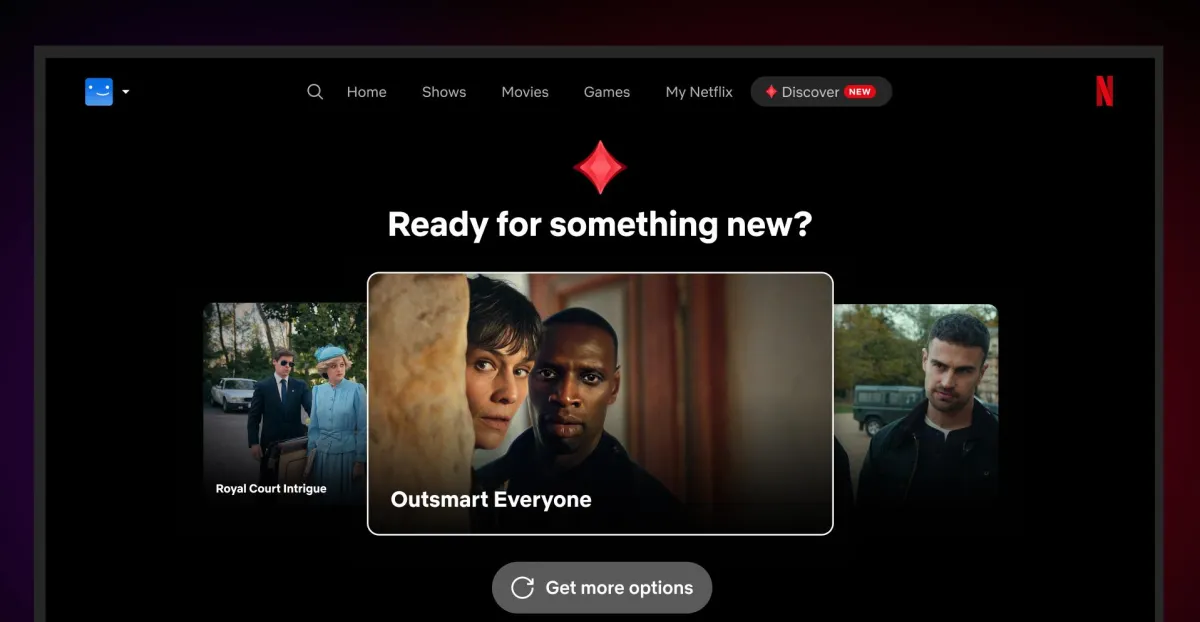
Netflix has started a limited U.S. rollout of AI Discover, a new TV-app tab that uses theme-based prompts and recommendation feedback to improve browsing. The test is aimed at making it easier for viewers to find something to watch and may inform future Netflix product changes.
- Netflix has launched a limited U.S. test of its AI Discover tab on supported TVs.
- The feature starts with themes like mood, group, time available, new titles and recent viewing.
- Users can tune recommendations with direct feedback, and the app remembers dislikes.
- The first version has no chat box and is controlled by Netflix rather than manual opt-in.
- Netflix says the feedback will not affect content-creation decisions.
Netflix has begun a limited U.S. rollout of a new TV-app AI Discover tab that uses theme-based prompts and recommendation tuning to help members find something to watch. The feature matters because Netflix is trying to improve one of its most stubborn problems: making TV browsing faster, more personal and less overwhelming as viewers keep scrolling instead of pressing play.
What Netflix is launching
According to The Verge, the new Discover tab is an experimental AI-powered discovery space inside the Netflix TV app. Rather than asking users to type a full search query, the first version starts with broad themes such as mood, group size or how much time someone has available.
What’s on Netflix describes the tab as a sort of company
“test kitchen”
for recommendation experiments. In practice, that means Netflix is using the space to try out interfaces and controls that may eventually make it into the core product, but not necessarily all at once.
The first release is limited to English-language members in the U.S. on supported TVs, with access arriving gradually over the coming weeks. Netflix has not said how many users are in the test, and the company says compatible-device details will be posted in a Help Center article.
How the feature works
The new experience is built around short, guided choices rather than open-ended chat. That is an important distinction. In the first version, there is no chat box and no conversational back-and-forth. Instead, users move through click-through themes and then refine what they see by reacting to recommendations.
What users can do inside Discover
- Start with themes such as mood, viewing group, time available, new or popular titles, or recent viewing.
- Give direct feedback on recommendations so Netflix can adjust what it shows next.
- Select Do Not Recommend when a title is not of interest or has already been seen.
- Use the Tune Your Recommendations button, which sits beside Play and My List on each title.
Netflix says the system is powered by what The Verge called
“a new intelligence layer we’ve been building that responds to what members tell us in real time and keeps learning.”
The company says that feedback can shape the suggestions it shows next, and that the app remembers dislikes.
That is a more reactive approach than the basic thumbs-up and viewing-history model Netflix has long used. It also reflects a wider industry effort to make discovery less dependent on users knowing exactly what they want before they start searching.
Why it matters
Netflix is not just adding another menu item. It is trying to reduce friction at the point where many streaming habits break down: the browse screen. On TV, where typing is slower and search is less convenient than on a phone, recommendation quality can determine whether a viewer stays engaged or gives up and leaves the app.
That is why this test matters for Netflix’s business. The company has long relied on recommendation algorithms built from viewing behavior and thumbs-up signals, but the TV interface remains a critical place where those systems have to perform in real time. If AI Discover makes it easier to find the right movie or series faster, Netflix could improve satisfaction and, by extension, retention.
The rollout also signals something broader about how Netflix sees AI. The company is experimenting with it as a tool for product design and discovery, not only as a back-end ranking system. And because the feature is confined to a controlled test cohort, Netflix can measure whether users actually want more guided recommendations before it decides how widely to deploy them.
Background: how Netflix got here
Netflix has spent years refining recommendation systems around what people watch, finish, rewatch and rate. That history explains why the company is now testing more explicit feedback controls: the streaming giant already knows that discovery is one of the main reasons people use its service, and one of the main reasons they abandon it mid-scroll.
The TV app is especially important. On television, Netflix is often a lean-back experience rather than a search-led one. That makes the home screen, recommendation rails and title pages central to the viewing journey. Small changes in how those pages are organized can have outsized effects on what people choose next.
Netflix has also been testing AI-assisted discovery in smaller experiments before this TV rollout. In May 2025, according to What’s on Netflix, the company ran an opt-in generative AI search beta on iOS. That earlier test suggests Netflix is trying to learn where AI helps and where it gets in the way before scaling any feature across its larger audience.
There is another reason the timing stands out. The Verge linked the announcement to a period in which Netflix had recently cut around 1,000 employees. That context does not mean the AI test is a direct response to layoffs, but it does underline how aggressively the company is reassessing costs, product priorities and how it invests in future growth.
What is different about this test?
The headline difference is that Netflix is not leading with a chatbot. The first version of AI Discover is a controlled, click-through experience with a narrow set of prompts. That makes it less open-ended than many consumer AI products and more like a recommendation interface with added intelligence behind it.
There are also limits. The feature is unavailable on kids profiles and there is no manual opt-in or opt-out switch for users; Netflix controls who gets assigned to the test. That tells us the company is still in an experimental phase and is more interested in observing behavior than in giving the entire user base access immediately.
Another notable detail: Netflix says this feedback will not influence content-creation decisions. In other words, the company is drawing a line between discovery optimization and the kinds of creative or commissioning judgments that shape what gets made in the first place.
By the numbers
| Metric | Detail | Why it matters |
|---|---|---|
| May 2025 | Netflix tested an opt-in generative AI search beta on iOS | Shows the company has been experimenting before the TV rollout |
| Nov. 3, 2026 | Date attached to the AI Discover announcement | Marks the start of the current rollout cycle |
| ~1,000 employees | Recent layoffs cited by The Verge in its context | Provides broader company context around the announcement |
How the rollout is being handled
Netflix is not opening the floodgates. The company says the feature is arriving first for a limited initial cohort in the United States, and access will expand over the coming weeks. What’s on Netflix reports that Netflix has not specified how many users are in the test, which is typical for a feature still being evaluated.
The company is also keeping the platform restrictions tight. The current test is for English-language members on supported TVs, which means the rollout is being shaped as much by technical compatibility as by product strategy.
That controlled approach gives Netflix room to study three key questions:
- Do people use theme-based discovery when they are offered it?
- Does the feedback loop actually improve recommendations over time?
- Do users find the new controls helpful enough to change how they browse?
Where The Verge and What’s on Netflix differ
The two outlets describe the same feature, but they emphasize different parts of it. The Verge focuses on the underlying AI system and the company’s framing of it as a learning layer that responds in real time. What’s on Netflix adds more detail on the product mechanics, including the lack of a chat box, the placement of the Tune Your Recommendations button and the fact that users cannot manually opt in or out.
That difference matters because it helps separate the marketing pitch from the actual user experience. Netflix may describe the feature in broad AI terms, but the implementation is still a structured browsing tool rather than a freeform assistant.
What happens next
The next phase is mostly about observation. Netflix has not said whether AI Discover will expand to mobile, additional countries or more languages. It also has not said which TV models are supported or whether any of these experiments will migrate into the main Netflix interface.
Those unanswered questions matter because product tests often start as narrow prototypes and then broaden only if the data supports them. If Netflix sees stronger engagement, it could add more themes, more controls or a more conversational layer. If not, the feature may stay limited to a small segment or be folded into other parts of the app.
One other open question is whether the company will use Discover as a bridge to other recommendation formats. The Verge suggested some future experiments may move into the main Netflix experience, which would make this test more than a one-off trial. For now, though, Netflix is treating it as a lab, not a launch.
What to watch for
There are several markers that will show whether the experiment is gaining traction:
- Whether Netflix expands beyond the initial U.S. English-language cohort.
- Whether more titles, themes or recommendation controls are added.
- Whether the company introduces a chat-based interface in later versions.
- Whether Discover features move from the test environment into the standard home screen.
- Whether Netflix uses the same approach on mobile or in other markets.
For now, the company is making a clear bet that discovery on TV can be improved by mixing familiar recommendation logic with more explicit user input. That may not sound revolutionary, but on streaming platforms, small changes to how people choose what to watch can have an outsized effect.
Bottom line
Netflix’s AI Discover rollout is a measured attempt to make TV browsing feel less random and more responsive. It is limited, experimental and carefully controlled, but it offers a glimpse of where the company thinks AI can help most: not in replacing human choice, but in narrowing the gap between “I want to watch something” and “I found it.”
Frequently asked questions
What is Netflix AI Discover?
Netflix AI Discover is a new TV-app test that helps members find titles using theme-based prompts and feedback controls. The first version starts with broad choices such as mood, group size and time available, then adjusts recommendations based on what users say they like or do not like.
Who can use Netflix AI Discover right now?
The limited rollout is starting with English-language members in the United States on supported TVs. Netflix has not said how many users are included, and access is being assigned by Netflix rather than by a manual opt-in setting.
Does Netflix AI Discover use a chatbot?
No, not in the first version. What's on Netflix reports that the initial release does not include a chat box and instead uses click-through themes and recommendation controls to guide discovery.
Can users turn Netflix AI Discover on or off?
No, not manually. According to What's on Netflix, Netflix controls who gets the test assignment, so users cannot directly opt in or opt out of the feature at this stage.
Will Netflix AI Discover affect what shows and movies Netflix makes?
No, Netflix says the AI Discover feedback will not affect content-creation decisions. The feature is meant to improve discovery and recommendations, not to determine which projects the company develops or commissions.