Updated September 5, 2026 10:23 am
In short
Ugreen’s HomeAgent is a local-first smart home hub lineup that combines NAS storage, camera recording and on-device AI, and now also includes a smart speaker, new cameras and an E Ink photo frame.
- Ugreen is moving beyond NAS hardware into a full smart home platform.
- HomeAgent stores footage and files locally and aims to avoid subscription fees.
- The system uses Uliya, a voice assistant that can run locally or in the cloud.
- Three hub versions will launch, including a top model based on NVIDIA Jetson Thor.
- Matter support and approved third-party device compatibility are central to the pitch.
Update — September 5, 2026 10:23 am
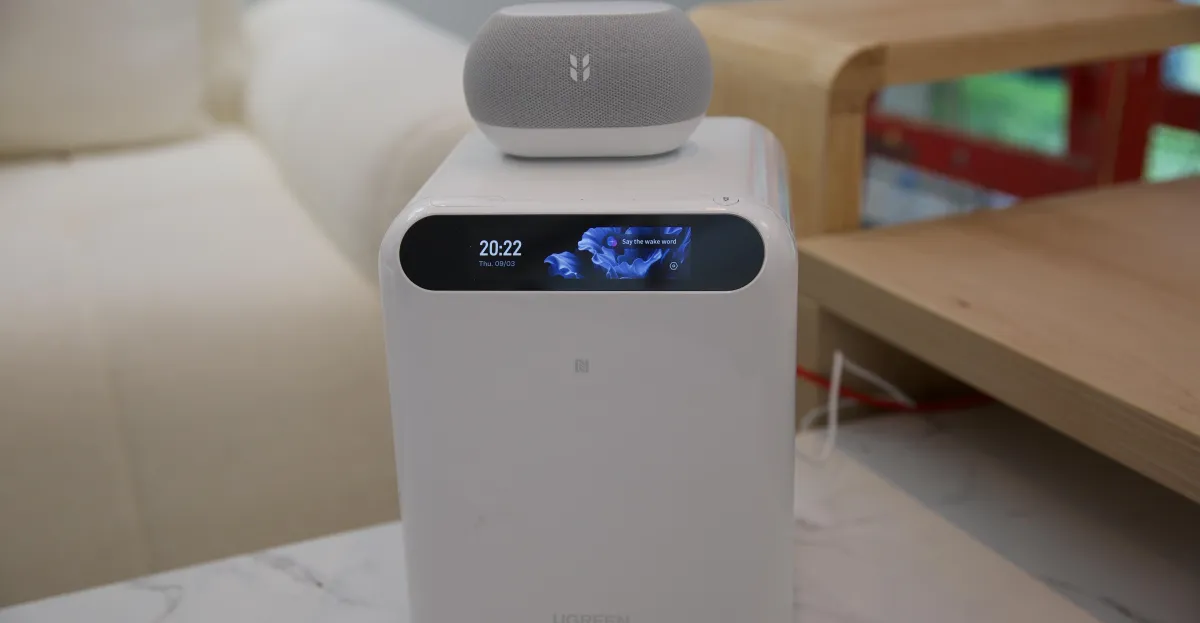
Ugreen has now confirmed that the HomeAgent lineup will also include a smart speaker for its Uliya assistant, plus a new SynCare camera family made up of the ID500 Pro indoor cam, OD600 Pro PoE cam and OD800 Pro battery cam.
The company is also tying the hub to an E Ink Spectra photo frame that can pull pictures stored on HomeAgent without uploading them to the cloud.
Ugreen further clarified the capabilities of each hub: the HA100 is for basic rule-based automation, the HA100 Pro adds more context-aware understanding, and the MasterAgent MA100 uses Nvidia’s Jetson Thor T5000 platform for the most advanced on-device processing.
Update — September 4, 2026 1:23 pm
Ugreen has now put prices on the HomeAgent lineup: the HA100 starts at $899, the HA100 Pro is priced at $2,999, and the MasterAgent MA100 costs $9,999.
The company also says the system will launch on Kickstarter in October, with retail pricing expected to roughly double after the campaign. Alongside the hubs, Ugreen is adding a Uliya smart speaker, new SynCare cameras, and an E Ink photo frame that can pull images from the hub without sending them to the cloud.
Ugreen further clarified that some features still need the internet, including push notifications and remote camera viewing, and that users can optionally route the Uliya voice assistant through the cloud.
Ugreen has unveiled HomeAgent, a new smart home platform that bundles local AI control, network-attached storage and security camera recording into a single home hub. Announced at IFA 2026, the system is designed to keep video, files and voice interactions on the user’s own hardware rather than in the cloud, making privacy and subscription-free operation the central selling points.
The launch marks a notable expansion for a company best known for chargers, power banks and NAS devices. With HomeAgent, Ugreen is pitching a home system that can manage smart devices, store photos and media, and act as a camera recorder and AI assistant all at once. The company says the platform is built to work locally, though some functions still depend on the internet.
What Ugreen announced at IFA 2026
Ugreen used the Berlin tech show to introduce HomeAgent as a local-first smart home ecosystem that combines storage, automation and AI-driven control. The core idea is simple: instead of splitting smart home features across separate cloud services, apps and subscription plans, HomeAgent brings them under one roof on a device you keep at home.
At the center of the system is a hub that serves as the brain of the setup. Ugreen says the hub handles natural-language interactions through a voice assistant named Uliya, processes security camera footage on-device and stores data locally. The company is also presenting HomeAgent as a NAS, so it can keep personal files such as photos, music and movies alongside home automation data.
That combination puts Ugreen in a crowded but increasingly important category: the local smart home hub. The company is betting that more customers are ready to trade cloud convenience for more control over data, fewer recurring fees and better integration across household devices.
Why is local AI becoming such a big smart home trend?
Local AI is becoming a big smart home trend because many buyers want faster responses, fewer subscription costs and less dependence on cloud platforms. Ugreen is leaning into all three of those concerns by making local processing the default for HomeAgent.
Cloud-based camera systems and assistants have long dominated the market, but they come with recurring charges and the uncomfortable reality that private footage and household behavior data may be stored on remote servers. HomeAgent is designed as an alternative to that model. Ugreen says the hub keeps camera footage on-site, processes AI tasks locally and avoids monthly storage fees.
The pitch is especially clear in the smart security market, where some of the biggest names rely heavily on cloud subscriptions. Ugreen is positioning HomeAgent against systems such as Amazon’s Ring and Alexa ecosystem and Google’s Nest cameras and Gemini for Home services, both of which typically depend on online accounts and paid tiers for more advanced features.
Ugreen’s argument is that a home should not have to send all of its video and voice data to a remote server just to get useful automation, alerts and search features.
That promise is likely to resonate with buyers who have grown more skeptical about data collection, as well as with smart home enthusiasts who want a system that remains useful even if cloud services change, fail or become more expensive over time.
How does HomeAgent work?
HomeAgent works by combining storage, AI inference and smart home control in one box. Ugreen says the hub stores data locally, handles camera processing at the edge and lets users interact with the system through voice commands and natural-language requests.
The company demonstrated the platform at IFA by controlling Nanoleaf lighting and smart blinds through Uliya. That hands-on example showed the system’s focus on everyday household automations rather than just security recording or file storage. The broader goal is to make one hub capable of managing devices, alerts, media and automations without requiring users to jump between different apps and services.
According to Ugreen, HomeAgent can provide cross-camera tracking, alerts for people, vehicles, pets and packages, and text descriptions of events. Users can also ask live questions such as where a pet is now, which suggests a move toward context-aware, conversational home management rather than simple command execution.
The platform also supports AI-assisted video search, so owners can look for events in recorded footage using natural language rather than scrubbing through hours of clips manually. That could be one of the system’s most practical features if it performs reliably in real homes with mixed lighting, varied camera angles and constant motion.
What devices does it support?
HomeAgent is built around Matter, the cross-brand smart home standard that aims to make device compatibility easier across manufacturers. Ugreen says the hub also supports Wi-Fi, Zigbee, Thread, Bluetooth, NFC, ONVIF/RTSP and Power over Ethernet, giving it a broad technical foundation for cameras and accessories.
In theory, that makes the platform flexible enough to work with a wide range of existing smart home gear. In practice, Ugreen is taking a more cautious approach during the first rollout. The company says the early compatibility list is still limited and currently includes devices from Aqara, ThirdReality, SwitchBot and Eve.
Ugreen also notes that the first phase of support covers only lights, switches, sensors and curtains. That suggests the company is prioritizing a narrow set of reliable use cases before expanding into more complex device types. It is also advising buyers to stick with approved products for now, even though the Matter standard should, in theory, broaden compatibility over time.
What’s inside the HomeAgent lineup?
Ugreen is launching HomeAgent as a family of hubs rather than a single product. The lineup includes three main versions, each with different levels of processing power and AI capability. The more expensive models are designed to support more advanced local intelligence.
| Product | Role | AI capability | Notable hardware |
|---|---|---|---|
| HomeAgent HA100 | Entry-level hub | Basic rule-based automation and direct voice commands | Local storage and smart home control |
| HomeAgent HA100 Pro | Mid-tier hub | Semantic and context-aware understanding | Expanded local processing for smarter interactions |
| MasterAgent MA100 | Top-tier hub | Most advanced local AI features | NVIDIA Jetson Thor T5000 platform |
The top-end MasterAgent MA100 is the most attention-grabbing model because it uses NVIDIA’s Jetson Thor T5000 platform. That hardware is aimed at higher-performance on-device compute, giving Ugreen a way to market the most advanced version as the model best suited for deeper AI workloads and more ambitious automation.
The lower-end HA100 appears intended for users who mainly want basic local automation and straightforward voice control. The HA100 Pro sits in the middle, adding more nuanced understanding of commands and context. Ugreen has not yet disclosed full retail pricing, which makes it difficult to compare the value proposition against traditional NAS hardware or cloud-based smart home subscriptions.
Who is Uliya, and what can it do?
Uliya is HomeAgent’s built-in voice assistant, and Ugreen is framing it as the main way users will interact with the system. The assistant can take natural-language requests, interpret commands and help manage automations, cameras and connected devices.
Ugreen says Uliya can operate locally, but it is also offering a cloud option for the assistant. That detail matters, because it shows the company is not drawing a hard line against online services. Instead, it is trying to give users a spectrum of privacy and convenience choices.
For some users, local voice control will be the major attraction. For others, the cloud fallback may improve reliability or extend functionality. Either way, Ugreen is trying to make voice control more useful than the basic command-and-response model seen in many older smart home products.
The assistant’s best-case scenario is a system that understands not just commands like turn on the lights, but also contextual requests about household activity, camera alerts and routines. That is the kind of feature set the company appears to be targeting with its higher-end hub models.
How does Ugreen compare with Ring, Nest and other cloud-first systems?
Ugreen is competing by offering local storage and no required monthly video fees, which directly contrasts with the subscription-heavy models used by many cloud-first smart home brands. That difference could be one of HomeAgent’s strongest selling points if the platform proves easy to install and dependable in day-to-day use.
Amazon’s Ring and Alexa ecosystem and Google’s Nest cameras and Gemini for Home services have helped define the modern smart home, but both lean heavily on remote services for intelligence, notifications and storage. By contrast, Ugreen is trying to keep the core experience inside the home.
That does not mean HomeAgent is cloud-free in every sense. Ugreen says push notifications and remote viewing still require internet access, and the voice assistant can also use the cloud if the owner wants. But the central computing and storage model is still fundamentally different from the mainstream approach.
- No mandatory monthly video storage subscription
- Local processing for footage and AI features
- Personal files stored alongside smart home data
- Smart home control combined with NAS-style storage
- Optional cloud support for some features
What else is Ugreen launching alongside HomeAgent?
Ugreen is building an ecosystem around HomeAgent, not just shipping a standalone hub. The company is also introducing a smart speaker designed to run Uliya, along with a new family of security cameras and a digital photo frame that connects to the hub.
New cameras and speaker
The camera lineup includes the SynCare Indoor Cam ID500 Pro, the SynCare POE Cam OD600 Pro and the battery-powered SynCare Cam OD800 Pro. These products extend the HomeAgent concept into a more complete home-security package, letting Ugreen control more of the hardware stack.
The smart speaker is important because it gives Uliya a dedicated voice interface. That could make the system easier to use in rooms where users want a hands-free control point without relying on a separate third-party speaker from Amazon, Google or Apple.
Digital photo frame integration
Ugreen’s E Ink Spectra-based photo frame is a small but telling part of the strategy. It can display photos stored on the HomeAgent hub, keeping those images local rather than uploading them to a cloud photo service. For households that want to preserve privacy while still keeping family images visible, that integration may be especially appealing.
The photo frame also helps illustrate Ugreen’s wider approach: a smart home system is not just about devices and sensors, but about managing the digital life of the household as a whole. That includes media, memories and everyday content storage.
Why does the Matter standard matter here?
Matter matters because it gives HomeAgent a better chance of working across brands in a fragmented smart home market. The standard is meant to make setup simpler and compatibility broader, which is exactly what local hubs need if they want to compete with more mature ecosystems.
Without Matter support, Ugreen would likely face a steeper uphill battle convincing buyers to trust a new platform. With it, the company can argue that the hub is not limited to a narrow proprietary device family, even if the initial compatibility list remains modest.
The presence of multiple wireless standards is equally important. By including support for Zigbee, Thread, Bluetooth and other protocols, HomeAgent is trying to bridge the gap between older devices and newer Matter-certified ones. That gives the platform a realistic shot at becoming a central controller rather than another isolated gadget.
What are the limitations?
HomeAgent’s ambitions are broad, but the system still has practical limits. Ugreen says some features will depend on internet connectivity, including remote camera viewing and push notifications. Users seeking a fully offline setup may need to accept those trade-offs.
There is also the matter of execution. A local smart home hub can sound compelling on paper, but it has to be easy to configure, stable under real-world conditions and compatible with the devices people already own. Ugreen itself acknowledges that adoption will likely depend on how well the system fits into existing homes.
Another open question is performance. The company is promising advanced on-device AI, but the true test will be whether voice recognition, event search and cross-camera tracking remain fast and accurate when the hub is handling multiple devices and large amounts of video data.
Then there is pricing. Ugreen has not announced full retail pricing yet, though it says Kickstarter backers will get early-bird discounts when the campaign starts in October. The upfront cost may be significant, especially if buyers compare HomeAgent to lower-cost cloud camera bundles that spread expense out through subscriptions.
Timeline: how HomeAgent is rolling out
Ugreen’s smart home push is moving in stages, with the first public appearance at IFA and a crowdfunding launch set for later in the fall.
| Stage | Event | What it means |
|---|---|---|
| IFA 2026 | HomeAgent unveiled | Public debut of the local AI smart home platform |
| October 2026 | Kickstarter launch planned | Early-bird pricing and first buyer sign-ups |
| Post-launch | Device compatibility expands | Broader support for approved smart home hardware |
How big is the opportunity for Ugreen?
The opportunity is sizable because the smart home market is still split between convenience and control. Many consumers like cloud ecosystems for their simplicity, but they dislike fees, privacy concerns and vendor lock-in. Ugreen is trying to solve all three at once.
That is a strong strategic opening for a company with strong roots in storage hardware. Ugreen already understands the value proposition of keeping files local, and HomeAgent extends that logic to cameras, voice interaction and home automation.
If the product delivers on its promises, it could appeal to two overlapping audiences: privacy-minded mainstream buyers who want fewer subscriptions, and advanced users who want a more capable local hub than the basic automation controllers currently on the market.
Still, the smart home market punishes complexity. A system that demands too much setup, too much hardware coordination or too much troubleshooting can quickly lose users. HomeAgent will need to prove that local-first does not mean difficult-first.
What happens next?
The next major milestone is the Kickstarter campaign in October, where pricing and package details should become clearer. That launch will help show whether there is genuine consumer demand for a premium local AI hub that also acts as a NAS and camera recorder.
Beyond the crowdfunding phase, the real test will be ecosystem growth. Ugreen needs to expand compatibility, refine Uliya, and make sure the hardware feels polished enough for mainstream homes rather than just enthusiasts.
If it succeeds, HomeAgent could become an early example of how smart homes evolve in the next phase of the market: less cloud-dependent, more private and more centered on local compute. If it falls short, it will still have highlighted a direction the industry is already moving toward.
For now, Ugreen has made a clear statement of intent. The company wants to transform the home hub from a passive storage box into an active domestic AI system — one that can watch, listen, search and automate without forcing users to hand over their household data.
Frequently asked questions
What is Ugreen HomeAgent?
Ugreen HomeAgent is a local-first smart home platform that combines NAS storage, security camera recording and AI-powered home control in one hub. It is designed to keep video, personal files and automations on-device instead of relying primarily on cloud services.
Does HomeAgent require a monthly subscription?
No, HomeAgent is being marketed as a subscription-free alternative for local storage and video processing. Ugreen says the system stores footage on the hub itself, although some internet-dependent functions such as remote viewing and push notifications still exist.
What is Uliya in Ugreen HomeAgent?
Uliya is the voice assistant built into HomeAgent. It lets users control smart home devices and automations with natural language, and Ugreen says it can run locally, with an optional cloud mode available for users who want it.
Which devices work with HomeAgent?
HomeAgent is built around Matter and supports Wi-Fi, Zigbee, Thread, Bluetooth, NFC, ONVIF/RTSP and PoE, but Ugreen says the initial compatibility list is still limited. Early supported brands include Aqara, ThirdReality, SwitchBot and Eve.