Updated July 9, 2026 11:20 pm
In short
Google is adding automatic AI-made ad labels across Search, Discover and YouTube, while non-Google AI ads still require manual disclosure and some regions may show the label directly on the ad.
- Google will automatically label ads made with its own generative AI tools.
- The disclosure will appear in My Ad Center and sometimes directly on the ad.
- Ads made with third-party AI tools will generally need manual disclosure.
- The move follows Google’s earlier political-ad and content-provenance transparency efforts.
Update — July 9, 2026 11:20 pm
Google says the new AI disclosure will also apply to ads made with its generative tools in Search, Discover and YouTube through My Ad Center, where users can open the three-dot or info menu to see the label and other ad controls.
In some markets, the notice may show directly on the ad itself. Google also says ads created with outside AI tools will still need a manual label.
The company’s broader provenance push includes earlier labels for politically altered content, plus wider support this year for SynthID and C2PA-based content markers.
Google is rolling out a new disclosure system that will automatically label ads made with its own generative AI tools, giving users a clearer way to see when artificial intelligence helped produce what they are viewing. The labels will appear in Google Search, Google Discover and YouTube, and matter because they add a new layer of transparency to digital advertising at a time when synthetic content is becoming harder to spot.
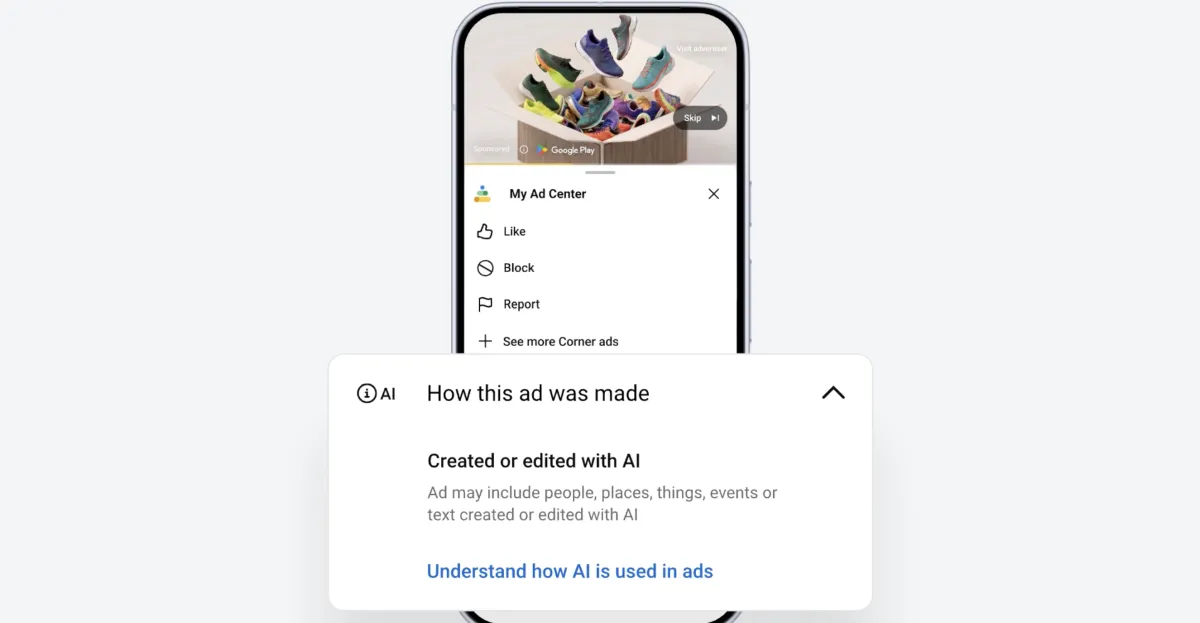
The update expands Google’s existing ad controls by adding a “created or edited with AI” notice inside the “how this ad was made” section of My Ad Center. In some cases, the label may also appear directly on the ad itself, depending on region and whether the advertiser has disclosed the AI use.
What Google is changing
Google’s new policy is aimed at making AI involvement in advertising easier to identify without forcing users to hunt through platform settings. The company says the label will be applied automatically when advertisers use its own generative AI advertising products, while ads made with other tools will require manual disclosure.
The disclosure sits within the same ad information panel users already see when they tap the three-dot menu or information icon on an ad. That panel also includes common controls such as reporting, blocking or learning why a particular ad was shown.
Where the labels will appear
The company says the disclosure will be visible across several of its most widely used products. That includes search results ads, recommendation feeds in Discover and video advertising on YouTube.
- Google Search: ads can display the AI notice in the ad details panel and, in some regions, on the ad itself.
- Google Discover: sponsored content can include the new AI disclosure in the ad information area.
- YouTube: viewers may see the label when they inspect the ad’s details.
How the AI label works
The label is designed to distinguish between ads that were generated, enhanced or otherwise modified by artificial intelligence and those that were produced through conventional creative tools. Google is drawing a line between ads built with its own generative products and ads that were created outside its ecosystem.
That distinction matters because it means the label will not be universal by default. If an advertiser uses a competing AI image or copy tool, Google says the disclosure will generally need to be added manually. In practice, the system relies partly on advertiser honesty and partly on Google’s own product integration.
Google says the new disclosure is meant to make it easier for people to understand when AI was involved in an ad, while preserving the familiar controls already available in My Ad Center.
Why automatic labeling matters
Automatic labeling reduces the chance that advertisers using Google’s AI tools will omit disclosure, whether intentionally or accidentally. It also signals that Google wants to normalize AI transparency before regulators or watchdogs push harder for stricter rules.
For users, the practical benefit is straightforward: the information is embedded in a place they already visit when trying to learn more about an ad. That lowers friction compared with a separate disclosure policy page or buried legal language.
Why Google is doing this now
Google’s update arrives as the broader advertising industry faces growing pressure to label synthetic media more clearly. AI-generated images, voice, video and copy are becoming common in marketing workflows, raising questions about authenticity, deception and consumer trust.
The timing also reflects a wider shift in platform policy. Tech companies are increasingly acknowledging that AI use in content production cannot remain invisible if they want users and regulators to trust the system. Clearer labeling may also help platforms avoid confusion when ads blur the line between real footage and machine-generated material.
Pressure from the AI content debate
As generative AI tools become cheaper and easier to use, advertisers can produce more variants of an ad faster than ever before. That efficiency is attractive for brands, but it also raises a basic question: should viewers be told when an ad image, slogan or video has been substantially created by software?
Google’s answer is to make the disclosure more visible, at least for ads made through its own tools. The move follows a broader industry effort to establish content provenance and user-facing labels before synthetic media becomes too ordinary to notice.
How does Google compare with Meta and other platforms?
Google is not alone in offering AI-related ad disclosures. Meta already shows an “AI info” indicator inside its “About this ad” panel, creating a similar experience for users on Facebook and Instagram. The common theme is that platform owners are using ad-information menus as the place to explain how content was produced.
What differs is the scope and the mechanics. Google’s system is tied closely to its own generative ad tools, which means automatic labeling is available when the creation process stays inside Google’s ecosystem. Other platforms may approach disclosure differently, but the overall direction is the same: more visibility, more notice, and less ambiguity.
| Platform | AI disclosure style | Where users see it | Automatic or manual? |
|---|---|---|---|
| “Created or edited with AI” | My Ad Center / ad info panel; sometimes on the ad itself | Automatic for Google’s own AI ad tools; manual for many others | |
| Meta | “AI info” | “About this ad” panel | Platform disclosure system |
| Google political ads | Synthetic or digitally altered content disclosure | Political ad disclosures | Mandatory disclosure framework |
What this means for advertisers
Advertisers using Google’s generative tools now have a clearer compliance path, but also a more visible record of AI involvement. That may be welcome for brands that want to be transparent, yet it could also discourage some marketers who worry that AI labels might affect how consumers perceive authenticity.
For agencies and in-house teams, the practical takeaway is that disclosure will need to become part of the campaign workflow. Creative approval, media planning and legal review may now need to include a question that was easy to ignore before: did any AI system materially help make this ad?
Likely operational changes
- Ad teams may need to track which assets were generated or edited by AI.
- Compliance teams may want to document disclosure requirements by region.
- Brands using third-party AI tools may need to ensure manual labeling is not missed.
- Creative teams may adjust how much AI is used if they want to avoid prominent labels.
How does this fit into Google’s broader AI transparency push?
Google has already been building a wider framework around content provenance and synthetic media detection. Earlier this year, the company expanded support for SynthID and C2PA content labels, both of which are intended to help identify digitally altered or AI-generated material.
Those tools are not the same as an ad label, but they point in the same direction. Together, they suggest Google is trying to establish a layered approach: watermarking and provenance tools on one side, and user-facing ad disclosures on the other.
The company has also previously introduced disclosures for political advertisements containing synthetic or digitally altered content, an area where deception risks are especially high. The latest update extends that philosophy into broader commercial advertising.
Why provenance tools matter
Watermarks and content labels can help platforms and outside researchers trace how an image or video was made, even when that information is not obvious to the naked eye. For advertisers and publishers, that can become part of an emerging standard for content accountability.
But provenance tools are only useful if they are widely adopted and if users can actually see the result. Google’s ad labeling feature is a more direct consumer-facing step, turning invisible technical metadata into plain-language disclosure.
What users will actually see
In most cases, the average user will not see a giant warning banner. Instead, the disclosure appears in the familiar ad details flow already used for platform transparency. A user taps the three-dot menu or info button, opens the “how this ad was made” section and sees whether AI played a role.
In some regions, the label may be more prominent and appear directly on the ad. Google says this can happen either automatically or when an advertiser voluntarily discloses AI use. That regional variation suggests the company is still testing how much visibility is practical, acceptable and legally aligned in different markets.
Why this matters for trust in online advertising
Trust is becoming one of the central issues in digital ads. Consumers already face spam, impersonation, deceptive editing and increasingly sophisticated synthetic content. AI disclosure will not solve those problems on its own, but it creates a baseline expectation that ads should not hide how they were produced.
That is especially important for video and image-heavy campaigns, where AI can generate convincing scenes, product demos or spokesperson-style visuals that may be difficult for viewers to interpret. Clear labeling gives people a chance to decide whether the use of AI matters to them.
The broader implication is that advertising may be moving toward a future where artificial intelligence is not a hidden production tool but a disclosed part of the creative process. If that trend continues, disclosure could become as routine as a sponsored-content tag or privacy notice.
Timeline of Google’s AI disclosure efforts
Google has gradually expanded its transparency efforts over the past two years, moving from political ad disclosures to wider AI content labeling. The latest update is part of that progression rather than an isolated policy tweak.
| Year | Policy move | What it covered |
|---|---|---|
| 2024 | Political ad disclosure for synthetic or digitally altered content | Election-related ads and manipulated media |
| Earlier in 2026 | Expanded access to SynthID and C2PA labels | Content provenance and detection of altered media |
| July 2026 | Automatic “created or edited with AI” label for ads made with Google’s own generative tools | Search, Discover and YouTube ads |
What happens next?
Google’s move is likely to encourage closer scrutiny of how all major ad platforms handle AI transparency. Once one company makes labeling easier to spot, rivals face more pressure to follow or improve on the standard.
At the same time, the update highlights the limits of platform-led disclosure. If AI-generated advertising is made elsewhere and not flagged properly, the burden still falls on advertisers, not the system itself. That leaves room for inconsistency, especially across borders and across different creative tools.
Still, the new policy marks a meaningful shift. It acknowledges that AI is no longer a niche experiment in marketing; it is part of mainstream ad production, and users deserve to know when they are seeing it.
For Google, the choice is both practical and strategic. It reduces ambiguity, aligns with the company’s broader content-authenticity efforts and helps position its ad products as more transparent than the alternatives. For users, it means the next time an ad looks unusually polished, strangely perfect or a little too synthetic, there may finally be a clear way to check.
Frequently asked questions
What is Google’s new AI ad label?
Google’s new AI ad label is a disclosure that says an ad was “created or edited with AI.” It appears in the ad details panel inside My Ad Center and, in some regions, may also show directly on the ad itself.
Which Google ads will get the label automatically?
Google says ads made with its own generative AI advertising tools will get the label automatically. Ads created with outside AI tools will usually need manual disclosure from the advertiser instead of automatic labeling by Google.
Where can users see whether an ad used AI?
Users can check the disclosure in Google’s My Ad Center by opening an ad’s three-dot menu or info button and looking under “how this ad was made.” The label can also appear on ads in Search, Discover and YouTube.
Why is Google adding AI labels to ads now?
Google is adding AI labels now because synthetic media is becoming more common in advertising and users need clearer transparency. The move also fits a broader industry push to make AI-generated content easier to identify and more trustworthy.
How does Google’s approach compare with Meta’s?
Google’s approach is similar to Meta’s “AI info” disclosure, which appears in the “About this ad” panel on Meta platforms. Both companies are using familiar ad-information menus to explain when AI may have played a role in creating an ad.