In short
Amazon is updating Alexa Plus to handle more complex smart-home requests and connect to a wider range of devices and services. The company is also using open standards and its developer toolkit to bring more brands into the assistant’s ecosystem.
- Alexa Plus can now connect to more smart-home devices and route requests automatically.
- Amazon is using the Model Context Protocol to make integrations easier for partners.
- More brands and services, including travel and payments partners, are coming later this year.
- The update pushes Alexa Plus closer to an AI agent that can act, not just respond.
Amazon is expanding Alexa Plus so the assistant can interpret more complex requests and control a broader set of connected devices, including products from Bosch, Delta, Ecovacs, iRobot, Yale Home, Whirlpool, Tapo and Eufy. The update matters because it turns Alexa Plus from a limited voice helper into a more capable smart-home command layer that can understand intent, route tasks to the right appliance and handle more multi-step instructions.
The company says the new capabilities are being powered by its AI developer toolkit and a growing push to adopt the Model Context Protocol, an open standard designed to help AI systems connect with external tools and services. Amazon also says more brand integrations are on the way later this year, along with new shopping and payment flows for some partners.
For Amazon, the move is part of a broader effort to make Alexa Plus useful in more households and on more devices after its wider rollout earlier this year. For device makers, it creates another channel to bring their hardware into Amazon’s AI ecosystem without having to build a completely custom integration from scratch.
What Amazon is changing in Alexa Plus
Amazon’s latest Alexa Plus update is focused on depth, not just breadth. Instead of simply adding more supported brands, the company is trying to improve how the assistant interprets the request itself and then finds the correct product or function to execute it.
That means Alexa Plus is being trained to do more than trigger a single pre-set command. In Amazon’s example, a user can describe a laundry problem in natural language, and the assistant can infer the right washer setting rather than requiring the person to manually navigate cycle menus.
The change is significant for a product category where voice assistants have historically struggled with nuance. A request such as “make this load safe for a cold wash” requires understanding the appliance’s available options, matching those options to the user’s intent, and then completing the task without forcing the user into a step-by-step script.
How the new smart-home routing works
Amazon says Alexa Plus can now connect to a wider range of smart-home devices and automatically send each request to the correct hardware or service. That routing layer is important because many households now mix appliances, security devices, cleaning robots and home accessories from different companies.
Rather than making users remember which brand owns which action, the assistant is meant to handle the translation. In practice, that could mean identifying whether a request belongs to a washer, a robot vacuum, a smart lock or another connected product and then executing the right function.
The company is also leaning on its new AI developer toolkit, which is intended to make it easier for hardware makers to expose distinctive features to Alexa Plus. Amazon says the toolkit is especially useful for products with capabilities that older integrations could not support.
Why this update matters for the smart-home market
This update is Amazon’s clearest attempt yet to make Alexa Plus more than a general-purpose assistant. The smart-home market has long been fragmented, with many devices offering separate apps, limited interoperability and inconsistent voice support. Amazon is trying to smooth over that fragmentation by putting Alexa Plus in the role of a universal interpreter.
That approach could make Alexa Plus more valuable in busy homes where users want to speak naturally instead of hunting through app menus. It also gives Amazon a better chance of keeping Alexa relevant at a time when consumers increasingly expect AI assistants to understand context, not just commands.
There is a competitive angle as well. The more devices Alexa Plus can support, the harder it becomes for competing ecosystems to lock users into a single brand or app. If Amazon can make the assistant work reliably across washers, locks, vacuums, thermostats and delivery services, it strengthens Alexa’s position as the default layer on top of the connected home.
How is Amazon connecting Alexa Plus to more services?
Amazon is connecting Alexa Plus to more services by using the Model Context Protocol, or MCP, an open-source standard that helps AI systems talk to external tools. In theory, that lowers the technical barrier for companies that want their services to work inside Alexa Plus.
MCP has become increasingly important in the AI industry because it offers a common language for linking models to outside systems. Instead of every integration requiring a one-off technical bridge, developers can use a shared framework that makes it easier for assistants to understand the available actions and data structures.
Amazon says this strategy will allow more brands to join the ecosystem later in the year, including Canva, Headspace, Priceline, Lyft, Cengage, Virgin Atlantic and Weekend. The company is effectively turning Alexa Plus into a hub where services can be discovered, booked or purchased through conversational prompts.
Amazon says the new toolkit is designed to help device makers connect products with “unique capabilities” that older Alexa integrations could not support.
What brands are joining the Alexa Plus expansion?
A growing list of hardware and service brands are either newly supported or expected to launch integrations later this year. The range suggests Amazon is targeting the full spectrum of daily routines: laundry, cleaning, home security, travel, entertainment, education and gig services.
Some of the companies mentioned in Amazon’s update are already tied to the smart home, while others are part of commerce and booking flows. Together, they reveal the company’s ambition to make Alexa Plus a utility layer for both home control and transaction handling.
| Category | Examples announced or referenced | What Alexa Plus can do |
|---|---|---|
| Smart home hardware | Bosch, Delta, Ecovacs, iRobot, Yale Home, Whirlpool, Tapo, Eufy | Route voice requests to the right device and execute specific actions |
| Consumer services | Ticketmaster, OpenTable, Uber, Thumbtack, Expedia, Yelp, Square, Angi | Handle limited third-party tasks already available in Alexa Plus |
| Upcoming integrations | Canva, Headspace, Priceline, Lyft, Cengage, Virgin Atlantic, Weekend | Expand Alexa Plus into creative, wellness, travel and education use cases |
| Payments partners | Priceline, Atom Tickets, Cengage, Fandango, Taskrabbit | Support purchases through Amazon Wallet |
What can Alexa Plus already do today?
Alexa Plus was broadly launched in February after Amazon reworked the assistant around more advanced AI capabilities. The current version can manage multi-step requests and help users build routines through voice commands, which marks a step up from the older Alexa experience.
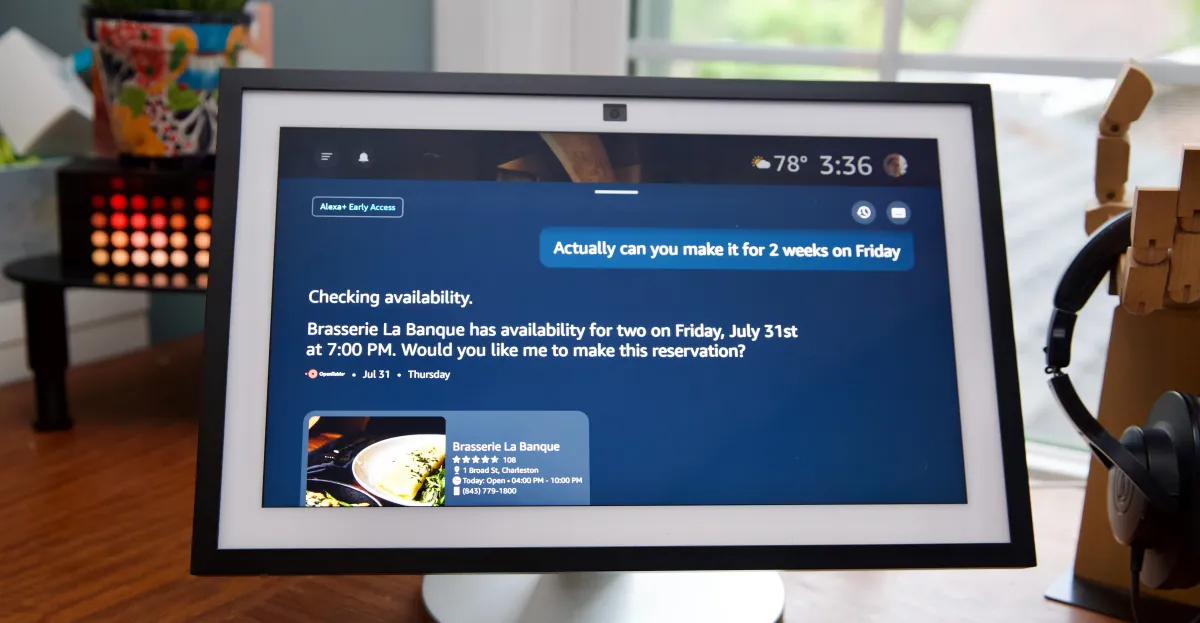
Even so, the assistant’s practical reach has remained limited in parts of the third-party ecosystem. Amazon had initially connected it to a relatively small set of services, including Ticketmaster, OpenTable, Uber, Thumbtack, Expedia, Yelp, Square and Angi.
The latest update suggests Amazon is now trying to close that gap by widening both the number of integrations and the sophistication of what those integrations can do. That shift could determine whether Alexa Plus becomes a daily-use assistant or remains a promising but narrowly deployed feature.
What changes for shopping and payments?
Amazon is also moving Alexa Plus further into commerce. Priceline will let users browse hotels and book trips inside the assistant, while several partners are preparing to support payments through Amazon Wallet.
The companies expected to enable Amazon Wallet payments include Priceline, Atom Tickets, Cengage, Fandango and Taskrabbit. That combination hints at a broader strategy: once Alexa Plus can understand what the user wants, it may also be able to complete the transaction without leaving the conversation.
For Amazon, this is important because it ties the assistant to higher-value actions than simple reminders or device toggles. Bookings, subscriptions and purchases create stronger commercial reasons for businesses to integrate, and they could make Alexa Plus more central to the company’s ecosystem.
Why Amazon is betting on MCP
Amazon’s embrace of MCP reflects a larger shift in the AI industry toward interoperable assistants. As AI products become more capable, their usefulness increasingly depends on access to outside data and services, not just on the model itself.
By using an open standard, Amazon is signaling that it wants Alexa Plus to be extensible in the same way modern software platforms are extensible. The more open the integration path is, the easier it becomes for device makers and service providers to participate.
That may also help Amazon avoid some of the bottlenecks that have slowed voice assistant expansion in the past. Historically, every new smart-home capability often required custom engineering, uneven support or a long certification process. A common protocol could reduce that friction.
What this means for users
For consumers, the immediate benefit is convenience. A user may no longer need to know which app controls a washer’s settings, which robot vacuum mode works best for a particular room, or which booking service is connected to the assistant. Alexa Plus is being positioned as the layer that figures those things out.
The broader implication is that Amazon wants voice interaction to feel less like issuing commands and more like delegating tasks. If the assistant can understand messy human language and map it onto the right device or service, it becomes genuinely useful in everyday situations.
That could be especially appealing in households with multiple people, different routines and several brands of connected hardware. A more capable assistant can reduce friction where smart homes often become complicated.
Potential limitations remain
Even with the update, Alexa Plus will still depend on the quality of each integration and the reliability of the underlying devices. If a washer, lock or travel service does not expose the right controls cleanly, the assistant’s ability to act intelligently will be limited.
There is also the question of trust. Consumers are increasingly willing to let AI agents act on their behalf, but only if they believe the system will choose correctly and avoid unintended actions. For Amazon, the challenge is not just technical reach but dependable execution.
Another issue is that AI-driven assistants can sometimes infer too much or too little from a user’s request. The more tasks Alexa Plus can handle, the more important it becomes for the system to ask clarifying questions when needed and avoid making assumptions that could lead to errors.
Timeline of Alexa Plus’s expansion
The company’s strategy has unfolded in stages, with a broader rollout earlier this year followed by a more aggressive expansion of supported services and devices. The current update appears designed to deepen that ecosystem rather than restart it.
| Period | Milestone | Why it matters |
|---|---|---|
| February 2026 | Amazon widely launches Alexa Plus | Introduces the revamped AI assistant to a broader audience |
| Earlier rollout phase | Supports a limited number of third-party services | Shows early boundaries of the assistant’s ecosystem |
| July 2026 update | Adds broader smart-home integrations and better routing | Makes Alexa Plus more useful across many device types |
| Later this year | More brands and payment-enabled partners expected | Expands the assistant into commerce and bookings |
Who benefits most from the update?
Device makers, service platforms and regular Alexa users all stand to benefit, but not equally. Hardware companies gain a lower-friction way to surface their product features inside Amazon’s AI assistant. Service providers gain access to a large installed base of users already accustomed to speaking to Alexa. Consumers gain a more practical assistant that can do more than switch on a light or set a timer.
The most important beneficiary may be Amazon itself. By making Alexa Plus more capable, the company improves the odds that its assistant remains relevant in the fast-moving AI market, where voice interfaces are being reimagined around agents, context and external tool access.
That does not guarantee success. But it does show Amazon is treating Alexa Plus as a serious AI platform rather than a legacy smart-speaker feature.
What comes next for Alexa Plus?
The next phase will likely be measured by adoption and reliability. If the new integrations work smoothly, Amazon can point to real-world usefulness and encourage more brands to connect. If they are clunky or inconsistent, the rollout may struggle to move beyond marketing claims.
Still, the direction is clear. Amazon is pushing Alexa Plus toward a more agent-like role, one that can understand a household’s needs, identify the right service or device and act on behalf of the user. That is a much more ambitious vision than the original Alexa ever attempted.
For now, the update signals that Amazon sees the smart home not as a collection of isolated gadgets, but as a connected environment in which AI can coordinate everyday tasks. If the company gets the execution right, Alexa Plus could become one of the most practical examples yet of consumer AI moving from chat to action.
Frequently asked questions
What is new in the Alexa Plus update?
The Alexa Plus update adds broader smart-home support, better request routing and new integrations with brands like Bosch, Delta, Ecovacs, iRobot, Yale Home, Whirlpool, Tapo and Eufy. It is designed to help the assistant understand more complex instructions and act on them more accurately.
How does Alexa Plus work with more devices now?
Alexa Plus works with more devices by using Amazon’s AI developer toolkit and the Model Context Protocol, which helps AI systems connect to external tools. That allows device makers to expose unique features and lets the assistant route requests to the correct appliance or service.
Which services are coming to Alexa Plus next?
Amazon says integrations from Canva, Headspace, Priceline, Lyft, Cengage, Virgin Atlantic and Weekend are expected later this year. Some partners, including Priceline and several ticketing and service platforms, will also support payments through Amazon Wallet.
Can Alexa Plus already book trips or handle purchases?
Yes, but only with supported partners. Amazon says Priceline will let users browse hotels and book travel through Alexa Plus, and some companies will support Amazon Wallet payments, which lets the assistant move from answering questions to completing transactions.