In short
OKA has launched Mori, a $649 AI robot lamp designed to react emotionally to people and surroundings without acting as a general assistant. The product is a market test for whether consumers will pay premium prices for calm, limited-function AI hardware.
- OKA’s Mori is a $649 mushroom-shaped robot lamp, not a smart assistant.
- The device reacts to movement, music and TV, and can dance, follow users and play nature soundscapes.
- Founder’s Edition sales begin with only a few hundred units available.
- OKA says Mori uses local AI models and processes raw audio and images locally before discarding them.
- The launch tests demand for premium AI hardware built around mood and companionship rather than utility.
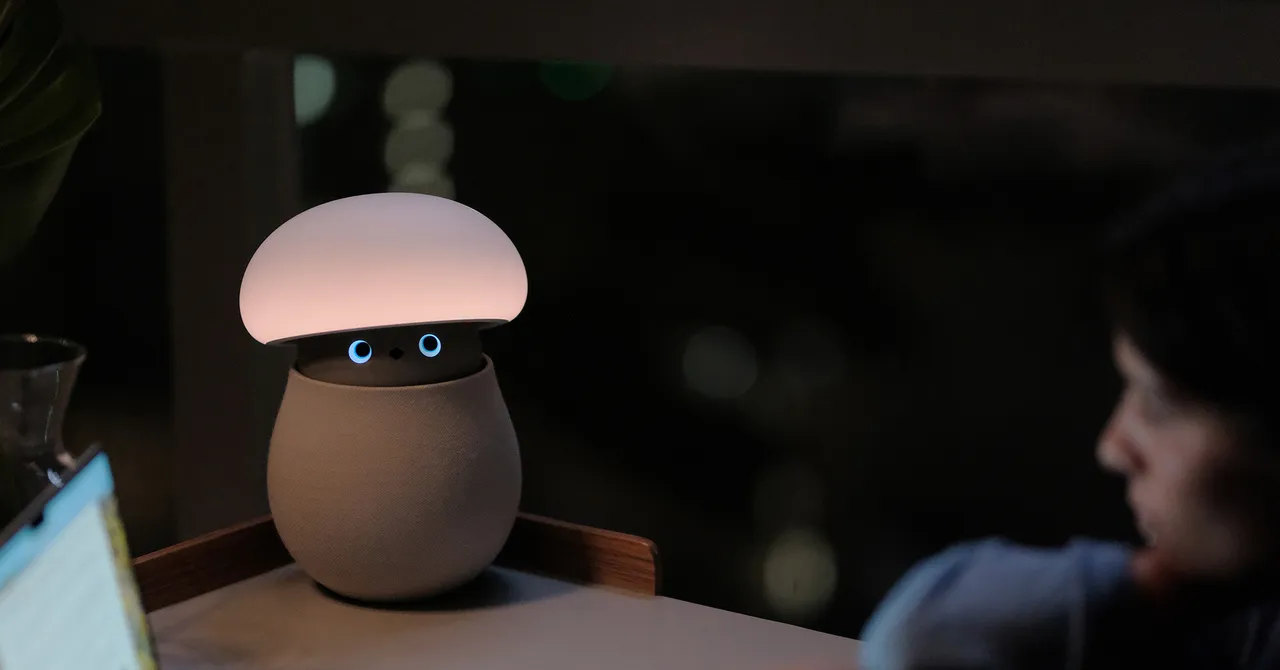
OKA has launched Mori, a $649 mushroom-shaped home robot lamp that reacts to people and surroundings but is deliberately not built as a general-purpose assistant. The debut, covered by WIRED, positions Mori as an experiment in “calm” AI hardware: a pricey device meant to create atmosphere, not answer weather queries or run a home.
The move matters because it tests whether consumers will pay hundreds of dollars for a limited-function robot that behaves more like an emotional companion than a utility device. In a market crowded with voice assistants and task-driven gadgets, OKA is asking a narrower question: can AI hardware win by being gentle, present and quietly expressive?
What OKA launched
WIRED reported that Mori is OKA’s first experimental “Artifact,” a nearly 12-inch-tall robot lamp designed for the home. It has a camera, microphones, eyes and animated reactions, and it is built to respond to movement, music and television rather than to serve as a catch-all assistant.
According to the company’s pitch, Mori is meant to reconnect users with nature and create calming experiences at home. That idea shows up in the product’s behavior: it can dance, follow users around, play nature soundscapes and guide breathing exercises.
But OKA has also drawn a firm line around what Mori is not. The device does not function as a smart assistant, and it does not offer voice control for lights, music or weather. That makes it a sharp contrast with the category most consumers already know from products like Amazon Echo, where utility and voice control are the central selling points.
How Mori works
WIRED says OKA uses local models for context awareness and describes the system as “Attentive Intelligence.” The company’s goal, as described by CEO Hua Wang, is to make the device feel responsive without turning it into a phone replacement or a house manager.
“Mori gives your attention back to you.”
That sentence captures the product’s unusual value proposition. Instead of asking for constant commands, Mori is supposed to notice the room, react in ways that feel alive and shape the mood of the space.
There is also a privacy angle, though it will likely be a central point of debate for any product that sits in the home with a camera and microphones. WIRED reports that Mori stores facial-feature data on-device, while raw audio and images are processed locally and then discarded. The camera retracts when lamp mode closes, and the microphone can be turned off by double-tapping the top.
Wang also told WIRED that Wi-Fi is used only for firmware updates. That design choice suggests OKA wants to reassure buyers that the device is not built around continuous cloud dependence, even as it remains connected enough to receive updates over time.
Why it matters
Mori is more than a new gadget. It is a market test for a broader idea in consumer tech: that AI hardware may not need to be maximally useful to be desirable. If a robot can become a source of calm, companionship or gentle presence, OKA is betting that some buyers will accept both the price and the trade-offs.
That matters for several reasons. First, it challenges the assumption that every successful home AI device must behave like a smart speaker. Second, it expands the conversation around on-device AI, where context-aware features are increasingly possible without sending everything to a remote server. Third, it raises a practical question for buyers: how much do they value atmosphere over function?
There is also a regional and industry dimension. Consumer robotics has long struggled to find products that people will keep in their homes for reasons beyond novelty. By positioning Mori as an “Artifact” rather than a mass-market assistant, OKA is trying to create a category where emotional design matters as much as technical capability.
Why a limited-function device can still attract attention
The broader consumer-tech market is full of machines that promise efficiency. Mori goes in the other direction. It offers motion, reaction and mood-setting behaviors, but it leaves out the features many buyers might expect from an AI product.
That tension may be the point. If OKA can sell a lamp that is intentionally not trying to do everything, it would suggest that some customers want AI to feel less intrusive and more human-scale. If it cannot, the launch may show that “calm” hardware is still too niche for mainstream adoption.
Background: how we got here
Home robots and smart speakers have spent years competing on utility, voice control and assistant features. The category has rewarded devices that can answer questions, play music on command or automate household tasks. Mori is a different attempt: it is aimed less at efficiency and more at relationship.
That shift reflects a broader turn in AI-enabled consumer devices. Increasingly, makers are using cameras, microphones and on-device processing to create systems that can interpret context rather than simply respond to fixed commands. OKA is pushing that idea into a more emotional register.
The history of consumer robots also helps explain why Mori is notable. Sony’s Aibo remains a well-known early example of a consumer robot pet, showing that people will bond with machines that appear expressive and alive. Mori takes a similar instinct and moves it into a lamp form factor, combining ambient lighting with animated behavior.
WIRED’s reporting also places Mori in the context of a wider hardware strategy at OKA. The company plans to make up to five experimental Artifacts over its lifetime, suggesting that Mori is not meant to be a one-off stunt but the first step in a small, carefully staged product line.
What is inside the launch offer?
OKA is opening sales with a Founder’s Edition priced at $649. WIRED says initial stock is limited to a few hundred units, which gives the launch a scarcity-driven feel that is common in experimental hardware but unusual for a consumer lamp.
The Founder’s Edition includes a two-year warranty and two years of subscription service. By contrast, the standard edition is listed at $799 and excludes subscription features.
That pricing structure makes the launch especially interesting because it combines a premium upfront cost with an ongoing service model. Buyers will not just be purchasing a lamp; they will be entering a relationship with a device whose full feature set depends partly on subscription access.
There is a notable split in what is free and what is paid. OKA says breathing exercises remain free, while nature soundscapes require a subscription. That arrangement suggests the company sees ongoing content and software as part of the product’s long-term value, rather than treating the lamp as a one-time hardware sale.
| Feature | Founder’s Edition | Standard Edition |
|---|---|---|
| Price | $649 | $799 |
| Initial availability | A few hundred units | Not specified in the fact sheet |
| Warranty | 2 years | Not specified in the fact sheet |
| Subscription service | 2 years included | Excluded |
| Breathing exercises | Free | Free |
| Nature soundscapes | Require subscription | Require subscription |
How does Mori handle privacy?
Mori’s privacy setup is part of the product story, not a side note. WIRED reports that facial-feature data is stored on-device, while raw audio and images are processed locally and then discarded. The camera retracts when lamp mode closes, and the microphone can be switched off with a double tap on the top.
Those details may reassure buyers who are uneasy about keeping an always-aware device in a living room or bedroom. Still, the presence of a camera and microphones will likely remain one of the most closely watched aspects of the product, especially because Mori is intended to move with and around its user.
OKA’s local-first approach also places the company within a wider shift in AI device design. As more products rely on contextual awareness, companies are being pushed to explain where data lives, how it is processed and when it is deleted. Mori’s launch is therefore as much about trust as it is about design.
Who is behind OKA?
Hua Wang, OKA’s CEO, is the public face of the launch. Wang’s comments to WIRED frame Mori as a device that changes the relationship between users and their environment rather than one that replaces everyday tools.
The company’s stated mission is unusually specific. Wang said, “We want to fix between humans and our surroundings,” language that suggests OKA sees a mismatch between modern digital life and the physical spaces people inhabit.
That framing helps explain the product’s odd but deliberate design choices. A mushroom-shaped lamp that dances, notices movement and plays nature sounds may sound whimsical, but those behaviors all serve the same goal: to make the room feel more alive without demanding constant interaction.
What the market test really is
OKA is not just selling a lamp. It is testing whether the market will support a premium, emotionally framed AI device that does not chase the usual feature checklist.
That makes Mori a useful case study in a few overlapping trends:
- Consumers are becoming more familiar with AI hardware that uses cameras and microphones to interpret context.
- Buyers are also becoming more cautious about what connected devices see, hear and store.
- Hardware companies are increasingly leaning on subscriptions to extend the life and value of products.
- There is a growing appetite for technology that feels less demanding and more ambient.
Those trends do not guarantee success. They do, however, explain why OKA’s launch is drawing attention beyond the novelty of a lamp with eyes.
What happens next
The immediate question is simple: will buyers actually pay $649 for a limited-run robot lamp that is intentionally less useful than a smart speaker?
Beyond that, several open questions will shape the story after launch:
- Whether the Founder’s Edition sells through quickly once the few hundred units are gone.
- How the subscription model performs after the initial two-year package.
- Whether OKA later adds voice commands, Spotify integration or wearable-data hooks.
- How customers respond to a camera-equipped product in private domestic spaces.
WIRED’s timeline notes that the Founder’s Edition sales begin today, with limited stock available. The broader arc will likely depend on whether Mori becomes a beloved niche object or a curiosity that illustrates the limits of “calm” AI hardware.
OKA has said it plans up to five experimental Artifacts over the company’s lifetime. If Mori finds an audience, it could become the template for a small but distinctive product family. If it does not, it may still stand as an early signal of how far AI hardware can move away from utility and toward mood.
Timeline
| Date | Event |
|---|---|
| Today | Founder’s Edition sales begin, with limited stock available |
| 2026-10-22 | WIRED published its profile of Mori and OKA’s launch |
Bottom line
OKA’s Mori is a deliberate challenge to the standard AI gadget formula. It is expensive, expressive and technically selective about what it does, which makes it one of the clearest recent tests of whether consumers want AI that comforts rather than commands.
Frequently asked questions
What is Mori by OKA?
Mori is a nearly 12-inch-tall home robot lamp from OKA that reacts to people and its surroundings. WIRED reports that it has a camera, microphones, eyes and animated reactions, but it is intentionally not designed as a general-purpose smart assistant.
How much does the OKA Mori cost?
The Founder’s Edition costs $649, while the standard edition is listed at $799. WIRED says the Founder’s Edition includes a two-year warranty and two years of subscription service, while the standard version excludes subscription features.
Does Mori work like Alexa or Google Assistant?
No, it does not. OKA says Mori does not function as a smart assistant and does not offer voice control for lights, music or weather. The product is built for atmosphere, movement and emotional response rather than household command functions.
How does Mori handle privacy?
OKA says Mori stores facial-feature data on-device and processes raw audio and images locally before discarding them. The camera retracts when lamp mode closes, and the microphone can be turned off by double-tapping the top, according to WIRED.
Why is Mori significant for the AI hardware market?
Mori is significant because it tests whether buyers will pay a premium for a deliberately limited AI device that focuses on calm, companionship and mood. If it sells well, it could point to demand for emotional rather than purely functional consumer robotics.