In short
Anthropic has launched Claude Duet, a research preview AI agent for professionals and small businesses that can brief users, monitor apps and take actions with approval. The rollout highlights the industry shift from chatbots to workplace agents, with strong safety limits and a waitlist-limited release.
- Anthropic launched Claude Duet as a research preview for work users.
- The agent can monitor connected apps, generate briefings and suggest actions.
- Access is limited to Claude Pro and Max customers, with rollout details differing slightly by outlet.
- Anthropic says the agent uses guardrails, including approval for major steps and a classifier for sensitive data.
Anthropic has launched Claude Duet, a research preview of an AI agent built for professionals and small businesses that can monitor connected apps, produce daily briefings and take on work tasks with user approval. The release marks a more aggressive push by Anthropic into the growing market for agentic AI, where companies are trying to move beyond chatbots and into software that can act on a user’s behalf.
What Anthropic launched
Claude Duet is Anthropic’s newest attempt to make Claude useful as a working assistant rather than just a conversational model. According to TechCrunch, the product is being introduced as a research preview for work users on iOS, Android and the web, with access limited to Claude Pro and Max customers on a waitlist.
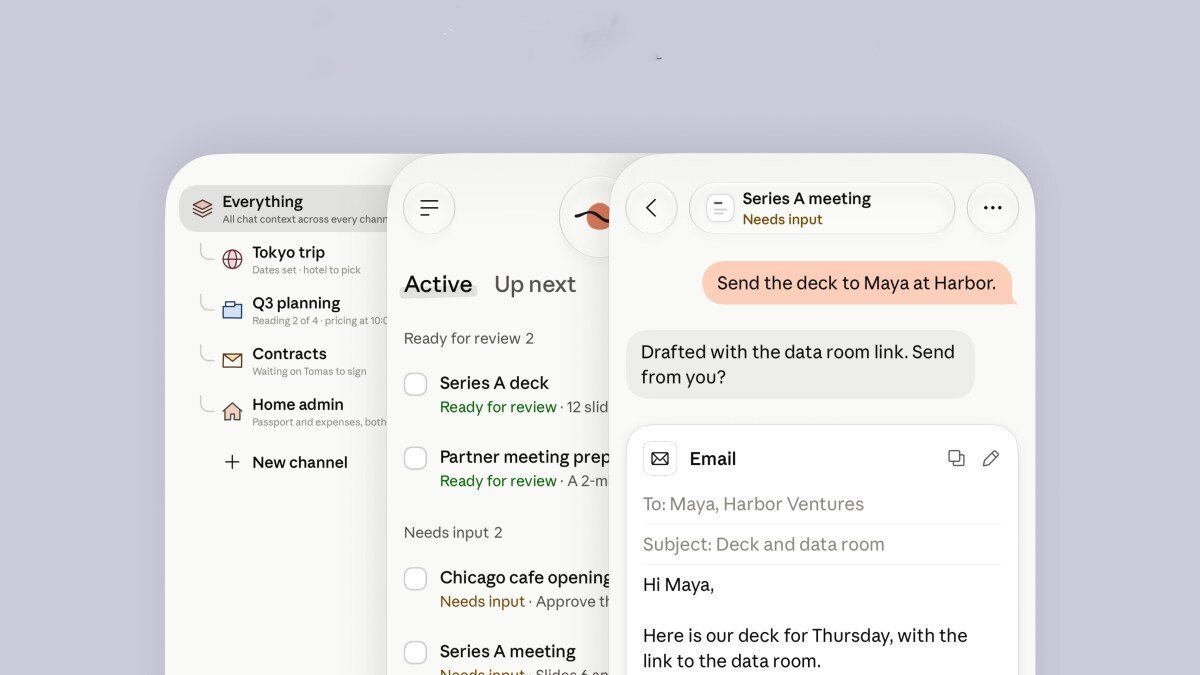
The basic pitch is straightforward: Duet is meant to observe the digital tools a person already uses, summarise what matters, and surface next steps. TechCrunch said the agent can build daily briefings, dashboards and action suggestions from user data. The Verge described a broader workflow in which Duet can send morning briefs, monitor connected apps during the day and message users when action is needed.
Anthropic is positioning the tool against a crowded field of competing agent products, including Meta Muse, OpenAI Dots, Hark, Instinct, Grok Bot and Fo, according to TechCrunch. Mashable India framed the launch the same way: not as a simple chatbot upgrade, but as a bid to make Claude behave more like a digital coworker.
How Claude Duet works
Claude Duet is built on Claude Opus 5.5 and can draw on Claude’s memory, skills and connected apps, while also using a browser-enabled virtual machine, The Verge reported. That combination is designed to let the agent keep work moving in the background, then pause for approval when it reaches a sensitive or consequential step.
Anthropic says the agent can run tasks inside its own virtual machine and then ask for confirmation when needed. In practice, that means it can keep churning through multi-step work without requiring the user to click through every stage, while still stopping before actions that matter more.
According to TechCrunch, Duet connects to more than 6,000 marketplace connectors and plugins through the Claude Marketplace. That matters because the usefulness of any work agent depends heavily on what it can actually reach: calendars, documents, dashboards, sales systems, finance tools and other business software are where these products either become indispensable or stay novelty features.
What kinds of tasks can it handle?
Duet appears aimed at the kinds of repetitive, cross-app chores that consume a workday. The Verge said the agent can handle scheduling, dashboards, sales or financial forecasts, prototyping and web apps. Mashable India added that Anthropic is targeting coordination work around calendars, dashboards and financial projections.
That list puts Duet in the middle of a broader race to build always-on agents that can manage work across consumer and business settings. In Anthropic’s telling, the advantage is not that the model knows everything, but that it can keep track of enough context to move a task forward while still leaving critical judgment with the user.
Safety and guardrails
Anthropic is clearly trying to anticipate the biggest objection to AI agents: the moment you let software act, you also create a risk of it acting badly. TechCrunch reported that Duet will not trade securities or move money between accounts, a notable boundary for a product that is supposed to help with work and finance-related tasks.
The company has also added a new classifier that blocks requests involving sensitive data by default, including credit card numbers and government IDs, according to TechCrunch. Mashable India quoted Anthropic saying:
“It never directly sees your passwords, a new classifier guards against sharing sensitive information, and the important decisions stay with you.”
The Verge said user approval is required before major steps such as payments or deletions. That extra stop is important, because the most serious failures in agent software are rarely dramatic on the first step; they usually happen when a system moves from helpful automation to irreversible action.
Anthropic is also signaling that this is not a polished, fully finished product. The Verge reported that the preview is early and may misread threads or misjudge urgency. The company also said Duet is not as strong at personal errands such as ticket booking, which suggests the initial scope is narrower than the broad “AI assistant” label might imply.
Why it matters
Claude Duet matters because it shows where the AI market is heading next. Chatbots helped companies prove there was demand for conversational interfaces. Agents are supposed to turn that demand into daily utility, especially in office settings where software already sits at the center of work.
For readers, the practical implication is that AI products are increasingly being sold not as answer engines but as doers. Instead of asking a model to draft text and then moving the result elsewhere, users may soon rely on one system to watch inboxes, update dashboards, suggest next steps and initiate approved actions across connected software.
For Anthropic, the launch is also a commercial move. Research previews often serve as a testing ground, but they also help a company gauge whether paid subscribers will adopt higher-value automation tools. Limiting access to Claude Pro and Max customers suggests Anthropic sees Duet as part of its monetisation strategy, not just a feature experiment.
For the market more broadly, Duet underscores how quickly competitors are converging on similar ambitions. TechCrunch noted a rival set that includes Meta Muse and OpenAI Dots, while Mashable India highlighted the scale of Meta’s reported uptake, saying the Meta CEO claimed more than 10 million people in the US and Canada set up Muse agents in six weeks. That figure, if accurate, helps explain why Anthropic would want to move quickly.
Background and context
The broader shift behind Duet is easy to see. AI companies are moving away from single-turn chat and toward systems that can take actions across apps on a user’s behalf. That evolution changes the product from a helper that responds when asked into a software layer that can work in the background.
Anthropic’s Claude family already sits in a crowded part of the AI market, but Duet gives the company a more concrete work-product pitch. The public story is no longer only about model quality or benchmark performance. It is about whether the model can help a professional get through a day’s worth of information overload without introducing new risks.
That matters because work software is full of edge cases. A dashboard can be out of date. A thread can be long and messy. An urgent request can be a false alarm. If an agent is going to sit in the middle of that mess, it needs not only language skill but also good judgment about timing, permissions and escalation.
Anthropic’s decision to put Duet into a research preview suggests it knows the problem is unresolved. A preview gives the company room to learn how the system behaves with real users, real documents and real workflows before it opens access more broadly.
How does Duet compare with rivals?
Duet is part of the same directional shift as products from Meta and OpenAI, but the available reporting suggests Anthropic is leaning more heavily on safety and work coordination. TechCrunch said the product is being positioned against Meta Muse, OpenAI Dots, Hark, Instinct, Grok Bot and Fo. Mashable India, meanwhile, cast rivals as pursuing always-on agents across both consumer and work settings.
What stands out is the similarity in ambition and the difference in framing. Some competitors appear to be pushing broad consumer convenience. Anthropic is emphasising professional use, business workflows and controls that slow the agent down before it can do something irreversible.
| Signal | What the reporting says | Why it matters |
|---|---|---|
| Product name | Claude Duet | Marks Anthropic’s move into agentic work software |
| Release stage | Research preview | Shows the tool is still being tested, not fully general availability |
| Supported platforms | iOS, Android and web | Makes the agent usable across mobile and desktop work |
| Access | Claude Pro and Max customers on a waitlist | Limits the rollout to paying users first |
| Core model | Claude Opus 5.5 | Indicates the agent is built on Anthropic’s latest model stack |
| Integrations | 6,000+ connectors and plugins | Suggests broad reach across workplace tools |
| Key safeguard | User approval for major steps | Helps prevent unwanted payments or deletions |
What the reporting differs on
The core picture is consistent across the outlets, but there are small differences in emphasis and access details. TechCrunch said Claude Duet is available on iOS, Android and web to Claude Pro and Max customers on a waitlist. The Verge said it is available only to Pro or Max subscribers in the US. Those reports are not necessarily contradictory, but they do suggest the rollout may be geographically limited or being staged differently depending on the channel.
The Verge also supplied more detail on the agent’s day-to-day behaviour, including morning briefs, monitoring connected apps and messages when action is needed. TechCrunch focused more on product positioning, the model backing the tool and its connector count. Mashable India leaned into the safety framing and the “digital coworker” angle, as well as the competitive race around always-on agents.
That combination makes the story bigger than a single feature launch. It is a snapshot of how AI firms are trying to carve out a role in work software: not just answering questions, but quietly running parts of the day.
What happens next
The immediate question is how quickly Anthropic broadens access beyond the current subscriber tiers and waitlist. The company has not said when, or even whether, Duet will move from research preview into a wider release.
The next things to watch are the integrations, the task types and the safety record. If Anthropic adds more connectors and allows more kinds of actions, the product could become materially more useful. But any expansion also raises the stakes around misfires, misread urgency and overconfident automation.
Users and businesses will also want to know how well the agent performs in the real world. The Verge’s warning that Duet may misread threads or misjudge urgency is a useful reminder that language fluency is not the same as operational reliability. A system can sound capable long before it becomes dependable.
Finally, Anthropic may eventually need to say more about the classifier that blocks sensitive-data requests, as well as how often it catches the wrong things or misses the right ones. For a product designed around trust, that detail will matter almost as much as the feature list.
By the numbers
Here is a quick look at the concrete details attached to the launch:
- More than 6,000 marketplace connectors and plugins are available through the Claude Marketplace.
- Claude Duet is built on Claude Opus 5.5.
- Access is limited to Claude Pro and Max customers on a waitlist, according to TechCrunch.
- The Verge said Duet is available only to Pro or Max subscribers in the US.
- Mashable India reported Meta’s CEO claimed more than 10 million people in the US and Canada set up Muse agents in six weeks.
Timeline
| Date | Outlet | What was reported |
|---|---|---|
| 2026-10-21 | The Verge | Report on the Claude Duet announcement |
| 2026-10-22 | TechCrunch | Launch details, connectors and access limits |
| 2026-10-22 | Mashable India | Explainer on the product’s work-assistant positioning |
Claude Duet is not yet the fully autonomous office assistant that AI vendors often imply in their demos. But the launch shows Anthropic moving decisively toward that goal, with a product built to watch, summarise and act — and with enough guardrails to keep the user in the loop when the stakes get higher.
Frequently asked questions
What is Claude Duet?
Claude Duet is Anthropic’s new research preview AI agent for professionals and small businesses. It can generate briefings, monitor connected apps and suggest or carry out tasks with user approval for important steps.
Who can use Claude Duet right now?
Claude Duet is currently limited to Claude Pro and Max customers on a waitlist, according to TechCrunch. The Verge reported that availability is restricted to Pro or Max subscribers in the US.
What can Claude Duet do?
Claude Duet can build daily briefings, dashboards and action suggestions from user data. Reporting says it can also handle scheduling, sales or financial forecasts, prototyping and some web-app work, with user approval required before major actions.
How is Claude Duet different from a chatbot?
Claude Duet is meant to act more like a digital coworker than a chatbot. Instead of only answering prompts, it can monitor apps in the background, surface what needs attention and help move tasks forward across connected tools.
Is Claude Duet fully autonomous?
No, Claude Duet is not fully autonomous. Anthropic and the reporting say user approval is still required for sensitive steps such as payments or deletions, and the company says the preview may still misread threads or urgency.