In short
Netflix has confirmed that its upcoming Wonka reality competition will premiere on September 23, and its teaser uses an AI-generated Gene Wilder voice with family consent. The move ties the series to ongoing debates over synthetic voices, nostalgia and entertainment ethics.
- Netflix’s Wonka reality show premieres September 23 with a two-part finale on September 30.
- The teaser uses an AI-generated Gene Wilder voice, reportedly created with his family’s consent.
- The series follows 12 golden ticket winners and their chosen partners in a weeklong competition.
- Netflix is extending its Roald Dahl partnership while doubling down on franchise-based reality TV.
- The project adds to growing debate over AI recreations of deceased performers.
Netflix is leaning further into the uneasy overlap between nostalgia, artificial intelligence and reality television with a new competition series inspired by Willy Wonka. The streamer has confirmed that Wonka’s The Golden Ticket will debut on September 23, and a teaser trailer has also revealed a noteworthy detail: the voice guiding viewers through the fantastical contest is an AI-generated recreation of Gene Wilder’s iconic performance.
The choice immediately places the show at the center of a broader entertainment industry debate. On one hand, Netflix is reviving one of the most recognizable voices associated with screen history. On the other, it is doing so through synthetic audio technology at a time when studios, artists and audiences are still arguing over the boundaries of digital likenesses, consent and authenticity.
The series itself is built as a “high-stakes social experiment,” according to Netflix, with 12 contestants selected from among those who secure golden tickets, each bringing a partner along for the ride. One participant will ultimately emerge as the winner after a week of competition, with the two-part finale scheduled for September 30.
What Netflix has announced
The streamer’s teaser confirms the broad shape of the project but leaves much of the format under wraps. The company says the show will follow 12 “lucky” golden ticket winners and the people they choose to bring with them into a staged contest inspired by Roald Dahl’s beloved fictional factory world.
Netflix is framing the series less as a straightforward game show and more as an engineered psychological test wrapped in a candy-colored aesthetic. That approach fits a trend the company has already embraced in other unscripted programming, especially its expansion of Squid Game-themed reality content built around the danger, spectacle and moral tension of the original drama.
The new series is set to premiere in late September and will arrive in two parts, with the concluding episodes landing a week after the debut. That staggered release gives the format room to build discussion, speculation and audience engagement, which is a familiar strategy for Netflix when it wants a title to become a weekly conversation rather than a one-night drop.
The AI voice at the center of the controversy
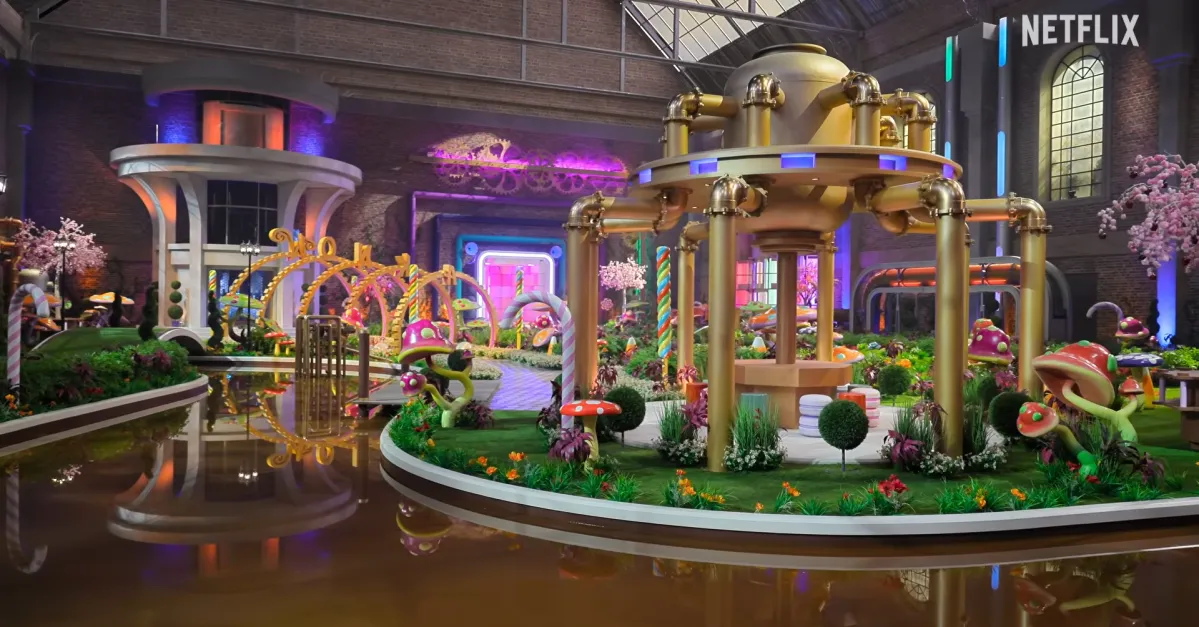
The most newsworthy element of the teaser is not the competition format or the elaborate set design, but the narration. The voiceover used in the trailer is an AI-generated version of Gene Wilder, the actor whose 1971 performance in Willy Wonka & the Chocolate Factory helped define the character for generations of viewers.
According to reporting from Deadline, Netflix worked with ElevenLabs, an AI audio company known for its voice-generation tools. The company has previously been involved in recreating the voices of figures such as Michael Caine and Stan Lee in separate productions. In this case, the synthetic Wilder voice was reportedly created with the approval of his family.
Netflix’s approach appears to hinge on consent as much as technology, with the company relying on permission from Wilder’s family while using AI to recreate the sound of a performer who cannot personally participate in the project.
That distinction matters. AI-generated voice work has become one of the most sensitive corners of entertainment technology because it can preserve a recognizable performance style while also raising concerns about posthumous use, creative control and whether an actor’s legacy can be licensed in ways that blur the line between tribute and exploitation.
Why Gene Wilder’s voice matters to this project
Gene Wilder is not just another classic-film reference. His portrayal of Willy Wonka is one of the most enduring performances in family entertainment, defined by a delicate balance of whimsy, menace and theatrical unpredictability. For many viewers, his voice is inseparable from the character’s identity.
Using a Wilder-like voice in a new Wonka project is therefore more than a stylistic flourish. It is a strategic attempt to anchor the show in nostalgia and instantly signal continuity with the original cultural memory surrounding the character. Netflix is effectively borrowing the emotional texture of an older era to market a new entertainment product built for streaming-era audience habits.
That makes the project commercially clever, but also culturally loaded. The performance evokes a beloved actor who died in 2016, and the AI recreation creates a sense of presence that is both familiar and artificial. For some viewers, that will feel like a respectful homage. For others, it may seem like an uncomfortable example of studios turning deceased performers into tools of promotion.
How this fits Netflix’s current strategy
Netflix has increasingly shown a willingness to turn major franchises into reality programming. The company’s Squid Game-inspired competition series helped establish a template: take a highly recognizable fictional universe, translate it into a real-world contest and allow audience familiarity to do a lot of the marketing work.
Wonka’s The Golden Ticket follows that same logic, but with a different tone. Instead of lethal games and dystopian tension, the new show packages itself around childhood wonder, confectionery spectacle and the bizarre logic of a factory where imagination and danger coexist.
Still, the underlying structure is similar. Netflix is using an existing story world to create an event series that is easier to market than a totally original format. The premise is simple enough to explain in a headline, and the brand recognition is strong enough to attract viewers who might otherwise skip an unknown reality title.
This is also a way for Netflix to extend the value of a long-term rights deal. The platform entered into a partnership with the Roald Dahl company in 2021, a relationship that has already produced and supported multiple adaptations and expansions of Dahl’s work. The new competition series is separate from the animated Charlie vs. the Chocolate Factory feature that is planned for 2027, but both projects show how the Wonka universe remains a durable asset for modern media companies.
What the show is actually promising
The company is calling the format a social experiment, which is a familiar reality-TV phrase that usually signals a mixture of competition, staged interpersonal drama and carefully managed escalation. In practice, that means viewers can expect a series designed to test behavior under pressure while still delivering visually playful set pieces and a strong narrative arc.
Netflix says 12 ticket winners and the partners they choose will take part in the contest. One champion will be left after a week, suggesting the show will compress elimination, strategy and endurance into a short, highly produced window.
That structure allows producers to create suspense without requiring the longer investment of a conventional season. It also aligns with Netflix’s appetite for event-style nonfiction that can generate rapid social-media attention. The shorter timeline may make the format more digestible, but it also increases the importance of each episode’s twist, challenge and reveal.
Key elements of the format
- 12 contestants are selected through golden ticket-style entry.
- Each contestant brings one partner into the experience.
- The competition unfolds over roughly one week.
- The finale is split into two parts.
- One winner remains at the end of the season.
A timeline of the project
Netflix has not published a detailed production history, but the key public milestones are now clear. The company has been building toward this project as part of its broader Roald Dahl strategy, and the teaser confirms that the release is no longer far off.
| Milestone | Details | Timing |
|---|---|---|
| Roald Dahl partnership | Netflix deepened its connection to the Dahl catalog through a company-wide deal | 2021 |
| Reality concept announced | A Wonka-themed competition format began taking shape under the title The Golden Ticket | Prior to teaser release |
| Teaser trailer released | Trailer confirmed the use of an AI-generated Gene Wilder voice | June 30, 2026 |
| Series premiere | First part of the competition debuts on Netflix | September 23, 2026 |
| Two-part finale | Winner is determined after the concluding episodes | September 30, 2026 |
The ethics of recreating a dead actor’s voice
AI-generated likenesses have become one of the defining disputes in entertainment technology. The promise is obvious: creators can revive a beloved tone, preserve continuity across media or build a compelling nostalgia-driven experience. But the risks are just as clear. These tools can be used to simulate approval, manufacture endorsement or extend a performer’s identity beyond the conditions under which it was originally created.
In the case of Wilder, Netflix appears to have taken a consent-based route by securing family approval. That may not resolve every concern, but it does differentiate the project from unauthorized digital imitation. It suggests the streamer is trying to present the voice as a sanctioned homage rather than an exploitative deepfake.
Even so, the optics remain complicated. The use of AI voices is no longer a niche technical experiment. It is increasingly becoming a mainstream production decision, and each high-profile use helps normalize a practice that critics believe should be tightly controlled.
Supporters of this kind of technology argue that it can extend artistic legacy respectfully when handled carefully and with permission. Opponents counter that the very act of reconstructing a voice creates the risk of reducing a person’s identity to an asset that can be reused whenever it suits a studio’s marketing needs.
Why this matters beyond one Netflix show
This is not only about Willy Wonka. It is about the future of posthumous performance, and whether audiences will accept synthetic recreations as legitimate parts of modern storytelling. The more these tools are used in high-profile projects, the more normalized they become across film, television, advertising and gaming.
That normalization could accelerate quickly if the results prove commercially successful. A strong audience response to the voiceover, for example, might encourage other studios to seek similar arrangements. In that sense, Wonka’s The Golden Ticket may become a test case for how much nostalgia-driven AI audiences are willing to tolerate.
Netflix’s gamble on spectacle and familiarity
There is a reason platforms keep returning to known intellectual property: familiarity lowers the barrier to entry. A reality competition built around Wonka needs less explanation than a brand-new concept, and an AI recreation of Gene Wilder’s voice gives the teaser immediate cultural traction.
That does not guarantee success. Audiences may be intrigued, skeptical or outright hostile depending on how the final series handles its source material. The show will have to balance novelty with reverence, and chaos with charm, if it wants to avoid feeling like a gimmick built entirely on brand recognition.
But Netflix has made a clear bet that viewers are willing to follow familiar franchises into unconventional formats. The streamer has increasingly treated reality television as a playground for recognizable worlds, and the Wonka property offers especially rich material: strong visual identity, built-in mythology and a premise that practically begs for competitive reinterpretation.
Netflix is betting that the combination of a beloved story world, a short-run competition and a recognizable AI voice will create the kind of conversation-worthy event series that can cut through a crowded streaming landscape.
What to watch next
With the teaser now public and the premiere date set, the main questions are less about whether the show exists and more about how far Netflix will push the concept. Will the AI voice remain limited to the trailer and promotional material, or will it be a recurring feature of the series? How much of the show will lean into Wonka mythology, and how much will simply use the aesthetic as a wrapper for standard competition-TV drama?
Another open question is whether the decision to use Gene Wilder’s AI voice will become a major part of the marketing campaign or a talking point that Netflix would prefer to keep secondary. Either way, the strategy has already ensured the series will enter the public conversation well before launch.
The streamer’s timing also places the show in an interesting spot on the calendar. A late-September debut allows Netflix to capitalize on the fall television season while also positioning the finale as a next-week follow-up event. For a platform that often struggles to keep subscribers engaged between tentpole releases, that kind of repeat attention is valuable.
The bottom line
Wonka’s The Golden Ticket is not just another reality competition. It is a convergence of streaming strategy, franchise recycling and AI-driven voice synthesis, packaged inside one of the most recognizable fantasy universes in popular culture.
By using an AI-generated Gene Wilder voice with family consent, Netflix is trying to present the project as both affectionate and modern. Whether viewers experience it that way will likely depend on how naturally the synthetic narration fits the series — and on how comfortable they are with the growing role of AI in shaping entertainment built on the memories of the dead.
For now, one thing is clear: Netflix wants this Wonka show to be more than a novelty. It wants it to be an event. And by attaching Wilder’s voice to the trailer, it has already made sure people will be talking about it long before the first golden ticket winner steps into the factory.