Updated September 18, 2026 7:54 pm
In short
Meta has brought its Muse assistant to Mac, where it can work inside native apps with user approval, as consumer AI agents race to add new features and win market share.
- Muse is now available on Mac after launching on mobile and the web earlier in September 2026.
- The assistant can work with files, messages, calendars, notes and mail inside native Mac apps.
- Meta says access is opt-in and sensitive actions require user approval.
- The release comes amid a fast-moving race to build the leading consumer AI agent.
- Muse’s early App Store momentum suggests strong interest, but long-term retention remains the test.
Update — September 18, 2026 7:54 pm
Meta’s Mac rollout also arrives amid a new round of competitive jockeying in consumer AI. In a post announcing the app, Alexandr Wang said Meta is moving quickly, while rival assistant makers are racing to add features of their own.
TechCrunch also noted that Muse and another buzzy assistant, Instinct, both rolled out voice calling this week, underscoring how fast the market is shifting beyond simple chat tools.
Meta has released its Muse AI assistant for Mac, extending the company’s new consumer agent beyond mobile and the web and into the desktop apps where people manage their daily work. The launch matters because Muse can now interact with files, mail, notes, messages and calendars on a Mac, while still requiring user permission before sensitive actions are taken.
The desktop debut, announced on Sept. 18, 2026, comes only weeks after Muse appeared on mobile and the web and quickly climbed the U.S. App Store charts. It also lands at a time when tech companies are racing to define what personal AI agents should do, how much autonomy they should have, and how quickly they can become indispensable.
What Meta launched on the Mac
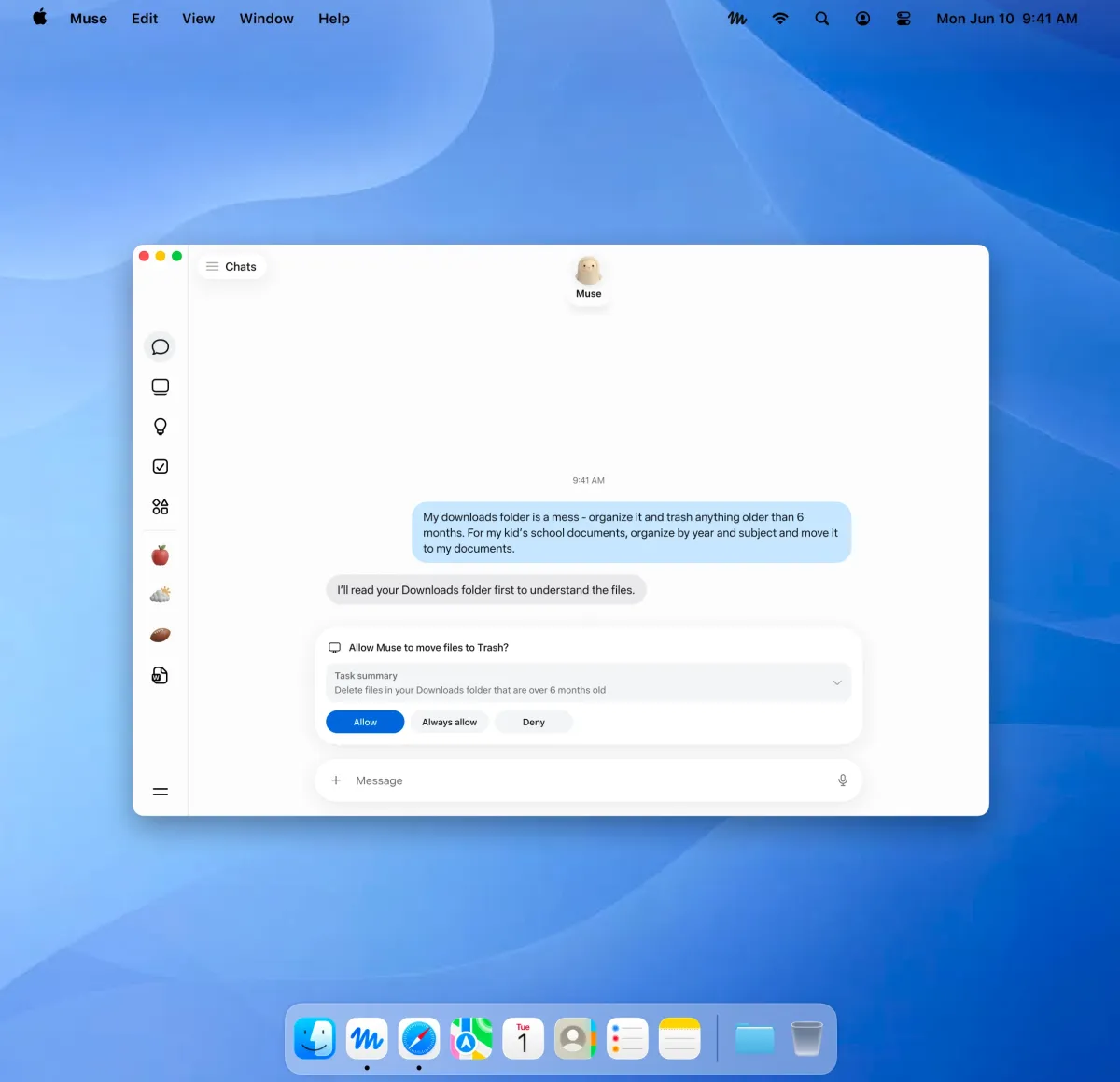
Meta’s Mac version of Muse is designed to behave less like a chatbot in a browser tab and more like an assistant that can operate across a user’s own software. On Apple’s desktop platform, the app can work with content inside native applications tied to a person’s everyday routines, including email, notes, calendars, messages and locally stored files.
The key feature is action-taking, not just text generation. Instead of merely drafting a response or summarizing information, Muse can help carry out tasks on the computer itself. That puts it in the fast-growing category of agentic AI tools, which aim to move from answering questions to completing multi-step jobs on a user’s behalf.
How the Mac version works
Meta says access remains opt-in. Users decide what Muse may connect to on their Mac, and the assistant is programmed to request approval before handling sensitive actions. That permission-based approach is meant to balance usefulness with safety, especially as desktop agents move deeper into personal and professional data.
In practical terms, the app is meant to sit in the background until a person asks it to help organize, draft, retrieve or coordinate information across applications. The promise is convenience; the challenge is trust. A desktop assistant that can see more of a user’s digital life can also do more harm if permissions are too broad or controls are unclear.
In announcing the Mac release, Meta executive Alexandr Wang framed the rollout as another sign of how quickly the company is moving, emphasizing that users can now bring the agent onto their computer while still controlling what it can access and approving sensitive steps before they happen.
Why Meta is pushing Muse onto desktop now
Meta’s timing reflects a broader industry belief that consumer AI agents could become a primary interface for computing. If that prediction proves right, the companies that win early attention may shape how people browse, communicate, schedule, shop and manage digital work in the years ahead.
Desktop is the next logical battlefield. Mobile assistants are useful, but computers still hold the richest set of personal productivity tools: inboxes, notes, calendars, documents and messaging clients. By bringing Muse to the Mac, Meta is trying to keep pace with competitors that are also expanding their consumer-facing agents across more surfaces.
That urgency helps explain why the company has been shipping features rapidly. Meta introduced Muse on mobile and the web earlier this month, then moved quickly to Mac. The pace is part of the product strategy, but it is also a competitive signal: in this market, speed is being treated as a requirement rather than a luxury.
What is the bigger market race?
The bigger market race is for consumer share in AI agents, and it is moving quickly. Several major AI companies now offer tools that are meant to feel personal, proactive and action-oriented, rather than purely conversational.
The industry’s view is that whoever captures user habits first may own the daily workflow layer that sits above traditional apps. That could affect software-as-a-service products, app discovery, and eventually even hardware ecosystems if people begin relying on agents to mediate many tasks that previously required direct app use.
How Muse fits into the broader agent boom
Muse is arriving into a crowded and rapidly changing market that now includes both established tech giants and a wave of newer startups. Some consumer agents have gained traction by being easy to reach through text messages. Others are trying to stand out by embedding themselves directly into operating systems or daily communication tools.
That diversity reflects an unresolved question: what is the most natural way for consumers to use an AI agent? Some users prefer a chat interface. Others want voice, while some may want an assistant that can quietly handle tasks inside the apps they already know.
Meta’s bet with Muse is that the desktop environment is where many people will want an assistant to take action, not just answer questions. The Mac version gives the company another chance to test that theory with a mainstream audience.
Who else is chasing the same opportunity?
Multiple AI companies are trying to define the category at the same time. The market has already seen startups rise, get acquired or seek fresh funding on the strength of early consumer enthusiasm for agentic tools.
Among the more notable examples, Poke became one of the first breakout names in the space before being acquired by Cognition in July. Another much-discussed assistant, Instinct, has reportedly been pursuing new capital at a valuation of $10 billion. Those moves show that investors still see major upside in the category, even though the product standards are still being written.
Why security and consent matter for AI on a computer
Security is central to the desktop agent conversation because a tool that can interact with local files and native apps can also reach into highly sensitive parts of a person’s life. That is why opt-in permissions and approval prompts are becoming baseline expectations rather than differentiators.
Muse’s design highlights the current compromise in consumer AI. The assistant can be useful only if it is given enough access to act, but it must also be constrained enough to earn trust. The tension between those two requirements is likely to define the next phase of the AI agent market.
For users, the practical concerns are straightforward:
- Which apps and data sources the assistant can access
- Whether sensitive actions require explicit confirmation
- How clearly the app explains what it is about to do
- Whether the assistant can be limited to specific tasks or locations
For Meta and its rivals, these details are not just product polish. They are the difference between a useful assistant and a tool people are reluctant to let near their inbox or documents.
What the launch says about Meta’s AI strategy
Muse’s expansion shows that Meta is treating AI assistants as a consumer product, not merely a research project or a behind-the-scenes model layer. The company appears to believe that ordinary users will be willing to adopt an agent if it is easy to install, easy to control and capable of immediate value on everyday devices.
The Mac release also underscores Meta’s willingness to move quickly across platforms once a new product proves there is interest. The app’s strong early showing on the U.S. App Store likely reinforced the idea that a broader desktop rollout could help sustain momentum.
That momentum matters in AI because first impressions can shape adoption patterns. If Muse becomes useful for scheduling, message handling or file-related tasks, it may become part of a person’s workflow before competitors have a chance to become habitual alternatives.
Why the App Store chart performance mattered
The early App Store success mattered because it gave Meta a public signal that consumers were curious enough to download the product quickly. While app-store rankings do not guarantee long-term retention, they can indicate that a concept has broken through the noise.
For a new AI assistant, that initial curiosity is valuable. It creates room to test whether users will return after the novelty fades. Bringing Muse to the Mac expands that test from a phone screen to a full desktop environment where task complexity is often higher and the potential value is greater.
Timeline: Muse’s rapid rollout across platforms
Muse has moved from launch to desktop expansion in a very short window, reflecting the pace at which AI products are now being iterated and marketed.
| Date | Milestone | Why it matters |
|---|---|---|
| Early September 2026 | Muse launches on mobile and the web | Introduces Meta’s consumer agent to a broad audience |
| Within days | App rises to the top of the U.S. App Store charts | Signals strong early consumer interest |
| Sept. 17, 2026 | Meta leadership publicly highlights the Mac rollout | Reinforces the company’s rapid shipping cadence |
| Sept. 18, 2026 | Muse becomes available on Mac | Extends the assistant into native desktop workflows |
What this means for users and rivals
For users, Muse on Mac may be appealing if it can genuinely save time across the applications they already use every day. The promise is a simpler way to handle small but frequent tasks that pile up across email, notes, calendars and messages.
For rivals, the launch is another reminder that consumer AI products are no longer competing only on model quality. They are competing on placement, habit, platform coverage and trust. A product that lives on a Mac desktop can become part of a user’s routine in a way that a standalone website may not.
That is why the market is moving so aggressively. Every company in the space knows that a winning assistant may become the default gateway between people and their digital work. If that happens, the stakes will extend beyond AI and into the broader structure of consumer software.
What comes next for Muse?
What comes next is likely more expansion, more feature releases and more scrutiny over how much control the assistant should have. Meta and its competitors are still in the earliest phase of testing consumer appetite for AI that does work rather than merely discusses it.
The immediate challenge is to turn novelty into repeat usage. The longer-term challenge is to convince users that an agent can be both helpful and safe enough to trust with parts of their digital life. If Meta can do both, Muse could become one of the company’s most important consumer AI products.
For now, the Mac release makes one thing clear: the AI agent race is no longer theoretical. It is arriving on desktops, in native apps and in the workflows people use every day.
Key facts at a glance
- Muse is Meta’s consumer AI assistant.
- The app is now available on Mac.
- It can interact with files, messages, calendar entries, notes and mail inside native apps.
- Access is opt-in, and sensitive actions require approval.
- The launch follows Muse’s earlier rollout on mobile and the web.
- The move comes amid intense competition in consumer-facing AI agents.
Frequently asked questions
What is Meta Muse on Mac?
Meta Muse on Mac is a desktop version of Meta’s consumer AI assistant that can interact with files, messages, calendars, notes and mail inside native applications. It is designed to do tasks on the computer, not just answer questions.
Can Muse access everything on a Mac?
No, Muse does not get unrestricted access. Meta says the app uses opt-in permissions, so users choose what it can reach, and the assistant must ask for approval before completing sensitive actions.
Why is Meta launching Muse on Mac now?
Meta is launching Muse on Mac now to extend its new AI agent beyond mobile and web while consumer competition is still forming. The move helps the company compete for early adoption in a market many believe could define the next computing interface.
How does Muse compare with other AI agents?
Muse is part of a broader wave of consumer-facing AI agents from major tech companies and startups. Like rivals, it aims to take actions on behalf of users, but the market is still unsettled and no single app has clearly won the category yet.
Why does the Mac launch matter for users?
The Mac launch matters because desktop computers hold many of the tools people use most often for work and personal organization. If Muse is useful, it could save time by coordinating tasks across those apps more naturally than a web-only chatbot.