In short
The Trump administration has unveiled an executive order targeting so-called “woke AI” in federal procurement, arguing that government-bought models should be truthful and ideologically neutral. Critics say the policy is itself biased and could pressure major AI companies to align chatbot outputs with the White House’s worldview.
- The Trump administration’s new AI order targets federal procurement, not private-market AI directly.
- Critics argue the policy replaces one form of bias with another by elevating the White House’s definition of truth.
- OpenAI, Google and Anthropic have not publicly pushed back, likely because government contracts matter.
- The move could shape chatbot behavior on sensitive topics like climate change, race, gender and history.
- Constitutional questions remain over whether government procurement pressure amounts to speech interference.
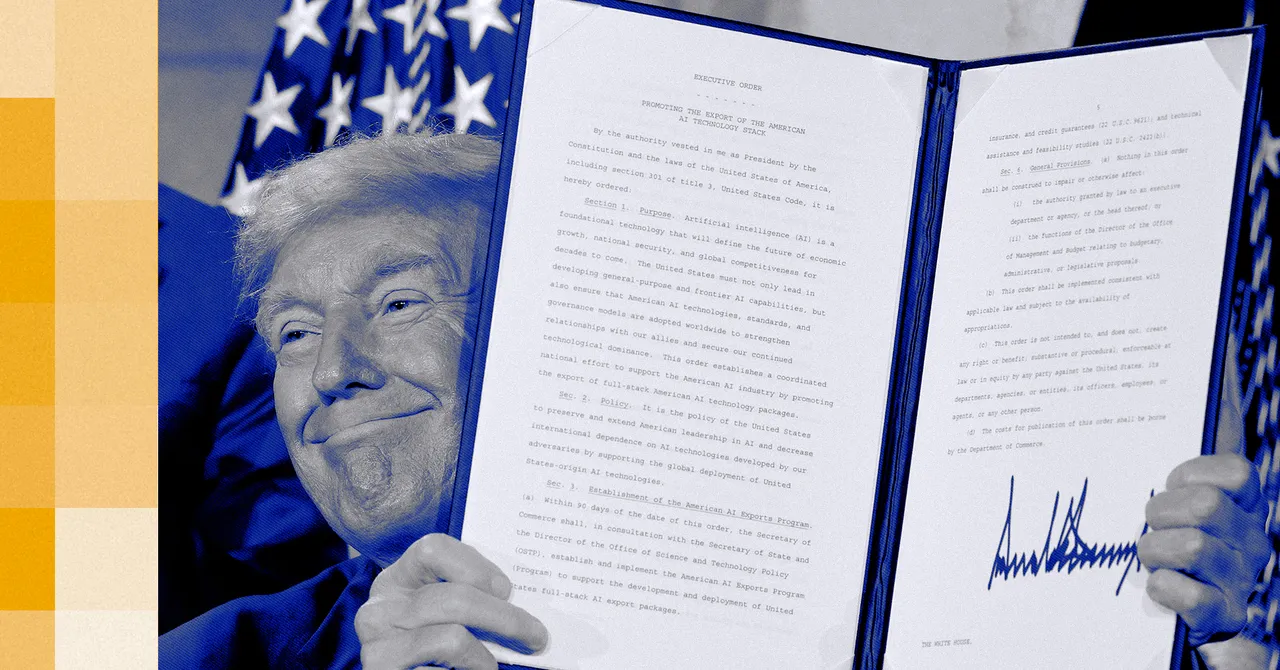
The Trump administration has ordered federal agencies to favor AI systems it says are “truthful” and free of “woke” bias, a move that could shape which chatbots win government business and how they answer politically sensitive questions. The directive matters because it may pressure major AI companies to align model behavior with the White House’s view of truth, history and identity in exchange for access to lucrative federal contracts.
Announced on Wednesday alongside a broader AI action plan, the order is being sold as a safeguard against ideological manipulation. But critics say it does the very thing it claims to oppose: it imposes a government definition of acceptable speech on technology that is increasingly used to mediate news, information and public knowledge.
The policy lands at a pivotal moment for the AI industry. Model makers such as OpenAI, Google and Anthropic are competing for enterprise customers, infrastructure support and public-sector contracts, while governments around the world try to decide how much influence they should exert over systems that can summarize history, explain policy and generate persuasive text at scale.
What did the Trump administration actually announce?
The White House released a wide-ranging AI strategy on Wednesday that is framed as a national competitiveness plan, but one section stands out for its focus on “woke” bias in federal AI procurement. The administration says federal agencies should avoid buying models that favor ideological agendas over what it calls truthfulness and accuracy.
In practice, that means the government is signaling to AI vendors that ideological neutrality — as defined by the administration — will become a factor in winning contracts. The order does not appear to ban companies from building or selling models in the private market. Instead, it targets how federal buyers evaluate them.
That distinction is central. The White House is not formally regulating every chatbot on the market. But because federal procurement can be an important revenue stream and a powerful signal of legitimacy, the order could influence model design far beyond government offices.
How is the order framed in the official plan?
It is framed as a defense of free expression and factual integrity. The administration’s plan says AI systems should be built with freedom of speech in mind and that government policy should not interfere with that goal. It also says federally procured AI should “objectively reflect truth” rather than “social engineering agendas.”
Supporters of the plan argue that taxpayers should not subsidize tools that encode partisan or activist assumptions. They say the federal government has a duty to buy systems that answer in a neutral, reliable way.
Detractors see the same language as slippery and self-serving. The phrase “truth” sounds neutral until someone has to decide whose history, scientific consensus or social values define it.
| Element | What the plan says | Why it matters |
|---|---|---|
| Federal procurement | Agencies should avoid models that sacrifice truthfulness for ideology | Could influence which AI vendors win government business |
| Free speech framing | AI systems should be built with freedom of expression in mind | Raises constitutional questions about government pressure on model outputs |
| Policy targets | References to misinformation, DEI and climate change are singled out for removal from earlier guidance | Shows what the administration considers ideological contamination |
| China comparison | The plan warns against Chinese Communist Party alignment and censorship | Places U.S. policy in a broader geopolitical rivalry over information control |
Why are critics calling it a form of bias?
Critics argue the order is biased because it substitutes one political ideology for another. Rather than eliminating government preference from AI, they say, it elevates the Trump administration’s own worldview and labels competing views as unacceptable.
The source of the criticism is not only the language in the plan, but the broader political context surrounding it. The administration has moved to remove references to misinformation, diversity, equity and inclusion, and climate change from the policy discussion. To opponents, that looks less like neutrality and more like ideological editing.
That is why the policy has been described as a contradiction: an anti-bias order that embeds a bias. The dispute is not about whether models should avoid falsehoods. It is about who gets to decide what counts as falsehood and what counts as legitimate interpretation.
Senator Edward Markey warned that the administration’s approach could push companies to shape chatbot output in ways that avoid upsetting the White House, arguing that the financial incentives are obvious for firms that want federal business.
What does “neutrality” mean in an AI model?
Neutrality in AI is harder to define than it sounds. A model that avoids all political tension may still reflect hidden choices about language, evidence, safety and relevance. When an AI system summarizes a controversial topic, it must decide which sources to emphasize, how to frame uncertainty and whether to repeat harmful claims.
That means a government demand for neutrality can quickly become a demand for conformity. A model that acknowledges structural racism, climate risk or gender identity is not necessarily partisan. It may simply be reflecting mainstream scientific or journalistic consensus. But an administration that rejects those frameworks can call that “bias.”
This is why the order is so contentious. It turns a technical problem into an ideological one, and then asks the industry to solve it by choosing sides.
How could this affect OpenAI, Google and Anthropic?
It could affect them by making government approval and federal contracts more valuable than ever, while also nudging model behavior toward language that is less likely to draw complaints from the White House. None of the major AI companies has mounted a public fight against the plan so far, which reflects both caution and self-interest.
OpenAI, Google and Anthropic are all trying to deepen their relationships with government buyers. That makes a direct confrontation risky. Instead of objecting, they have mostly responded with restrained or supportive language, emphasizing neutrality, infrastructure investment or concerns about separate policy issues.
OpenAI has said it is already close to achieving objectivity in its systems. Anthropic published a positive assessment of the broader plan, even while worrying about the administration’s shifting approach to export controls. Google welcomed elements that support infrastructure and AI development. The public silence on the bias order itself stands out.
Why haven’t the companies pushed back?
Because the AI action plan is, on balance, good for business. The administration is signaling that it wants the private sector to lead in the race against China, and that means less friction on data centers, more support for research and fewer constraints from environmental or state-level objections.
For the companies, the calculation is straightforward. Open protest could jeopardize access to federal contracts or invite closer scrutiny. Silence preserves room to negotiate and avoids being cast as hostile to the administration’s national-security agenda.
But that silence has a cost. If companies believe they have First Amendment protections over model behavior, critics say they may eventually have to choose between defending those rights and preserving a comfortable relationship with Washington.
What is the constitutional argument?
The constitutional argument is that the government may be crossing a line when it pressures private companies to tailor their expressive outputs. AI models are not human authors, but they do generate speech-like content, and companies increasingly describe model behavior as the product of intentional design choices.
If a company decides to reduce racial bias, highlight climate science or avoid endorsing discriminatory claims, that decision could be viewed as editorial judgment. Under that framing, a federal policy that punishes the company for those choices may amount to government interference with speech.
On the other side, the administration appears to be treating procurement as a market choice rather than censorship. It is saying the federal government is free to buy whatever systems it deems fit, and that vendors can decide how to configure their models if they want those contracts.
The distinction is important but not clean. When a dominant buyer like the federal government ties purchases to ideological standards, the line between procurement and coercion becomes blurry.
What makes AI different from ordinary software?
AI is different because it produces language, interpretations and recommendations that look and feel like expression. A spreadsheet program can be evaluated for functionality. A chatbot, by contrast, can be asked about race, war, gender, history or elections and respond in prose that users may treat as authoritative.
That gives governments a temptation to shape outputs indirectly. It also gives companies a potential constitutional argument that their models are not just tools but speech products with expressive characteristics.
The legal landscape is still unsettled, which is why this order could become an important test case if a dispute reaches the courts.
Why does climate change keep appearing in the debate?
Climate change appears in the debate because it has become a marker issue for what counts as factual consensus versus political ideology. The Trump plan specifically tells officials to remove references to climate change from earlier AI guidance, signaling that the administration sees it as an ideological battleground rather than settled scientific context.
That matters for chatbot behavior. If a user asks whether climate change is real, a model trained or tuned to satisfy the administration’s definition of neutrality might be less likely to present the overwhelming scientific consensus in direct terms. Conversely, a model optimized to follow scientific literature may be labeled biased by the government.
For critics, that is the core danger: a federal preference for one narrative can end up downgrading evidence-based answers. For the White House, the same move is portrayed as a pushback against elite consensus and ideological capture.
What role does China play in the administration’s argument?
China plays the role of warning label and strategic foil. The plan repeatedly frames AI policy as part of a race for supremacy with Beijing and argues that the United States should not allow its models to become aligned with authoritarian censorship or propaganda.
The irony, according to critics, is that the administration’s attempt to prevent ideological distortion could itself become a form of ideological distortion. They say the White House is borrowing the logic of state influence it claims to oppose.
The comparison is politically powerful because it turns AI model governance into a national security issue. Once the discussion shifts to beating China, the argument for broad industry latitude becomes easier to sell, even if the domestic consequences for speech and truth are more troubling.
How do federal contracts give the policy leverage?
Federal contracts give the policy leverage because they are large, prestigious and technically demanding. AI vendors want to prove their systems can serve agencies, defense-related work, scientific research and public services. If procurement rules start favoring models that avoid certain topics or phrases, companies may adapt their systems accordingly.
That can produce indirect pressure on the wider market. A company that tunes its model to satisfy the government may end up using the same behavior settings for broader commercial deployments. In that way, procurement rules can shape product norms across the industry.
That is why even an order that formally applies only to federal buying decisions can have nationwide effects.
Timeline: how the policy debate reached this point
The fight over AI bias did not begin with this order. It has developed over several years as models became more capable, more visible and more politically sensitive.
| Date | Event | Significance |
|---|---|---|
| November 2022 | Google hosts an AI event in New York focused on responsible AI | Raises early public questions about whether model tuning can reflect values or censorship |
| 2023–2024 | AI companies expand model deployment and seek more public-sector interest | Government procurement becomes more important to the industry |
| Earlier in July 2025 | The administration signals changes to export-control thinking | Some AI firms welcome parts of the broader policy direction |
| Wednesday, July 2025 | Trump unveils the AI action plan and signs the “Preventing Woke AI in the Federal Government” order | Turns the bias debate into formal federal procurement policy |
| After the announcement | Senator Markey urges major AI CEOs to resist | Signals potential congressional pushback and constitutional scrutiny |
What are the broader stakes for the public?
The broader stakes are about who controls the information layer of daily life. AI systems are increasingly the first place many people turn for answers, summaries and explanations. If the government can influence what those systems are encouraged to say — or avoid saying — that shapes public understanding in subtle but far-reaching ways.
This is especially important because AI does not behave like a traditional news outlet. It can answer the same question differently depending on prompts, settings and training choices. That flexibility is a strength, but it also creates openings for political pressure to slip in under the banner of objectivity.
There is also a market effect. If the most powerful buyer in the world rewards one version of “truth,” companies may standardize around that preference. What begins as a procurement rule could become a default style for mainstream AI assistants.
Could this change how chatbots answer sensitive questions?
Yes, it could change how chatbots answer sensitive questions if companies redesign system behavior to reduce the risk of conflict with federal standards. That might mean more cautious language on race, gender, climate, history or elections, depending on how the rules are enforced.
It could also make models less willing to provide context that one political faction considers biased but mainstream experts consider accurate. In that sense, the order may shape not only what the government buys but what millions of users see when they ask an AI assistant for help.
What happens next?
What happens next depends on how aggressively the Commerce Department and procurement officials interpret the order, and on whether AI companies decide the risk to their speech rights is worth challenging. The administration’s legal and policy language leaves room for implementation, enforcement and internal guidance that could either sharpen or soften the directive.
If agencies use the order narrowly, it may function mainly as a signal to vendors. If they use it broadly, the policy could become one of the most consequential attempts yet to steer AI outputs through federal purchasing power.
Congress may also step in. Markey’s letter to leading AI executives suggests at least some lawmakers are prepared to frame the issue as a free-speech and consumer-information problem rather than a mere procurement dispute.
For now, the largest companies appear to be keeping their heads down. That may be a practical survival strategy, but it also leaves the administration with considerable room to define the rules of acceptable AI speech.
Bottom line
The Trump administration says it wants AI free from ideological bias. Critics say the new order embeds its own ideology into the definition of truth. With federal contracts, constitutional questions and political pressure all converging, the fight over “woke AI” is really a fight over who gets to decide what an AI system is allowed to sound like.
Frequently asked questions
What is Trump’s AI bias order?
Trump’s AI bias order is a federal directive that says government agencies should avoid buying AI models that sacrifice truthfulness or accuracy for ideological agendas. It is aimed at procurement, but it could influence how major chatbot makers tune their systems to win public-sector contracts.
Why are critics saying the order is biased?
Critics say the order is biased because it replaces one political framework with another. They argue the administration is defining “truth” in its own terms and pressuring companies to avoid answers that acknowledge subjects like climate change, diversity or gender equality.
How could the order affect OpenAI, Google and Anthropic?
It could affect them by making federal business more dependent on model behavior that matches the administration’s standards. Even if the rule only applies to government purchases, major AI firms may adjust their systems to avoid losing contracts or inviting political backlash.
Is the order likely to face legal challenges?
Yes, legal challenges are possible because the policy raises First Amendment questions about government interference with private companies’ expressive choices. If procurement rules effectively punish models for offering certain viewpoints or evidence-based answers, courts may be asked to decide where the line is.
Will this change how chatbots answer sensitive topics?
It may change chatbot behavior if companies redesign outputs to reduce friction with the federal government. That could mean more cautious or limited responses on climate change, race, gender and history, depending on how agencies interpret and enforce the procurement standards.