In short
Stockholm startup Fika Jobs has raised $4 million to build a video-first hiring platform that uses AI interviews to create candidate profiles. The company is launching in Sweden first and says its approach could help employers assess communication skills earlier, though it also raises bias concerns.
- Fika Jobs raised $4 million in pre-seed funding led by Luminar Ventures.
- The startup uses AI interviews and short video clips to build persistent candidate profiles.
- Employers pay a 10% success fee on the first-year salary if they hire through the platform.
- The company is launching in Sweden first, with broader public access planned for fall.
- The model could help surface communication skills, but it also introduces new bias risks.
Stockholm startup Fika Jobs has raised $4 million in pre-seed funding to build a hiring platform that tries to replace the static resume with something far more dynamic: a short, AI-led video interview that can live on as a candidate profile. The company’s pitch is straightforward but ambitious. Instead of forcing job seekers to repeatedly repackage themselves for each application, Fika wants to create a persistent, discoverable profile built from a short conversation with an AI agent.
The product sits at the intersection of recruiting software, creator-style short video and the rapidly growing wave of AI tools reshaping white-collar work. To the founders, the timing is right. Employers are drowning in applications, candidates are frustrated by opaque screening systems, and hiring teams are under pressure to move faster without sacrificing quality.
Fika Jobs says its platform will launch first in Sweden before expanding internationally. Early access for candidates is slated to begin this week, with a broader rollout expected later in the year. The company says more than 100 employers are already on a waitlist, while more than 50 have tested the system so far.
Why Fika thinks the resume is no longer enough
The company’s core argument is that a resume captures experience, but not always the traits that matter most when someone is actually hired. Communication style, energy, confidence, curiosity and adaptability are difficult to infer from a page of bullet points. Fika believes that short video interviews can surface those signals earlier in the process.
That idea is not entirely new in recruiting, but Fika is attempting to make it the center of the product rather than a side feature. The company’s system starts by connecting a candidate’s LinkedIn profile. From there, Fika’s AI analyzes the person’s background and generates a set of tailored questions. The candidate then completes a roughly 10-minute video interview with the company’s AI agent, which is currently powered by Google’s Gemini models.
Once the interview is finished, the platform automatically slices the responses into short clips and assembles them into a living profile. Rather than reapplying for each opening, candidates can maintain one video-based presence that employers can browse, revisit and compare against future opportunities.
Co-founder and CEO Jakob Dubois said the startup’s idea was shaped by a hiring mistake they nearly made while building their previous company. During the process, he said, a candidate’s resume did not stand out at first, but an in-person conversation quickly revealed the kind of drive and determination the team valued.
That lesson, the founders argue, exposed a common flaw in conventional screening: some of the most important attributes are invisible on paper.
From social app experiment to hiring infrastructure
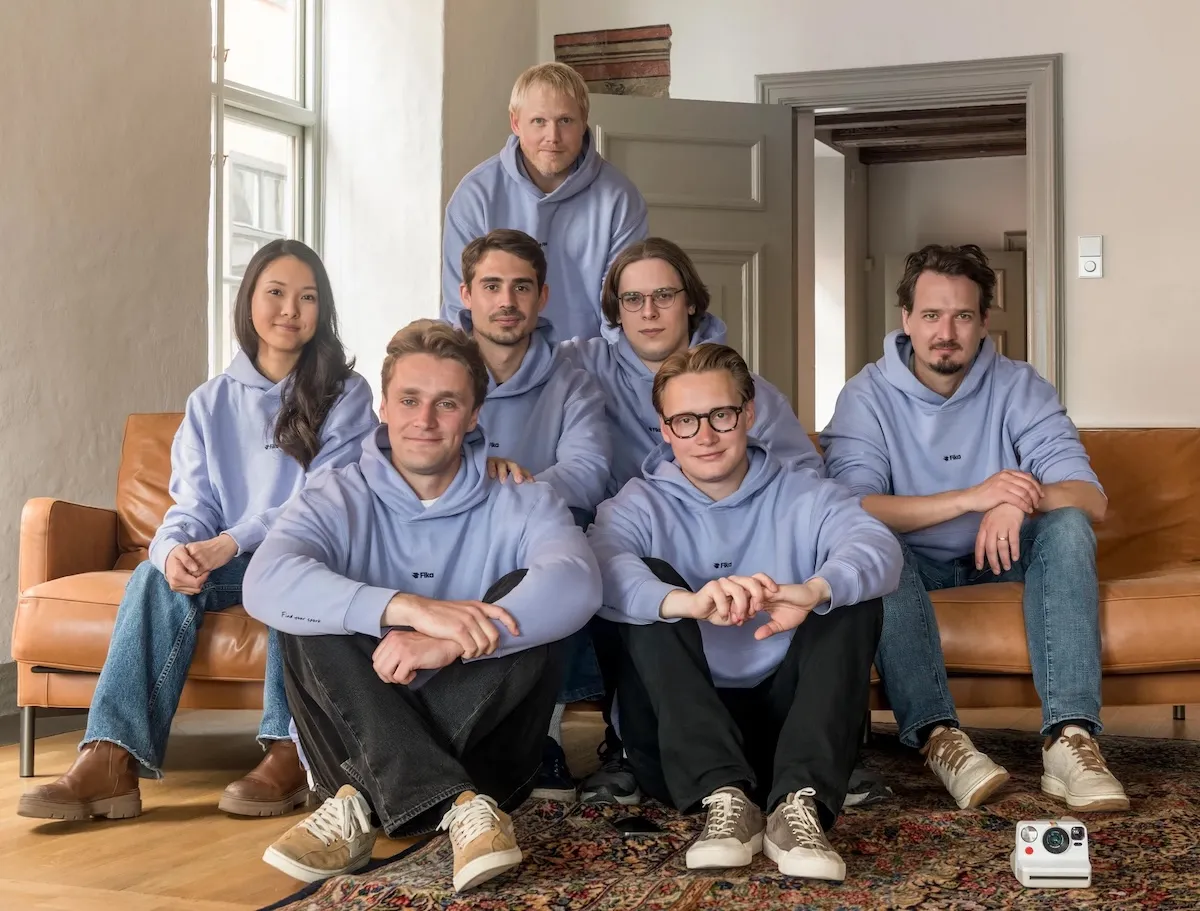
Fika was founded by brothers Jakob Dubois, now chief executive, and Alexander Dubois, who serves as chief technology officer. The pair previously worked on a social app called Gaff, an experience they say gave them a close look at recruitment from the hiring side.
According to the founders, that work made one thing clear: the early stages of hiring still rely too heavily on imperfect proxies. A polished CV can overstate fit, while a nontraditional background can undersell talent. In their view, the market needs a product that reveals more of the person before a recruiter has spent hours manually screening applications.
Fika is positioning itself as a candidate-first alternative to a growing set of AI recruiting platforms. Many of those tools are focused on automating sourcing, ranking and matching for employers. Fika is taking a different route by building a profile layer that candidates can keep updated and that employers can search over time.
How the platform works
The company’s workflow is designed to be fast for candidates and standardized for employers. It also borrows some familiar mechanics from social and creator platforms, where short video is used to communicate personality and presence much faster than text can.
Candidate journey
- A candidate links a LinkedIn profile.
- Fika’s system reviews the background and suggests personalized questions.
- The candidate records a video interview with an AI agent.
- The platform automatically extracts short clips and builds a profile.
- The profile remains active for employers to search and review later.
Employer journey
- Employers browse a pool of pre-interviewed candidates.
- They can assess communication style and presentation earlier.
- They pay only when a successful hire is made.
- Fika charges a fee tied to the candidate’s first-year salary.
The company says the end result is a more fluid market in which candidates do not need to start from scratch every time they apply. In theory, this could reduce repetitive screening work for applicants while also shortening the path from discovery to interview for employers.
The funding round and who backed it
Fika’s $4 million pre-seed round was led by Luminar Ventures, with additional participation from Alliance VC and two prominent gaming industry founders: Sebastian Knutsson and Riccardo Zacconi, the duo behind Candy Crush.
The involvement of investors with deep experience in consumer products and scaled digital platforms may be notable given Fika’s consumer-like interface. Even though the business model is recruiting software, the product itself is built to feel intuitive and familiar, especially to job seekers who already live on video-rich platforms.
The startup said the new capital will support product development, team expansion and preparation for a wider public launch. Fika currently has a small team but expects to grow to around 10 employees by the end of the year.
A bet on video-first hiring
Fika is entering a crowded but active category. AI recruiting startups have multiplied as employers look for tools that can handle high application volumes and reduce time-to-hire. Competitors in the wider market include companies such as Alex, Maki and Mercor, which mostly focus on helping employers source and screen talent more efficiently.
What differentiates Fika is the emphasis on a persistent candidate profile built around video. The company is not just trying to automate the recruiter’s workflow; it is trying to reformat the candidate’s identity into a more expressive, searchable asset.
That could be especially useful for early-career candidates, people changing industries and applicants from nontraditional backgrounds. For those groups, a resume may not fully reflect ambition, soft skills or potential. A short, well-structured video interview might help create a better first impression before a human recruiter even enters the process.
At the same time, Fika’s concept raises bigger questions about what hiring should optimize for: efficiency, accuracy, personality or fairness. The answer may depend on who is being evaluated and how the system is used.
The promise and the problem of video-based screening
Video can reveal qualities that written applications often obscure. It can show how a candidate communicates under light pressure, how clearly they organize thoughts and whether they can explain experience with confidence. For some roles, especially those involving sales, customer interaction or leadership, that may be valuable.
But video also makes a candidate more visible in ways that can introduce bias. Recruiters may be influenced by age, race, gender, accent, physical appearance or other traits unrelated to performance. In that sense, a video profile can amplify the very discrimination that blind screening was designed to reduce.
That tension is central to Fika’s business model. A platform built to improve signal can also make it easier to infer factors employers are not supposed to judge. As hiring software becomes more AI-driven, the challenge is not just speed, but also how to preserve fairness while using richer forms of candidate data.
The company acknowledges that the move to video-based profiles comes with real bias concerns, particularly because visual and vocal cues can influence human judgment before a candidate’s qualifications are fully considered.
That issue is hardly unique to Fika, but it is likely to be especially important if the platform scales beyond early adopters and into broader enterprise hiring.
Why employers may still be interested
Despite those risks, Fika’s model could appeal to employers facing two persistent problems: too many applicants and too little time. In a market where job postings can attract hundreds or thousands of responses, any system that filters more effectively can save hours of work.
The platform’s video layer could also help recruiters decide who deserves a real conversation earlier in the process. Instead of moving straight from a resume to a structured phone screen, employers may be able to form a more complete picture in advance.
Fika says its pricing model is another part of the pitch. Job seekers do not pay to participate. Employers also pay nothing up front. If a hire is made, Fika takes 10% of the candidate’s first-year salary. The company says that is below the 20% to 30% fees commonly charged by traditional recruiters and headhunters.
That structure could make the platform attractive to startups and smaller firms that need hiring help but do not want to commit to expensive placement fees unless a search succeeds.
Platform economics: what the fee structure means
| Item | Fika Jobs model | Traditional recruiting model |
|---|---|---|
| Cost to job seeker | Free | Usually free |
| Upfront employer cost | None | Often retainer or paid services |
| Success fee | 10% of first-year salary | Typically 20% to 30% of first-year salary |
| Candidate format | AI-led video profile | Resume and interview process |
| Launch geography | Sweden first | Varies by provider |
| AI engine | Google Gemini | Depends on vendor |
The economics make sense only if the product delivers enough value to influence actual hiring decisions. That means Fika has to prove not just that it can attract candidates, but that employers will trust the profiles enough to use them as a meaningful part of the hiring process.
Sweden first, global ambitions later
Fika is starting in Sweden, a market that can serve as a useful testing ground for product-market fit. Launching in a relatively compact labor market allows the startup to refine its workflow, study employer behavior and tune the experience before expanding abroad.
The company expects broader public availability this fall. If early adoption goes well, the next challenge will be localization. Hiring norms vary substantially across countries, and what works in one market may not translate cleanly into another. Different industries also have different expectations for how candidates should present themselves.
Still, the basic premise has international appeal. Every labor market deals with noisy applications, subjective screening and the problem of matching talent with opportunity. A standardized video interview, if done well, could travel more easily than many recruiting products tied to local legal or cultural conventions.
How Fika fits into the AI hiring boom
The company’s launch comes at a moment when AI is reshaping both sides of the hiring equation. Employers are using automation to sort through more candidates than they can reasonably handle. At the same time, job seekers are using AI to mass-produce applications, which has made the flood of submissions even harder to manage.
That has created an arms race of sorts: candidate tools make it easier to apply, while employer tools make it easier to filter. Fika is trying to escape that cycle by changing the format of the application itself.
Instead of a document designed to be skimmed, the company wants a profile built around a short, guided performance. In principle, that could produce more meaningful early interactions and reduce the randomness of resume review.
Whether it becomes a durable category will depend on a few factors:
- Whether candidates are willing to record themselves for job discovery.
- Whether recruiters find the format easier to trust than a resume.
- Whether the company can manage bias and fairness concerns responsibly.
- Whether AI-generated interviews feel helpful rather than awkward or impersonal.
What to watch next
Several milestones will determine whether Fika becomes more than another well-timed recruiting startup.
- Candidate adoption: The launch will test whether job seekers want to present themselves through video before there is a specific job in view.
- Employer engagement: The waitlist and pilot users are promising, but actual hires will matter more than early interest.
- Product quality: The AI interview experience will need to feel natural, relevant and consistent across roles.
- Trust and fairness: The company will need to show that its system improves decisions without deepening bias.
- International expansion: Success in Sweden will not guarantee that the model works elsewhere.
For now, Fika has secured enough capital to make its case. The startup is betting that the future of hiring is not a stack of resumes or a one-off video call, but a persistent, AI-assisted profile that lets candidates be seen more clearly from the start.
That is a compelling proposition in a market that many people already consider broken. It is also a risky one, because the more a hiring product reveals, the more it must answer for what it exposes.
If Fika can convince both sides of the market that video makes hiring better, faster and fairer, it could become one of the more distinctive entrants in the AI recruiting space. If it cannot, it may end up as another reminder that fixing hiring is harder than digitizing it.