In short
Meta is launching a lower-priced smart glasses lineup without Ray-Ban branding, aiming to expand its audience with more styles, better fit options and upgraded AI features. The company also says privacy improvements are coming as concerns about recording and facial recognition continue to grow.
- Meta’s new smart glasses start at $299 and drop the Ray-Ban branding.
- The lineup includes three frame families, seven colors and improved fit adjustments.
- Meta is pushing AI features such as translation, navigation and better photo tools.
- Privacy remains the biggest obstacle as scrutiny over recording and facial recognition grows.
Meta is widening its bet on smart glasses with a new lineup that strips away one of the company’s most recognizable partners while broadening the product line, lowering the entry price, and adding new AI features. The company’s latest glasses arrive under the Meta name alone, with three frame families and a starting price of $299 — roughly $80 less than the newest Ray-Ban-branded model.
The move marks an important shift for a category that Meta helped popularize by pairing its hardware with Ray-Ban’s familiar aesthetics and cultural appeal. But the company is now trying to prove that its glasses can stand on their own, even as questions around privacy, public acceptance, and the practical value of AI wearables continue to shadow the market.
At a hands-on event, Meta executives presented the new glasses as a more accessible, more customizable, and more capable version of what came before. The pitch is straightforward: give consumers more shapes, more colors, more fit options, broader prescription support, and a better AI assistant, all at a lower price. Yet the biggest challenge remains unchanged — convincing people that smart glasses are not just fashionable gadgets, but a product category worth trusting.
Meta breaks the Ray-Ban formula
For the past few years, the smart glasses conversation was basically inseparable from Ray-Ban. That partnership gave Meta’s first successful wearable a legitimacy that many earlier attempts at camera-equipped glasses never had. Where other products looked awkward or overtly futuristic, Meta’s Ray-Ban models resembled ordinary eyewear. That familiarity helped turn a niche gadget into a mainstream conversation piece.
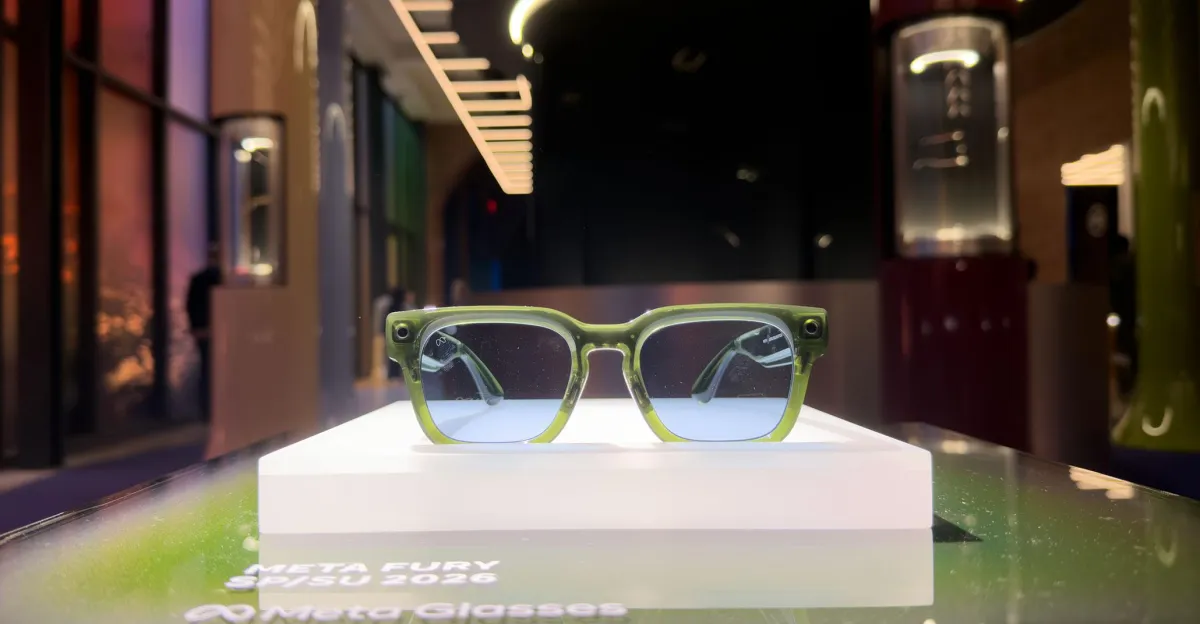
Now Meta is testing whether the brand equity it built can travel without Ray-Ban on the label. The company’s latest models are sold as Meta Glasses, with styles that include the Meta Fury, Meta Adventurer, and a version tied to Kylie Jenner’s name. Although the Ray-Ban mark is gone, EssilorLuxottica still plays a central role in the product’s design and production, and its name remains stamped inside the frames.
In other words, the supply chain relationship has not disappeared. What has changed is the branding strategy. Meta executives say the decision was driven mainly by price positioning. The new lineup starts at a lower entry point, and the company did not want to force consumers into a premium brand association that might not fit a cheaper tier.
The company’s wearables chief said Meta wanted a lower-priced option but could not find an obvious fit among EssilorLuxottica’s lesser-known labels, making a standalone Meta-branded product the more practical route.
The shift also underscores a broader reality: Meta is no longer just borrowing legitimacy from its partners. It is trying to build its own hardware identity, one that can eventually support a much wider family of glasses across price points, styles, and use cases.
Why the price cut matters
Meta’s new glasses start at $299. That pricing is meaningful for a few reasons. First, it undercuts the starting point of the most recent Ray-Ban Meta Gen 2 models. Second, it places the glasses closer to the range of a serious consumer electronics purchase rather than a luxury-adjacent fashion item. Third, it signals that Meta wants smart glasses to feel less experimental and more like a product people might buy on impulse.
Price has always been one of the hardest barriers for wearables. Consumers may be intrigued by the idea of glasses that can capture photos, handle translations, answer questions, and play audio, but that interest fades fast if the device is too expensive or too awkward to wear often. By lowering the starting cost, Meta is trying to reduce friction at the exact moment people decide whether the device is a curiosity or a real purchase.
The company’s wearables leadership argued that the market needed a lower tier, but that not every lower-tier brand in EssilorLuxottica’s portfolio would have worked equally well with consumers. A Meta-only label, the company suggested, lets it offer a less expensive product without attaching it to an unfamiliar fashion name.
That strategy may be especially important as Meta seeks to push smart glasses beyond early adopters. If the category is going to expand, it will likely need to serve buyers who are less interested in brand cachet and more interested in fit, function, and price.
What’s different about the new frames
On a visual level, the new Meta Glasses are close cousins of the Ray-Ban models they replace in the minds of many shoppers. The idea is still to make connected eyewear look like regular glasses first and tech second. But Meta has expanded the aesthetic range considerably.
Three styles, seven colors
The lineup spans three frame families and seven color options, giving Meta a broader menu than the earlier Ray-Ban-only approach. The styles are meant to appeal to different face shapes and fashion preferences rather than force one signature look across the entire category.
- Meta Adventurer: slimmer rims and a more squared silhouette
- Meta Fury: a thicker, bolder frame that leans more into a statement look
- Kylie-branded style: a more distinct design with a Y2K feel and a lower-slung fit
The Adventurer model appears to be the most understated of the bunch, while the Fury pushes harder toward a chunky, fashion-forward frame. The Kylie version is the most visually distinctive, with a style that is clearly trying to capture a more playful, trend-driven audience.
The company has clearly learned that smart glasses have to compete not only with other wearables, but with everyday eyewear customers already like. If the product is going to be worn often, it has to resemble something people might already choose in an optical shop.
Fit features aimed at real-world wear
Perhaps the most practically important updates are the ones that matter least in marketing photos. Meta has added adjustable nose pads that can be clicked into different positions, plus temple tips that can be bent slightly for a more personalized fit. The frames also include overextension hinges to better accommodate wider faces.
These small mechanical changes matter because wearables fail quickly when they do not feel like normal glasses. A product can have great specs and still end up in a drawer if it pinches, slips, or feels too rigid. Meta seems to understand that comfort is not a minor detail in this category — it is the product.
Prescription support is another major selling point. The glasses can accommodate a wide range of prescriptions, from -12 to +2.25, though prescriptions stronger than -6 require an optician. That flexibility broadens the addressable market substantially, especially for people who already wear glasses daily and need the device to function as a true replacement pair.
Battery life, camera design and the privacy debate
Meta says the new glasses use the same core internal specifications as its recently released prescription-focused styles, with a modest battery-life improvement. The camera module also appears smaller than in earlier versions, although Meta says that change actually arrived with a previous frame line rather than debuting here.
The hardware refinements are important, but they sit in the shadow of a far bigger issue: privacy.
Smart glasses have always invited concern because they blend a camera, a microphone, and a wearable form factor into something that can be used casually in public. For some critics, that combination raises obvious questions about consent, surveillance, and social etiquette. Those concerns have only intensified as reports have circulated that Meta is exploring facial recognition features for its glasses.
At the same time, there have also been high-profile complaints about abuse of the technology, including incidents where people have used smart glasses to record or harass others without their knowledge. That backdrop means Meta is not just launching a device; it is trying to rehabilitate an entire category’s reputation.
Meta’s wearables executive acknowledged that tampering and misuse are already happening and said the company has been discussing ways to respond more directly in the near future.
He argued that if people become uncomfortable with others wearing the glasses, the company itself will ultimately suffer because adoption depends on trust. The message from Meta is clear: the business cannot scale if the public believes the product is inherently invasive.
What Meta says it plans to do
Meta did not detail the exact privacy changes it is preparing, but the company says it is working internally on new protections and trying to help shape a more consistent standard for the industry.
That matters because the patchwork of rules around recording devices, wearable tech, and AI features is getting more complicated. If different cities, states, or countries adopt different requirements, consumers may become confused and companies may struggle to ship one product globally. Meta says it wants to avoid that outcome.
To hear the company tell it, the challenge is not just technical. It is regulatory, social, and behavioral all at once. Smart glasses need a common set of expectations if they are ever going to be widely accepted.
| Product | Starting price | Branding | Notable features | Target audience |
|---|---|---|---|---|
| Meta Glasses | $299 | Meta only | Three styles, seven colors, adjustable fit, broad prescription support | Mainstream buyers seeking a lower-cost entry point |
| Ray-Ban Meta Gen 2 | Higher starting price | Ray-Ban + Meta | Established fashion branding, similar core specs | Consumers drawn to legacy eyewear branding |
| Meta Glasses by Kylie | $299 and up | Kylie/Meta | Distinct Y2K-inspired design, more fashion-forward positioning | Style-conscious shoppers |
AI becomes the main sales pitch
Meta is not hiding what it believes will ultimately sell these glasses: artificial intelligence. The company is leaning harder than ever into AI as the defining use case for its wearables, and the new lineup launches with Muse Spark, the first model from Meta’s Superintelligence Labs. The same software update is also being pushed to older Ray-Ban and Oakley glasses in the United States and Canada.
This is the heart of Meta’s wearable strategy. Hardware alone will not carry smart glasses. The company needs the software to feel magical enough that users tolerate the tradeoffs — battery life, awkward interactions, or privacy concerns — because the product is genuinely useful.
Meta says the assistant is becoming less stiff and better at handling natural conversation. It is also adding support for 14 more languages, including Arabic, Japanese, Mandarin, Hindi, and Korean. That expansion signals that the company sees smart glasses as a global platform, not just a U.S.-centric novelty.
Additional features are coming as well. Pedestrian turn-by-turn navigation is on the roadmap for displayless glasses, and a new dynamic photo feature will automatically capture several frames before recommending the strongest shot. That kind of passive assistance is exactly what Meta needs: capabilities that feel useful without requiring the wearer to think too hard about them.
Live demos showed progress — with caveats
During the hands-on session, Meta demonstrated live Mandarin translation and more conversational AI behavior. The translation demo appeared mostly smooth, though there was some lag, likely due to the busy demo environment. Conversation flow also improved, but the assistant still felt overly talkative at times.
One example involved asking for shopping suggestions in a room filled with trinkets. The assistant, voiced as Kylie Jenner, asked for more detail about color preferences, style, and mood before suggesting more specific ideas, including grape-shaped charms or lavender-themed accessories. The response was more relevant than earlier iterations, but it still leaned generic rather than truly insightful.
The same was true when the assistant was asked to estimate calorie counts for a plate of canapés. It provided a rough figure and flagged uncertainty about one particular item. That kind of answer is helpful in a limited way, but it also shows how far the technology still has to go before it can be a dependable everyday companion.
Meta’s argument is that this is just the next step in a long evolution: the software will keep improving, and the glasses will become more useful as the models get better. The company wants customers to buy into that future now.
Can AI override the privacy problem?
That is the central question hanging over Meta’s entire smart glasses effort. The company is offering a more affordable product with broader style options and promising a more capable AI assistant. Yet all of that may still fail to overcome one basic obstacle: many people remain uneasy about being recorded by someone wearing glasses that look ordinary but behave like surveillance devices.
Meta appears to believe the answer lies in a combination of better policy, better etiquette, and better software. If the company can create clear norms around when glasses are acceptable, what signals they give off, and how bystanders are protected, it may be able to normalize the category. If not, even a well-designed product could remain socially controversial.
The comparison Meta made to smartphones is informative but incomplete. Smartphones also raised serious privacy concerns in their early years, but they quickly became indispensable. Smart glasses do not yet have the same killer app. AI assistance, live translation, and photo capture are appealing, but not yet obviously transformative enough to make the privacy tradeoff feel necessary for most people.
That tension defines the entire market. For every consumer interested in a helpful, hands-free device, there is another worried about being filmed or analyzed by someone else’s eyewear. Meta cannot afford to ignore either group.
The bigger business strategy behind the launch
The new glasses are also a sign of how Meta wants to structure its wearable business over time. Instead of relying on one fashion partner and one flagship style, the company seems to be building a broader portfolio that can span multiple aesthetics and price bands.
That approach makes sense if Meta believes smart glasses will eventually become a mass-market category. A single iconic collaboration can establish credibility, but a real hardware business needs lineup depth. Consumers need entry-level options, premium options, prescription-friendly options, and styles that suit different personalities.
By moving beyond the Ray-Ban label, Meta is signaling that it wants more control over the category’s identity. It is no longer simply a collaborator in someone else’s eyewear story. It wants to be the name consumers associate with the next generation of connected glasses.
That is a bold move, especially for a company whose hardware reputation has historically been uneven. Meta has repeatedly shown that it can make technically ambitious devices. The harder part has always been persuading people to trust them, wear them, and return to them every day.
What to watch next
Several questions will determine whether these glasses become a real step forward or just another incremental refresh.
- Will the lower price move the market? A more accessible entry point could widen adoption if consumers see enough value in the hardware and AI features.
- Will Meta deliver meaningful privacy updates? Promises about future safeguards will matter only if they are concrete and easy for users and bystanders to understand.
- Will AI use cases feel indispensable? Translation and navigation are useful, but they need to feel routine and reliable before people rely on them daily.
- Can Meta sustain style variety? A broader fashion strategy only works if the company keeps refining fit and aesthetics across multiple models.
- Will regulators create a patchwork or a standard? The more inconsistent the rules become, the harder it will be for Meta to make one product work everywhere.
Bottom line
Meta’s latest smart glasses are not a radical reinvention. They are an expansion: cheaper, more varied, more configurable, and more aggressively AI-driven than before. The company is clearly betting that better design, lower pricing, and stronger software can move smart glasses from novelty to habit.
Whether that bet pays off depends on something hardware alone cannot solve. Meta has to convince people that smart glasses can be useful enough to justify their presence in daily life, while also convincing everyone else that the product will not make public spaces feel less private. That is a difficult balance to strike, and it remains the defining test for the category.
For now, Meta has done what many consumer tech companies try to do when a product line starts gaining traction: it has broadened the lineup, lowered the barrier to entry, and promised that the next version will be more intelligent and more considerate than the last. The rest will depend on whether the public is ready to wear the future on its face.
| Launch element | What Meta changed | Why it matters |
|---|---|---|
| Branding | Dropped Ray-Ban from the product name | Gives Meta more control over its own hardware identity |
| Price | Started at $299 | Lowers the barrier to mainstream adoption |
| Design | Added multiple styles and colorways | Expands appeal across different tastes and face shapes |
| Fit | Improved adjustability and prescription support | Makes the glasses more practical for everyday wearers |
| Software | Introduced Muse Spark and more languages | Strengthens Meta’s AI-first sales pitch |