In short
OpenAI has replaced ChatGPT’s older voice system with GPT-Live-1, a full-duplex model designed to sound more natural and interrupt less. The update adds real-time translation, visual context and stronger safety features.
- GPT-Live-1 is a full-duplex voice model that can listen and speak simultaneously.
- OpenAI says the new system interrupts users less and handles pauses more naturally.
- The model can route difficult tasks to text models like GPT-5.5 for deeper reasoning.
- Free users get GPT-Live-mini-1, while paying subscribers receive the full GPT-Live-1 experience.
- OpenAI is pairing the release with new safety guardrails and crisis-support behavior.
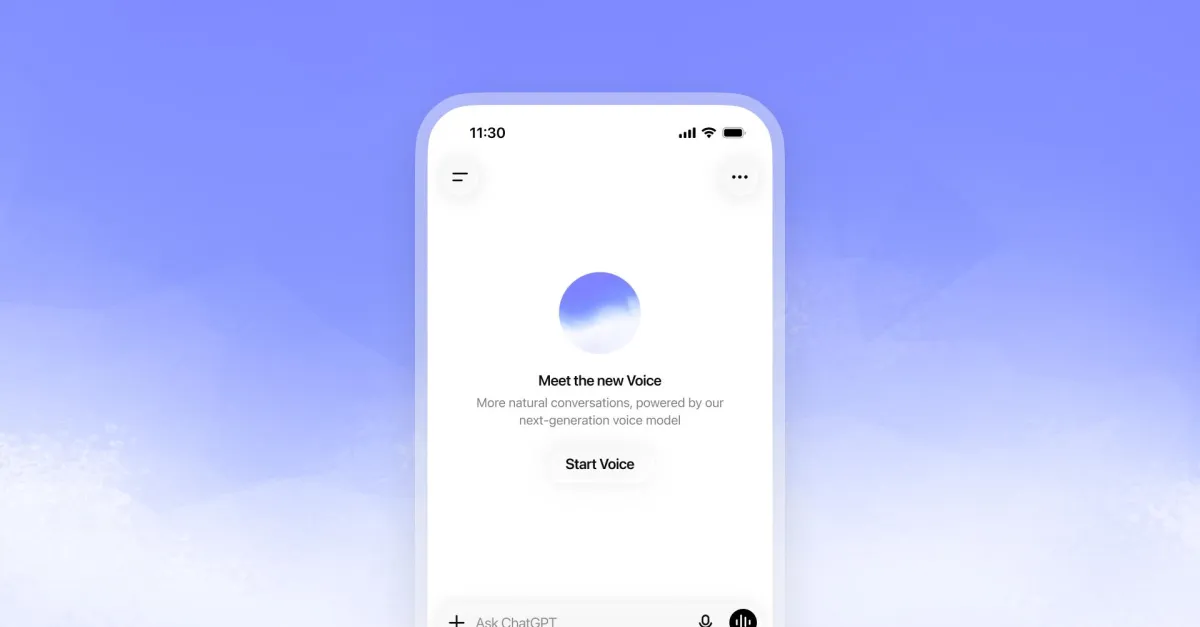
OpenAI is pushing ChatGPT’s voice experience closer to the way people actually talk: overlapping, pausing, changing course and occasionally needing a machine that knows when to stop. The company has introduced a new voice model, GPT-Live-1, that it says is more responsive, more natural and far less likely to interrupt users mid-thought.
The upgrade marks one of the most significant changes to ChatGPT’s voice mode since its debut. Instead of the older, turn-based approach that required users to wait for a back-and-forth exchange to finish before continuing, GPT-Live-1 is designed for continuous conversation. It can listen while it speaks, respond with less delay and hand off tasks to stronger text models when it needs deeper reasoning or fresh information.
OpenAI is also adding new behavior controls, including a “hold” style mode that lets users keep ChatGPT quiet until called on again. The company says the system is now better suited for real-time translation, quick factual updates and voice interactions that feel closer to speaking with another person than querying a software feature.
What OpenAI changed in ChatGPT Voice
The headline improvement is simple: the assistant should interrupt less. But under the hood, the change is much larger. GPT-Live-1 is a full-duplex voice model, which means it can process incoming speech and generate outgoing speech at the same time. In practical terms, that allows a more fluid exchange, including moments when the user pauses briefly without losing their turn.
OpenAI says the new model is built to wait when a speaker pauses mid-sentence rather than jumping in too early. That makes it better suited to the natural rhythms of conversation, where people often stop to think, search for a word or reconsider what they are saying.
According to OpenAI product lead Atty Eleti, the move to full duplex processing is what unlocks the new behavior. The company’s earlier voice system depended on a more rigid sequence in which one side had to finish before the other could continue. The new approach lets the assistant listen and talk at once, continuously handling streams of input and output rather than enforcing a strict turn order.
OpenAI described the new setup as a full-duplex model, meaning it can listen and speak simultaneously while continuously processing speech in both directions.
Why the old voice mode felt clunky
ChatGPT’s previous voice system was useful, but it often felt constrained. Because it handled conversations in turns, the assistant could sound less natural and sometimes fail to keep pace with the flow of a live exchange. In some situations, that made it more likely to cut in too soon or miss the conversational cues that human speakers use all the time.
That limitation mattered because voice is not just another interface. People use it differently from text. They pause, interrupt, correct themselves, ask follow-up questions before a thought is complete and expect the assistant to keep up without demanding perfect syntax. A model that only understands one sentence at a time can feel slow or awkward in those settings.
OpenAI’s update is a clear attempt to narrow that gap. Rather than treating voice as a spoken version of text chat, the company is moving toward a system that can handle the messiness of actual dialogue.
GPT-Live-1 and the shift to hybrid reasoning
One of the most important architectural details is that GPT-Live-1 does not do everything by itself. When it needs to reason more deeply or look up information, it can automatically route the request to OpenAI’s more capable text models, including GPT-5.5. That means the voice layer can stay quick and conversational while the heavier thinking happens elsewhere.
This division of labor is increasingly common in AI products. Fast models are used for immediate interaction, while larger models handle search, synthesis or more complex reasoning. The result is intended to preserve the feeling of conversation without sacrificing answer quality when the question becomes more difficult.
In OpenAI’s framing, the voice model becomes the front door to a more capable system. Users speak naturally, the assistant responds in real time and the platform quietly decides whether it needs to consult a stronger model before answering.
What that means for users
- Faster conversational responses with less awkward waiting.
- Better handling of pauses, interruptions and mid-sentence corrections.
- Automatic escalation to stronger text models for harder questions.
- More natural support for spoken translation and live interaction.
New voice features: translation, visual context and quiet mode
OpenAI is using the model upgrade to introduce several practical new features. The most notable is real-time translation. Instead of waiting for a user to stop speaking before translating the entire segment, ChatGPT Voice can now translate while the person is still talking. That makes the feature more useful in live settings such as travel, informal meetings or conversations where speed matters more than polished phrasing.
Another addition is the ability to tell ChatGPT Voice to stay silent until it is invited to speak again. According to OpenAI, this was not possible in the previous voice system. The assistant can now acknowledge that it is still following along with short verbal signals such as “mhmm,” “yeah” or “got it,” while holding off on a fuller answer.
The model is also being used to enrich certain categories of conversation with AI-generated visuals. OpenAI says voice interactions about weather, markets and sports will now be accompanied by relevant on-screen graphics, such as forecast details or live scores. That suggests the company sees voice not as a replacement for the ChatGPT interface, but as one part of a multi-modal experience that can blend speech, text and visuals depending on the topic.
Where visuals fit into the voice experience
The use of graphics is especially notable because it reflects how often spoken queries are really information-seeking prompts rather than open-ended conversation. A user asking about the forecast or the latest score may want an instant visual summary as much as an audio response. By layering graphics into voice, OpenAI is trying to keep the session interactive without forcing the user to switch contexts.
That approach may also give ChatGPT Voice a stronger role in everyday utility tasks. A spoken question about the weather or stock performance can now come back with data that is easy to scan, rather than a purely verbal readout.
How OpenAI says it is handling safety
With more natural voice behavior comes a familiar AI challenge: ensuring the system remains safe, especially in emotionally sensitive situations. OpenAI says GPT-Live-1 includes built-in safeguards that can redirect harmful prompts or shut down conversations entirely when the context is considered high risk.
The company says the model is trained to provide crisis hotline guidance vetted by experts when conversations involve self-harm. It also says the new voice system is designed to produce age-appropriate responses for teenagers, indicating that the company is trying to tailor behavior based on user context.
Those safeguards arrive at a time when OpenAI is facing multiple lawsuits alleging that ChatGPT contributed to delusional thinking or worsened users’ mental health. While the company has not linked the new voice release directly to those cases, the timing makes safety messaging especially important. A more conversational assistant may be easier to use, but it can also create stronger emotional expectations and a greater sense of trust.
OpenAI says the upgraded voice system can steer away from harmful replies, end conversations in higher-risk scenarios and surface expert-vetted crisis help when needed.
Why a more human-like voice model matters
The voice assistant market has been moving steadily toward lower friction and greater realism. People increasingly expect AI systems to understand natural speech patterns, recognize hesitations and continue a conversation without forcing a strict Q-and-A rhythm. In that sense, OpenAI’s latest update is part of a broader competition to make AI assistants feel less like tools and more like responsive companions.
That may sound like a cosmetic shift, but it has product implications. A voice assistant that can wait, listen and resume smoothly is more likely to be used for long sessions, translated conversations, quick lookups and assisted brainstorming. It can also make the overall system feel more capable, even if the actual intelligence behind the scenes is being shared between multiple models.
For OpenAI, the upgrade also helps differentiate ChatGPT from simpler voice interfaces. The company is not just making speech output faster; it is trying to preserve the continuity of a live conversation while retaining access to its most capable reasoning systems.
How GPT-Live-1 compares with the previous system
| Feature | Older voice mode | GPT-Live-1 voice mode |
|---|---|---|
| Conversation style | Turn-based, more rigid | Full-duplex, more continuous |
| Interruptions | Could interrupt or respond too soon | Designed to interrupt less |
| Pauses mid-sentence | Less tolerant of hesitation | Waits for the user to continue |
| Reasoning and search | Handled more directly by the voice model | Can route to stronger text models like GPT-5.5 |
| Real-time translation | Less suited to live translation | Can translate while the user is speaking |
| Visual support | Limited or absent | Can show relevant AI-generated visuals |
| Quiet mode | Not available | Can stay silent until called on |
Rollout details and subscriber access
OpenAI says GPT-Live-1 is rolling out across iOS, Android and the web, expanding the voice feature across the main places people use ChatGPT. The company is also splitting access by subscription tier and user type.
Go, Plus and Pro subscribers will receive the full ChatGPT Voice experience powered by GPT-Live-1. Free users will instead get GPT-Live-mini-1, a smaller model that OpenAI says is more efficient and better suited to the needs of the free tier.
This tiered structure reflects a familiar pattern in AI product launches: the most advanced capabilities appear first, while lighter or cheaper variants serve broader usage. It also suggests OpenAI sees voice as valuable enough to reserve its highest-quality experience for paying customers, while still offering a capable version to non-subscribers.
Access at a glance
- Go subscribers: Full GPT-Live-1 voice mode.
- Plus subscribers: Full GPT-Live-1 voice mode.
- Pro subscribers: Full GPT-Live-1 voice mode.
- Free users: GPT-Live-mini-1 by default.
- Platforms: iOS, Android and web.
What this says about OpenAI’s product strategy
The update reveals several things about where OpenAI is trying to take ChatGPT. First, the company clearly wants voice to be more than a novelty. By adding real-time translation, visual overlays and the ability to hold conversation naturally, it is turning voice into a serious interface for information retrieval and everyday assistance.
Second, OpenAI is signaling that the future of ChatGPT may be increasingly modular. Instead of one model doing everything, the experience can now be assembled from multiple layers: a responsive speech model up front, more powerful text models behind the scenes, and specialized safeguards handling sensitive scenarios.
Third, the company appears to believe that the value of conversational AI lies not just in what it can answer, but in how it behaves while answering. Reducing interruptions, respecting pauses and acknowledging the user with small verbal cues may seem minor, but in voice interfaces those details can define whether the product feels usable or frustrating.
Competitive pressure in AI voice assistants
OpenAI is not making this move in a vacuum. AI companies have been racing to improve voice-based interactions because spoken interfaces can be more immediate and emotionally engaging than text. For users who want to talk to an assistant hands-free, or who need quick help while moving through the real world, voice can be a major differentiator.
That competition is likely to intensify as companies continue to fold speech, vision and reasoning into the same product ecosystems. The winning assistant may not be the one that sounds most polished in a demo, but the one that best handles the reality of human conversation: interruptions, corrections, background noise, uncertainty and the need to keep going without restarting from scratch.
OpenAI’s latest release is a sign that the company understands that challenge. GPT-Live-1 is not just about sounding better. It is about making the assistant behave in ways that feel more adaptive, less mechanical and more useful when conversation happens in real time.
What to watch next
The key question is whether the new voice mode will actually feel more natural in everyday use. Real-time speech systems often sound impressive in a controlled demo and less reliable in messier environments. Network latency, background noise, speech accents and sudden context shifts can all affect how smooth the experience becomes.
Another open question is how users will respond to the model’s more human-like behavior. An assistant that waits, acknowledges and speaks continuously may feel dramatically better than the old version, but some users may still want tighter control, more explicit turn-taking or less conversational filler.
For now, the release shows OpenAI doubling down on voice as a core ChatGPT surface rather than a side feature. If the rollout performs well, it could set a new baseline for what users expect from an AI assistant they can actually talk to.
And if it works as advertised, the best thing about ChatGPT’s upgraded voice mode may be that it finally knows when to let people finish a sentence.
Key facts about GPT-Live-1
| Item | Details |
|---|---|
| Model name | GPT-Live-1 |
| Main improvement | Full-duplex voice interaction with fewer interruptions |
| Reasoning path | Can route complex tasks to text models such as GPT-5.5 |
| New capabilities | Real-time translation, quiet mode, AI visuals |
| Safety features | Guardrails for harmful content, crisis support, teen-appropriate responses |
| Availability | iOS, Android and web |
| Paid tiers | Go, Plus and Pro |
| Free tier model | GPT-Live-mini-1 |
OpenAI’s redesign makes a clear bet: the next frontier in consumer AI is not only smarter answers, but smoother conversations. If voice is going to matter, it has to sound less like a prompt engine and more like a live exchange. GPT-Live-1 is OpenAI’s latest attempt to close that gap.