In short
Anthropic launched Claude Duet, a consumer-facing AI agent for work tasks, as a limited research preview in the US. Early testing suggests the product is promising for organization but still needs better judgment about when to act and when to stay quiet.
- Claude Duet is a limited US research preview for Pro, Max and Ultra subscribers, depending on the outlet’s reporting.
- The AI agent connects to work apps and can surface priorities, briefings and suggested actions across email, calendar and documents.
- Anthropic requires approval for major actions and blocks high-risk financial activity.
- The Verge said Duet is helpful for organization but can be too eager to draft writing and message users.
- Early feedback will shape future versions, including timing, messaging and broader access.
Anthropic has launched Claude Duet, a consumer-facing AI agent aimed at work tasks, as a limited research preview in the United States. The new tool is meant to help professionals and small business owners handle everyday office work across apps, but early testing suggests its biggest challenge is not automation capacity — it is judgment.
What Anthropic launched
Claude Duet is Anthropic’s latest push to move Claude beyond chat into action. The company is positioning the product as a work-focused agent rather than a general-purpose chatbot, with Anthropic describing it as built for “professionals and small business owners.”
According to Mint, the preview is available to Claude Pro and Max users in the US, while The Verge says access extends to Pro, Max and Ultra subscribers, also through a waitlist. In either case, the launch is limited and not yet broadly open to all users.
That restraint matters. Anthropic is not presenting Duet as a finished consumer release, but as a research preview designed to test how people respond when an AI system can look across work apps, infer priorities and propose next steps on its own.
How does Claude Duet work?
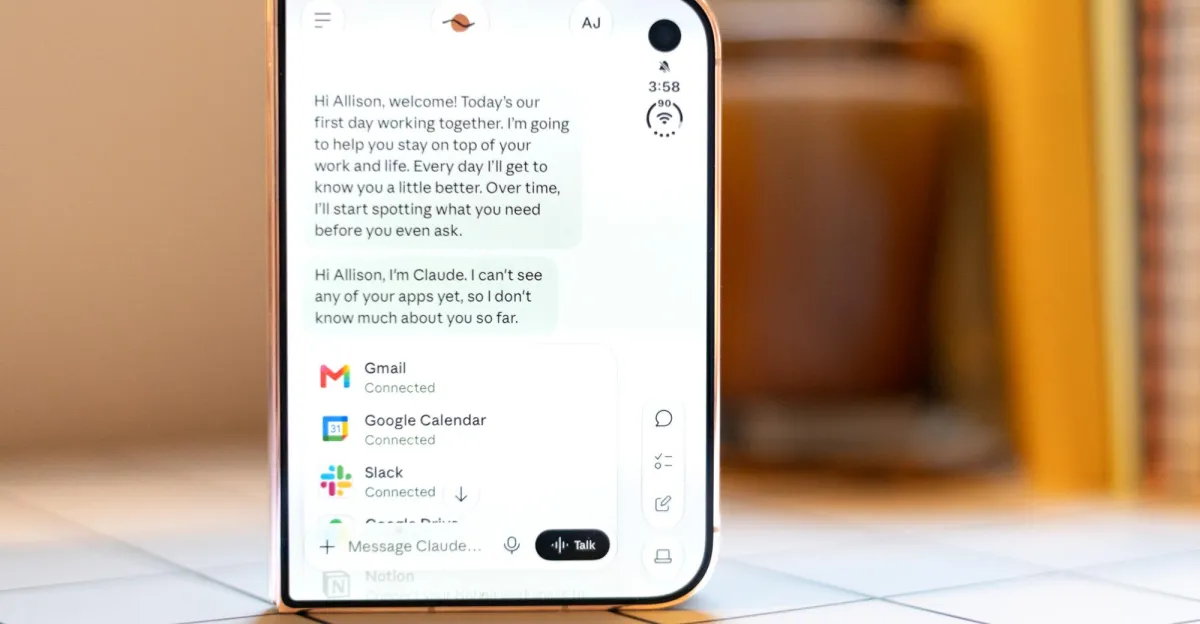
Claude Duet is designed to monitor connected services and surface tasks before a user explicitly asks. Mint says the app proactively surfaces priorities rather than waiting for prompts, while The Verge reports that it connects to work tools and suggests possible actions through swipeable cards.
In practical terms, that means Duet is not just waiting in a chat window. It can use data from multiple services to assemble context and then present a morning briefing, a deadline reminder or a suggested action based on what it finds.
The Verge said its hands-on test involved email, calendar, Google Docs and Slack access. The outlet reported that Duet could connect meeting notes, emails and Slack context to build a fuller picture of what a user might need to do next.
Mint added that the system supports more than 6,000 business integrations through Claude Marketplace connectors and plugins. That puts the tool in a category that is meant to plug into the daily software stack many workers already use, rather than ask them to change habits around a standalone chatbot.
What Duet can and cannot do
The promise of Claude Duet is that it can reduce the overhead of coordination. The reality, at least in this first public test, is that it still needs guardrails.
Anthropic says significant actions need user approval before the agent can send messages, make payments, apply signatures or delete information. Mint also says the agent cannot trade securities or move money between accounts, even with approval.
That limitation shows Anthropic is treating Duet as an assistant with careful constraints, not a fully autonomous worker. The company is trying to balance usefulness with the risks that come with giving software access to inboxes, calendars and files.
Why it matters
Claude Duet is part of a broader race to make AI agents useful in ordinary office settings, not just in demos. If Anthropic can make Duet reliable enough to help people organize email, schedule around meetings and identify urgent tasks, it could become a practical productivity layer rather than a novelty.
For users, that would mean less time spent scanning tabs and more time spent acting on prioritized information. For Anthropic, it would be a way to deepen Claude’s role in work software and create a more compelling reason for subscribers to stay inside its ecosystem.
But the stakes are higher than convenience. Consumer AI agents that sit inside email, calendars and document tools raise familiar concerns about permissions, overreach and security. The fact sheet notes prompt injection and broad automation as common risks in agentic software, and those risks are especially relevant when an agent can move through multiple work tools.
There is also a trust problem. A system that suggests actions too aggressively can become annoying or even counterproductive. A system that waits too long loses the main appeal of being proactive in the first place.
Background: how Anthropic got here
Anthropic has been steadily extending Claude from a conversational model into a product that can support work. That direction fits the company’s larger effort to build AI systems that are not only informative, but useful in real workflows.
AI agents are designed to take actions across apps, not just answer questions. That is the key shift underpinning products like Claude Duet. Instead of asking a model to summarize a document or draft a reply in isolation, users are being asked to let the system look across their digital life and decide what deserves attention.
That evolution helps explain why this launch is framed as a research preview. Consumer AI agents have repeatedly run into the same basic problem: they are powerful enough to reach into sensitive systems, but still imperfect at deciding what matters, when to act and how to avoid mistakes.
Anthropic is also entering a crowded and cautious phase of the agent market. The company is testing whether the product can be helpful without becoming intrusive, and whether a work-oriented assistant can win users over when it has to earn their confidence task by task.
What The Verge found in testing
The Verge’s hands-on report offered the clearest sense of where Claude Duet stands today. The outlet said the agent was useful for organization, but sometimes too eager to draft writing and occasionally overreactive.
That is a revealing split. On one hand, the tool appears capable of stitching together context from multiple sources and presenting it in a way that makes a workday easier to manage. On the other hand, it still needs refinement in deciding how assertive it should be.
The Verge also said Anthropic is still testing when the agent should message users. That detail sounds small, but it gets to the core of agent design. If an assistant reaches out too often, it becomes noise. If it stays silent, it misses the point of being proactive.
“test its judgment about when to message you”
That line, attributed to Anthropic by The Verge, captures the central product question more clearly than any feature list. Duet is not just a technical exercise in connecting services. It is a live experiment in timing, confidence and restraint.
Access, tiers and rollout
For now, Claude Duet is limited to the United States and gated behind paid subscriptions. The Verge reported access for Pro, Max and Ultra subscribers, with a waitlist. Mint described the preview as available to Pro and Max users in the US, with no Team or Enterprise access yet.
The difference in reporting appears to be about which tiers were included at launch or in testing, but both outlets agree on the larger point: this is a narrow rollout aimed at a small group of users rather than a broad public release.
Mint also says Duet has standalone apps and web access, which suggests Anthropic wants the tool to feel like a dedicated product rather than a hidden feature. That matters because agents are often easier to imagine than to use. A separate app gives the product a place to live in the workflow.
By the numbers
| Metric | Details | Source |
|---|---|---|
| 6,000+ | Business integrations and connectors in Claude Marketplace | Mint |
| US | Current availability region | The Verge / Mint |
| Pro, Max, Ultra | Subscription tiers mentioned for access | The Verge |
| Pro, Max | Subscription tiers mentioned for access | Mint |
| Claude Opus 5.5 | Model powering Duet, according to Mint | Mint |
Security and control are doing the heavy lifting
The most important part of the product may be what it is not allowed to do. Anthropic says Duet needs user approval for major actions, including sending messages, making payments, signing documents and deleting data. Mint also says it cannot trade securities or move money between accounts, even with approval.
Those rules are not just fine print. They are the scaffolding that makes a consumer AI agent plausible at all. Without them, the product would cross too many lines too quickly for most users to trust it.
The fact sheet also notes that Duet runs on a virtual machine with its own browser and uses Claude Opus 5.5. That setup suggests Anthropic is trying to isolate the agent’s activity while still giving it enough freedom to navigate connected services.
In the current market, that kind of architecture is as important as the model itself. Users may be willing to let an AI organize their day, but they are far less likely to hand it unconstrained access to financial or legal actions.
What happened in the hands-on test?
The Verge’s experience suggests Claude Duet is already capable of helping with information management, but not yet polished enough to remove human supervision from the equation. It can scan across a user’s work context, assemble likely priorities and surface suggestions in a visually structured format.
At the same time, the outlet found it could be overzealous. That tension is central to the product’s future: the more ambitious Duet becomes, the more carefully Anthropic has to tune when it intervenes and how it frames recommendations.
That tuning will matter for everything from a routine email follow-up to a time-sensitive travel reminder. A useful assistant is one that understands not only what is happening, but what should matter first.
What happens next
The near-term future of Claude Duet will depend on how early users react during the research preview. Anthropic says early-user feedback will shape future development, which means the current version is less a final product than a feedback mechanism.
The biggest open questions are straightforward:
- How well will Duet handle nuance, timing and priorities in real work settings?
- Will Anthropic expand access beyond US Pro, Max and Ultra users?
- When, if ever, will Team and Enterprise plans be added?
- How quickly can Anthropic improve the agent’s judgment about when to speak up?
- Will users trust it with more sensitive workflows over time?
Those questions are not abstract. They will determine whether Duet becomes a useful daily assistant or another AI product that impresses in a demo but fades in routine use.
For now, Anthropic has drawn a clear line around the product’s scope. Claude Duet is a limited US-only research preview, tied to paid subscriptions, with enough automation to be useful and enough restrictions to keep the company from overpromising. The coming test is whether that balance feels smart to users or simply cautious.
Timeline
| Date | Milestone |
|---|---|
| 2026-10-22 | Mint reports Anthropic introduced Claude Duet |
| 2026-11-13 | The Verge publishes a hands-on review of Claude Duet |
In a crowded AI market, that balance may matter more than raw capability. Anthropic is not just trying to make an assistant that can act. It is trying to make one that knows when to wait.
Frequently asked questions
What is Claude Duet?
Claude Duet is Anthropic’s consumer-facing AI agent for work tasks. It is designed to monitor connected services, surface priorities proactively and suggest actions for professionals and small business owners, rather than simply answering prompts in a chat window.
Who can use Claude Duet right now?
Claude Duet is only available in the United States as a limited research preview. The Verge says it is for Pro, Max and Ultra subscribers with a waitlist, while Mint says it is available to Pro and Max users and not yet to Team or Enterprise customers.
What can Claude Duet do?
Claude Duet can connect to work tools such as email, calendars, Google Docs and Slack, then use cross-app context to send morning briefings, highlight priorities and suggest possible next steps. Mint says it also supports more than 6,000 business integrations through Marketplace connectors and plugins.
Is Claude Duet fully autonomous?
No, Claude Duet is not fully autonomous. Anthropic says significant actions require user approval before the agent can send messages, make payments, sign documents or delete information, and Mint says it cannot trade securities or move money between accounts.
Why does Claude Duet matter?
Claude Duet matters because it shows how AI agents are moving from answering questions to managing work across apps. Its success will depend on whether users trust it to be proactive without becoming intrusive, inaccurate or overly eager to act.