Updated July 15, 2026 11:56 pm
In short
Fountain 0’s AI-made Odysseus: The Fall is being pitched as a low-budget, AI-forward stunt timed to Nolan’s The Odyssey, with new details revealing the trailer’s tools and the project’s self-promotional intent.
- Fountain 0’s Odysseus: The Fall is a digitally released AI-generated feature planned for later this summer.
- The announcement arrives alongside major buzz for Christopher Nolan’s The Odyssey, making the timing highly strategic.
- The trailer suggests heavy use of AI video tools, with uncanny visuals and synthetic performances.
- The project appears designed as both a film and a marketing vehicle for Fountain 0’s AI workflow.
- The release reflects a broader trend of AI entertainment projects relying on stunts, not audience demand.
Update — July 15, 2026 11:56 pm
Fountain 0’s latest framing is even more explicit about the film’s purpose: the company now describes Odysseus: The Fall as a way to market its AI production workflow, not just an adaptation riding Nolan’s buzz.
The updated source also adds that the trailer was made with Kling’s video generator and Google’s Nano Banana, and says the film’s Odysseus character was modeled on director Ash Koosha himself, with Koosha voicing the entire cast.
More broadly, the new version sharpens the comparison to other AI publicity stunts, drawing a parallel with ElevenLabs’ AI-narrated The Odyssey audiobook and Particle6’s plans for an avatar-led feature.
Fountain 0 has announced Odysseus: The Fall, an AI-generated retelling of The Odyssey that it plans to release digitally later this summer, positioning the project as both a film and a demonstration of its artificial-intelligence production tools. The move is notable because it arrives just as Christopher Nolan’s own The Odyssey adaptation is poised to dominate theaters, highlighting how AI entertainment startups are increasingly using borrowed cultural moments to market low-budget, machine-made projects.
The announcement underscores a growing pattern in which AI companies are leaning on spectacle, controversy, and familiar intellectual property to attract attention. Rather than presenting a new artistic standard, projects like Odysseus: The Fall are being framed as proof-of-concept ads for the technology behind them, raising fresh questions about whether AI-generated entertainment can win audiences on its own merits.
What Fountain 0 announced
Fountain 0 says Odysseus: The Fall will be available to rent or buy online later this summer. The movie is being directed by Ash Koosha, who previously worked with the company on Dreams of Violets, an AI-produced docudrama focused on civil unrest and state violence in Iran.
According to the company, Koosha was able to write, direct, and edit the film on a budget in the “mid-five figures,” a figure that is tiny compared with the reported $250 million behind Nolan’s version of The Odyssey. Fountain 0 has presented that cost gap as evidence of how cheaply and quickly AI can manufacture feature-length content.
| Project | Creator / Studio | Format | Reported Budget | Release Plan |
|---|---|---|---|---|
| Odysseus: The Fall | Fountain 0 / Ash Koosha | AI-generated feature | Mid-five figures | Digital rental or purchase later this summer |
| Dreams of Violets | Fountain 0 / Ash Koosha | AI-generated docudrama | About $2,000 | Previously released |
| The Odyssey | Christopher Nolan / Universal | Major studio feature | Reportedly $250 million | In theaters this weekend |
Why the timing matters
The timing of Fountain 0’s announcement is impossible to ignore. Nolan’s The Odyssey is arriving in theaters this weekend and is expected to take in roughly $80 million to $100 million over its opening stretch, according to early industry projections. The buzz around the film has already put Homer’s epic back into the cultural spotlight, making it a useful target for a company hoping to piggyback on a much larger release.
That strategy appears deliberate. By linking its own AI project to one of the most visible movies of the summer, Fountain 0 can borrow some of the attention generated by a major studio release without having to build audience awareness from scratch. In practice, the company is treating a classic story not as a work to be reinterpreted with care, but as a marketing hook for its technology stack.
How the trailer signals the film’s approach
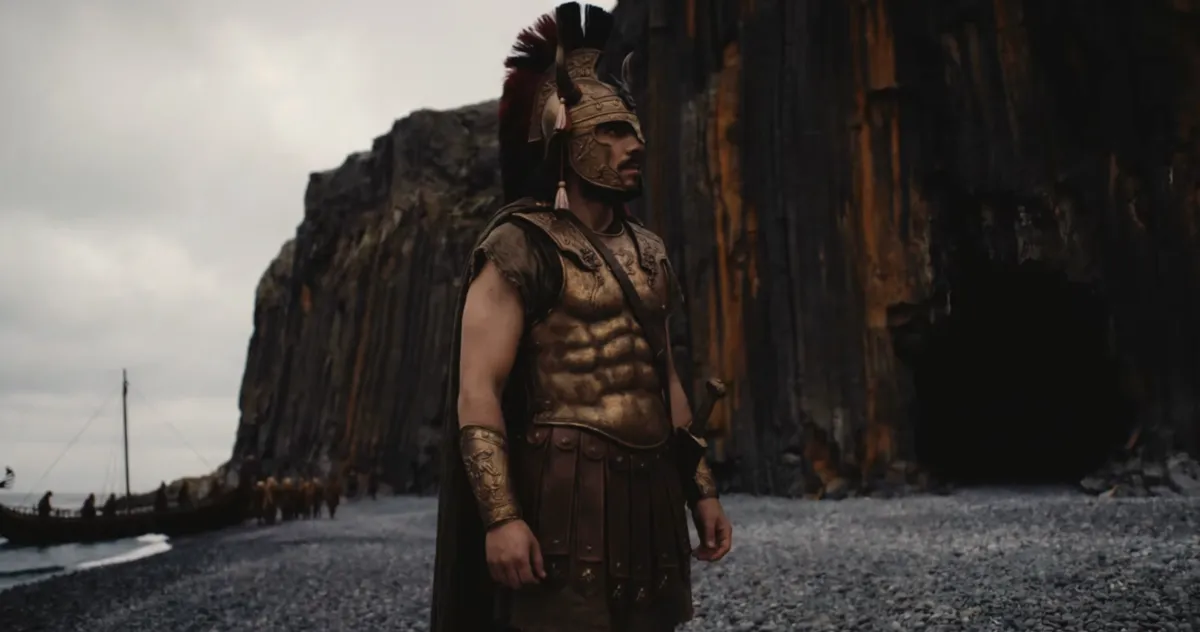
The released trailer suggests that Odysseus: The Fall is less a conventional adaptation than a showcase for AI-generated visuals. It appears to rely on Kling’s video generator and Google’s Nano Banana image tool, producing short, highly polished shots that carry the glossy, synthetic look now associated with AI slop.
The characters are also tied closely to the people behind the project. Koosha reportedly modeled the lead character on himself, and he provides the voices for the entire cast. Even so, the characters’ movement and speech still appear stiff and uncanny, reinforcing the sense that the film is designed to demonstrate what AI can assemble quickly rather than what it can make emotionally convincing.
How Fountain 0 is selling the project
Fountain 0 is not hiding the fact that Odysseus: The Fall is meant to be a showcase for its production workflow. The company is pitching the movie as a sign of what AI-enabled filmmaking can do at scale, with executives presenting the project as an example of efficiency, speed, and technological ambition.
In comments to Variety, executive chairman Tom Rogers said the target audience includes people who may not be interested in going to theaters but are curious about AI and its capabilities. That framing makes the film sound less like a creative adaptation and more like a product demo packaged as entertainment.
Tom Rogers said the company sees the film as a way to draw in people who are interested in AI as a technology, and as a comparison point between traditional filmmaking and what he described as the current state of the art in AI production.
Rogers also argued that the movie could encourage viewers to see Nolan’s version afterward, so they could compare the results of “the highest state of human filmmaking achievement” with what AI can do today. The implication is clear: Fountain 0 is using the contrast itself as a selling point, even if that contrast ultimately emphasizes the limitations of machine-generated storytelling.
What makes AI movie stunts so controversial?
AI movie stunts are controversial because they often rely on borrowed prestige, minimal labor, and a heavy dose of provocation to appear relevant. Instead of competing with major films through storytelling, craft, or emotional depth, these projects frequently market themselves through novelty, celebrity mimicry, or the spectacle of how little they cost to make.
That approach has become especially visible as entertainment companies try to translate generative-AI buzz into consumer demand. But the results so far have often looked like advertising rather than art, with the final product serving mainly as proof that the tool exists.
Why comparison to Nolan is unavoidable
Any AI-generated Odyssey project released near Nolan’s film will inevitably be judged against the enormous scale of the studio production. That comparison is not just about budget. It is about the fact that large-scale cinema typically depends on the coordination of writers, designers, performers, camera crews, editors, composers, and visual-effects teams working in concert.
By contrast, Fountain 0 has emphasized that Koosha and his brother Pooya handled most of the work on Odysseus: The Fall themselves. While that may sound efficient, it also strips away the collaborative infrastructure that gives traditional filmmaking its emotional and artistic weight. For many viewers, the human effort behind the final image is the point.
Dreams of Violets showed both the promise and the problem
Dreams of Violets, Fountain 0’s earlier collaboration with Koosha, offered a clue to how the company thinks about AI-generated media. The project reportedly cost just $2,000 and was framed around political violence and unrest in Iran, giving it at least some claim to topical urgency.
Even so, the film was described by critics as resembling a collection of generated clips more than a disciplined documentary or drama. That perception matters because it shows how cheaply made AI projects can struggle to establish coherence, mood, or narrative momentum, even when they are trying to speak to serious real-world events.
If Odysseus: The Fall is meant to represent a leap forward, it still has to overcome the same issue: whether the tool creates a convincing film or simply a sequence of eye-catching fragments stitched together under the label of cinema.
How does this fit into the broader AI entertainment push?
This development fits into a larger wave of AI-driven experiments across entertainment, where startups and toolmakers are trying to prove that generative systems can replace or imitate parts of the creative process. The pitch is often similar: lower costs, faster production, and limitless scalability.
But the actual release strategy often reveals something else. Rather than quietly building audiences, many of these companies seem to be chasing virality by provoking artists, fans, and critics. The more attention they can generate through outrage or novelty, the more they can position themselves as inevitable players in the industry.
- AI-generated films are often marketed as demonstrations of technical capability first and stories second.
- Familiar titles and iconic characters make these projects easier to notice, even if they invite backlash.
- Low budgets are used as proof that AI can disrupt the traditional production model.
- Audiences, however, still tend to respond most strongly to emotional resonance and craftsmanship.
Other examples of the same strategy
Fountain 0 is not alone in taking this route. Another high-profile example is ElevenLabs’ AI-narrated audiobook version of The Odyssey, which used a synthetic facsimile of Michael Caine’s voice. The project was widely discussed not because listeners demanded it, but because it raised questions about consent, identity, and the commercial use of recognizable performance styles.
Similarly, Particle6 has repeatedly pushed the idea of “AI actress” Tilly Norwood, a generated avatar that the company wants the public to treat as a serious creative proposition. These efforts suggest a common playbook: create a concept that sounds absurd, push it aggressively, and hope the controversy itself creates market value.
Who benefits from AI filmmaking spectacles?
The companies behind these projects appear to benefit the most, especially when the projects function as commercials for their underlying software. Even if a film draws ridicule, the company can still claim it has proven a pipeline, attracted press coverage, and entered the conversation around the future of entertainment.
That makes the project useful for brand building, investor interest, and product positioning. It is less clear, however, whether audiences gain anything meaningful from the arrangement. If the final work does not move viewers, and if the technology does not yet create something better than established methods, the spectacle may simply be self-promotion in a different form.
Fountain 0’s messaging suggests that the movie is intended to spark curiosity about AI filmmaking as much as to function as a standalone artistic work.
Why audiences still matter more than buzz
Buzz can launch a campaign, but it cannot sustain a film culture on its own. The reason audiences show up for a major movie like Nolan’s The Odyssey is not simply the title or the technology. It is the expectation of a carefully crafted experience shaped by human judgment, taste, and collaboration.
That is why many AI entertainment efforts run into a wall. They may be able to imitate surface-level aesthetics, but they struggle to reproduce the deeper reasons people care about cinema: tension, performance, emotional texture, originality, and the sense that real artists have wrestled with a story until it feels alive.
What the reaction to Nolan’s film reveals
The intense anticipation, praise, and even criticism surrounding Nolan’s movie are themselves evidence of cinema’s enduring power. A film that can provoke that much feeling is already doing something that most AI stunts cannot: it is creating a cultural event rather than merely advertising a tool.
That distinction matters for the business of entertainment. Studios still depend on audience excitement to sell tickets, subscriptions, and long-term franchises. If generative AI cannot produce work that people genuinely want to discuss, revisit, and recommend, then cost savings alone are not enough to justify its place at the center of the industry.
The bigger question for Hollywood
Hollywood is still trying to determine where AI belongs in production, post-production, and marketing. In some cases, the technology may be useful for visual development, pre-production workflows, localization, or supporting tasks that do not define the final creative voice. But projects like Odysseus: The Fall push the industry toward a more uncomfortable question: can AI-generated movies become desirable cultural products, or will they remain mostly demonstrations of automation?
For now, the answer appears to lean toward the latter. The fact that AI firms keep turning to stunts, mimetic branding, and opportunistic tie-ins suggests that the technology has not yet earned audience trust on content quality alone. If the pitch must always be “look how cheaply we made this” or “compare us to a better movie,” the value proposition remains weak.
Timeline: How this story developed
| Date / Period | Event | Why it matters |
|---|---|---|
| Late 2025 to early 2026 | Fountain 0 and Ash Koosha released Dreams of Violets | Established the company’s AI-first production approach |
| This week | Fountain 0 announced Odysseus: The Fall | Confirmed another feature-length AI project tied to a classic story |
| This weekend | Nolan’s The Odyssey opens in theaters | Creates the cultural moment Fountain 0 is trying to exploit |
| Later this summer | Odysseus: The Fall is expected to go on digital sale or rental | Signals the company’s direct-to-viewer release strategy |
What happens next?
The immediate test will be whether Odysseus: The Fall can attract viewers beyond the AI-curious crowd. If the film is memorable only as a curiosity or a provocation, it will reinforce the argument that generative entertainment still relies on controversy more than craftsmanship.
If, on the other hand, Fountain 0 can persuade audiences that its workflow produces something emotionally persuasive, it could become a modest case study in AI filmmaking’s next phase. For now, though, the project looks less like a rival to Nolan than a loud attempt to stand in his shadow.
That may be the clearest lesson of all: the AI hype machine can imitate a film launch, but it still cannot easily manufacture the sense of anticipation that comes from a work people actually want to see.
Frequently asked questions
What is Odysseus: The Fall?
Odysseus: The Fall is an AI-generated feature project announced by Fountain 0 and directed by Ash Koosha. The company says it is a reimagining of The Odyssey and plans to release it digitally later this summer as a rental or purchase title.
Why is Fountain 0 releasing this movie now?
The timing appears designed to capitalize on the publicity surrounding Christopher Nolan’s The Odyssey, which is opening in theaters this weekend. By launching its own Odyssey-themed project now, Fountain 0 can borrow attention from a much larger and more anticipated film.
How much did Odysseus: The Fall cost to make?
Fountain 0 says the film was made on a budget in the mid-five figures. That is far below the reportedly $250 million cost of Nolan’s The Odyssey and is being used to promote AI’s potential for low-cost production.
What tools were used to make the trailer?
The trailer appears to rely on Kling’s AI video generator and Google’s Nano Banana. The result is a stylized, synthetic look with short shots and stiff motion that makes the project feel more like a generated demonstration than a traditional film.
Is this part of a larger trend in AI entertainment?
Yes, it is part of a wider trend in which AI companies use provocative entertainment projects to market their tools. Similar examples include AI-narrated audiobooks and avatar-led film concepts that generate attention by mimicking familiar media rather than creating truly original hits.