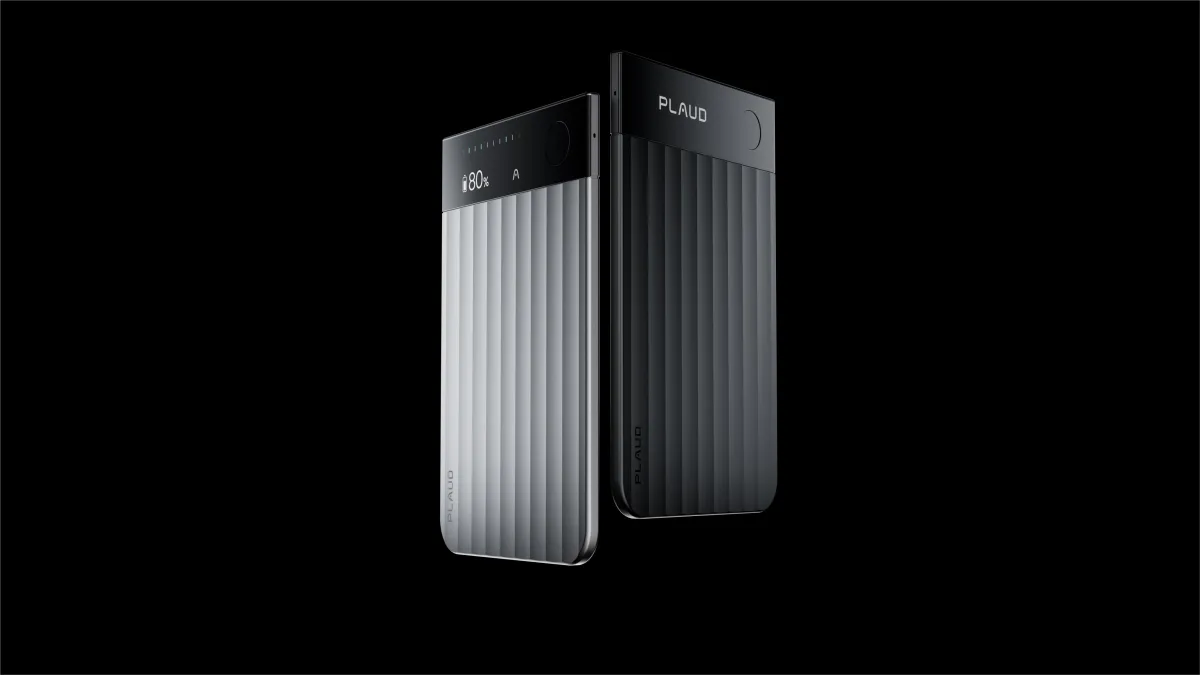
Plaud says its business has reached a major milestone that few AI hardware companies can claim: more than 2 million devices shipped and over $100 million in annualized revenue run rate from subscriptions. The company, best known for screenless AI notetakers that clip to a phone or sit on a desk, is positioning itself as one of the clearest examples that consumer hardware can still work in the AI era — if it solves a specific, repeated problem.
The startup’s latest figures underline a simple bet: millions of professionals are willing to pay for a device that records conversations, turns them into notes and surfaces action items without requiring them to type furiously during meetings. Plaud’s growth also suggests that, at least in certain categories, the future of AI may not be purely software delivered through a browser window or chat interface.
Instead, Plaud is leaning into a more tactile pitch. Its devices are designed to capture in-person and online discussions, then convert them into summaries, transcripts and follow-up points after the meeting ends. The company argues that this approach reflects how work actually happens — in rooms, over calls and in conversations that are easy to forget once the day gets busy.
A hardware company built around the meeting problem
Plaud’s core products are compact AI-powered note-taking devices, including Plaud Pin and Plaud Pro, which sell at roughly the same price point as a premium consumer accessory. The devices are intentionally minimalist: there is no display to distract the user, and the product is meant to disappear into the background while it captures audio.
That simplicity is central to the company’s value proposition. Rather than asking users to open an app, start a recording, and later sift through a long file manually, Plaud wants to create a near-automatic workflow for meetings. The device records, transcribes and organizes the material into notes that are easier to revisit and share.
In a crowded AI market dominated by chatbots, productivity assistants and browser-based software, Plaud has found room by focusing on a specific high-frequency use case: people who spend a large share of their day in meetings. That audience includes managers, sales teams, consultants, founders, recruiters and enterprise workers who need reliable memory support more than novelty.
Why the “post-screen” pitch matters
Plaud’s leadership frames the company as a response to the limits of screen-based AI. The idea is straightforward: many of the most useful conversations never begin in a text box. They happen face to face or on a voice call, and the value of AI is in preserving and structuring what was said afterward.
Plaud’s chief executive Nathan Xu said the company deliberately chose a different path from most AI businesses, arguing that the most important conversations do not happen on a keyboard and that the market has already rewarded the company’s “post-screen” approach.
That framing is more than branding. It reflects a larger trend in AI product design, where companies are increasingly trying to build tools around workflows rather than generic model access. For Plaud, the workflow is obvious: capture the meeting, generate the summary, extract the tasks, and let the user move on.
What the numbers say about Plaud’s momentum
The company’s headline metrics are striking for a hardware startup operating in one of the hardest categories in consumer tech. Plaud says it has shipped more than 2 million devices. It also says subscription revenue has climbed to an annualized run rate of more than $100 million, a level that indicates substantial paid usage beyond the initial hardware purchase.
That subscription figure matters as much as the device shipments because the real economics of the business appear to come from recurring software revenue. Like many hardware companies, Plaud sells the device first, then monetizes ongoing transcription and advanced features through plans that users can upgrade to.
Plaud says nearly half of device owners move from the basic tier to higher-priced pro or unlimited plans. The company did not disclose total revenue, but an annualized run rate above $100 million suggests a business that has escaped the earliest-stage novelty phase and is now operating at scale.
| Metric | Latest figure | What it suggests |
|---|---|---|
| Devices shipped | Over 2 million | Broad adoption for a niche AI hardware category |
| Subscription ARR | More than $100 million | Recurring revenue is becoming the core business engine |
| Free transcription allowance | 300 minutes | Enough for light use, but insufficient for heavy meeting users |
| Upgrade rate | Nearly 50% of users | Strong conversion from free access to paid plans |
How Plaud makes money beyond the device
Plaud’s hardware is only part of the story. Buyers receive a limited amount of transcription time for free, and the company says that allowance is enough for casual use but quickly runs out for people sitting through multiple meetings every day. That creates a built-in incentive to upgrade.
Users who need more transcription capacity or access to premium features can pay monthly, annually or through add-on plans. This structure allows Plaud to combine a one-time device sale with recurring revenue from active users, a model that is more attractive than a single purchase but still more difficult than a pure software business.
Importantly, Plaud does not yet offer standalone software subscriptions to people who do not own its hardware. In practical terms, that means the company’s monetization is still tied tightly to its devices. It is not yet a broad SaaS platform; it is a hardware gateway into a paid AI note-taking ecosystem.
That constraint gives the company both strength and exposure. On one hand, the hardware helps define the product and create a loyal customer base. On the other hand, growth depends on continuing to sell devices in a market where competitors can potentially imitate the form factor and price strategy.
Product expansion: from a note taker to a team tool
Plaud has moved quickly to expand the software layer around its hardware. Earlier this year, it introduced a desktop application capable of capturing online meeting audio directly from a user’s system, echoing the style of other AI note-taking tools that sit inside the broader productivity market.
That move matters because it signals an effort to remain relevant even as meeting workflows become more hybrid. Not every conversation happens with a physical device clipped to clothing or magnetically attached to a phone. Some users want software that can handle remote meetings, webinars and calls without additional hardware steps.
More recently, the company launched Plaud Teams, a product aimed at organizations rather than individuals. The feature set includes shared memory, which suggests the company wants to move from personal note-taking to collective knowledge management inside enterprises.
Enterprise ambitions and the challenge ahead
The enterprise market is attractive because it can support larger contracts and deeper usage. But it is also harder to penetrate. Companies care about security, administration, compliance, data retention and integration with existing workflows.
Plaud’s move into team-based collaboration indicates it sees a future beyond individual professionals buying devices for personal productivity. If the company can prove that its notes become a useful shared asset for managers and teams, it may be able to move upmarket and raise the lifetime value of each customer.
That said, the company’s current structure still centers on a device-first purchase. A broader shift into enterprise software would require a more complete platform strategy, something Plaud has not yet fully disclosed.
The competitive landscape is getting crowded
Plaud’s progress comes in a competitive category that has started to draw multiple hardware and software entrants. The market for meeting note-taking devices now includes consumer electronics brands and startups alike, each trying to carve out an edge through design, price, transcription quality or ecosystem features.
Among the names in the field are Anker, the accessories giant; Viaim, which is backed by Transsion; Vibe, supported by Sequoia China; and Pocket, a startup backed by Y Combinator. That lineup suggests the space is no longer an experiment. It is becoming a real product category with enough promise to attract capital and distribution muscle.
Competition may also intensify as larger software companies continue to improve their own meeting tools. The long-term question is whether a dedicated device can maintain its advantage as phone operating systems, conferencing apps and AI assistants add stronger native note-taking features.
What differentiates Plaud today
- Dedicated hardware: The devices are designed solely for note capture, reducing friction during meetings.
- Screenless design: The lack of a display supports the “background” usage model.
- Recurring revenue: Subscriptions create a more durable business than a one-off gadget sale.
- Multi-format workflow: Plaud now supports both physical devices and desktop meeting capture.
- Enterprise push: Shared memory and team features indicate a broader workplace strategy.
Why AI hardware remains hard
For all the enthusiasm around new AI devices, the category has struggled to produce many breakout consumer successes. Hardware requires manufacturing, shipping, customer support, returns handling and inventory management — all before the software economics even begin to matter.
That makes Plaud’s reported scale notable. Hitting more than 2 million shipped units suggests the company has solved not just product-market fit but also at least some of the operational challenges that sink hardware startups. The more difficult test may be sustaining momentum as early adopters are replaced by mainstream buyers.
There is also the issue of habit formation. A meeting assistant only becomes indispensable if it is consistently accurate, easy to use and valuable enough that users trust it with sensitive conversations. If note quality slips or the workflow becomes cumbersome, users may revert to simpler tools or built-in recording features.
In that sense, Plaud is not just selling a gadget. It is selling confidence — the promise that important details will not be lost after the meeting ends.
The broader AI market context
Plaud’s success arrives at a moment when the AI industry is increasingly divided between pure software platforms and products that attach AI to a real-world use case. Chat interfaces remain central to the conversation, but the market has also started rewarding specialized tools that solve concrete pain points.
Meeting notes are a natural fit for AI because the task is repetitive, high-volume and easy to measure. A user can immediately tell whether a summary is useful, whether action items are accurate and whether the transcript saves time. That makes the category especially suitable for subscription monetization.
At the same time, the product sits at the intersection of privacy, workplace etiquette and workflow efficiency. Recording devices in meetings can be sensitive, and organizations may need clearer rules around consent and data storage before widespread adoption is possible.
That means Plaud’s next stage of growth may depend not only on engineering and sales, but also on trust. The company will need to reassure both individuals and enterprises that its devices are safe, useful and easy to govern.
What Plaud’s milestone means
In a sector crowded with experiments, Plaud has produced one of the stronger signs that AI hardware can become a real business when it is tied to a specific work habit. Two million shipped devices and a subscription ARR above $100 million do not guarantee a lasting category winner, but they do show that users are willing to pay for an AI tool that helps them remember and act on conversations.
The company’s challenge now is to prove that its lead is durable. It must defend against rival hardware makers, improve its software, expand into teams and enterprises, and keep the product indispensable as the market evolves. The early numbers are strong. The next phase will determine whether Plaud becomes a lasting hardware brand or simply the first standout in a wave of AI note-taking devices.
For now, Plaud has made a case that there is still room for a new kind of AI company — one that starts with a physical object, not a prompt box, and builds revenue by helping people capture the meetings that shape their work.
| Milestone | Approximate timing | Significance |
|---|---|---|
| Launch of Plaud Pro | Last year | Established the premium hardware line |
| Introduction of Plaud Pin S | This year | Expanded the lineup at a similar price point |
| Desktop app release | Earlier this year | Added software-based meeting capture |
| Plaud Teams debut | Last month | Signaled a move toward enterprise collaboration |
| 2 million devices shipped | Current milestone | Evidence of scale in a difficult hardware category |
| $100M+ ARR | Current milestone | Shows recurring revenue strength |