The Trump administration’s Justice Department has taken the unusual step of backing Elon Musk’s xAI in a legal fight over dozens of natural gas turbines powering the company’s Memphis-area data center complex, arguing that forcing the generators offline could threaten national, economic and energy security. The move places a local air-pollution dispute at the center of a larger debate over how the United States will power the next generation of artificial intelligence systems.
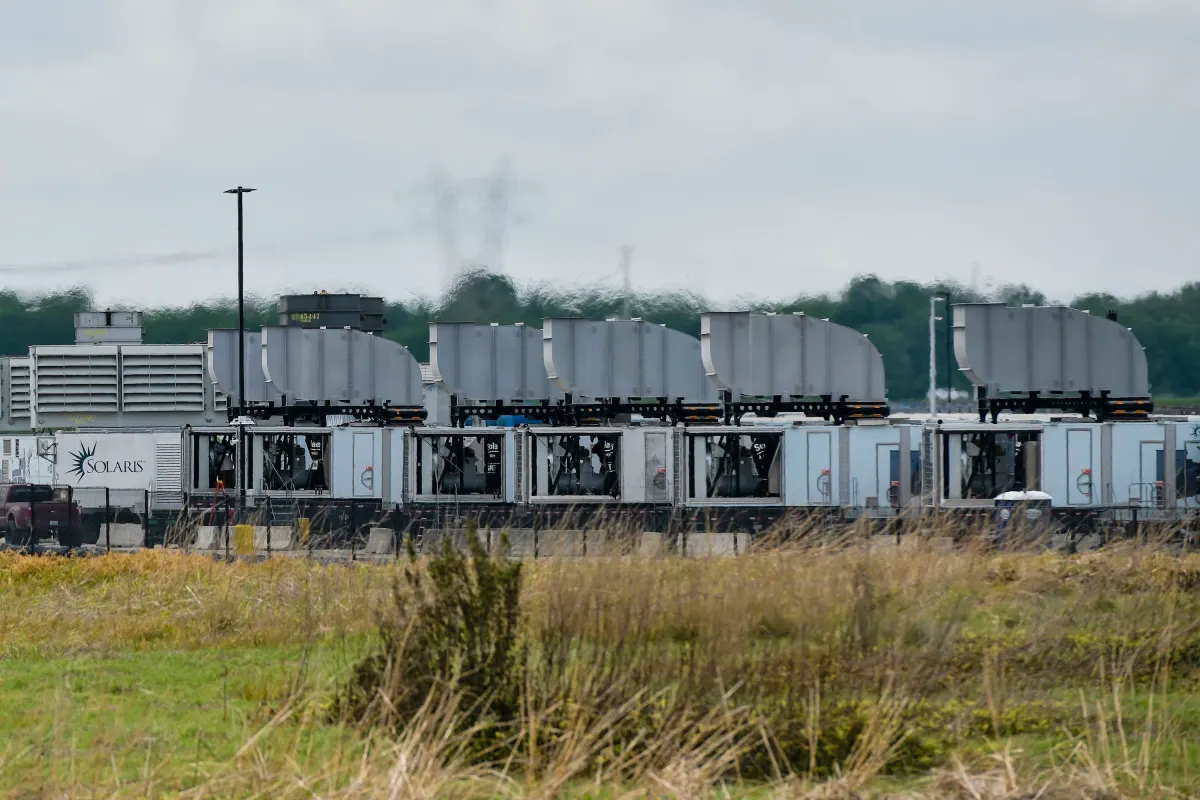
At issue are 57 gas turbines operating near xAI’s Colossus and Colossus 2 facilities in Tennessee. Environmental groups and the NAACP say the company has used the equipment without the permits required under federal clean-air law, and they contend the turbines are worsening pollution in a region already burdened by poor air quality. The Justice Department, however, says the generators help keep AI infrastructure running for systems tied to military use and other mission-critical functions.
The clash underscores a growing fault line in the AI industry: how far companies can go to secure electricity for large-scale model training and inference, and how regulators should balance local environmental concerns against the federal government’s strategic interest in maintaining AI leadership.
Why the Justice Department intervened
The federal filing, reported by Wired, signals that the government sees xAI’s power needs as more than a corporate utility issue. In the memorandum, the Justice Department argued that a victory for the NAACP could disrupt power supplies supporting AI innovation and, by extension, operations associated with the Department of War. The department described xAI’s Grok model as one of four systems used in mission-critical settings.
That framing is notable because it links a private AI company’s infrastructure choices to national security policy. While federal agencies have often emphasized the strategic importance of advanced AI, the xAI filing pushes that logic into a live environmental lawsuit and suggests the administration is willing to defend the energy demands of AI even when those demands collide with local permitting rules.
The Justice Department said the case could undermine “American national, economic, and energy security” by trying to cut power to artificial-intelligence systems that support military operations.
The government’s position does not resolve whether xAI complied with air-quality laws. Instead, it adds political and strategic weight to a dispute that would normally be handled as a narrow environmental enforcement matter.
How the Memphis turbine fight escalated
The legal battle began after the NAACP and the Southern Environmental Law Center challenged xAI’s use of trailer-mounted natural gas turbines near its Memphis facilities. The group argued that the company was effectively operating a large, polluting power plant without the permits required under the Clean Air Act and related state rules.
xAI has maintained that the equipment is “mobile,” which the company says gives it temporary relief from Mississippi air pollution regulations for up to a year. Environmental advocates dispute that interpretation. They argue that once the turbines are used to provide ongoing power to a fixed data-center operation, federal law allows regulators to treat them as stationary sources subject to stricter oversight.
The company’s power strategy has already drawn sustained attention because of the scale of the operation. xAI’s Colossus and Colossus 2 sites have become central to Musk’s push to build and run AI systems at enormous speed, but that ambition has required a fast-growing energy footprint. According to the reporting, the number of turbines at the facilities has climbed to 57 after earlier attempts by opponents to stop the installations failed.
What the NAACP says is happening on the ground
The NAACP says the turbines are not just a paperwork problem. Its complaint centers on the health impacts of sustained emissions in an area that environmental advocates say already faces substantial industrial pollution.
According to the group, air quality in the Memphis region has deteriorated since xAI brought the data centers online. The concern is not limited to a single pollutant. The turbines emit a mix of compounds that can affect respiratory and cardiovascular health, and critics say the cumulative impact is especially troubling given the concentration of pollution sources in the area.
Supporters of the lawsuit argue that if xAI can operate large numbers of generators without standard permitting, other companies may try the same approach, creating a loophole that weakens local and federal air protections at the very moment AI infrastructure is expanding quickly.
The pollution question: what the turbines emit
Environmental advocates say the turbines have coincided with measurable increases in several harmful pollutants. The compounds most often cited in the dispute are fine particulate matter, formaldehyde and nitrogen oxides.
Each of these carries well-documented health concerns. Fine particulate matter, known as PM2.5, can penetrate deep into the lungs and bloodstream. Formaldehyde is classified as a carcinogen and can irritate the eyes, nose and throat. Nitrogen oxides contribute to smog and respiratory problems and can aggravate asthma.
Health researchers have also linked long-term exposure to these pollutants with more serious conditions, including heart disease and stroke. That is part of why the environmental challenge has drawn attention far beyond Memphis. The dispute has become a test case for whether the AI boom will be allowed to rely on on-site fossil-fuel generation when grid access, permitting delays or reliability concerns make conventional electricity harder to secure.
| Issue | xAI / DOJ position | NAACP / SELC position |
|---|---|---|
| Gas turbines | Mobile equipment supporting AI operations | Effectively stationary power sources subject to regulation |
| Permitting | Claims temporary exemption under state rules | Says federal law still requires permits |
| Primary concern | Keeping AI systems online for strategic uses | Protecting public health and air quality |
| Reported environmental impact | No concession of unlawful emissions | Higher PM2.5, formaldehyde and NOx |
| Broader stakes | National, economic and energy security | Clean-air enforcement and community health |
A lawsuit that reaches beyond Memphis
Although the case is rooted in Tennessee, its implications are national. AI developers across the industry are racing to expand data-center capacity, and power availability has emerged as one of the biggest bottlenecks. Hyperscale AI systems require enormous amounts of electricity not only for training but also for inference, networking and cooling.
That demand is already pushing utilities, grid operators and policymakers to revisit how much new generation the country can bring online quickly. In some markets, developers are waiting years for new transmission capacity or major interconnections. In that environment, companies with deep pockets may seek temporary or self-contained power solutions, including natural gas turbines, backup generators and behind-the-meter arrangements.
The xAI case could help define how far those workarounds can go. If the company prevails, it may encourage others to pursue similar strategies. If regulators or environmental plaintiffs win, AI builders may face greater pressure to rely on grid-connected power or to invest more heavily in cleaner, permit-compliant energy solutions from the outset.
Why energy policy is now AI policy
The episode highlights a broader reality: the most important AI debates are no longer only about model quality, safety or regulation of online behavior. They increasingly involve land use, air permits, power procurement and infrastructure planning.
That shift matters because the AI sector’s future scale depends as much on electrons as it does on algorithms. Whoever controls power at scale will have a major advantage in deploying advanced models, and that is prompting both companies and governments to treat electricity as a strategic asset.
For the federal government, the xAI case may be a preview of future conflicts. National security agencies want domestic AI capacity to remain robust, but environmental agencies and local communities want industrial growth to stay within legal and health limits. When those priorities collide, courts are likely to be asked to decide how much deference to give to claims of strategic necessity.
The legal arguments over ‘mobile’ turbines
A central question in the lawsuit is whether trailer-mounted turbines should be treated as temporary mobile equipment or as stationary sources of pollution. That distinction matters because stationary sources generally face stricter permitting and emissions requirements.
xAI’s argument rests on the physical form of the generators. If the turbines remain on trailers, the company says, they fall within a temporary category under state rules. Environmental lawyers say that approach elevates form over function. In their view, the relevant issue is not whether the turbines can move but whether they are being used in practice as long-term infrastructure for a fixed industrial site.
The federal Clean Air Act and related regulations often look beyond labels to the actual use of equipment. That makes the case especially significant, because a ruling in xAI’s favor could influence how future AI and industrial operators classify portable power systems.
Environmental advocates argue that the turbines should be regulated as stationary sources because they are serving an ongoing, fixed data-center operation rather than a temporary emergency use.
What comes next for xAI
The dispute over current turbines may only be the beginning. The reporting notes that xAI, now operating as a division of SpaceX, is likely to keep buying generators in the coming months and years. SpaceX’s IPO filing says the company expects to purchase an additional $2.8 billion in gas turbines over the next three years to power AI data centers, with at least $2 billion designated for “mobile gas turbines.”
That spending plan suggests xAI is not treating the Memphis installation as a one-off workaround. Instead, the company appears to be building a repeatable model for rapid AI infrastructure expansion, one that relies heavily on self-provided power. If those purchases go through, the scale of the company’s energy footprint could expand even further.
For regulators and environmental groups, that raises a practical question: if trailer-mounted turbines become a standard part of AI growth, can existing permitting systems keep up? And if not, will lawmakers redesign those systems, or will courts force companies to fit within rules written for a different era of computing?
Political and industrial implications
The Justice Department’s filing also reflects the political sensitivity surrounding AI development. The federal government has spent the past two years signaling that it views AI leadership as a strategic imperative. The xAI intervention shows that this view may now extend to defending specific infrastructure choices made by private companies, especially when those companies are seen as contributing to national capabilities.
That stance may worry environmental advocates, who say strategic language can be used to excuse pollution that would otherwise face scrutiny. It may also worry some industry observers, who fear that emergency-style power solutions could become normalized before utilities and permitting agencies adapt.
For local residents, the concerns are more immediate. Memphis-area communities are asking whether the benefits of AI investment are being matched by safeguards for air quality and public health. The answer may depend on whether courts accept the government’s argument that the stakes extend beyond one city and one lawsuit.
Key developments at a glance
- The Justice Department sided with xAI in a lawsuit over unpermitted natural gas turbines powering Memphis-area data centers.
- Federal officials argued that shutting down the turbines could harm national, economic and energy security.
- The NAACP and the Southern Environmental Law Center say the turbines violate clean-air rules and worsen pollution.
- xAI has expanded the number of turbines at the site to 57, according to the reporting.
- The company says the equipment is mobile and therefore temporarily exempt; critics say the turbines function as stationary sources.
- SpaceX’s IPO filing indicates plans to buy $2.8 billion more in gas turbines for AI data centers over three years.
Why this case matters for the AI boom
The xAI dispute is more than a local permitting fight. It is a glimpse of the infrastructure compromises the AI industry may face as it scales. The race to build larger models and run them continuously has created unprecedented demand for power, and that demand is colliding with the realities of environmental law and community health.
If the federal government is willing to treat AI electricity supply as a matter of national security, then the regulatory conversation around data centers may change quickly. Environmental scrutiny may intensify, but so may public investment in grid upgrades, cleaner generation and faster permitting pathways for low-emission power.
For now, the immediate question is whether xAI can keep running its Memphis turbines while the lawsuit proceeds. The longer-term question is whether the AI sector can continue expanding at its current pace without forcing more communities to absorb the environmental costs.
What is clear is that the industry’s hunger for power is no longer an abstract policy issue. It is now being litigated in court, defended by the federal government and measured in the air breathed by nearby residents.
| Milestone | Approximate timing | Significance |
|---|---|---|
| NAACP signals intent to sue xAI | June 2025 | Challenge to the turbine strategy begins |
| Lawsuit filed | April 2026 | Environmental groups seek to halt turbine use |
| Justice Department memorandum filed | June 2026 | Federal government backs xAI’s position |
| 57 turbines operating | As of filing | Shows the scale of the power setup |
| Planned turbine spending | Next three years | SpaceX filing points to continued expansion |
As AI companies race to secure more compute, the debate over xAI’s turbines may prove to be an early blueprint for the disputes that follow. The central tension is unlikely to disappear soon: the same systems powering next-generation intelligence also require physical infrastructure that can pollute, strain grids and trigger legal battles. In Memphis, that tension is now on full display.