Updated August 14, 2026 4:25 pm
In short
Higgsfield’s AI feature Cully Hill Boys is a hybrid production built from a human-written script, licensed likenesses and a multi-model prompting workflow that the company says produced unusually cohesive AI-generated scenes.
- Higgsfield released Cully Hill Boys as a showcase for its AI filmmaking tools.
- The movie is based on a human-written screenplay and licensed performer likenesses.
- Prompts, longer video clips and post-production editing were central to the workflow.
- The film’s most convincing elements still come from human story structure and direction.
- The project highlights both the progress and the limits of AI-generated cinema.
Update — August 14, 2026 4:25 pm
Higgsfield’s breakdown of Cully Hill Boys now includes a few more specifics about the production pipeline. The company says it generated multiple versions of individual shots before settling on what made the final cut.
It also says the work had to be divided across different model jobs because one task would get in the way of another. That meant separate prompt-writing setups were used for image generation and for the video clips that became the film.
According to the updated material, the prompts were mostly written in English, but some were in Simplified Chinese. Higgsfield also says Seedance 2.5 can produce clips of roughly 30 seconds, which helps explain why the movie feels less chopped up than many other AI videos.
Update — August 13, 2026 7:24 pm
The updated source adds a few concrete details about how the movie was put together. Higgsfield says Seedance 2.5 can generate clips of about 30 seconds, which helps explain why the finished film feels less chopped up than many other AI videos.
It also says the workflow was split across multiple model jobs because, as the company put it, the constraints of one task interfere with the next. In practice, that meant separate prompt-writing setups were used for image generation and for video clips.
The source further notes that the prompts were not all in one language: most were written in English, while some were in Simplified Chinese. It also says the team generated many different versions of individual shots before choosing what appeared in the final cut.
Higgsfield has unveiled Cully Hill Boys, a feature-length AI-generated film built from a human-written screenplay, celebrity likeness licenses, and a sprawling prompt workflow that the company says demonstrates what its Cinema Studio tools can do. The project matters because it is one of the clearest public examples yet of how generative video can imitate the shape of a conventional movie while still relying heavily on human storytelling, performance rights, and editorial judgment.
The release is also a pointed piece of marketing. By publishing the film alongside many of the prompts used to make it, Higgsfield is trying to show filmmakers, studios, and creators how its model stack can be used to assemble a polished-looking action comedy from a mix of text prompts, generated clips, voice work, and edited image assets.
What emerges is less a simple proof that AI can replace moviemaking than a reminder that the most convincing parts of the finished product still depend on human craft. The film’s structure, pacing, and character beats come from a script written by a person. The best visual flourishes lean heavily on recognizable cinematic styles. And the whole production sits inside a workflow that still needs careful supervision to keep the output coherent.
What is Cully Hill Boys, and why is Higgsfield pushing it now?
Cully Hill Boys is Higgsfield’s latest AI filmmaking showcase, released online rather than through theaters so the company can demonstrate its tools directly to would-be users. The movie is designed to function both as entertainment and as an extended product demo for Higgsfield’s Cinema Studio suite, including its newly promoted Seedance 2.5 capability.
The timing is strategic. AI video generation is advancing quickly, but most public examples still look fragmented, awkward, or obviously synthetic. By releasing a feature with more narrative flow and more elaborate action scenes, Higgsfield is making a bid to persuade the market that AI filmmaking is moving beyond short clips and rough experiments.
At the same time, the company is using the film to normalize a particular production model: a hybrid workflow in which human writing, voice, likeness licensing, prompt engineering, and generative video all sit inside the same pipeline. That is the bigger story behind the movie’s glossy surface.
How the film was made
Cully Hill Boys was assembled through a layered production process that relied on both human and machine input. Higgsfield says the project was co-directed by Adilet Abish and Aitore Zholdaskali, who also worked on the company’s earlier AI feature Hell Grind. According to Higgsfield, the directors led a team of nine additional filmmakers while stitching the movie together from generated assets and scripted scenes.
The underlying story came first. The screenplay was originally written by Tim Planagan, who later placed it on the Black List, the well-known industry service for unproduced scripts. Higgsfield then secured AI production rights to adapt the material while Planagan kept the option to produce the story traditionally in the future.
That point is important. The movie is not simply a machine inventing a story from scratch. It begins with an actual screenplay, which gives the project a conventional dramatic spine that many AI productions lack.
Who appears in the film?
The lead characters are represented by real public figures whose likenesses were licensed for the project. The principal cast includes streamer Mikyle “N3on” Rafiq, basketball creator Matt Kiatipis, and UFC fighter Israel Adesanya.
None of them physically performed scenes on a set, but each signed agreements allowing Higgsfield to use their image and likeness in the finished work. That makes the film part performance simulation and part digital casting exercise, with the actual acting generated from photos, audio clips, prompts, and model outputs rather than live production.
Higgsfield’s approach shows how AI filmmaking is moving toward a new kind of talent economy, one built around licensing likenesses and transforming online personalities into synthetic screen performers.
The company’s casting decisions also speak to the film’s audience strategy. By using recognizable internet and sports personalities, Higgsfield is not only creating a movie; it is trying to make the project shareable, clickable, and culturally legible to fans who already know the faces involved.
What the story is about
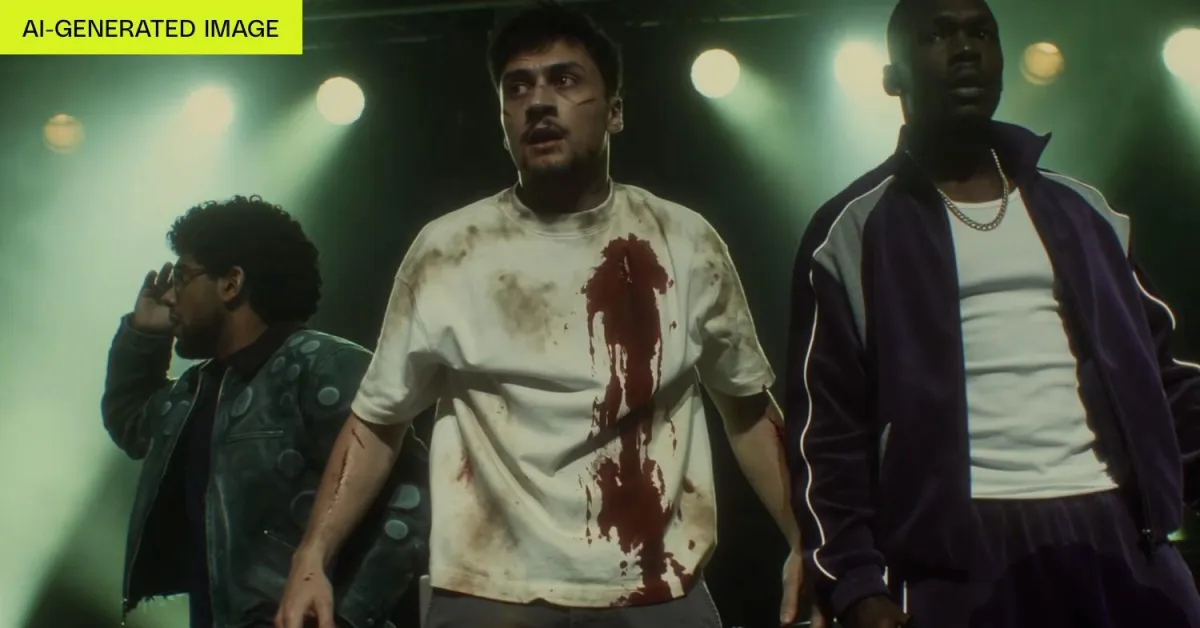
Cully Hill Boys follows three East London rappers whose friendship and ambitions are tested after they accidentally steal money from a crime boss. The setup is a classic underdog-crime premise: a mix of comedy, aspiration, bad decisions, and escalating danger.
On paper, the story has all the ingredients of a crowd-pleasing genre film. The trio dreams of fame, imagines a more glamorous future, and finds itself drawn into chaos after a criminal mistake. Higgsfield leans into that familiar arc by presenting the film as a fast-moving action comedy with stylized chase scenes, pub banter, and fantasy sequences that reflect the characters’ inflated imaginations.
What gives the film its most recognizably human qualities is the way the story is paced. The opening establishes who the characters are, what they want, and what is holding them back. Their personal problems are set up quickly but clearly, making the film feel more like an organized feature than a random chain of generated moments.
Why does the movie feel more coherent than other AI films?
The movie feels more coherent because its structure comes from a real screenplay and because the team appears to have followed the script’s beats closely during generation and editing. In many AI video projects, the seams between clips are obvious; here, the scenes often flow with more continuity and a clearer sense of escalation.
That improvement likely has a lot to do with Seedance 2.5, which Higgsfield says can generate longer clips than many rival tools. When AI models produce footage only a few seconds at a time, the result often looks stitched together. Longer clips can reduce that fragmentation, even if they do not eliminate it entirely.
Still, the movie’s coherence should not be mistaken for full synthetic autonomy. It reflects careful human oversight, script discipline, and editing choices that keep the narrative on track.
How Higgsfield used prompts to build a movie
Higgsfield made the production process unusually visible by publishing many of the prompts that helped build the film. That transparency is part technical demonstration, part marketing theater. It lets viewers see how the company chained together several AI systems to produce different pieces of the final result.
According to Higgsfield’s own materials, Anthropic’s Claude was used to generate prompts, which were then sent to Seedance 2.5 for video and speech generation. ByteDance’s Seedream and Google’s Nano Banana were also used for editing images and video elements. The company says different models were split into separate workflow roles because, in its words, “the rules of one job poison the other.”
In practice, that means one prompt-writing workflow was dedicated to generating imagery-friendly descriptions, while another focused on prompts suitable for video clips. Some of the prompts were written in English, and others in Simplified Chinese, underscoring how international and modular the production pipeline has become.
| Element | What Higgsfield used | Why it mattered |
|---|---|---|
| Screenplay | Tim Planagan’s original script | Provided the story structure and pacing |
| Directors | Adilet Abish and Aitore Zholdaskali | Guided the AI workflow and editing |
| Lead performers | N3on, Matt Kiatipis, Israel Adesanya | Supplied licensed likenesses and voice assets |
| Prompt generation | Anthropic Claude | Helped create production prompts |
| Video generation | Seedance 2.5 | Produced longer clips and synthetic speech |
| Image/video editing | Seedream, Nano Banana | Refined visual assets across the workflow |
Why human influence is still obvious on screen
The most revealing thing about Cully Hill Boys is that its best material does not feel purely machine-made. The pacing, the banter, and the broad rhythm of the plot suggest a human writer who understands how a scene should build and release tension. That is why the film often feels closer to a conventional direct-to-video crime comedy than to the more erratic AI shorts that have flooded the internet.
At the same time, the synthetic nature of the production remains visible. Some on-screen text is unreadable. Character chemistry can feel thin. The emotional transitions are occasionally too smooth or too generic, as if the film knows how to imitate genre behavior without always understanding what gives a moment its weight.
That tension sits at the heart of the project. It looks like a movie because humans planned it to resemble one, and because the machine systems were guided tightly enough to produce something coherent. But the final product also makes clear that today’s AI tools still need human writers, directors, and editors to avoid collapsing into randomness.
What does the movie borrow from Edgar Wright and Guy Ritchie?
The film borrows heavily from the visual language associated with Edgar Wright and Guy Ritchie. Higgsfield’s prompts reportedly reference “Guy Ritchie coverage” and “Edgar Wright snap” style editing, signaling a deliberate attempt to recreate the energy of fast-cut British crime filmmaking.
That is not unusual in traditional cinema, where directors regularly study and echo one another. The difference here is that the AI systems appear to have been instructed through prompts to approximate those signatures, which raises broader questions about how generative models are trained and how style is encoded, imitated, and monetized.
Several of the movie’s action-heavy sequences clearly aim for that kind of kinetic, swaggering rhythm. The result is not an exact copy of any one filmmaker’s work, but it is unmistakably rooted in that tradition.
Higgsfield’s prompts make clear that the film’s creators were not trying to invent a wholly new visual language; they were trying to translate familiar cinematic styles into AI-readable instructions.
How close is this to a mainstream AI movie?
Cully Hill Boys is still better understood as a polished demonstration than as a fully mainstream feature film. It may be one of the most convincing AI-generated movies released so far, but it is not yet a project likely to replace studio-backed entertainment or attract large theatrical audiences on its own terms.
The film’s likely audience is narrower and more specialized: fans of the creators, observers of AI video, developers, industry insiders, and people curious about the future of digital production. For them, the project offers a useful look at what a more mature AI production pipeline can produce when enough human labor is wrapped around it.
For everyday moviegoers, the experience may still feel novel more than satisfying. The appeal comes less from the story itself than from the fact that the movie exists at all in this form.
What this means for Hollywood, creators, and IP holders
The release of Cully Hill Boys highlights a developing business model in which AI companies can turn scripts, likeness rights, and creative labor into proof-of-concept products. That creates new opportunities for production, but it also sharpens the debate over compensation, consent, and the value of human authorship.
For performers and creators, the film demonstrates how likeness licensing may become an increasingly important revenue stream. For screenplay writers, it suggests that AI production rights might become a parallel market alongside traditional adaptation rights. For AI companies, it shows that successful demos may depend on sourcing high-quality human material before any model is asked to generate a frame.
That last point may be the most consequential. The movie strongly implies that AI filmmaking is currently strongest when it is least autonomous. The better the source material, the better the output. The more disciplined the direction, the less obviously synthetic the result. In other words, the machine is getting better at executing human intent, not replacing it.
Timeline: how Cully Hill Boys came together
The project’s path from script to online release shows how many steps now sit between an idea and a synthetic film.
| Stage | What happened | Significance |
|---|---|---|
| Script development | Tim Planagan wrote the screenplay | Gave the project a traditional narrative base |
| Industry circulation | The script landed on the Black List | Signaled professional interest in the story |
| Rights deal | Higgsfield acquired AI production rights | Allowed adaptation through generative tools |
| Likeness licensing | Performers agreed to digital use of their image and voice assets | Enabled synthetic casting |
| AI assembly | Prompts, generated clips, and edits were created using multiple models | Built the final film |
| Public release | The movie and prompts were posted online | Turned the project into a showcase for Cinema Studio |
Why the best parts still feel human
The strongest scenes in Cully Hill Boys work because they are built on recognizable storytelling instincts: setup, contrast, escalation, and payoff. The characters are introduced with enough specificity to make them readable. The conflict develops in a way that feels earned. And the film knows when to linger and when to move.
That does not mean the project escapes the limitations of AI generation. Rather, it shows how much human knowledge has to be layered into the process to make the technology look good. The script writer, directors, prompt authors, rights holders, and editors all help hide the rough edges.
In that sense, the film is not a triumph of AI over cinema. It is a demonstration that AI becomes far more persuasive when it is embedded inside old-fashioned filmmaking discipline.
What viewers should watch for
Anyone interested in the future of synthetic media should pay attention to three things in the film:
- the way the narrative stays organized despite heavy use of generative tools;
- the way the visuals borrow from established film styles rather than inventing a new one;
- and the way licensed likenesses and human-authored scripts remain central to the project’s appeal.
Those elements suggest where the industry may be headed next: toward hybrid productions that use AI for scale and speed, but still depend on human talent for taste, structure, and legitimacy.
The bigger takeaway
Cully Hill Boys is not simply another novelty AI film. It is an intentionally transparent attempt to prove that a large-language-model-driven prompt pipeline, combined with licensed personas and a traditional screenplay, can produce something closer to a real movie than most people have seen from generative video so far.
But the film also inadvertently makes a second argument: the more convincing AI cinema becomes, the more obvious it is that human artists are still doing the hardest creative work. In that way, Higgsfield’s showcase may be less a replacement for filmmaking than an admission that, for now, the machine is best at amplifying human choices rather than inventing its own.
That may be enough for marketers, developers, and early adopters. Whether it will be enough for audiences is a very different question.
Frequently asked questions
What is Cully Hill Boys?
Cully Hill Boys is an AI-generated feature film released by Higgsfield to demonstrate its Cinema Studio filmmaking tools. The movie combines a human-written script, licensed likenesses, generated video, and AI-assisted editing into a crime-comedy story about three East London rappers.
Who wrote Cully Hill Boys?
Cully Hill Boys is based on a screenplay originally written by Tim Planagan. Higgsfield acquired the AI production rights to adapt the script, while Planagan retained the ability to produce the story through traditional filmmaking in the future.
Why is Higgsfield releasing the film online instead of in theaters?
Higgsfield is releasing the film online because its main purpose is to showcase what the company’s AI tools can do. By posting the movie and many of the prompts used to create it, Higgsfield turns the project into a product demonstration rather than a conventional theatrical release.
Did the cast act in front of cameras?
No, the cast did not shoot live-action scenes on set. Mikyle “N3on” Rafiq, Matt Kiatipis and Israel Adesanya licensed their likenesses to Higgsfield, which then used photos and audio assets to create their on-screen performances synthetically.
Is Cully Hill Boys a sign that AI can replace filmmakers?
No, the film suggests the opposite in many ways. Its strongest qualities come from a human-written script, careful direction, and close editorial control, showing that AI works best here as a tool for amplifying human decisions rather than replacing them.