Updated August 7, 2026 4:24 pm
In short
Ditto is pairing AI matchmaking with college-only verification, while also using viral marketing and inbound investor interest to fuel its early growth.
- Ditto is an AI matchmaking dating app built for college students who are tired of swiping.
- Users join by text, answer onboarding questions, and receive a weekly date recommendation every Wednesday at 7 p.m.
- The startup says it has 150,000 signups and that about 20% of connected matches turn into dates.
- Ditto has raised $9.2 million from Gradient, Peak XV and Scribble and is live at a few dozen colleges.
- The company is using viral marketing and campus verification to balance growth with safety.
Update — August 7, 2026 4:24 pm
TechCrunch adds that Ditto is leaning more heavily into safety as it tries to expand. For now, its college-only model gives it a built-in verification layer because users must sign up with a .edu email address.
The update also fills in more of the company’s backstory: Ditto now says it has 12 full-time employees, and its growth has been fueled in part by viral marketing stunts, including robot videos. The startup is also hiring a “chief yacht officer” to help with promotional parties.
On funding, TechCrunch says Ditto’s backers include Gradient, Peak XV and Scribble, and Wang said most investor interest came from inbound outreach rather than formal pitching.
Update — August 6, 2026 7:23 pm
TechCrunch also says Ditto is widening its pitch around safety as it grows, noting that the app’s current college-only setup gives it a built-in layer of verification through .edu email addresses.
The updated source adds a few more details about the company behind the app: Ditto now has 12 full-time employees and is using viral stunts, including robot videos, to attract students. It is also hiring a “chief yacht officer” to help with promotional parties.
The article further says the startup’s investors include Gradient, Peak XV and Scribble, and that Wang said most investor interest came in through inbound outreach.
Ditto, a new dating app aimed at college students, is betting that Gen Z is ready to trade endless swiping for an AI-powered matchmaker that schedules real-life dates. The San Francisco startup has already drawn 150,000 signups, raised $9.2 million in seed funding, and built a campus-focused product around one core idea: chemistry is better predicted by behavioral signals than by scrolling through profiles.
Founded by former UC Berkeley students Allen Wang and Eric Liu, Ditto is part of a growing backlash against the mechanics of swipe-based dating. Rather than asking users to hunt for matches in a feed of faces, the service uses texting, automated onboarding, and weekly date assignments to reduce friction and push people into offline interactions.
The company’s pitch reflects a broader shift among younger daters who increasingly describe mainstream apps as exhausting, superficial, and strangely disconnected from the purpose of dating in the first place. Ditto’s founders say they are building for a generation that wants less performance and more actual connection.
Why Ditto thinks dating apps need a reset
Ditto’s founders believe the problem with modern dating platforms is not a lack of people, but a lack of momentum. Allen Wang, who co-founded the company after leaving UC Berkeley, says many 20-somethings are frustrated with the repetitive cycle of swiping, matching, chatting, and then losing interest before ever meeting.
That diagnosis has become increasingly common among Gen Z users, who often describe traditional apps as time-consuming and emotionally draining. Instead of treating dating as a social feed problem, Ditto treats it as an operations problem: identify compatible people, remove the bottlenecks, and get them on a date quickly.
Wang has said the company was built after observing how his peers were changing the way they met one another. In his view, the strongest demand is not for more filters or more profiles, but for a service that can reliably move people from introduction to in-person interaction.
Wang said the company was shaped by watching Gen Z become tired of endless swiping and repetitive small talk, and by noticing a stronger appetite for real-world connection.
How does Ditto work?
Ditto works by turning the familiar app experience into a text-based concierge service. Instead of downloading a conventional dating app and browsing a stack of profiles, college students join by texting a designated iMessage number and entering a code.
From there, an AI chatbot takes over the onboarding process. It introduces itself as Ditto, a dating service created by college students for college students, and emphasizes that the platform is designed to eliminate swiping and awkward direct messages in favor of scheduled dates.
Users then answer a series of questions by text. The onboarding begins with basic information such as name, gender, and birth date, before moving into more detailed prompts about interests, personality, and dating preferences. Some users even upload images of celebrity crushes, giving the system additional clues about taste and attraction.
The company says the goal is not just to collect surface-level preferences, but to interpret what those preferences reveal about someone’s personality. In practice, that means Ditto is trying to infer compatibility from underlying traits, not just shared hobbies.
What the AI is looking for
Ditto’s matching system is designed to read between the lines. The startup says it is less interested in matching two people because they both like hiking than in understanding what that activity says about them.
A person who loves rock climbing, skydiving, and other outdoor activities may share deeper personality traits with someone whose interests include streetwear, skateboarding, and hip-hop, even if their hobbies look different on paper. Ditto argues that both people might be adventurous, independent, or drawn to novelty, and that those traits matter more than checkbox-style overlap.
That philosophy sits at the center of the product. The company’s claim is that chemistry is not random, but identifiable if a system can gather the right cues and make better use of them than a human user casually browsing profiles.
Wang has argued that compatible people often share deeper traits even when their hobbies appear unrelated, and that those signals can make chemistry more predictable.
What happens after a match?
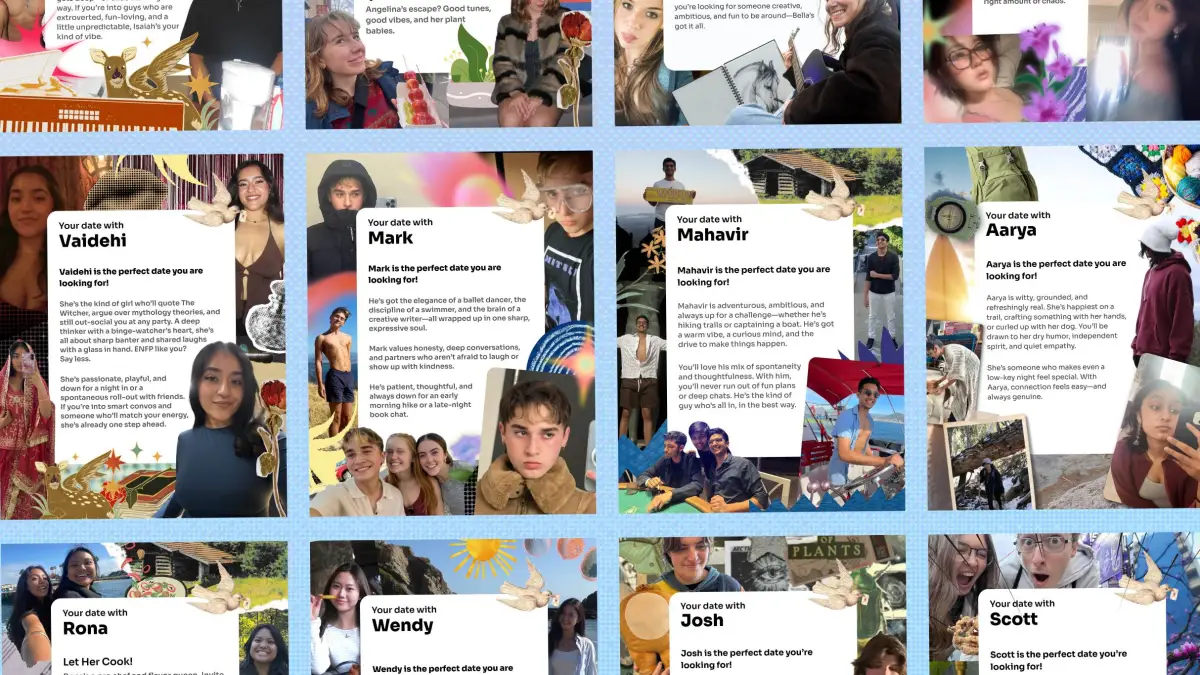
Every Wednesday at 7 p.m., Ditto sends users a match. The app does not stop at introductions. It also supplies the time and place for the date, aiming to remove the awkward back-and-forth that often stalls conversations on other platforms.
That approach is central to the startup’s strategy. Rather than letting users build endless chat threads that can fade before meeting, Ditto pushes participants toward a concrete plan and then gathers feedback afterward to improve future recommendations.
Wang describes the workflow as a feedback loop. The system learns from every date, uses that information to refine its understanding of a user, and then attempts to offer a stronger match the next week.
The product is designed to minimize the amount of work users have to do. Instead of spending time setting up logistics, they are essentially asked to show up and evaluate the result.
How big is Ditto so far?
Ditto says it has collected 150,000 signups, a notable figure for a company that is still early in its lifecycle and operating mostly on college campuses. Wang says roughly 20% of the matches the company connects result in a date.
That conversion rate may not sound impressive at first glance, but it is worth noting in the context of consumer dating apps, where matching does not necessarily translate into a conversation, let alone an in-person meeting. Ditto’s model is intentionally more aggressive about moving users offline, so a lower top-of-funnel conversion can still reflect meaningful engagement.
The company is currently available at only a few dozen schools. That limited rollout gives Ditto a more controlled setting in which to refine the product, measure outcomes, and build trust before moving to a broader audience.
| Metric | Ditto’s current status | Why it matters |
|---|---|---|
| Founders | Allen Wang and Eric Liu | Both are former UC Berkeley students building for Gen Z daters |
| Funding | $9.2 million seed round | Provides runway to expand beyond campus pilots |
| Signups | 150,000 | Shows early demand for AI-assisted dating |
| Reported match-to-date rate | About 20% | Measures how often matches turn into real dates |
| Current availability | A few dozen colleges | Limits rollout while the company tests safety and product fit |
| Weekly cadence | Wednesday at 7 p.m. | Creates a predictable routine and encourages action |
Why the startup is leaning into college campuses
College campuses offer Ditto a built-in trust layer that most dating apps lack. Students using the service generally know that the person on the other end is enrolled at the same university and has a .edu email address, which reduces some of the uncertainty that often accompanies meeting strangers online.
That verification is especially important for a product that compresses the timeline between matching and meeting. If an app is actively encouraging users to show up for a date, the company has to think seriously about identity, safety, and accountability.
For now, the university setting gives Ditto an environment in which the pool is more limited and the social graph is easier to understand. But the company’s long-term ambition goes beyond a handful of schools.
Its next challenge is to figure out how to expand safely to more campuses and, eventually, to users outside college altogether without losing the trust advantage that makes the current model viable.
Why safety is a bigger issue for AI matchmaking
Safety becomes more complicated when a dating product is optimized to reduce delay. The fewer steps between first contact and an in-person meeting, the less time there is for users to evaluate whether a match is legitimate or comfortable.
That challenge is not unique to Ditto. Larger and better-funded dating platforms have spent years trying to improve identity checks, moderation, and fraud prevention, often with mixed success. The speed that makes these apps feel efficient can also make them riskier.
Ditto’s campus-only approach is a practical response to that problem, but it is not a complete solution. As the startup grows, the company will need to prove that its AI-led system can scale without sacrificing user safety.
Where did the money come from?
Ditto has raised $9.2 million in seed funding from investors including Gradient, Peak XV, and Scribble. The company says most of its investor interest came inbound, after it gained attention on LinkedIn and Twitter.
Wang says the startup’s visibility spread quickly enough that even Severin Hacker, co-founder of Duolingo, reached out to express interest in what the team was building. That level of attention suggests Ditto has already managed to stand out in a crowded consumer app market.
The funding round gives the company a substantial cushion for hiring, marketing, and product development. It also signals that some investors see an opportunity in rethinking dating around AI-assisted matchmaking rather than user-driven browsing.
Wang said most investor conversations began as inbound outreach, helped by the startup’s strong social media presence and visibility among young users.
How is Ditto marketing itself to Gen Z?
Ditto is using spectacle as a growth strategy. The startup has attracted attention with offbeat campaigns, including robot stunt videos, and is now leaning into a highly shareable brand identity that feels designed for social platforms.
That approach is deliberate. Wang says the company knows college students are quick to identify overly polished or corporate messaging, so Ditto tries to market itself with a looser, more self-aware tone.
The company has also added a job listing for a “Chief Yacht Officer,” a playful title meant to coordinate promotional parties. It is the kind of stunt that would likely seem absurd at a traditional consumer startup, but may help a young company break through on campuses where novelty and social cachet matter.
Still, the founders insist that the performance is only part of the strategy. Viral attention, in their view, gets students to try the product once; the quality of the actual date determines whether they return.
Marketing on the top, product underneath
That distinction matters because many consumer startups fail by confusing visibility with retention. Ditto’s branding may attract the first wave of users, but the company’s economics will depend on whether those users feel their dates are worth repeating.
In other words, Ditto is not trying to become famous for novelty alone. It is trying to turn novelty into habit, and habit into data that can make future matches better.
How does Ditto compare with mainstream dating apps?
Ditto is trying to solve a different problem than Tinder, Hinge, or similar services. Those platforms optimize for browsing and choice; Ditto optimizes for faster commitment and offline interaction.
That difference changes almost every part of the user experience. On a conventional app, the user does the work of searching, filtering, messaging, and proposing plans. On Ditto, much of that burden is shifted to the company’s AI system.
The result is a more curated, less open-ended experience. That may appeal to users who are tired of decision fatigue and endless chat, but it also introduces dependence on the quality of the algorithm. If the system gets the match wrong, users may feel the mistake more acutely because the product has promised to do the hard work for them.
What comes next for Ditto?
Ditto’s near-term future depends on two things: whether it can keep growing on college campuses, and whether it can prove that AI matchmaking can be both effective and safe enough to expand beyond them.
The company already has some of the ingredients that consumer startups need: strong branding, early user traction, significant seed capital, and a clear problem statement. But scaling dating products is notoriously difficult because users are not just downloading software; they are entrusting it with intimate and potentially sensitive social decisions.
That means Ditto must do more than look clever. It has to create repeatable outcomes that feel better than the alternatives. If the startup succeeds, it could offer a template for a new kind of dating app—one that treats algorithms less like a catalog and more like a human matchmaker with a database.
For now, Ditto is making a bold bet that Gen Z’s disappointment with swiping has opened the door for something more opinionated, more automated, and more directly tied to meeting in person. Whether that turns out to be the future of dating or just the latest experiment in consumer AI will depend on how many Wednesday night dates actually happen.
Timeline: How Ditto has evolved
- After UC Berkeley: Allen Wang and Eric Liu leave school and begin building Ditto.
- Early growth: The startup gains traction through campus interest and social media buzz.
- Funding: Ditto raises a $9.2 million seed round from Gradient, Peak XV, and Scribble.
- Current rollout: The service operates at a few dozen colleges and reports 150,000 signups.
- Weekly operation: Users receive matches every Wednesday at 7 p.m. and are sent directly to dates.
Why this matters beyond one app
Ditto is notable because it reflects a wider product trend: AI is increasingly being used not just to generate text or images, but to mediate human relationships. In this case, the technology is being positioned as a better social filter than the endless browsing model that defined the last decade of dating apps.
If the company succeeds, it could validate a broader class of AI consumer products that aim to reduce effort rather than expand options. If it fails, it may still have highlighted a lasting truth about dating apps: many users do not want more choice, they want better judgment.
For Gen Z, that may be the most important shift of all. The next wave of dating technology may not be about giving people more profiles to sort through. It may be about giving them fewer decisions, fewer dead-end chats, and a faster path to a real first date.
Frequently asked questions
What is Ditto and how does it work?
Ditto is an AI matchmaking dating startup for college students. Users sign up by text, answer personality and preference questions, and then receive a weekly match with a planned time and place instead of browsing a swipe feed.
Why is Ditto replacing swiping with AI matchmaking?
Ditto is replacing swiping because its founders believe Gen Z is exhausted by endless profiles, small talk and decision fatigue. The app is designed to reduce friction by using AI to identify likely chemistry and push people toward real dates.
How many users does Ditto have?
Ditto says it has 150,000 signups. The company also reports that about 20% of the matches it connects end up leading to a date, which it uses as an early signal that the product is working.
Is Ditto available outside college campuses?
Not yet. Ditto is currently available only at a few dozen colleges, where the .edu email verification helps with trust and safety. The company says it wants to expand more broadly later, but it is focused first on scaling safely within campus communities.