Updated July 18, 2026 2:27 am
In short
Vertu’s $6,880 Alphafold remains a luxury foldable pitched around its Hermes AI agent, though the review now adds that the device appears to rely on ZTE/Nubia hardware and that early software issues required fixes before testing could continue.
- Vertu’s Alphafold is a luxury foldable priced from $6,880 and marketed to executives.
- Its Hermes Agent can automate tasks and analyze files, but testing showed uneven accuracy and memory.
- The hardware feels premium, but much of the design appears to be based on a ZTE/Nubia platform.
- Security and concierge services are central to Vertu’s pitch for business users.
- A cheaper foldable like Samsung’s Galaxy Z Fold 7 delivers a more mature overall experience.
Update — July 18, 2026 2:27 am
TechCrunch also says the Alphafold appears to share much of its underlying hardware with ZTE’s Nubia Fold, including the hinge layout and several component placements. The site says system details exposed ZTE identifiers as well.
Vertu confirmed that the phone was built through a supply-chain partnership that involved ZTE/Nubia’s hardware platform, component integration and production engineering, while Vertu handled the luxury materials, software, quality control and after-sales support.
The review also adds that early software builds were shakier than initially tested, with file uploads, image analysis and concierge handoff initially breaking before Vertu pushed server-side fixes to restore those features.
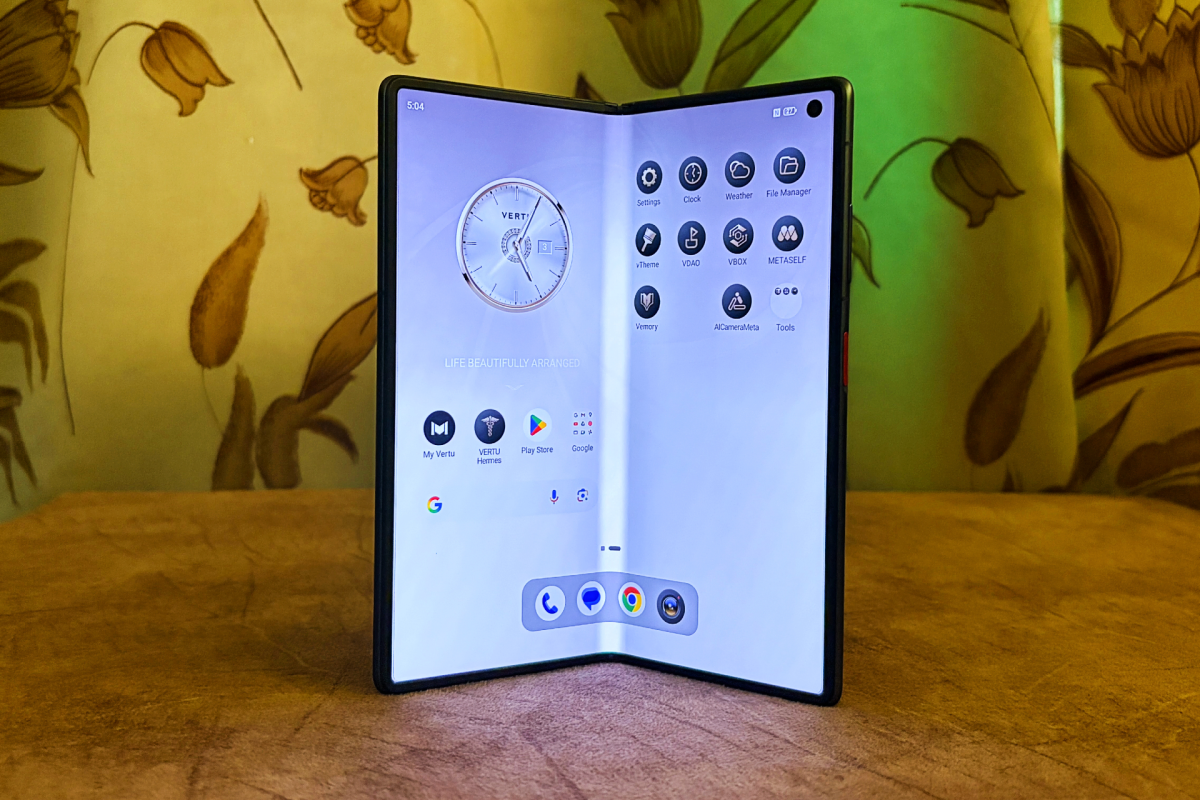
Vertu’s new Alphafold is a luxury foldable phone priced from $6,880 that pairs premium materials with an AI agent meant to help executives manage work, travel and documents. The device’s Hermes Agent can automate tasks across apps and analyze local files, but testing showed it is promising rather than polished, with accuracy, memory and workflow issues still holding it back.
That matters because Vertu is not selling a standard smartphone upgrade. It is trying to convince wealthy buyers — especially business leaders — that an AI-first phone can save time, handle routine requests and even step in as a digital assistant, while also serving as a status symbol.
Vertu has spent years building phones for buyers who want exclusivity more than raw specs. With the Alphafold, the company is leaning harder than ever into that model: a foldable wrapped in calfskin and titanium, packaged like a luxury accessory, and marketed around an AI agent that can supposedly do some of the work of an executive assistant. After several days of hands-on testing, the pitch looked ambitious, but the execution still felt uneven.
What Vertu is trying to sell
Vertu’s Alphafold is not positioned as a mainstream foldable competing on value. It is a premium device built for affluent customers, with executives at the center of the sales pitch, and the AI layer is the main differentiator. The company wants buyers to see it less as a phone and more as a mobile productivity tool backed by concierge-style service.
At the center of that idea is Hermes Agent, a preloaded AI system built on the open-source Hermes project. Vertu says the agent can review files, carry out multi-step actions across apps, remember prior conversations and hand requests to a human concierge when the situation calls for it.
Unlike basic assistants that mainly answer prompts, Hermes is designed to act. That distinction is key to Vertu’s strategy. The company is betting that busy professionals will pay a large premium if a phone can not only answer questions, but also perform a sequence of tasks without constant supervision.
How much does the Alphafold cost?
The Alphafold starts at $6,880, placing it far above most flagship smartphones and well above many high-end foldables. Vertu’s pricing reflects both the hardware and the brand’s broader luxury positioning, which emphasizes craftsmanship, exclusivity and service rather than aggressive technical value.
| Device | Starting price | Weight | Notable AI feature |
|---|---|---|---|
| Vertu Alphafold | $6,880 | 264g | Hermes Agent with task automation |
| Samsung Galaxy Z Fold 7 | Lower than Alphafold | 215g | Google Gemini integration |
| ZTE Nubia Fold | About $1,100 | Not specified in review | Base hardware platform comparison |
For a phone at this price, Vertu is asking customers to pay not only for luxury finishes, but also for the idea that AI can become part of their daily operating system. That is a high bar, particularly when mainstream rivals already offer capable foldables and increasingly advanced assistants.
Why the hardware matters less than the software
Vertu’s device makes a strong first impression. The review unit was finished in genuine calfskin leather with titanium accents, and the packaging was closer to a jewelry presentation than a smartphone box. The out-of-box experience reinforces the brand’s luxury identity, with accessories arranged in drawers and presented as part of a premium ritual.
The device is also physically substantial. At 264 grams, it is noticeably heavier than Samsung’s Galaxy Z Fold 7, which weighs 215 grams. In use, that extra mass is obvious over long sessions, though the phone does not feel unmanageable. The Alphafold’s curved frame makes it easier to unfold than Samsung’s flatter-edged design, but the Galaxy remains more comfortable to hold when closed and easier to use one-handed.
Still, hardware was never the real story. The Alphafold’s success depends on whether Hermes Agent can deliver meaningful time savings and practical assistance throughout an executive’s day. On that front, the results were mixed.
Is Vertu’s AI agent actually useful?
Yes, sometimes — but not consistently. Hermes Agent was strongest when handling local files and structured information, especially compared with Google Gemini on Samsung’s foldable during testing. It also showed more willingness to carry out actions across apps without repeated confirmation, which made it feel more like an actual agent than a traditional chatbot.
That autonomy is part of Vertu’s pitch. The company wants Hermes to move beyond simple answers and into workflow execution: moving documents, coordinating travel, handling messages and taking small but important tasks off a user’s plate. In best-case moments, the experience suggested how an executive AI layer might eventually work.
But the agent also produced mistakes, missed context and incomplete actions. Those shortcomings matter even more in a device marketed to people who may rely on it for calendar coordination, business travel and document review. In a premium product at this price, partial success is not enough.
Vertu describes Hermes Agent as a system that can analyze files, automate tasks, remember earlier exchanges and escalate requests to a human concierge when needed. In practice, the tests showed a useful but still maturing assistant, one that can perform real work yet still requires oversight.
What happened in a travel test?
In one scenario, the phone was asked to send a message saying the user would be 20 minutes late, switch on Do Not Disturb, open directions to the airport and remind the user to call the hotel after 15 minutes. Hermes completed some of the steps, but not all of them correctly. It sent the message and enabled Do Not Disturb, but it did not fully initiate navigation and set the reminder for the wrong time.
Samsung’s Gemini, by contrast, asked clarifying questions before acting. It wanted to know which airport was meant and where the reminder should be stored. That slower approach produced a more accurate outcome. The comparison highlighted a central trade-off: Hermes was more autonomous, but Gemini was more careful.
What about planning a business trip?
That test was also uneven. When asked to plan a trip from Mumbai to Pune with a morning flight, hotel suggestion and calendar entry, Hermes identified that no direct morning flight was available. It then offered to escalate to Vertu’s concierge service, but it also created a calendar event for the wrong dates.
Gemini handled the same scenario differently. Rather than ending the interaction early, it kept working through alternatives after determining that the ideal flight was unavailable. For a business user, that persistence may matter as much as speed.
How did the Alphafold handle documents and spreadsheets?
The Alphafold’s strongest showing came with local files. Hermes performed well on uploaded spreadsheets and could summarize quarterly numbers, which is the kind of task Vertu wants executive buyers to imagine using daily. In that respect, it felt ahead of Samsung’s Gemini in one important way: it was more inclined to work directly with files on the device.
However, the experience was not seamless. During early testing, some uploads failed, image analysis was unreliable and connections to the concierge service were incomplete. Vertu pushed server-side fixes while the review was underway, restoring some missing functions and allowing further testing to continue. That kind of evolving behavior suggests a platform still being actively tuned rather than fully finished.
Memory was another weak spot. At one point, Hermes correctly handled a spreadsheet. Days later, in the same conversational thread, it no longer recognized the document and asked for it to be uploaded again. Gemini kept more of the earlier context and was still able to answer follow-up questions without requiring the file to be resent.
For executives, that difference matters. An AI assistant that loses track of the document it just reviewed will not inspire confidence in a workflow built around contracts, reports or financial planning.
What is Vertu’s hardware really based on?
Vertu confirmed that the Alphafold was developed through a specialist supply-chain partnership involving ZTE and Nubia’s hardware platform, along with component integration and production engineering. Vertu says it handled the luxury materials, software experience, quality control and after-sales support.
The review unit showed strong visual and physical similarities to the ZTE Nubia Fold, including the hinge design, dimensions and the placement of speakers, microphones and the fingerprint reader. System information also surfaced ZTE identifiers in parts of the software. Those observations align with earlier reporting on Vertu’s hardware strategy, which appears to involve adapting existing foldable designs and recasting them as premium products.
That approach is not unusual in the luxury-phone niche, where differentiation often comes from materials, branding and services rather than from building a completely original handset from the ground up. But it does mean the Alphafold’s value proposition rests heavily on the software and the experience around it.
Why security is part of the sales pitch
Security may be as important as AI for Vertu’s target audience. If a phone is going to process contracts, spreadsheets, business plans and confidential messages, buyers will want to know where data goes, who can access it and whether it is used to improve other models.
Vertu says Hermes conversations are encrypted and not used to train public AI systems. The company also says customers can choose where data is processed, and that enterprise deployments can run on private infrastructure for organizations that need tighter control over sensitive information.
To reinforce that promise, Vertu points to a dedicated A5 security chip that it says protects credentials, encrypted communication and other sensitive data at the hardware level. Those claims were not independently verified in testing, but they are central to the company’s effort to sell trust along with luxury.
For executive users, the message is clear: Vertu wants the Alphafold to be seen as both a prestige object and a secure business device. Whether buyers accept that promise may depend on how much confidence they have in the company’s architecture and its operational discipline.
Living with the Alphafold
Outside the AI layer, the Alphafold acts much like a modern premium foldable. Battery life was solid, lasting more than a day during testing. That is a practical advantage for a device aimed at travelers and heavy users. But the omissions are hard to ignore at this price point, especially the absence of wireless charging.
That missing feature stands out even more because Samsung’s comparable foldable supports Qi charging. At nearly $7,000, buyers will reasonably expect convenience features that have become routine in much cheaper devices.
The camera app includes a document-scanning mode under a “Smart AI” label, which can recognize paperwork and save enhanced copies. That is useful for receipts, contracts and other business documents, though Samsung provides a similar feature in its own camera software. In other words, the Alphafold’s camera tools are helpful, but not especially distinctive.
How does Hermes compare with Gemini?
Hermes and Gemini represent two different philosophies of mobile AI. Hermes is more eager to act on its own and is more deeply tied to Vertu’s concierge-oriented vision. Gemini is more conservative, asking clarifying questions before taking action and, in some cases, producing more reliable results.
- Hermes strengths: more autonomous, better with local files, willing to attempt cross-app actions.
- Hermes weaknesses: inconsistent memory, occasional timing errors, incomplete workflows.
- Gemini strengths: more accurate follow-through, clearer clarification, better retention of context in testing.
- Gemini weaknesses: less likely to feel like a true agent because it seeks confirmation more often.
That comparison helps explain Vertu’s challenge. Buyers may admire a phone that tries harder to act independently, but they will only trust it if it consistently gets the details right. The more valuable the task, the less tolerance there is for error.
Who would buy this phone?
Vertu appears to be aiming at executives, entrepreneurs and wealthy professionals who want a phone that reflects status and promises productivity. This is a small, high-margin audience, but one that may be willing to pay for luxury, service and exclusivity if the experience feels genuinely differentiated.
The company also seems to be targeting organizations that may want customized deployments with more control over data and workflows. The business-oriented presentation, enterprise language and concierge escalation features all point in that direction.
Still, the market question is whether there are enough buyers who care about this exact mix of features. A luxury phone can succeed by being rare and desirable. An AI-first luxury phone has to be useful, too.
Why the Alphafold’s value is hard to defend
The central problem is not that the Alphafold is bad. It is that the gap between what it costs and what it delivers is difficult to justify. The underlying hardware does not clearly outclass cheaper foldables, and the AI assistant is still too inconsistent to be a must-have tool.
Samsung’s Galaxy Z Fold 7 offers a more mature foldable experience at a far lower price, with a broader ecosystem and a more polished balance between hardware and software. Vertu’s device may be more exclusive and more ornate, but exclusivity alone is not the same as value.
That becomes even more obvious when considering the pace of the market. Samsung is expected to refresh its foldable lineup again soon, which could widen the gap further. In that context, Vertu is not just selling a costly gadget; it is asking buyers to bet that a luxury wrapper and an evolving AI agent are worth several thousand dollars more than a mainstream alternative.
Timeline of the Alphafold review
| Stage | What happened | Result |
|---|---|---|
| Early testing | File uploads, image analysis and concierge integration were unreliable | Some workflows failed or stopped midway |
| Mid-review update | Vertu rolled out server-side fixes | Missing functions were restored |
| Travel scenario | Assistant was asked to send a delay message, open navigation and set a reminder | Partial completion, with timing errors |
| Trip planning scenario | Asked to organize Mumbai-Pune business travel and add it to calendar | No direct morning flight found; calendar dates were wrong |
| Document test | Spreadsheet analysis and follow-up questions | Strong initial analysis, weaker memory later |
The bigger picture for AI phones
Vertu’s Alphafold is part of a broader industry race to make smartphones feel indispensable again through AI. Nearly every major device maker is trying to use AI to sell upgrades, but most of those efforts are centered on software features that are useful in small doses. Vertu is attempting something more ambitious: turning the phone itself into an executive assistant.
That ambition gives the Alphafold a distinct identity, but it also exposes the limits of the category. The more a product claims to replace human labor, the less room it has for uncertainty. A flashy device can survive a few awkward edges; an executive tool cannot.
In that sense, the Alphafold is both a signal and a warning. It shows how far manufacturers are willing to push AI branding in mobile hardware, but it also shows how far the underlying technology still has to go before a premium phone can credibly stand in for a trusted assistant.
Bottom line
Vertu has built a striking luxury foldable that clearly knows its audience. The Alphafold looks expensive, feels expensive and is priced to match. Its Hermes Agent can do useful work, especially with local files and some app automation, and its concierge-style framing gives it a business-friendly identity that separates it from ordinary consumer phones.
But the device is also a reminder that AI usefulness is still uneven. The assistant sometimes gets the job done, sometimes needs help and sometimes gets the details wrong. For a phone that starts at nearly $7,000, that is a serious drawback.
Vertu’s latest handset may appeal to buyers who want something rare, polished and conversation-starting. Whether it convinces executives that it can truly improve their workday is a different question — and one the Alphafold has not fully answered yet.
Frequently asked questions
What is Vertu’s Alphafold?
Vertu’s Alphafold is a luxury foldable smartphone designed for wealthy buyers and executives. It combines premium materials such as calfskin leather and titanium with Hermes Agent, an AI system meant to automate tasks, analyze files and support day-to-day work.
How much does the Vertu Alphafold cost?
The Vertu Alphafold starts at $6,880. That price places it well above mainstream flagship phones and many competing foldables, with much of the premium tied to luxury materials, branding, concierge service and the company’s AI-first positioning.
Is Vertu’s Hermes Agent better than Gemini?
Not overall. Hermes Agent was more willing to act autonomously and handled some local file tasks better, but Gemini was more consistent, asked clarifying questions and produced more accurate results in several workflow tests.
Does the Alphafold use ZTE hardware?
Vertu said the Alphafold was developed through a supply-chain partnership involving ZTE/Nubia’s hardware platform, component integration and production engineering. Review testing found strong similarities to the ZTE Nubia Fold in design and software identifiers.
Is the Alphafold good for business users?
It could appeal to some business users, especially those who value exclusivity and concierge support, but its AI assistant is still inconsistent. For high-stakes work like scheduling, travel planning and document handling, the current software feels promising but not fully dependable.