SpaceX has spent more than two decades reshaping spaceflight, satellite internet and the economics of launch. On Friday, it entered an entirely different arena: the public markets. The company’s initial public offering, priced at $135 a share and structured around 555.6 million shares, raises $75 billion and lands as the largest IPO ever completed. The debut instantly recasts SpaceX from the most valuable private company in the world into one of the most closely watched public listings in market history.
The scale alone would make the deal noteworthy. But the implications go much further. The IPO is expected to transform the wealth of founder and chief executive Elon Musk, amplify questions about governance and control, and create one of the most unusual public companies ever listed. SpaceX has never fit neatly into standard corporate categories, and its transition to a public ticker only deepens that sense of exception.
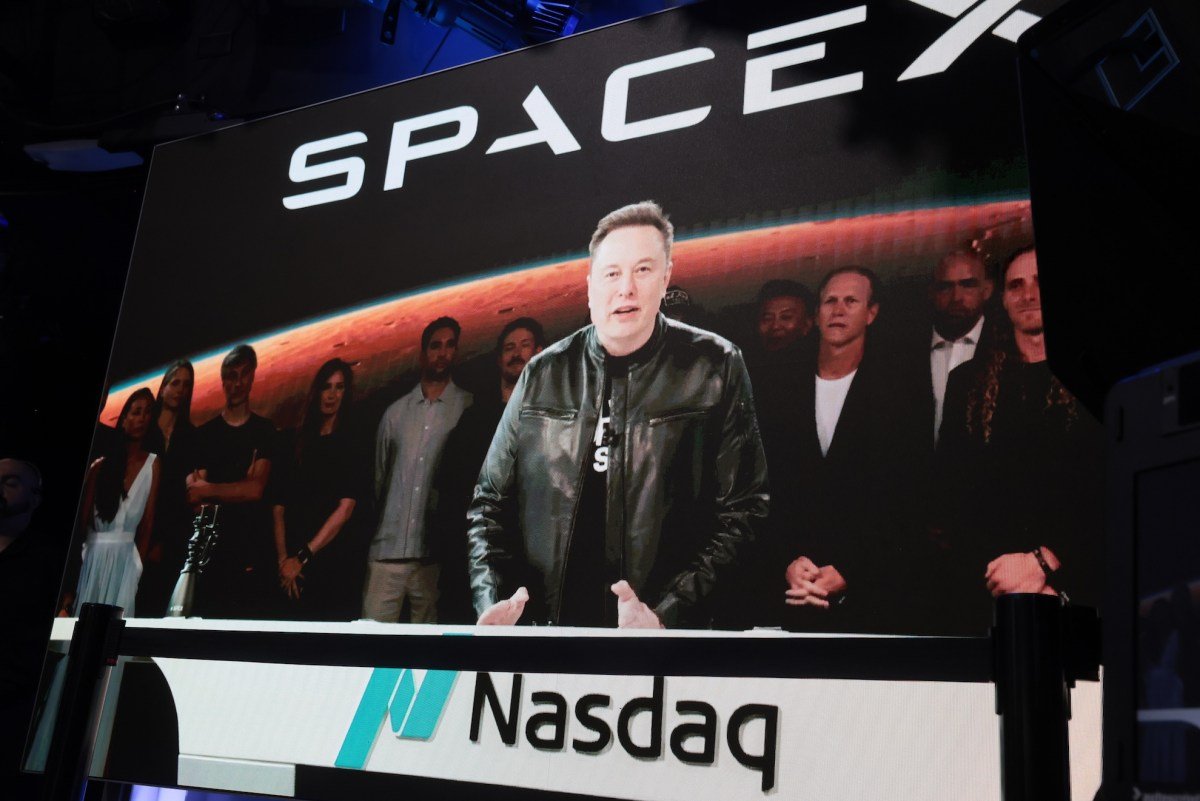
By the end of the first day of trading, SpaceX shares had opened at $150 on Nasdaq, jumped as much as 30% intraday, and closed at $160.95, up 19% from the offering price. The first-day move signaled intense demand and reinforced expectations that this debut would be measured not just in valuation, but in symbolism.
A debut that breaks records before the opening bell
SpaceX’s IPO arrives with a level of anticipation usually reserved for once-in-a-generation market events. Investors, analysts, retail traders and industry watchers had been tracking rumors, filings and leaks for months. The public listing confirmed what many had long assumed: there was enough demand for a marquee SpaceX debut to support a deal larger than any on record.
The company’s decision to sell 555.6 million shares at $135 each was designed to raise roughly $75 billion. That figure surpasses every prior IPO in U.S. market history and underscores how SpaceX has become more than a launch provider. It is also a satellite network operator, a defense-adjacent infrastructure company, and increasingly a strategic asset in the broader AI and cloud-compute ecosystem.
In practical terms, the offering gives public investors a direct way to own a piece of the company that has helped define modern commercial spaceflight. Symbolically, it marks the point at which one of Musk’s most important companies moves from private control to market scrutiny — even if that scrutiny is likely to be limited by the unusual voting structure that protects the founder’s grip.
How the stock performed on day one
The first trading session gave Wall Street a simple answer to one early question: demand is real. SpaceX shares opened at $150 on Nasdaq, representing an immediate premium to the IPO price. They then moved even higher through the day, with midday trading showing gains of roughly 30% before the stock finished at $160.95, a 19% rise.
Heavy volume followed, as expected for a debut of this size. Brokerage apps and trading platforms reported major traffic spikes, and Robinhood said its platform saw what it called record-breaking use in the hours after the listing.
The opening performance matters for more than optics. A strong debut can help a company build momentum with institutional investors, reinforce confidence in pricing, and signal that underwriters left room for additional demand. It also widens the spotlight on the so-called green shoe option, which allows underwriters to sell up to 15% more shares if the market proves especially receptive.
Robinhood said it saw record-breaking traffic on its trading platform in the hours after SpaceX’s public-market debut.
That kind of attention is not surprising. SpaceX is not merely another fast-growing tech company; it is a business that many investors have been waiting years to access directly. For some, the listing is an opportunity to buy into a rare asset with significant strategic value. For others, it is a chance to trade one of the most talked-about names in modern business history.
What the numbers say about SpaceX
The IPO filing, and the market reaction around it, reveal both the scale and the contradictions of the company. SpaceX is profitable in the sense that it has built enormous revenue streams, but it remains expensive to run, capital intensive and far from consistently profitable.
According to the S-1, SpaceX lost $4.9 billion in 2025 even as revenue exceeded $18 billion. That is a sizable improvement from the company’s cumulative losses, which have surpassed $37 billion since its founding. It is also a reminder that rapid growth and engineering ambition still come with a steep financial price tag.
One of the more striking figures attached to the listing is the potential impact on employees. The New York Times reported that about 4,400 SpaceX employees could become millionaires as a result of the IPO. That possibility reflects the company’s long-running use of stock as a retention tool, and the way years of private growth can suddenly translate into life-changing liquidity when a company finally goes public.
The offering also has far broader consequences for Musk himself. The public valuation of SpaceX is expected to push his paper fortune above $1 trillion, making him the first person to cross that threshold. That milestone, while theoretical in some respects, reinforces the degree to which one founder now sits at the center of a vast network of companies influencing transportation, energy, communications and artificial intelligence.
Key SpaceX IPO facts
| Metric | Figure | What it means |
|---|---|---|
| Shares offered | 555.6 million | Largest IPO share count in history |
| IPO price | $135 | Pricing set to maximize demand while raising $75 billion |
| Total raised | $75 billion | Largest IPO by proceeds ever completed |
| Opening price | $150 | First-trade premium of roughly 11% |
| Closing price | $160.95 | Ended day one up 19% from IPO price |
| 2025 revenue | Over $18 billion | Shows the company’s scale as a commercial operator |
| 2025 net loss | $4.9 billion | Indicates persistent capital intensity |
| Cumulative losses | Over $37 billion | Reflects the long cost of building the company |
| Voting power | About 85.1% for Musk | Highlights the founder’s extraordinary control |
Why this IPO matters so much to Musk
For Elon Musk, the IPO is not simply a liquidity event. It is a power event. SpaceX’s structure gives him dominant voting control, and the company’s public status may increase that influence rather than dilute it. In the filing, Musk is shown to hold around 85.1% of voting power, an extraordinary concentration of authority for a company with public shareholders.
That reality has triggered renewed debate about governance. Public companies are usually expected to balance founder influence with board oversight, shareholder rights and market discipline. SpaceX looks different. Musk’s position suggests a model closer to founder-led control than conventional public ownership, with very limited practical ability for minority investors to shape strategy.
That same control is part of what makes the IPO attractive to some investors. They are buying into a company whose founder has an unusual record of executing audacious projects. The argument in favor of Musk’s control is straightforward: he has a track record of making bets that traditional executives might avoid.
Still, the concentration of authority raises questions about what public market discipline can actually change. If a founder already has the power to direct the company, a public listing may do little to alter the strategic direction of the business. Instead, it may simply create a liquid market for shares while leaving operational control largely intact.
During a CNBC interview, SpaceX COO Gwynne Shotwell suggested that a merger between SpaceX and Tesla could make Musk’s life easier.
That comment, though informal, lit up social media and shareholder discussion because it pointed to a recurring theme around Musk’s empire: the possibility that his companies may be more interconnected than their legal structures suggest.
Who benefits from the listing
The headline winner is Musk, but he is far from the only one. A successful IPO creates value across the company’s ecosystem: employees, early investors, venture backers, bankers and select insiders all stand to benefit.
For employees with meaningful stock grants, the listing could unlock significant wealth. For early-stage backers, it provides long-awaited liquidity after years of holding illiquid private shares. For the banks that led the deal, the fee pool is substantial: about $500 million in total, according to reporting cited around the offering. Goldman Sachs and Morgan Stanley are understood to be among the biggest beneficiaries.
There is also a broader market effect. SpaceX’s public debut gives investors a new, highly visible benchmark for the commercial space sector. It may influence valuations, capital allocation and strategic planning across launch services, satellite networks and adjacent AI infrastructure businesses.
Yet not everyone is positioned equally. Lower-tier special purpose vehicle investors may face delays, fee complications and uncertainty about their eventual payouts once lockups expire. The structure of private-market participation often leaves smaller investors with less clarity than headline IPO buyers, particularly in a deal of this size.
Likely winners and likely limitations
- Elon Musk: gains enormous paper wealth and reinforced control.
- Employees: may receive life-changing equity value if grants are sizable enough.
- Early backers: can finally monetize long-held positions.
- Lead banks: collect major underwriting fees.
- Retail investors: gain access to a high-profile stock, but with limited influence.
The S-1 revealed a more complex company than many expected
The registration statement offered one of the clearest public views yet into the company’s finances and business mix. While SpaceX is often described in shorthand as a rocket company, the filing showed a more diversified operation increasingly centered on Starlink, supported by launch services and shaped by long-term bets on future systems such as Starship.
That mix is important. Launch is still foundational to the brand, but Starlink is what gives SpaceX a recurring revenue model with global reach. The company’s satellite internet system has grown into a major business with customers ranging from rural consumers to government clients. That makes SpaceX partly a telecom company, partly a space infrastructure company, and partly a platform for strategic government and enterprise relationships.
The S-1 also indicated how closely the company’s future remains tied to Musk’s broader ambitions, including artificial intelligence and the interconnected ventures around xAI. Investors looking at SpaceX are not just assessing rockets and satellites; they are trying to understand how the company fits into a larger industrial and technological architecture built around one founder’s agenda.
That is one reason the filing drew so much attention. It did not merely disclose financial data. It gave public markets a way to map the machinery behind one of the most ambitious private enterprises ever built.
Starlink, Starship and the challenge of future growth
SpaceX’s growth story depends on several moving parts, but two stand out: Starlink and Starship. The former is already generating substantial business. The latter remains a long-range bet whose success would dramatically expand the company’s capabilities if it can be made reliable and economical at scale.
Starlink offers a more familiar commercial path. It creates recurring revenue from customers who need internet access, whether they are in remote areas, at sea or in sectors that require portable connectivity. The service also adds geopolitical weight, since satellite internet is increasingly part of the infrastructure of modern conflict, disaster response and remote operations.
Starship, by contrast, is still in the proving phase. SpaceX has presented it as the key to deeper spaceflight ambitions, greater reusability and lower-cost access to orbit. But the S-1 and recent test history suggest the road ahead remains uncertain. Reusability remains the central prize, but the path to achieving it at scale is far from guaranteed.
The tension between near-term revenue and long-term engineering ambition is one of the reasons SpaceX is so hard to price. Investors are not buying a company with stable, mature cash flows. They are buying a platform for future technological leverage, with all the associated upside and execution risk.
Compute deals added an unexpected twist before the listing
In the weeks before the IPO, SpaceX also drew attention for a set of unusual deals that appeared to be aimed at strengthening its balance sheet. Rather than focusing solely on rockets and satellites, the company increasingly entered conversations about compute, AI demand and infrastructure leasing.
Among the more notable arrangements was a reported deal under which Anthropic would pay xAI $1.25 billion per month for compute. Google, meanwhile, was reported to be paying SpaceX $920 million per month for compute in a short-term arrangement tied to unexpected demand for its newly launched AI products.
These transactions stood out because they underscored a wider industry reality: compute capacity is now one of the most valuable commodities in technology. Even a company primarily known for launch vehicles can become part of the compute supply chain if it controls enough infrastructure, connectivity or strategic assets.
For SpaceX, the deals also hinted at a broader effort to diversify revenue and support the balance sheet ahead of public-market scrutiny. In an IPO environment, anything that improves visibility into future earnings or reduces risk can make a difference.
Recent pre-IPO developments
| Date or period | Event | Why it mattered |
|---|---|---|
| May 2026 | Anthropic reported to be paying xAI for compute | Highlighted how AI demand is reshaping infrastructure deals |
| Pre-IPO period | Google reported to be paying SpaceX for compute | Suggested unexpected revenue support ahead of listing |
| Days before debut | SpaceX amended its S-1 | Refined risk disclosures and dilution language |
| IPO day | Shares began trading on Nasdaq | Marked the company’s transition to public markets |
What the filing said about dilution and future capital needs
One of the clearest warnings in the filing concerned future dilution. SpaceX signaled that additional capital needs could affect shareholder value after the IPO, a disclosure that added another layer to the debate over control, governance and long-term strategy.
For a company as capital-hungry as SpaceX, this is not a trivial issue. Building rockets, deploying satellites and developing next-generation launch systems require enormous sums of money. Even an IPO of this scale may not eliminate the need for future financing.
That warning matters because it raises a basic question: if the company continues to need capital, how much of the economic benefit of the IPO will ultimately accrue to public shareholders versus insiders and future rounds of financing?
It also helped fuel ongoing speculation about whether SpaceX might one day be structurally linked more closely with Musk’s other businesses. While a merger with Tesla remains speculative, the public comments from Shotwell and the filing’s control structure gave the rumor mill enough material to keep running.
The banks, the market and the size of the fee pool
A deal this large is a windfall not only for insiders but also for Wall Street. The underwriting syndicate stands to collect approximately $500 million in fees, a sum that reflects both the size of the offering and the complexity of taking a high-profile private company public.
Goldman Sachs and Morgan Stanley are reported to be among the key winners. Their role extends beyond simply placing shares. In an IPO of this magnitude, bankers help calibrate demand, manage investor relations, coordinate disclosures and keep the process on track across dozens of moving parts.
The sheer scale of the fee pool also reflects how unusual the transaction is. Few deals in modern markets combine this level of brand recognition, founder controversy, financial complexity and public fascination. That combination alone makes the offering a case study in how capital markets respond to dominant technology founders.
The public appetite around the debut also underscores how much investor culture has changed. A stock listing is no longer simply a financing event. For a company like SpaceX, it is also an entertainment product, a political signal and a social-media moment.
Where the IPO leaves the broader SpaceX story
SpaceX’s move into public markets does not end its story. In many ways, it starts a more complicated one. The company still has to operate rockets safely, scale satellite services, manage global regulatory issues and show that its long-term ambitions can coexist with public scrutiny.
The first day of trading offered a strong validation of investor demand, but it did not answer the deeper strategic questions. Can SpaceX continue to grow without diluting its original engineering edge? Will Starlink keep expanding fast enough to justify the company’s valuation? Can Starship move from prototype ambition to commercial reality? And how much can a public market actually influence a company whose founder already commands such overwhelming voting power?
There is also the broader Musk question. SpaceX now joins a corporate empire that already influences electric vehicles, social media, AI and transportation. The IPO makes that empire more legible to markets, but not necessarily easier to understand. If anything, it reveals just how interconnected and founder-centric the whole structure has become.
In a social post after shares climbed, Musk expressed appreciation for SpaceX employees and reposted several IPO-related images, including one that appeared to reference the green shoe option.
The image fit the moment. SpaceX is a company built on engineering symbols, market symbolism and public theater. Its IPO is not just a financing milestone. It is the latest expression of Musk’s ability to turn a corporate event into a global spectacle.
What investors should watch next
Now that the stock is public, attention will shift from the mechanics of the listing to the behavior of the shares and the details of the business underneath them. Several issues will be worth watching closely over the coming weeks and months.
- Lockup timing: When insiders and SPV holders are allowed to sell will shape supply and price pressure.
- Further filings: Amendments and disclosures may clarify risk factors, dilution plans and capital needs.
- Starlink growth: The strength of the satellite business will be central to valuation expectations.
- Starship progress: Successful test flights and reliability gains could re-rate the long-term story.
- Governance questions: Investor pressure may mount over Musk’s voting control and public accountability.
- Secondary market demand: Trading volume and institutional participation will indicate whether the enthusiasm is durable.
For now, the market has delivered its first verdict: demand is powerful, the brand is formidable, and SpaceX remains one of the rare companies capable of commanding attention at the scale of both an industrial platform and a cultural phenomenon.
What happens next will depend on whether the company can convert a historic listing into sustained public-market performance. The opening pop is only the beginning.
Why the SpaceX IPO may matter beyond Wall Street
The significance of this IPO goes beyond shareholder returns. SpaceX sits at the intersection of private industry, public infrastructure and geopolitical competition. Its satellites support connectivity in remote regions. Its launch services influence defense and commercial access to orbit. Its technology roadmap shapes how the next generation of space systems may be built.
That makes the company more than just a high-growth tech story. It is a strategic asset with implications for communications resilience, government procurement, industrial policy and the commercialization of space. A public listing does not change those facts, but it does make them more visible.
It also gives the public a clearer look at how modern industrial power is constructed: through a mix of engineering ambition, capital markets, elite control and ecosystem relationships that extend well beyond a single product line.
For SpaceX, the IPO is not a finish line. It is a new operating environment. And for Elon Musk, it is another reminder that the biggest stage in business may now be the one he created around himself.