In short
Google has started rolling out Universal Cart, an AI shopping cart that lets U.S. users save products from multiple retailers in one place across Search and Gemini. The tool adds price-drop alerts, restock notices, promo code suggestions, and checkout options as Big Tech races to own AI-assisted shopping.
- Google is rolling out Universal Cart in the U.S. across Search and the Gemini app.
- The AI shopping cart lets users save items from multiple retailers in one shared space.
- Google will send price-drop and restock alerts and may surface promo codes.
- Users can pay with Google Wallet or transfer items to a merchant’s own checkout flow.
- The launch comes as Google, OpenAI, Meta, and Shopify compete in AI-powered commerce.
Google has begun rolling out Universal Cart, an AI-powered shopping tool that lets U.S. users save products from different retailers in one place across Google Search and the Gemini app. The launch is designed to make holiday shopping easier, help shoppers track deals, and push Google deeper into the increasingly competitive market for AI-assisted commerce.
The feature, first previewed at Google I/O in May, arrives as consumers head into the year’s busiest online shopping season. By combining products from multiple stores into a single digital cart, Google is betting that shoppers will welcome a more organized way to compare, track, and eventually buy items without constantly hopping between merchant sites.
What Google’s Universal Cart does
Universal Cart is meant to function like a shared basket for products discovered through Google’s AI tools. If a user finds an item in Search AI Mode or in the Gemini app, they can add it to the same cross-platform cart and keep building a list from multiple stores. Google says the goal is to make shopping less fragmented and easier to manage as consumers browse across retailers.
In practical terms, the feature gives users a single place to track products that may otherwise be scattered across tabs, apps, and merchants. That can be especially useful during peak shopping periods, when price changes, inventory shifts, and limited-time promotions make it difficult to keep track of everything manually.
How does Universal Cart work?
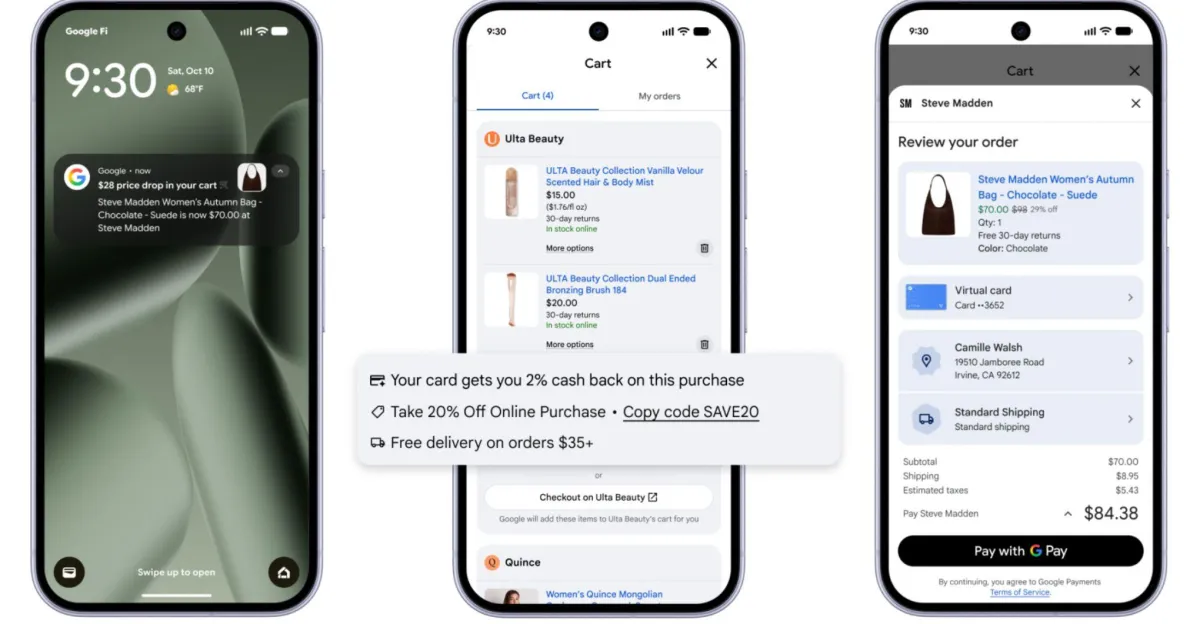
Universal Cart works by connecting the items a user saves in Google Search and Gemini into one shared shopping space. Google says the system can notify users when the price of a saved item drops or when stock becomes available again, and it can surface promotional codes it finds for relevant products.
Shoppers will also have payment flexibility. They can complete a purchase through Google Wallet or move selected items to a retailer’s own cart and check out directly with the merchant. Google says Universal Cart can also look at the benefits attached to saved payment cards and suggest the best one to use at checkout.
The company is positioning the tool as a way to reduce shopping friction, help users save money, and keep important purchase decisions in one place instead of forcing people to manually monitor each store.
Why is Google launching it now?
Google is bringing Universal Cart to market ahead of the holiday shopping rush, when consumers are most likely to compare prices and chase discounts. The company is also trying to strengthen its role in AI-led shopping before rivals become the default destination for product discovery and purchasing assistance.
The timing matters because online shopping is no longer just about search results and price comparison. Tech companies are increasingly pitching AI systems that can browse, organize, and even complete transactions on a user’s behalf. Google is trying to make sure it remains central to that workflow rather than being bypassed by newer assistants.
What makes holiday shopping the right moment?
Holiday shopping is the right moment because it is when consumers feel the greatest pressure to track deals, manage wish lists, and move quickly on in-demand products. Google’s pitch is that Universal Cart can reduce the busywork of comparing offers while helping users avoid missing price drops or restocks.
That value proposition is especially appealing for shoppers juggling multiple retailers. Instead of checking each store separately, users can keep an organized list and let Google watch for changes. For a platform built on search and discovery, that is a logical next step toward purchase completion.
| Feature | What it does | Why it matters |
|---|---|---|
| Universal Cart | Saves products from multiple retailers in one cart | Creates a single shopping list across Google services |
| Price-drop alerts | Notifies users when saved items become cheaper | Helps shoppers time purchases and save money |
| Restock notifications | Flags when sold-out products become available again | Useful for limited-stock or high-demand items |
| Promo code suggestions | Surfaces possible discounts for saved products | Can lower checkout costs without extra searching |
| Wallet checkout | Lets users pay via Google Wallet or transfer to a merchant cart | Offers flexibility at the final purchase step |
How does this fit into Google’s AI strategy?
Universal Cart is part of a broader effort by Google to weave AI into everyday consumer behavior, especially discovery and shopping. The company has been expanding AI Mode in Search and pushing Gemini as a general-purpose assistant, and shopping is one of the clearest ways to turn those products into direct consumer utility.
Rather than simply showing links or product listings, Google is building a workflow that can guide the user from question to purchase. That is important because shopping is one of the most commercially valuable activities in search, and AI assistants are increasingly competing to own that experience.
Why is shopping so important to AI companies?
Shopping is important because it combines intent, attention, and transaction value in a single user journey. If an AI assistant helps a user compare products, track prices, and finalize payment, it can become a powerful gateway to commerce and potentially influence where money is spent.
That makes shopping tools attractive not only for user convenience but also for platform strategy. Whoever controls the assistant may also control the decision point, and that is why Google, OpenAI, Meta, and Shopify are all moving quickly in this area.
Who is Google competing with?
Google is entering a crowded field that already includes major players trying to make AI more transactional. OpenAI and Meta have both introduced agentic assistants capable of helping users shop online, while Shopify has moved to make its storefronts easier for AI agents to access and buy from.
The shared bet across the industry is that shopping will increasingly be mediated by software agents that do much of the browsing, filtering, and sorting automatically. In that future, the winner may not be the company with the most product listings, but the one whose assistant is most trusted to make sense of them.
What could Universal Cart change for shoppers?
For shoppers, Universal Cart could make online buying less repetitive and more transparent. Instead of rebuilding a cart every time they move between retailers or devices, they can collect items in one place and wait for the right moment to buy.
The tool could also make bargain hunting less tedious. Price alerts and restock notices are common individually across retail sites, but Google is trying to centralize them into one system tied to its search and assistant products. That consolidation may be enough to win over users who already rely on Google to start their shopping research.
Potential benefits at a glance
- One cart across multiple retailers
- Automatic tracking for price changes
- Restock alerts for hard-to-find items
- Promo code discovery inside the shopping flow
- Checkout options through Google Wallet or the merchant
What happens next?
Google has said Universal Cart is rolling out in the United States first through Search and the Gemini app. The company has also indicated that it wants to bring the feature into Gmail and YouTube, although it has not provided a release date for those integrations.
Those future connections could make the shopping experience even more seamless. Gmail could surface items tied to receipts, shipping updates, or product recommendations, while YouTube could help turn product discovery from creator content into a more direct purchasing path. For now, though, the immediate focus is on making Search and Gemini more useful during the holiday season.
Why this launch matters beyond shopping
Universal Cart is not just another convenience feature. It is part of a broader race to define how AI systems participate in ordinary consumer decisions. The more a platform can reduce the effort involved in comparing, choosing, and paying for products, the more likely it is to become the default starting point for online commerce.
That has implications for retailers, advertisers, and shoppers alike. Retailers may gain a new channel for discovery and checkout, but they could also find themselves more dependent on Google’s ecosystem. Shoppers may save time, but they will also place more trust in an AI tool to filter opportunities and make recommendations.
For Google, the rollout is a clear signal that AI in Search is moving beyond answers and toward action. If the company can make shopping feel faster, smarter, and more organized, it may convince users that AI is not just a novelty but a practical part of how they buy online.
Timeline of Universal Cart
| Date | Event | Significance |
|---|---|---|
| May 2026 | Google previews Universal Cart at I/O | First public look at the shopping tool |
| October 2026 | Rollout begins in the U.S. | Users can start using it in Search and Gemini |
| Future | Possible Gmail and YouTube integration | Could extend the shopping workflow across more Google products |
As AI shopping features multiply, Universal Cart gives Google a more concrete role in the buying process. The company is no longer just helping people find products; it is trying to help them hold on to those choices until they are ready to act.
Frequently asked questions
What is Google’s Universal Cart?
Google’s Universal Cart is an AI-powered shopping tool that lets users save products from different retailers into one shared cart across Search and Gemini. It is designed to help shoppers organize items, track changes, and move more easily toward checkout.
How does the AI shopping cart help users save money?
It helps users save money by sending price-drop alerts, highlighting restocks, and showing relevant promo codes when available. Google also says it can analyze the perks of saved payment cards and suggest the best one for the purchase.
Can shoppers pay directly with Google Wallet?
Yes. Google says users can check out through Google Wallet or transfer items to a retailer’s own cart and complete the purchase with the merchant. That gives shoppers more flexibility depending on where they want to finish buying.
Which Google products support Universal Cart right now?
Universal Cart is rolling out first in the United States across Google Search and the Gemini app. Google has also said it plans to integrate the feature with Gmail and YouTube later, but it has not announced a timeline.