In short
Rivian says its future vehicles may support AI agents from companies like Anthropic, extending its in-house assistant into a more advanced software platform. The automaker says those agents will not control safety-critical systems such as braking or steering.
- Rivian is exploring support for third-party AI agents in future vehicles.
- The company has already built an in-house assistant and agent routing framework.
- Safety-critical controls like brakes and steering will remain off-limits to agents.
- Rivian could show more of its AI roadmap at its December AI & Autonomy Day event.
Rivian is preparing a future in which its electric vehicles can run outside AI agents from companies such as Anthropic, moving the automaker beyond its newly launched voice assistant and toward a more expansive software platform inside the car. Chief executive RJ Scaringe said the company wants its vehicles to eventually coordinate with frontier AI systems, a shift that could make the cabin feel more like an intelligent workspace than a traditional dashboard.
The idea matters because Rivian has built its software stack in-house rather than relying heavily on Apple CarPlay or Android Auto, giving it more control over how artificial intelligence is embedded into the driving experience. But Scaringe also made clear that safety limits will stay in place: agents may help manage tasks and context, but they will not be allowed to control brakes, steering or other vehicle-critical functions.
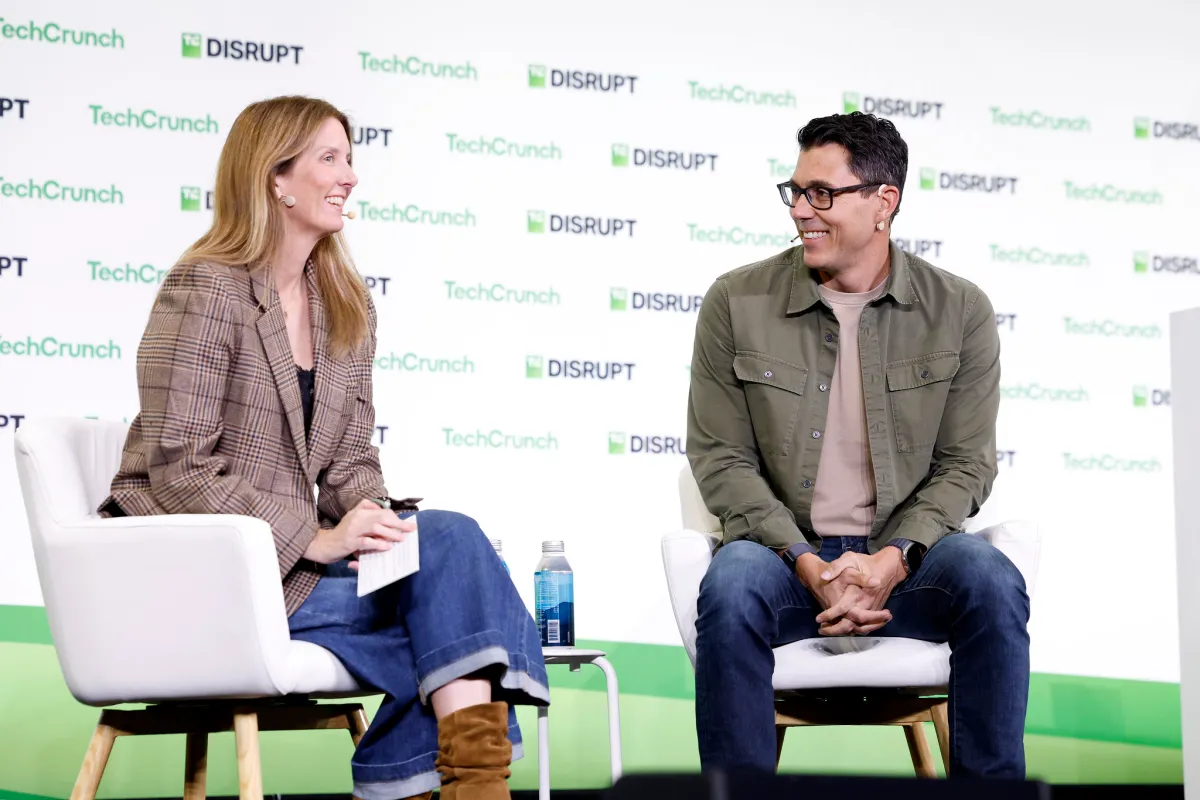
Scaringe discussed the company’s roadmap during a TechCrunch Disrupt appearance this week, saying the most compelling version of the technology would be one that can smoothly hand off from Rivian’s own assistant to models made by AI labs such as Anthropic, OpenAI or Meta when a user’s request becomes more complex.
What Rivian is trying to build
Rivian is working toward an in-car system that can understand what a person wants, decide which AI model is best suited to handle the request and then route the task accordingly. The company already has a voice assistant in its vehicles, but the longer-term vision is broader: a digital layer that can support simple commands, more advanced question answering and eventually agentic features from third-party AI providers.
According to Scaringe, the company has created an internal framework that functions like a decision layer for requests made to the car. In practice, that means a driver could ask for something straightforward, such as lowering the cabin temperature, before moving into more complicated requests that might require cloud processing or additional reasoning from a larger model.
Rivian’s approach reflects a growing belief in the auto industry that future cars will be defined not only by motors and batteries, but also by how well they can interpret human intent. For Rivian, the software distinction is especially important because it has chosen to own more of the user experience than many carmakers that depend on phone projection systems.
How Rivian’s assistant works today
Rivian’s current assistant can already handle everyday tasks that drivers and passengers would normally perform through physical controls or touchscreen menus. That includes adjusting climate settings, activating heated or ventilated seats and summarizing information such as news updates.
The company says the system can choose between a local model running on the vehicle itself and larger cloud-based models when a request calls for more computing power or a broader context window. Scaringe described this as a routing mechanism that sends the right job to the right model, rather than treating every prompt the same way.
Scaringe said the useful part of the system comes when multiple models can be layered together, with the vehicle deciding whether to use on-device intelligence or push a question to the cloud depending on complexity.
That model-selection logic is central to Rivian’s pitch. It suggests that the company does not want to simply bolt a chatbot onto the dashboard. Instead, it wants an assistant architecture that can move fluidly between small, fast local models and more capable external systems.
Why third-party AI agents matter to Rivian
Third-party agents matter because they could extend the car’s usefulness beyond basic vehicle commands. If Rivian succeeds, a driver might be able to ask the vehicle to do something practical and then continue the same conversation across other devices, with the car remembering context and pulling in information from outside apps.
Scaringe suggested that one appealing use case would involve a driver asking the vehicle to prepare the cabin before tackling a more involved personal task. In his example, a person might ask the car to cool the seats while also referencing a previous discussion about dinner plans, allowing the assistant to help think through a meal for guests later that week.
That kind of experience depends on continuity across devices. Rivian would need its vehicle software to connect with the memory and context collected by AI apps elsewhere, so that the conversation does not reset every time the user switches from a phone, laptop or other assistant-enabled product to the car.
That raises the bar significantly. The vehicle would no longer be a closed environment limited to its own software. It would become part of a broader AI ecosystem, one that reaches into calendars, preferences, past conversations and possibly future commerce or scheduling tools.
Why this is harder than it sounds
The technical challenge is not just about connecting APIs. Rivian has to coordinate with frontier AI labs to make sure their systems can communicate safely and reliably with vehicle software, while also preserving the automaker’s own control over the experience.
Scaringe said there is substantial behind-the-scenes work involved, including the plumbing that allows different systems to talk to one another. He also emphasized that any rollout would require close coordination with the labs building the underlying AI products.
That caution is especially important in a car, where a bad software decision can have physical consequences. The company is trying to preserve the distinction between convenience functions and safety-critical operations, which is why the most advanced agents are being kept away from direct control of acceleration, braking and steering.
How Rivian is drawing the safety line
Rivian says it will not hand life-or-death vehicle controls to AI agents. Scaringe was explicit that the company does not want an agent deciding when to brake or steer, and that those functions remain outside the scope of the planned integrations.
That boundary reflects a larger industry debate about how much autonomy consumers should be given inside a vehicle. A conversational assistant can be helpful, but the stakes change dramatically once software is allowed to influence motion or safety systems.
For now, Rivian’s strategy appears to be to keep agents focused on language, context and productivity-style tasks. The company wants AI to make the cabin more useful without crossing into the systems that directly govern how the vehicle behaves on the road.
This separation may also help Rivian move faster. By limiting the first wave of agent integrations to non-critical functions, the company can experiment with new software experiences while reducing regulatory, engineering and liability risk.
What Rivian has already shipped
Rivian has already taken steps toward a more intelligent cabin. As of May, the company said its assistant could access external apps such as Google Calendar, an early sign that the software is designed to work with services beyond the vehicle itself.
That capability is important because it shows Rivian is thinking about the car as one node in a larger digital life, not a sealed-off island of features. Calendar integration, for example, can be a bridge to reminders, travel timing, work meetings and other forms of context that make voice interaction more useful.
The company has also continued to build out its in-car applications rather than leaning on the dominant smartphone ecosystems. While Rivian has integrated some popular services, including Apple Music, it has largely treated software as a core differentiator rather than a commodity layer supplied by Apple or Google.
That decision may make future AI integration easier in one sense, because Rivian controls the environment. But it also means the automaker is responsible for a much larger share of the experience, from interface design to cloud routing to long-term maintenance.
| Milestone | What happened | Why it matters |
|---|---|---|
| May 2026 | Rivian said its assistant could connect to external apps such as Google Calendar. | Showed the system was already moving beyond basic voice commands. |
| TechCrunch Disrupt 2026 | RJ Scaringe said Rivian could eventually support AI agents from companies like Anthropic. | Signaled a broader plan to integrate frontier AI into the vehicle. |
| December 2026 | Rivian plans to hold the company’s AI & Autonomy Day event. | Expected to provide more detail on the company’s software and AI roadmap. |
How would an AI agent work inside a Rivian?
An AI agent inside a Rivian would act less like a simple command parser and more like a coordinator. It would likely receive a request, determine what kind of information or action is needed, then hand the job to the appropriate model or service.
Scaringe compared the decision process to a traffic light, with the vehicle deciding whether to use a local model or send the request to the cloud. If the request is simple, it can stay on-device. If it is more complex, it can move outward to larger systems.
That architecture is important because it can balance speed, privacy and capability. On-device models may respond quickly and handle basic tasks without a network connection, while cloud models can be more powerful and better at complex reasoning or conversation.
In the car context, the ideal result is an assistant that feels immediate for routine tasks but capable when the situation calls for more intelligence. Rivian appears to want both at the same time.
Possible use cases Rivian is envisioning
- Adjusting seat climate before a trip
- Pulling in calendar details for travel planning
- Summarizing news or updates during a drive
- Using a conversation started on another device as context
- Helping manage errands or dinner planning without leaving the vehicle interface
These examples matter because they show where the company sees value: not in replacing a driver, but in making the cabin more attentive to the person using it.
Who else is bringing AI agents into cars?
Tesla has already moved in a similar direction, making it one of the first U.S. automakers to bring third-party conversational AI into the car environment. Earlier this year, Tesla added access to its Grok chatbot and a related assistant feature inside its software.
That makes Rivian’s announcement part of a broader race among EV makers to turn the car into a software platform that can host AI services. The competition is not only about electric range or performance anymore; it is increasingly about whether the vehicle can become a meaningful extension of the digital assistant ecosystem.
Still, Rivian’s philosophy appears somewhat different. Rather than tie itself to one AI brand, it is signaling interest in supporting multiple frontier labs, which could give the company more flexibility and perhaps a more independent platform strategy over time.
Why Rivian’s software strategy stands out
Rivian stands out because it has made a deliberate choice to build a large portion of its software stack itself. That is not the easiest path, but it gives the company more control over features, user experience and future integrations.
Many automakers rely on Apple CarPlay or Android Auto for much of the in-car interface. Rivian’s approach means the company can decide how deeply AI is woven into the driving experience, what data the assistant can access and how the system should evolve over time.
That control is especially valuable in the age of agentic AI. If future assistants are expected to take action, not just answer questions, the company that owns the platform will have much more influence over what those actions look like and where the lines are drawn.
Rivian is also positioning itself for an environment in which software updates matter as much as hardware launches. A vehicle that can gain new intelligence over time is easier to market as a living product rather than a one-time purchase.
What happens next?
Rivian has not given a timeline for launching third-party AI agents in its vehicles, and the company declined to elaborate beyond pointing to its AI & Autonomy Day event in December. That suggests more information is coming, but not yet enough for a concrete release schedule.
For now, the public signal is clear: Rivian wants its cars to support a more advanced, more connected and more context-aware AI experience. Whether that arrives first with a partner such as Anthropic or through another lab will depend on the technical and safety work still ahead.
The next few months will likely show whether Rivian can turn its broad vision into a practical in-car product. If it succeeds, its vehicles could become one of the clearest examples yet of how AI agents move from chat windows into physical products people use every day.
That transition would mark a significant step for both the automaker and the AI industry. It would show that the agent era is no longer limited to software apps on screens; it is starting to shape the systems inside the products that move us through the world.
Frequently asked questions
What did Rivian announce about AI agents?
Rivian said its future vehicles may support AI agents from outside companies such as Anthropic, expanding beyond the automaker’s own voice assistant. The goal is to make the cabin more context-aware and useful for tasks that go beyond simple commands.
Will AI agents be able to drive Rivian vehicles?
No. Rivian says it will not let AI agents control critical vehicle functions like braking or steering. The company wants agents to handle convenience and information tasks, while safety-related systems remain under tighter human and vehicle controls.
How does Rivian’s current assistant work?
Rivian’s assistant can already manage requests such as climate control, seat warmers and news summaries. The company says it routes each request to either a local model in the car or a cloud model, depending on how complex the task is.
Which AI companies could Rivian work with?
Rivian specifically mentioned Anthropic, and Scaringe also suggested the company could work with other frontier AI labs such as OpenAI and Meta. The automaker has not confirmed a launch partner or a timeline for rollout.
When will Rivian share more details?
Rivian has not given a release date for third-party AI agents, but it pointed to its AI & Autonomy Day event in December as the next opportunity for more information. That event is expected to offer a deeper look at the company’s software plans.