In short
Amazon-owned Bee has launched two new personal AI devices: a $74.99 wearable called Frontier and a $99.99 phone-attached Eclipse. Both focus on conversation summaries, reminders, and privacy-minded voice capture.
- Bee launched its first new devices since Amazon acquired the company last year.
- The lineup includes the $74.99 Bee Frontier and the $99.99 Bee Eclipse.
- Both devices are built to summarize conversations, surface tasks, and help users remember key details.
- Bee says raw audio is not stored, and transcripts are encrypted under user control.
- The devices integrate with Alexa, Amazon.com, Gmail, Google Calendar, Outlook, and Apple HealthKit.
Amazon-owned wearable AI company Bee has introduced two new personal devices, including a $74.99 model that can be worn on the wrist or clipped to clothing and a $99.99 companion gadget that magnetically attaches to the back of a smartphone. The launch matters because it expands Bee’s push to make always-available, conversation-aware AI cheaper, more discreet, and more integrated with Amazon’s ecosystem.
The new products, announced Thursday, are the first major releases from Bee since Amazon acquired the company last year. They build on the startup’s original pitch: use AI to quietly capture everyday conversations, turn them into useful summaries, and help users remember tasks, plans, and key details without having to manually take notes.
The lower-cost entry point is notable in a market where AI hardware has often arrived at premium prices. Bee’s newest devices are positioned not just as note-taking tools, but as personal assistants that can convert spoken exchanges into calendar events, reminders, follow-up suggestions, and other action items.
What did Bee announce?
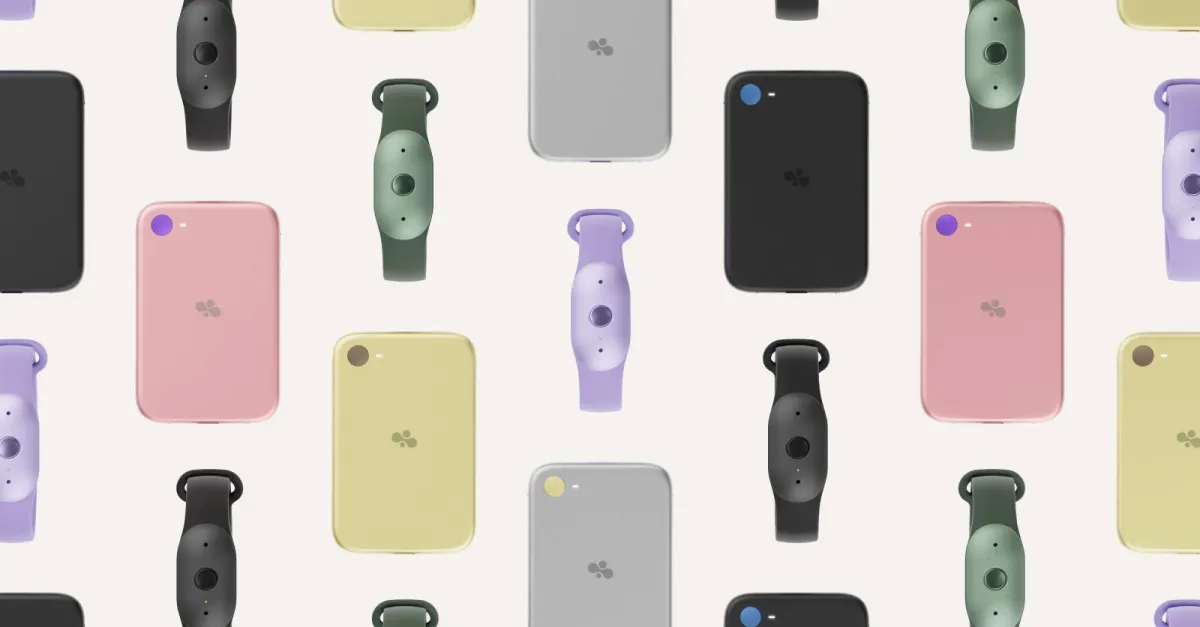
Bee launched two devices: the Bee Frontier, which can be worn on the wrist or pinned to clothing, and the Bee Eclipse, a credit-card-sized device that snaps onto the back of a smartphone with a magnetic connection. The company is targeting users who want AI assistance in a form factor that feels more natural than pulling out a phone or typing into a chatbot.
Bee Frontier starts at $74.99, making it one of the least expensive AI wearables in the category. Bee Eclipse costs $99.99. Both devices are meant to work with Bee’s companion software, which organizes conversations into summaries, memory prompts, and productivity actions.
The company said the Frontier will be sold in Onyx, Lavender, and Sage. The Eclipse will come in Silver, Midnight, Honey, and Blush.
How do the new devices differ?
The Frontier is the more traditional wearable. It is designed for all-day use, with a body that can be worn like a wrist device or attached to clothing. The Eclipse, by contrast, is built for people who prefer to keep the hardware attached to their phone rather than on their body.
That design choice places Bee in more direct competition with products such as the Plaud Note and Pocket AI device, which focus on portable recording and AI-generated summaries. Bee is also trying to undercut those rivals on price.
| Device | Price | Form factor | Primary use | Key colors |
|---|---|---|---|---|
| Bee Frontier | $74.99 | Wearable / clip-on | Always-on personal AI notes and reminders | Onyx, Lavender, Sage |
| Bee Eclipse | $99.99 | Phone-attached accessory | Conversation summaries tied to smartphone use | Silver, Midnight, Honey, Blush |
| Plaud Note | $159 | Portable note device | AI transcription and summaries | Varies |
| Pocket AI device | $129 | Portable device | AI memory and note capture | Varies |
Why is Bee betting on personal memory devices?
Bee is betting that people want help remembering what was said, not just another chatbot to ask questions. The company’s devices are designed to sit quietly in the background during everyday conversations, then turn those exchanges into usable information.
In practical terms, that could mean remembering the date and time of a dinner plan and creating a calendar invitation automatically. It could also mean capturing lecture details for a student, or summarizing treatment instructions after a doctor’s appointment. Bee’s pitch is that people often need help with memory, not just with search.
The products are also part of a broader trend in consumer AI hardware: moving the technology out of the app and into a physical object that can listen, interpret, and act in real time. In that sense, Bee is trying to make AI feel more like a companion than a destination.
What can the devices do out of the box?
All Bee devices can generate conversation summaries and recaps at no charge. They also retain 14 days of memory by default, which gives users a limited window to revisit what was said.
For users who want more, Bee offers a $11.99 monthly Pro subscription. That plan unlocks unlimited conversation summaries, deeper integrations with Amazon.com, Alexa+, and third-party apps, plus suggested to-dos, daily memory digests, a personal chat assistant, and conversation templates.
Bee’s software is also meant to be practical rather than experimental. It can help draft emails, organize meetings, surface action items, and push information into the apps people already use.
- Free features: conversation summaries and recaps
- Default memory window: 14 days
- Bee Pro price: $11.99 per month
- Pro additions: unlimited summaries, integrations, assistant tools
How does Bee handle privacy?
Bee says privacy is central to its product design. The company says it uses a private computing architecture that does not keep raw audio recordings from conversations. Instead, audio is processed as it happens and then deleted.
According to Bee, the transcripts are encrypted with keys generated and controlled by the user’s own device. That means, in the company’s account, even Amazon employees cannot access the files unless the user intentionally shares them.
Bee says its system is built so that speech is processed in real time and the original audio is not stored, while encrypted transcripts remain under user control unless shared manually.
There is also an opt-in connection to Alexa. If enabled, the user’s Echo device can use Voice ID to recognize who is speaking and help Bee capture relevant conversations. Bee says users can delete transcripts and summaries whenever they want.
What role do Alexa and Amazon services play?
Amazon’s ecosystem is becoming a deeper part of the Bee experience. With Alexa integration enabled, users can ask for summaries, insights, or to-dos hands-free through Alexa. They can also use Bee to make purchases from Amazon.com.
That makes the new devices more than passive recorders. They become a bridge into Amazon’s commerce and voice-assistant ecosystem, which could make Bee more useful to existing Amazon customers while also strengthening the retail giant’s position in consumer AI hardware.
At the same time, the company is making sure the Amazon links are optional. Bee presents the voice recognition and conversation-capture features as features users choose to activate, rather than defaults forced on them.
How does Bee fit into the broader AI hardware race?
Bee’s launch arrives as startups and larger tech companies experiment with devices designed specifically for AI interactions. Many of those products have emphasized premium pricing, niche use cases, or novelty. Bee is taking a different route by offering two relatively affordable form factors and leaning heavily on practical note-taking.
The Bee Eclipse, in particular, suggests a move toward competing with dedicated AI audio and summary devices rather than only wearable companions. By placing the device on the back of a phone, Bee is making the hardware feel less like a separate gadget and more like an accessory to the smartphone people already carry everywhere.
That strategy could matter if consumers remain hesitant to buy yet another always-on device. A lower price and a familiar attachment method may lower the barrier to trial, especially for users who are curious about AI but skeptical of bulky wearables.
What are the main competitive advantages?
Bee appears to be leaning on four advantages: lower pricing, multiple form factors, strong Amazon integration, and a privacy story centered on no stored raw audio.
The price gap is significant. Bee’s Frontier starts at less than half the price of the Plaud Note, and the Eclipse undercuts several competing AI audio devices as well. That could help Bee reach a broader consumer audience.
- Price: lower than several direct rivals
- Form factor: wearable and phone-mounted options
- Integrations: Alexa, Amazon.com, Gmail, Google Calendar, Outlook
- Privacy: real-time audio processing with no stored raw recordings
What apps and services work with Bee?
Bee is trying to be useful in the software people already depend on every day. The devices connect with Gmail, Google Calendar, and Microsoft Outlook, allowing them to draft emails, create meetings, and surface follow-up items.
The company is also pushing beyond productivity apps. Users can upload photos, and Bee can connect with Apple HealthKit to incorporate wellness-related information into its insights. That suggests a broader ambition than simple transcription: Bee wants to act as a personal memory layer across communications, scheduling, and health context.
The new devices ship with a redesigned mobile app and a new desktop app, extending Bee’s reach beyond the hardware itself. That matters because AI wearables often succeed or fail based on software quality rather than industrial design alone.
What hardware features does Bee Frontier include?
The Frontier includes a single button that turns the device on and off, along with an indicator light that signals when a conversation is being summarized. Bee says the device is designed for simplicity rather than complexity, which aligns with its promise of ambient AI.
Its technical specifications include IP67 water resistance, up to seven days of battery life, USB-C charging, and dual microphones with advanced noise filtering. Those features make it more suitable for everyday use than a novelty accessory.
The Eclipse also has a single power button and an indicator light, but Bee has not positioned it as the same rugged all-day wearable. Instead, it looks like a lighter-weight option for phone-centered users.
| Feature | Bee Frontier | Bee Eclipse |
|---|---|---|
| Power controls | One button | One button |
| Conversation indicator | Yes | Yes |
| Battery life | Up to 7 days | Not specified |
| Water resistance | IP67 | Not specified |
| Audio hardware | Dual microphones with noise filtering | Not specified |
When are the new Bee devices available?
The Bee Frontier is available now through Amazon, while the Eclipse will arrive shortly afterward. That rollout gives Bee a chance to capitalize on Amazon’s distribution and retail infrastructure at a time when AI hardware still depends heavily on discoverability and trust.
The timing is also important because Bee’s launch comes after Amazon’s acquisition of the company last year. This is the first clear sign that the acquired startup is being folded more fully into Amazon’s consumer product pipeline.
Why this launch matters for Amazon
For Amazon, Bee offers a way to broaden its role in AI beyond Alexa smart speakers and cloud infrastructure. The company has long had a consumer voice footprint, but Bee gives it a more personal, wearable interface that can move with the user throughout the day.
That could help Amazon compete in a part of the market where people are searching for a practical AI companion rather than a general-purpose assistant. If the product resonates, it could also expand the value of Amazon’s ecosystem by tying shopping, voice control, productivity tools, and memory capture together.
Just as important, Bee’s privacy messaging may help Amazon address consumer concerns that have historically surrounded always-listening devices. The company is clearly trying to reassure users that the system is designed to minimize data retention while still providing rich utility.
What happens next?
The next test is whether consumers see enough value in an AI wearable to justify a new device purchase. Bee is betting that a cheaper price, clearer use case, and tighter Amazon integration will make the answer yes.
If that bet works, Bee could help define a more mainstream version of personal AI hardware: smaller, lower-cost, and centered on remembering the details of everyday life. If not, the launch will still show how aggressively Amazon is willing to explore consumer AI beyond the assistant model it already knows.
For now, Bee’s message is straightforward. It wants to make AI useful in the background of ordinary life, whether that means remembering a conversation, drafting a follow-up message, or turning a casual discussion into an actionable plan.
And with two new devices now on the market, Amazon has a fresh opportunity to prove that wearable AI can be both practical and affordable.
Frequently asked questions
What are Bee Frontier and Bee Eclipse?
Bee Frontier and Bee Eclipse are new personal AI devices from Amazon-owned Bee. Frontier is a wearable that can be worn on the wrist or clipped to clothing, while Eclipse is a phone-mounted accessory designed to capture conversations and turn them into summaries and reminders.
How much do the new Bee devices cost?
The Bee Frontier starts at $74.99, and the Bee Eclipse costs $99.99. Those prices put Bee below several competing AI audio and note-taking devices, including the Plaud Note and Pocket AI device.
Does Bee store raw audio from conversations?
Bee says it does not store raw audio. The company says conversations are processed in real time, then deleted, while transcripts are encrypted using keys controlled by the user’s device unless the user chooses to share them.
What can Bee do with conversations?
Bee can create summaries, recaps, reminders, and to-do suggestions from everyday speech. It can also help turn conversations into calendar invites, draft emails, and surface action items through connected apps and services.
When will the new Bee devices be available?
The Bee Frontier is available now on Amazon, while the Bee Eclipse will be available shortly afterward. Bee’s launch follows Amazon’s acquisition of the company last year and marks its first new product release under Amazon ownership.