In short
Amazon has launched new Bee wearable devices, added a $11.99 monthly subscription, and tied the product more closely to Amazon shopping and Alexa Plus. The move positions Bee as both an AI memory assistant and a new commerce channel, while raising fresh privacy questions.
- Bee Frontier launches at $74.99 with wearable and clip-on options.
- Bee Eclipse will cost $99.99 and attach magnetically to a phone.
- Bee Pro adds features for $11.99 per month, including Alexa Plus support.
- Opt-in Amazon integration can surface shopping suggestions from conversations.
- Amazon says Bee encrypts outputs and does not store audio recordings.
Amazon has expanded its Bee AI wearable line with two new devices, a paid subscription, and tighter links to Amazon’s shopping and Alexa ecosystems. The update matters because it moves the always-listening gadget from a simple conversation recorder into a more action-oriented assistant that can surface purchases, draft tasks, and plug into Amazon’s broader AI strategy.
The company introduced the $74.99 Bee Frontier, a refreshed version of the original wearable, and previewed the $99.99 Bee Eclipse, a phone-friendly magnetic model that will arrive later. At the same time, Amazon added Bee Pro, an $11.99 monthly plan that unlocks more memory, more summaries, app integrations, and compatibility with Alexa Plus.
What Amazon announced and why it matters
Amazon’s latest Bee rollout is more than a product refresh. It is a sign that the company wants Bee to evolve from a niche note-taking device into an AI companion tied directly to the services millions of people already use.
Bee’s core pitch remains familiar: the devices listen throughout the day, then generate summaries, transcripts, insights, and reminders from conversations. That concept places them in the same emerging category as AI recorders and memory assistants, a market now crowded with products aimed at turning spoken exchanges into useful digital action items.
The Amazon connection changes the stakes. If a user opts in, Bee can now use conversation context to surface shopping suggestions, connect with calendars and inboxes, and interact with Alexa Plus. That gives Amazon a way to link ambient AI hardware to the company’s most valuable businesses: retail, voice assistants, and subscriptions.
What are Bee Frontier and Bee Eclipse?
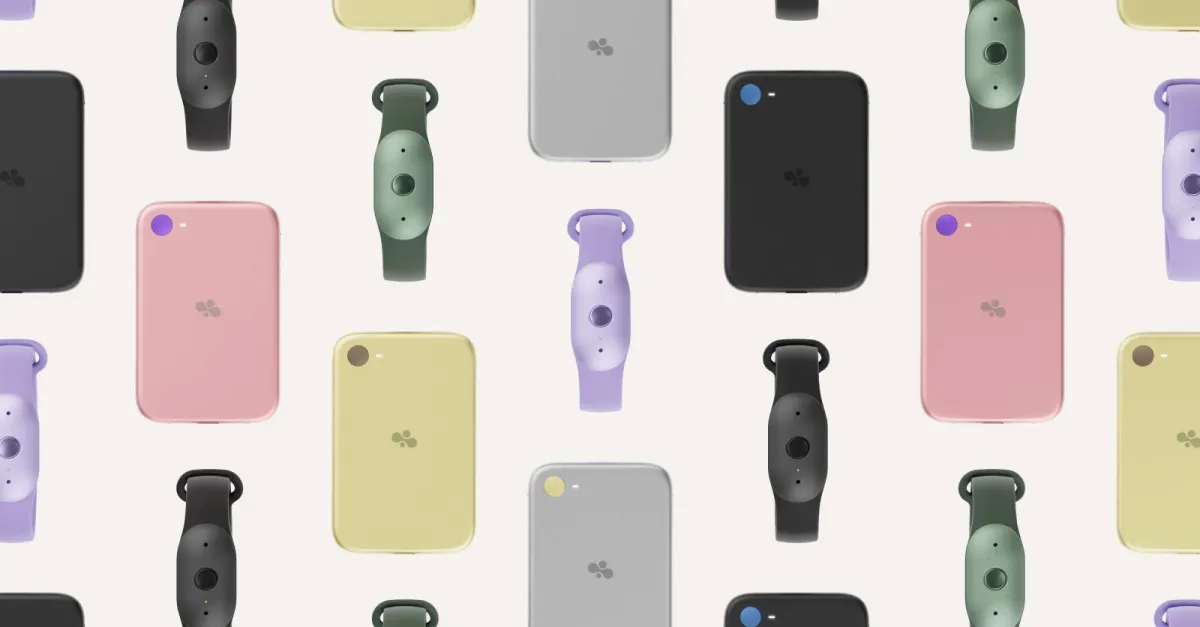
The Bee Frontier is the new version of Bee’s original wearable. The Bee Eclipse is a new, larger product shaped more like a credit card and designed to attach magnetically to the back of a smartphone.
Amazon says the two devices are built for slightly different lifestyles. Frontier is meant to be worn, while Eclipse is aimed at people who want a less wearable option and may prefer a device that feels more like a pocketable work tool.
Bee Frontier: a wearable with a familiar design
The Frontier is priced at $74.99 and goes on sale immediately. It can be worn on the wrist like a fitness band or clipped onto clothing like a pin. Amazon says the redesign makes the recording button easier to reach, and the device now comes in three colors.
Like the earlier Bee hardware, Frontier includes dual microphones, a visible recording light, and about seven days of battery life. It also carries an IP67 rating, meaning it is resistant to dust and can handle brief water exposure.
Bee Eclipse: the magnetic phone companion
The Eclipse costs $99.99 and is listed as coming soon. Amazon describes it as a more professional-leaning product, and its larger body is supposed to support a much longer battery life: up to 21 days on a single charge.
The Eclipse’s magnetic design is one of the more notable changes in the lineup. Instead of being worn, it snaps to the back of a smartphone, making it easier to carry as an always-available recording tool without using wrist space or clothing.
How do the new Bee devices work?
The new Bee devices work by listening to conversations, processing them, and then turning them into usable outputs such as summaries, transcripts, reminders, and to-dos. Amazon positions that as a way to help users stay engaged in the moment while still preserving the details later.
In practice, the feature set is designed to reduce the cognitive load of remembering what someone said, what a meeting covered, or which errand came up during a conversation. Bee then turns those exchanges into something closer to an organized personal record.
Supported apps and services
Bee can connect with a range of third-party services, including Gmail, Google Calendar, Outlook, Apple HealthKit, and photos. Those integrations allow the device to do more than archive speech; they let the system transform conversation into action.
For example, if a conversation mentions scheduling, Bee can help draft an email or create a calendar invite. If health-related context comes up, the Apple HealthKit tie-in may help the system build a more complete picture of daily routines and habits.
- Email and calendar integrations support task automation.
- Photo access helps Bee fold visual context into summaries.
- HealthKit compatibility broadens the device’s personal data reach.
Why is Amazon charging for Bee Pro?
Amazon is charging for Bee Pro because the company is reserving its most advanced functions for paying users and creating a recurring revenue stream around the hardware.
The subscription costs $11.99 per month and includes “unlimited” summaries, suggested to-dos, daily memories, a personal chat assistant, conversation templates, third-party app integrations, and a desktop app. Free users still get conversation summaries, recaps, and 14 days of memory, but the paid plan is where Bee becomes a more capable assistant.
From a business perspective, the structure is straightforward: low-cost hardware pulls people into the ecosystem, then software subscriptions increase the lifetime value of each customer. That is a common pattern in consumer tech, and Amazon appears eager to apply it to AI wearables.
| Product | Price | Form factor | Battery life | Availability |
|---|---|---|---|---|
| Bee Frontier | $74.99 | Wearable band or clip-on pin | About 7 days | Available now |
| Bee Eclipse | $99.99 | Magnetic phone accessory | Up to 21 days | Coming soon |
| Bee Pro | $11.99/month | Software subscription | N/A | Available with Bee devices |
How does Amazon shopping integration change Bee?
Amazon shopping integration turns Bee from a passive recorder into an active commerce tool. When users opt in, the device can highlight products based on things people say during everyday conversations.
Amazon gave a simple example: if someone mentions needing cat litter, the system could surface a related product card on the user’s Amazon homepage or place a product link inside the Bee app. That is a meaningful shift because it connects casual speech with a direct shopping path.
For Amazon, this is valuable because it converts ambient conversation into shopping intent. For users, it may be convenient. But it also raises obvious questions about how much context a shopping platform should be allowed to infer from private discussion.
What Alexa Plus adds
Alexa Plus compatibility is the marquee feature of Bee Pro. Amazon says it is intended to make it easier to access Bee summaries and insights hands-free through its upgraded voice assistant.
That could make Bee feel less like a standalone gadget and more like an extension of Amazon’s voice ecosystem. In effect, Bee becomes another front end for Alexa, while also providing Alexa with richer personal context.
Amazon says the integrations are opt-in and are designed to help the device connect conversation history to shopping and assistant functions without forcing those links on every user.
How is Amazon handling privacy concerns?
Amazon is trying to preempt criticism by emphasizing that Bee uses encrypted data handling and does not store audio recordings. The company says transcripts, summaries, and to-dos are protected using its Private Compute security architecture.
Bee can also be configured to stop recording automatically if no sound is detected for a set period of time. That is meant to reduce unnecessary capture, though it does not eliminate the broader concerns associated with a device that listens frequently throughout the day.
There is also an important distinction around speaker identification. Amazon says Bee learns the voice of the primary user during setup. Other people are not automatically identified unless they separately permit the system to train on their voice.
Amazon frames that voice-training model as a way to personalize the device for its owner, while leaving open the question of how other speakers are handled in shared spaces.
Why privacy skeptics may remain unconvinced
Even with encryption and opt-in settings, the product still sits at the intersection of surveillance, convenience, and consumer AI. The key issue is not only what Bee stores, but what users believe is being recorded in the first place.
That concern has grown sharper as more tech companies promote always-on assistants and ambient computing devices. When a gadget is built to listen continuously, many consumers will ask whether the difference between a transcript, a summary, and an audio recording is meaningful enough to matter.
- Audio is not stored, according to Amazon.
- Transcripts and summaries are encrypted through Private Compute.
- Other speakers are only identified if they opt in separately.
Who is Bee for?
Bee appears aimed at two overlapping audiences: people who want help remembering conversations and tasks, and early adopters who are comfortable with AI wearables that monitor daily life.
Frontier is the more obviously consumer-oriented device, especially with its band and clip-on options. Eclipse, by contrast, looks better suited to office-heavy users, travelers, or people who want a more discreet device to attach to a phone rather than wear on the body.
The new subscription tier also suggests Amazon wants a user base that will keep using the product long after the novelty fades. That makes Bee less of a gadget experiment and more of a platform play.
How Bee fits into Amazon’s broader AI strategy
Amazon has been trying to deepen its role in consumer AI across hardware, cloud services, and voice assistants. Bee now gives the company another entry point into that ecosystem, one that starts with everyday speech and ends with shopping, scheduling, and assistant-driven recall.
This is strategically important because AI wearables can produce a steadier stream of personal context than traditional apps. If Amazon can persuade users to trust Bee, the company gains another channel for personalization that connects naturally to its retail business and Alexa products.
The move also follows Amazon’s acquisition of Bee last year, when the startup was still relatively obscure. By pairing new hardware with subscription software and Amazon integrations, the company is signaling that the acquisition was meant to become a product family, not just a talent grab.
Timeline: how Bee reached this point
Bee’s rollout has moved quickly from startup curiosity to Amazon-backed product line. The timeline below shows the major steps in that transition.
| Timeframe | Development | Why it matters |
|---|---|---|
| Last year | Amazon acquired Bee | Gave the e-commerce giant an AI wearable platform |
| Today | Bee Frontier launched | Introduced a refreshed wearable at a lower price |
| Today | Bee Pro announced | Created a recurring subscription business model |
| Soon | Bee Eclipse will arrive | Expands Bee into a magnetic phone accessory |
What happens next?
The biggest question is whether consumers will accept an always-listening product that is now more deeply tied to shopping and assistant functions. The hardware itself may be easy to understand, but the social contract around it is not.
Amazon will likely pitch Bee as a convenience product that relieves users from mental clutter. Critics are likely to see it as another step toward ambient surveillance wrapped in helpful AI language. Both views can be true at once, which is why Bee may become one of the more closely watched consumer AI launches of the year.
For now, the market will get the Bee Frontier immediately, while the Bee Eclipse will test whether a magnetic phone accessory can be more palatable than a wearable. If the company can convince users that the subscription is worth paying for, Bee may become one of Amazon’s more durable AI hardware bets.
Either way, Amazon has made its intentions clear: Bee is no longer just an experimental recorder. It is now a connected AI service designed to listen, organize, and increasingly recommend what users should do next.
Key facts at a glance
- Bee Frontier costs $74.99 and is available now.
- Bee Eclipse costs $99.99 and is coming soon.
- Bee Pro costs $11.99 per month.
- Free users get summaries, recaps, and 14 days of memory.
- Paid users get unlimited summaries, integrations, a desktop app, and Alexa Plus support.
Frequently asked questions
What is Amazon’s Bee wearable?
Amazon’s Bee wearable is an always-listening AI device that listens to conversations and turns them into summaries, transcripts, insights, and to-dos. It is designed to help users remember details and take action later without manually recording everything themselves.
How much do the new Bee devices cost?
The Bee Frontier costs $74.99 and is available now, while the Bee Eclipse will cost $99.99 when it launches. Amazon also offers Bee Pro for $11.99 per month as a software subscription with expanded features.
What does Bee Pro include?
Bee Pro adds unlimited summaries, suggested to-dos, daily memories, a personal chat assistant, conversation templates, third-party app integrations, a desktop app, and compatibility with Alexa Plus. The free tier has more limited memory and fewer features.
Does Bee store audio recordings?
Amazon says Bee does not store audio recordings. Instead, it encrypts transcripts, summaries, and to-dos using its Private Compute security architecture, and it can stop recording automatically when no sound is detected for a period of time.
How does Bee connect to Amazon shopping?
Bee’s Amazon integration is opt-in and can use conversation context to surface shopping suggestions. For example, if someone mentions needing a household item, Bee may highlight a product card or a shopping link related to that item.