In short
Square has launched a new restaurant kiosk that combines a 21.5-inch touchscreen, built-in payments, and conversational AI for natural-language ordering. The device starts at $1,999 for eligible Square subscribers, plus a monthly software fee.
- Square’s new kiosk adds conversational AI to self-service restaurant ordering.
- The device includes a 21.5-inch touchscreen, presence detection, and payment hardware.
- Pricing starts at $1,999 plus a $99 monthly software fee for eligible subscribers.
- Square is targeting restaurants that want faster ordering and fewer front-of-house bottlenecks.
Square has introduced a new self-service kiosk that pairs a 21.5-inch touchscreen with conversational AI, giving customers a way to place orders by speaking naturally instead of tapping through a rigid menu. The Square Kiosk goes on sale today for eligible Square subscribers and is designed to speed up ordering while helping restaurants handle questions, substitutions, and custom requests more easily.
The launch matters because it shows how payment and restaurant software companies are turning AI into a front-of-house product, not just a back-office tool. Square is betting that a conversational ordering flow can reduce friction for customers, cut staff workload, and make kiosks feel less mechanical in quick-service settings.
What Square is selling with the new kiosk
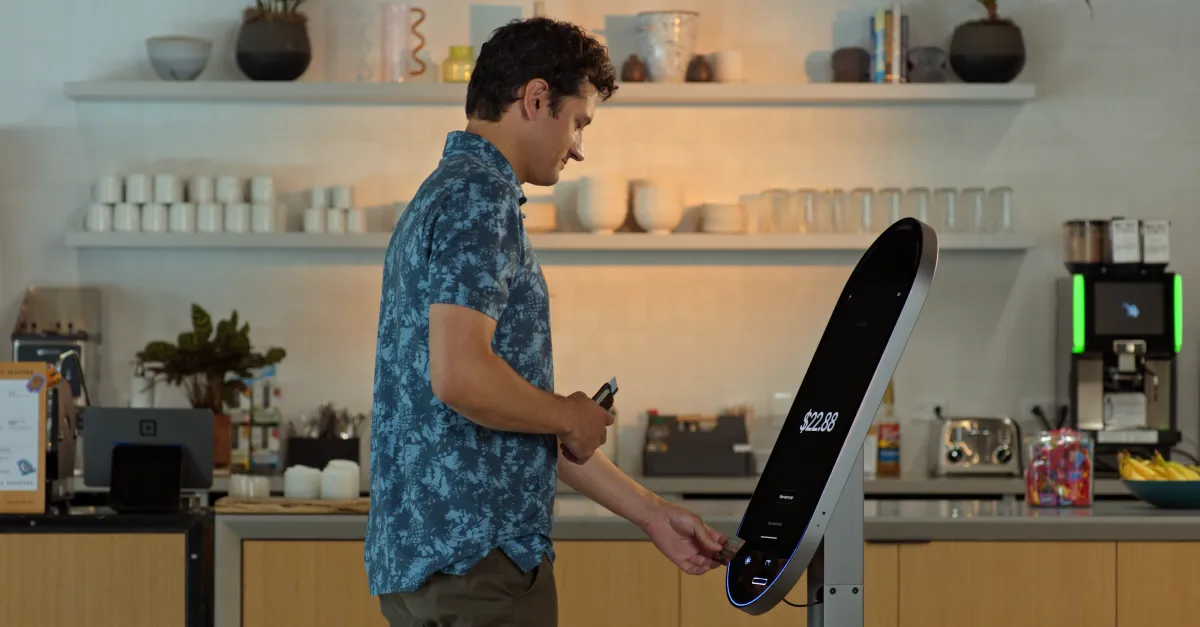
Square’s latest hardware product is built around a large, pill-shaped terminal that combines self-service ordering, payment processing, and an AI voice interface in one unit. The company says the kiosk is meant to let diners interact with the system in a more human way, asking for information or making order changes in language they would normally use with an employee.
The device features a 21.5-inch touchscreen and supports contactless payment as well as card insertion. It also includes presence detection, which allows the kiosk to greet customers when they walk up to it. Square is positioning the product as a complete ordering station rather than a simple tablet menu.
How the AI ordering experience works
The company describes the software as an “agentic, conversational voice layer” that can understand a merchant’s menu and respond in real time. In practical terms, that means a customer can ask about ingredients, request substitutions, or tailor an order without having to navigate a long chain of buttons and screens.
Square’s pitch is that people should be able to order the same way they naturally speak to staff. That approach could be especially useful in busy restaurants where customers often want quick clarification about menu items, allergens, or customization options.
Square says the kiosk is designed to listen and respond in real time so customers can order in a more natural way and make changes as they go.
Why this launch matters for restaurants
The kiosk reflects a broader push to use AI at the point of sale, where even small gains in speed and accuracy can matter. For restaurants, self-service hardware has long been attractive because it can reduce lines, free up staff time, and increase order consistency. Adding conversational AI could make those systems easier for customers who do not want to tap through endless categories.
For Square, the product is also a strategic extension of its restaurant ecosystem. The company already sells payment tools, software subscriptions, and hardware to merchants. A kiosk that combines all three helps Square deepen its role in operations that happen before a payment is ever processed.
There is also a clear competitive angle. Restaurants increasingly face pressure to modernize ordering experiences, especially in quick-service and fast-casual environments where diners expect speed and convenience. A voice-enabled kiosk could become one way to stand out without hiring more front-line staff.
What problems Square is trying to solve
Square appears to be targeting a familiar set of pain points: long lines, repetitive customer questions, menu complexity, and staffing strain. If the AI can accurately understand orders and modifications, it may reduce mistakes and help staff spend more time preparing food and less time taking orders.
The kiosk’s presence detection and built-in payment tools also suggest a more seamless checkout flow. Instead of sending customers to a separate register or relying on a human cashier, the process can happen in one place from greeting to payment.
How the Square Kiosk is priced
Square is launching the kiosk at a starting price of $1,999 for businesses that subscribe to Square Plus or Square Premium. In addition to the hardware cost, merchants will pay a monthly software fee of $99 per device.
That pricing places the product in the category of business technology investments rather than low-cost accessories. For smaller operators, the total cost may be a meaningful decision point. For larger multi-location restaurants, however, the kiosk could be easier to justify if it improves throughput or boosts order accuracy.
| Square Kiosk feature | Details |
|---|---|
| Screen size | 21.5-inch touchscreen |
| Form factor | Large pill-shaped kiosk |
| AI capability | Conversational voice layer for natural ordering |
| Customer interaction | Questions, substitutions, and modifications |
| Payment options | Contactless reader and card slot |
| Starting price | $1,999 |
| Monthly software fee | $99 per device |
| Availability | Available starting today |
Who can buy it and when
The kiosk is available now, but not to every Square user. Buyers need to be on Square Plus or Square Premium, which signals that the company is aiming the product at more serious business customers rather than casual users experimenting with hardware.
That subscription requirement may also be a clue about Square’s strategy. By bundling the kiosk into higher-tier plans, the company can tie hardware sales to recurring software revenue and make the product part of a broader merchant relationship.
How this fits Square’s broader business model
Square has long sold tools that help small and medium-sized businesses accept payments and manage day-to-day operations. The kiosk extends that model into the customer-facing ordering moment, where software and hardware meet the realities of running a restaurant.
In that sense, the product is not just a machine. It is a platform device that can help Square collect ongoing subscription revenue while making its ecosystem more difficult for merchants to leave.
What the presence detection adds
Presence detection is a small detail that could make a big difference in user experience. Instead of forcing customers to figure out whether a terminal is active, the kiosk can acknowledge them when they approach, which makes the interaction feel more immediate and less transactional.
That design choice also reinforces Square’s effort to make the kiosk feel conversational. The company is not only adding voice input; it is trying to make the hardware behave more like a host or cashier than a static self-service screen.
Why conversational ordering is becoming more important
Conversational ordering is gaining traction because it addresses one of the biggest weaknesses of traditional self-service systems: they often require customers to adapt to software rather than the other way around. AI changes that equation by letting the interface respond to natural speech and context.
In restaurants, that matters because order-taking is rarely simple. Diners may want to ask about ingredients, swap items, remove allergens, or compare meal combinations. A rigid menu can slow all of that down. A system that understands everyday language can make the process feel closer to a real conversation.
Square’s move also reflects a larger trend across retail and hospitality. Businesses are looking for ways to use AI not just to automate, but to improve the customer experience in moments where speed and clarity directly affect sales.
How does the Square Kiosk compare with older self-service tools?
The Square Kiosk is more ambitious than a standard ordering tablet because it combines self-service, payment, and voice interaction in one product. Older kiosks typically relied on touch menus alone, which could be effective but often felt impersonal and inflexible.
Here is a simple comparison of the main differences:
| Feature | Traditional kiosk | Square Kiosk |
|---|---|---|
| Ordering method | Touch only | Touch plus conversational voice |
| Menu navigation | Fixed screen flow | Natural-language questions and requests |
| Customization | Manual selection | Substitutions and modifications by voice |
| Checkout | Often separate payment step | Built-in contactless reader and card slot |
| Customer greeting | Usually none | Presence detection welcome |
What this says about AI in physical spaces
Square’s kiosk is part of a growing wave of AI products that move beyond software screens and into real-world locations. The promise is not just better automation, but a more intuitive bridge between digital systems and human behavior.
That shift is important because many AI products have been criticized for being impressive in demos but awkward in daily use. A kiosk in a restaurant offers a concrete test: if the voice layer truly helps people order faster and with fewer errors, the product has a clear commercial purpose. If it confuses customers or slows lines, the limitations will show up quickly.
In other words, Square is betting that customers will welcome a system that talks back, understands context, and handles the kind of messy requests that real restaurant orders often involve.
Timeline: Square Kiosk launch at a glance
- Today: Square announces and opens sales for the Kiosk.
- Launch price: $1,999 for eligible subscribers.
- Ongoing cost: $99 monthly software fee per device.
- Availability: Requires Square Plus or Square Premium.
What comes next for Square
The real test for Square will be whether restaurants see enough value to adopt the kiosk at scale. Pricing, reliability, and ease of setup will all matter, but so will the quality of the voice experience. If the AI genuinely understands menu details and customer intent, it could make self-ordering feel far less cumbersome.
Square is clearly trying to move the kiosk category forward by making it feel more human. The company’s bet is that the future of restaurant ordering will not just be digital, but conversational.
For now, the Square Kiosk gives merchants a new option at the intersection of payments, self-service, and AI — and a glimpse of how the company wants to shape the next generation of front-of-house technology.
Frequently asked questions
What is Square’s new AI kiosk?
Square’s new AI kiosk is a self-service ordering terminal for restaurants that combines a 21.5-inch touchscreen, payment hardware, and a conversational voice layer. It is designed to let customers ask questions, make substitutions, and place orders more naturally.
How much does the Square Kiosk cost?
The Square Kiosk starts at $1,999 for businesses that use Square Plus or Square Premium. Merchants also pay a $99 monthly software fee per device, making it a subscription-based hardware and software package.
What can customers do with the kiosk’s AI?
Customers can ask about menu items, request substitutions, and modify orders using natural speech. Square says the system is built to understand the merchant’s menu and respond in real time, making the ordering process feel more conversational.
Who can buy the Square Kiosk?
The kiosk is available to businesses that subscribe to Square Plus or Square Premium. Square is positioning it for restaurants and other merchants that want a more advanced self-service ordering setup.
Why is Square adding AI to a kiosk?
Square is adding AI to make self-service ordering easier, faster, and more human-like. The goal is to reduce friction for customers, limit repetitive staff interactions, and improve the overall front-of-house experience.