In short
Meta’s free Muse and OpenAI’s paid Dots show that AI agents are moving into the mainstream. The new battle is about distribution, privacy, and whether users will trust agents with sensitive data.
- Meta is using Muse as a free, consumer-first AI agent to drive mass adoption.
- OpenAI is positioning Dots as a paid productivity tool for knowledge workers and businesses.
- Both products rely on the same broad technical idea: a model connected to a browser or computer harness.
- Privacy and security concerns are becoming central because agents need deep access to user data.
- The winner may be the company that builds the strongest ecosystem lock-in, not necessarily the best model.
Meta and OpenAI are now competing over who gets to define the first mainstream AI agent, with Meta’s free Muse and OpenAI’s paid Dots emerging as the clearest signs yet that always-on assistants are moving from demos to consumer products. The stakes are bigger than convenience: whoever wins this race could control a new layer of personal and work data that makes future software harder to leave.
The latest shift in the market comes as major AI companies race to turn once-brittle agent experiments into products that can handle real tasks such as booking travel, sorting email, and managing work workflows. But the competition is no longer just about model quality. It is also about distribution, pricing, privacy, and how much trust users are willing to place in a system that can act with access to their inbox, calendar, and payment details.
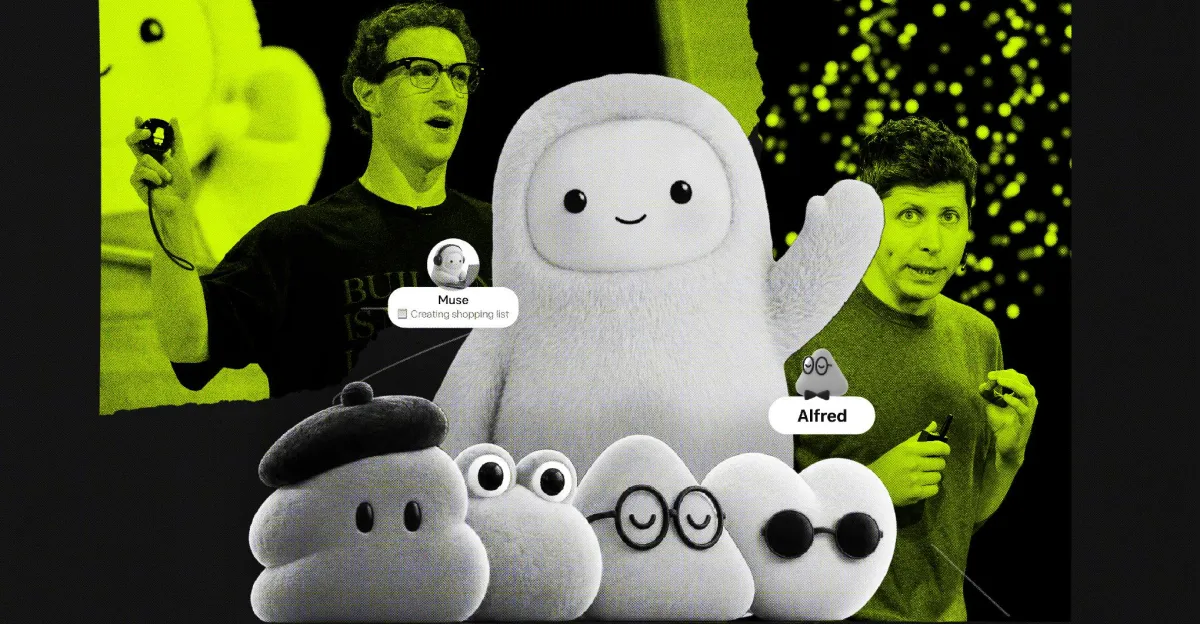
In a recent conversation on Decoder, The Verge’s senior AI reporter Hayden Field described the current moment as the point where consumer-facing agents are finally becoming usable for ordinary people, after years of hype, prototypes, and frequent failures. The difference now is that companies like Meta, OpenAI, and xAI are packaging these tools into polished products with mascots, product names, and clear use cases—an indication that the agent era is moving from concept to commercialization.
What changed in the AI agent race?
The AI agent race changed when companies stopped treating agents as experimental features and started shipping them as products people can actually use. That shift matters because it marks the transition from abstract promises about autonomous software to tools that can perform practical, multi-step actions on a user’s behalf.
For years, agents lived mostly in the realm of tech-keynote optimism. Industry leaders talked about them as the next major computing interface, but the systems were often unreliable, awkward, and too dependent on hand-holding. The new wave looks different because the leading labs are now wrapping models in browser-based harnesses that let them complete tasks using software in the background.
That technical direction has become the industry default. Instead of inventing wholly new kinds of systems, companies are converging on a similar architecture: a model connected to a browser or computer environment that can click, type, navigate, and reason through a task in multiple steps.
Why are Meta and OpenAI suddenly pushing agents now?
Meta and OpenAI are pushing agents now because the category finally looks ready enough for everyday use and valuable enough to influence user behavior at scale. Both companies also see agents as a way to lock customers into their ecosystems before rivals do.
Meta has an especially strong incentive to move quickly because it does not need a frontier model to dominate the user experience. It already has huge consumer platforms, including Instagram and Facebook, where it can put Muse in front of millions of people immediately. OpenAI, by contrast, is more dependent on monetization and premium subscriptions, so Dots is being positioned as a paid product that can support more serious work tasks.
The result is a split strategy. Meta is leaning into mass adoption by making Muse free and easy to find inside its apps. OpenAI is treating Dots as part assistant, part productivity platform, aimed at users and businesses willing to pay for deeper functionality.
How do Muse and Dots differ?
Muse and Dots differ mainly in pricing, distribution, and the audiences their makers are courting. Both are designed as autonomous assistants, but Meta is presenting Muse as a consumer product while OpenAI is pitching Dots as a higher-end tool for professionals and enterprises.
Muse is free and heavily integrated across Meta’s products. The company’s approach appears designed to normalize agent use by putting the feature in front of people repeatedly and removing as many barriers as possible. In practice, that means one-click access, broad visibility, and a consumer experience meant to feel lightweight rather than technical.
Dots is more complicated. OpenAI is reserving the feature for paying customers at its upper subscription tiers, which limits its reach but fits the company’s need to generate revenue. The product is also framed as a work assistant for tasks like marketing, legal review, accounting, software development, and planning.
| Product | Company | Pricing | Main focus | Distribution edge |
|---|---|---|---|---|
| Muse | Meta | Free | Consumer-facing personal assistance | Instagram, Facebook, Meta ecosystem |
| Dots | OpenAI | Paid, high-tier subscriptions | Enterprise and knowledge work | ChatGPT user base and business integrations |
| Grok Bot | xAI | Subscription-based | Coding and productivity tasks | X and developer workflows |
| Gemini Spark | Varies by Google product tier | General AI assistance | Google services and Android ecosystem |
Why is privacy becoming the central issue?
Privacy is becoming the central issue because agents only become truly useful when users let them access sensitive information and act on it. That raises the obvious question: how much trust should people place in a system that can read emails, manage payment details, and interact with websites on its own?
The appeal of an always-on agent is obvious. It can book flights, handle dinner reservations, triage inboxes, and complete tasks without constant supervision. But the more capable the agent becomes, the more it needs access to the personal data that makes those tasks possible.
That includes email accounts, calendars, loyalty numbers, payment information, documents, browser history, and sometimes work systems. In other words, the same data that makes the tool useful also makes it risky. A security mistake, a permissions flaw, or a malicious prompt could turn a convenience product into a serious exposure point.
Field noted that this tension is part of what makes the category so consequential. The future being promised by the industry is one where users no longer open apps for every task. Instead, they delegate work to a software layer that operates continuously in the background. The tradeoff is that the layer must know a lot about the person it is helping.
Field’s view, paraphrased from the interview, was that the whole category depends on users being willing to hand over highly sensitive data in exchange for convenience—and it is still unclear whether most people are comfortable doing that at scale.
How did OpenClaw influence today’s agents?
OpenClaw influenced today’s agents by proving that a relatively simple always-on assistant could be useful enough for people to tolerate its flaws. The project helped establish the browser-plus-harness approach that the rest of the industry is now copying.
In the interview, Field traced the current moment back to the homebrew tools that AI enthusiasts were building before the major platforms moved in. Those experiments showed that even rough agents could save time if they were capable enough to do real tasks. That was enough to force larger companies to take the category seriously.
The important lesson from OpenClaw was not that it was perfect. It was that users were willing to accept some privacy and security issues if the tool delivered actual value. That gave major labs a blueprint: build an agent that can operate a browser, wrap it in a better interface, and make it easier for mainstream users to try.
Meta says Muse was developed from scratch, though the company has acknowledged that the concept was inspired by OpenClaw. OpenAI’s connection is even more direct, since it hired the creator of the original project. That shared lineage helps explain why the current generation of agents looks technically similar across companies.
What exactly is an AI agent in this context?
An AI agent is a model combined with tools that let it complete multi-step tasks without constant human direction. Instead of answering a single prompt and stopping, it can plan, execute, correct itself, and finish a goal such as booking a trip or sorting an email queue.
That means the agent is not just generating text. It is operating like software with agency, using a browser or other interface to take actions in the real digital world. The promise is less typing, fewer app switches, and more delegated work.
Why Meta may have the distribution advantage
Meta may have the distribution advantage because it already owns consumer platforms that reach billions of people and because it has a long track record of turning complicated software into products that feel easy. That combination is especially powerful in a category where first-time adoption matters.
Field argued that Meta’s edge is not frontier-model leadership. It is product design and reach. The company does not appear to believe that it needs the most advanced model on earth to win the consumer market. Instead, it can rely on familiarity, convenience, and placement inside apps people already use every day.
Muse is not just an app users must remember to install. It can be surfaced inside Meta’s existing products, which gives the company a built-in funnel. That matters in a category where repeated exposure could determine whether users ever develop the habit of relying on an agent at all.
For Meta, the strategic goal is to make agents feel normal. The company appears to be trying to create its own version of a ChatGPT moment for autonomous assistants, but with a mass-market consumer-first rollout and a free entry point.
- Meta can place Muse directly inside Instagram and other apps.
- OpenAI has a large paying user base, but access is gated by subscription tiers.
- xAI and Google are also moving into the agent category, raising competitive pressure.
- Early user habits could create long-term switching costs and product lock-in.
How does OpenAI plan to compete?
OpenAI plans to compete by turning Dots into a premium, broadly integrated productivity layer. The company is betting that users will pay for a tool that can work across many services, even if each individual integration is not always the deepest one available.
That strategy reflects OpenAI’s business reality. Unlike Meta, it cannot afford to subsidize a large-scale consumer product indefinitely without a strong path to revenue. As a result, Dots is being marketed not just as a general assistant but as a serious assistant for professionals.
The company is also emphasizing breadth over specialization. If a user wants access to Gmail, Outlook, and a wide range of other tools, OpenAI wants to be the platform that can offer them all in one place. The pitch is that variety itself creates value, even if some competitors have more native integrations for their own services.
OpenAI’s presentations suggest another motive as well: lock-in. Once a user gives an agent access to workflows, contact lists, calendars, and account data, switching becomes harder. That kind of retention is especially valuable in a market where the underlying model can change quickly but the surrounding workflow layer may be much stickier.
What role does enterprise play in the agent battle?
Enterprise plays a major role because work users are more likely to pay for agent functionality and more likely to integrate it into daily routines. That makes the business case stronger, even if the consumer appeal is broader.
OpenAI’s Dots launch showed this clearly. The company highlighted use cases across marketing, legal work, accounting, design, and software engineering, presenting the product less as a novelty and more as an upgrade to the modern knowledge worker’s desk.
Sam Altman reportedly described the product in terms closer to a chief of staff than a simple assistant. That framing is important because it implies a more ambitious role: not just booking dinner or handling calendars, but supporting high-value decisions and repetitive work inside a company.
Enterprise also helps explain why OpenAI is willing to tolerate the friction of a paid product. If Dots can become embedded in teams and workflows, the company may gain more durable customer relationships than it would through casual consumer use alone.
According to Field’s account of the launch, OpenAI’s leadership was signaling that it wants Dots to serve as a serious workplace companion rather than a lightweight consumer toy.
What about xAI, Google, and the rest of the field?
xAI, Google, and other large AI players are all trying to claim a place in the same race, which makes the agent market look less like a single product category and more like an emerging layer of computing. Every major platform company appears to believe that agents will become a default interface for digital work.
xAI’s Grok Bot is part of that push, and Google has also introduced its own agent-focused efforts. The important point is not just that these companies are following Meta and OpenAI. It is that they all recognize a future in which users delegate tasks across connected services rather than manually operating each app.
That future could be worth enormous sums because the company that owns the agent layer may control user attention at a more foundational level than any single app today. It would sit between the person and the rest of the internet, deciding what gets done and when.
That is why the competition is now as much about ecosystem power as model performance. Better benchmarks matter, but so do login systems, identity layers, cloud access, browser control, app integrations, and habit formation.
| Timeline | Development stage | What changed |
|---|---|---|
| 2022 | Ideation | Agents were discussed as an emerging concept, often with Jarvis-style comparisons. |
| 2023 | Deployment experiments | Companies tested early systems, but many failed or underperformed. |
| 2024–2025 | Iteration and frustration | Agent tools improved slowly but remained unreliable for broad consumer use. |
| 2026 | Commercial launch | Meta Muse, OpenAI Dots, and other products brought consumer-friendly agents to the mainstream. |
Why lock-in may matter more than model quality
Lock-in may matter more than model quality because agents sit inside a user’s routines, not just in a one-off chat window. Once the software knows enough to complete recurring tasks, the cost of switching becomes larger than the cost of choosing a slightly better model elsewhere.
This is the same dynamic that has shaped other software markets. Email, cloud storage, office suites, and mobile platforms all became powerful not only because they were good, but because they accumulated the data and workflows that made leaving inconvenient.
Field’s reporting suggests AI companies understand that lesson well. They know users may compare chatbot outputs casually, but they are far less likely to recreate months of permissions, preferences, integrations, and task history in a new product.
That is why agents are so strategically important. They could shift competition away from individual prompts and toward an entire operating layer that quietly handles the most repetitive parts of modern digital life.
How much trust will users really give AI agents?
Users will probably give AI agents only as much trust as the products earn through reliability, transparency, and utility. The problem is that agents need a lot of trust before they can become truly useful, which creates a classic adoption dilemma.
People may be willing to let an agent book a restaurant or draft an email. They may be much less willing to let it manage sensitive correspondence, payment information, or legal and financial tasks without clear guardrails. That hesitation could slow adoption even as the technology improves.
Still, the appeal is obvious. If the software works, it can remove many of the small tasks that consume time and attention every day. The question is whether users believe the convenience is worth the exposure.
For now, the answer appears to vary by use case. Consumer-facing tasks look easier to embrace, while workplace and enterprise scenarios may depend on stronger controls and clearer vendor accountability.
What the agent race means for the future of computing
The agent race may end up defining the next phase of computing because it changes the relationship between people and software. Instead of opening apps and issuing commands manually, users would delegate outcomes to systems that can act on their behalf.
If that shift happens at scale, the most important products in tech may no longer be the apps themselves, but the layers that organize and execute tasks across them. That would make agents both a convenience feature and a control point for the entire software stack.
Meta’s Muse and OpenAI’s Dots are early attempts to define that layer. One is built for reach, the other for revenue and workflow integration. Both are betting that users will eventually accept a software assistant that is always present, increasingly autonomous, and deeply embedded in their digital lives.
Whether that future becomes mainstream will depend on more than marketing. It will depend on whether the tools actually save time, whether the security model holds up, and whether people decide the tradeoff between convenience and privacy is one they are willing to make.
Key facts at a glance
- Meta launched Muse as a free, consumer-focused AI agent.
- OpenAI launched Dots as a paid agent aimed more at professional and enterprise users.
- Both products use a similar technical idea: a model paired with a browser or computer harness.
- The category is growing around always-on agents that can manage multi-step tasks.
- Privacy, security, and ecosystem lock-in are now central competitive issues.
As the agent race accelerates, the biggest unresolved question is not which company has the flashiest demo. It is which company users will trust enough to hand over the data and permissions that make autonomous AI actually work.
Frequently asked questions
What are Meta Muse and OpenAI Dots?
Meta Muse and OpenAI Dots are new AI agent products designed to complete multi-step tasks on a user’s behalf. Muse is aimed at consumers and is free, while Dots is a paid product focused more on professional and enterprise workflows.
Why is Meta ahead in the AI agent race?
Meta appears ahead because it has stronger consumer distribution and a better product-launch machine. Muse can be surfaced inside Meta’s existing apps, giving it immediate reach, while OpenAI must rely more on subscriptions and outside integrations to grow.
Are AI agents safe to use with personal data?
AI agents can be useful, but they also require access to sensitive information such as email, calendars, and payment details. That makes them potentially risky if permissions, security, or prompt handling fail, so trust and safeguards are critical.
How do AI agents differ from chatbots?
AI agents are more capable than chatbots because they do not just respond to prompts. They can plan and execute multi-step tasks, often by using a browser or other computer interface to take actions rather than simply generating text.
Why are companies building AI agents now?
Companies are building AI agents now because the technology has become good enough to be commercially useful and because agents can create customer lock-in. Once a user depends on an assistant for daily workflows, switching to a competitor becomes much harder.