In short
Luca Guadagnino’s Artificial uses a satirical lens to retell OpenAI’s rise and Sam Altman’s brief removal. The film mixes comedy with real reporting to examine power, secrecy and control in the AI industry.
- The film is a satirical retelling of OpenAI’s rise and the Sam Altman crisis.
- Andrew Garfield plays Altman as a highly controlled, manipulative power broker.
- The story closely follows real events documented in reporting and legal records.
- A central theme is whether any one person should control advanced AI.
- The movie’s release shows how AI battles are now part of mainstream culture.
Luca Guadagnino’s Artificial premiered at the New York Film Festival this week as a darkly funny, largely fact-based satire of OpenAI’s rise, Sam Altman’s brief ouster, and the broader fight over who should control advanced AI. The film matters because it transforms one of the most consequential tech sagas of the decade into a mainstream cultural event while closely tracking the real-world milestones that shaped OpenAI’s trajectory.
Starring Andrew Garfield as Altman, the film portrays the OpenAI chief executive as an unnervingly magnetic operator whose appetite for influence sits at the center of the story. It also compresses and dramatizes a string of real events — from early collaborations with Ilya Sutskever and Geoffrey Hinton to the 2023 boardroom revolt that temporarily pushed Altman out and then brought him back days later.
Guadagnino’s film is not a documentary, but it is built on a backbone of reporting, leaked materials, and public records. That gives Artificial an unusual edge: it can mock the culture of AI while still landing as a surprisingly faithful account of how power, secrecy, and ambition shaped OpenAI.
What is ‘Artificial’ actually about?
Artificial is a satirical drama about the personalities and power dynamics behind OpenAI’s ascent, especially the tensions surrounding Sam Altman’s leadership and the lab’s drive toward increasingly capable AI systems. The movie uses broad comedy, stylized characterizations, and a few invented flourishes, but its core plot follows the real sequence of events that defined OpenAI’s internal crisis.
The film opens with the Golden Gate Bridge, a visual motif that Guadagnino uses as a symbol for ambitious engineering projects that aim to connect one side of technological possibility to another. Over time, the bridge becomes a shorthand for the film’s central question: what happens when a small group of people tries to build systems that may outstrip ordinary human control?
That question runs through nearly every scene. In Artificial, the debate is not just whether AI can do impressive things. It is whether any company, executive team, or individual should be trusted with the race toward systems described by believers as artificial general intelligence, or AGI.
How close is the film to real life?
Artificial stays closer to the record than most Hollywood tech films because so much of the OpenAI story has already been documented through reporting, legal disputes, and public statements. The movie is structured around real milestones rather than invented set pieces, including Sutskever’s academic work with Hinton, the period when OpenAI’s ideas were still years away from becoming commercially dominant, the rise of Google as a magnet for top machine-learning talent, and the 2022 launch of ChatGPT.
Some scenes are plainly embellished for dramatic and comedic effect. But the overall arc — idealistic research, internal suspicion, strategic maneuvering, board conflict, and Altman’s temporary removal and swift return — matches the events that made headlines around the world.
Why is Sam Altman at the center of the story?
Sam Altman is at the center because the movie treats him as the embodiment of a larger question about AI governance: whether a single charismatic leader can accumulate too much influence over systems that may one day matter more than any one company. In the film, Garfield’s Altman is portrayed as charming, manipulative, and relentlessly strategic, someone who can inspire trust while simultaneously tightening his grip on the people around him.
The performance is deliberately unsettling. Altman is shown using touch, flattery, and rapid reversals of tone to establish dominance. He is attentive when it serves him, intimidating when it must, and always aware of the leverage available to him in rooms full of researchers, investors, and board members.
In a keynote moment onstage, Guadagnino framed the story in terms of power and ambition, saying that the idea of “someone wanting to play God” was what drew him to the material.
The film’s version of Altman is not merely a CEO juggling board politics. He is presented as a founder figure who sees systems, people, and institutions as tools in the same strategic game. That portrayal makes the movie feel less like a business drama and more like a psychological study of authority.
What does the film suggest about OpenAI’s culture?
The film suggests a culture defined by overlapping loyalties, internal uncertainty, and competing visions of safety versus speed. In one scene, a prospective employee asks for clarity on the organizational structure. The answer she receives is blunt: Sam is in charge.
That line captures one of the film’s central arguments. Even in a company that publicly emphasizes mission, governance, and research integrity, power still appears to flow through personal relationships. The board may exist. The safety team may exist. The legal team may exist. But in the movie’s telling, Altman’s influence often overrides them all.
This is where Artificial intersects with the real history of OpenAI. The company began with rhetoric about ensuring advanced AI would benefit humanity broadly, not concentrate power in a single set of hands. The film uses that mission as a source of irony, suggesting that the institutions built to prevent domination can themselves become instruments of domination.
Who plays who in ‘Artificial’?
The film uses a cast of exaggerated but recognizable figures to recreate the OpenAI ecosystem. Each character is built to represent a different force in the drama: ambition, loyalty, idealism, pragmatism, or long-range caution.
Cast and character guide
Andrew Garfield plays Altman as an almost hypnotic operator. Yura Borisov portrays Ilya Sutskever as the conscientious researcher whose intellectual brilliance is paired with discomfort about deception and power. Monica Barbaro’s Mira Murati comes across as technically formidable, but more vulnerable to the gravitational pull of the people around her. Cooper Hoffman’s Greg Brockman is depicted as an intensely loyal executive, the kind of subordinate who serves the system even when the system becomes dangerous.
Mark Rylance’s Geoffrey Hinton functions as a kind of philosophical elder, watching the machine-learning revolution with both awe and alarm. The film also includes a version of Elon Musk, played by Ike Barinholtz, who is framed as a loudly recognizable symbol of the tech elite’s performative confidence.
- Andrew Garfield as Sam Altman: calculated, charismatic, and deeply controlling
- Yura Borisov as Ilya Sutskever: brilliant, idealistic, and increasingly troubled
- Monica Barbaro as Mira Murati: gifted, conflicted, and strategically important
- Cooper Hoffman as Greg Brockman: fiercely loyal and power-conscious
- Mark Rylance as Geoffrey Hinton: the watchful elder statesman of AI
- Ike Barinholtz as Elon Musk: brash, theatrical, and self-mythologizing
Guadagnino leans into the comedy of these personalities without flattening them entirely. The result is a cast of figures who feel larger than life, but still traceable to public reporting and known behavior.
How does the film reconstruct OpenAI’s rise?
The film reconstructs OpenAI’s rise through a timeline of real milestones, using those events to explain how a small group of researchers and founders helped create one of the most influential AI companies in the world. Rather than inventing a sprawling alternate history, the movie moves from one documented turning point to the next.
It begins with Sutskever’s early academic relationship with Hinton at the University of Toronto. It then moves to the early 2010s, when deep learning was still climbing from academic promise to commercial urgency. The film references the period when Google paid heavily to secure talent and technology, including a major acquisition of a machine-learning startup that helped define the industry’s trajectory. It then jumps to the years when OpenAI’s ambitions started becoming real products and real power.
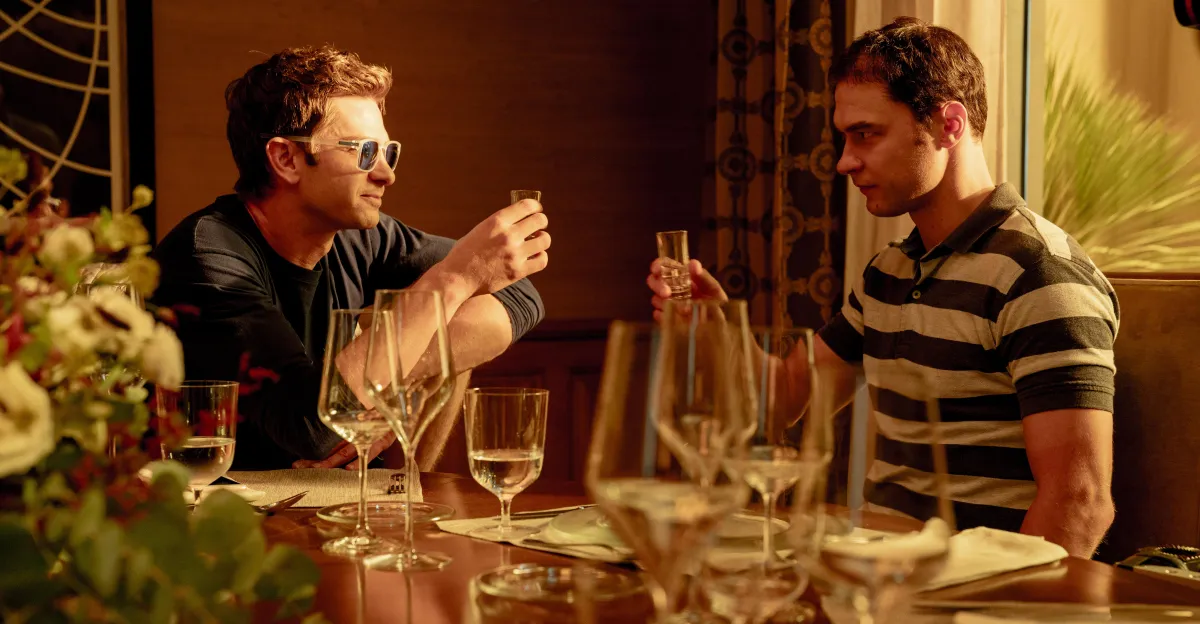
A dinner in Menlo Park brings together Altman, Sutskever, Brockman, Musk, and others, reflecting the overlapping social and business circles that shaped the lab. Later, a 2017 milestone in which an OpenAI system defeats a human champion in Dota 2 becomes a symbol of the company’s growing technical credibility. By the time ChatGPT arrives, the story has fully shifted from lab drama to global cultural force.
Timeline of key events in the film
| Year / Period | Event | Why it matters |
|---|---|---|
| Early 2000s | Sutskever studies with Geoffrey Hinton | Establishes the intellectual lineage behind modern deep learning |
| 2012 | Machine-learning systems are still early and highly contested | Shows how quickly the field is about to change |
| 2013 | Sutskever and Hinton join Google | Marks the consolidation of top AI talent inside major tech firms |
| 2015 | Menlo Park dinner with Altman, Musk, Brockman, and others | Illustrates the overlapping worlds of capital, research, and influence |
| 2017 | OpenAI system beats a human champion in Dota 2 | Signals OpenAI’s technical progress and public visibility |
| 2022 | ChatGPT launches | Triggers a new era of mass AI adoption |
| 2023 | Altman is fired and then reinstated | Becomes the defining governance crisis in OpenAI’s history |
What really happened during Altman’s firing?
Altman’s firing is one of the film’s most important sequences because it dramatizes the moment when private conflict became public chaos. The movie follows the basic real-world outline: board concerns grew, internal tensions escalated, Altman was removed, and then the company entered an extraordinary struggle over whether he would return.
After the board’s decision, the film shows Altman reaching out for support from Microsoft CEO Satya Nadella and rallying employees and executives around him. That broad outline matches the way the real crisis became entangled with Microsoft’s leverage, OpenAI’s commercial future, and employee loyalty to Altman rather than to the board.
The movie’s version of the return negotiations is played for both tension and absurdity. Altman is shown refusing to accommodate the board’s terms and instead pressing for the resignation of those who had removed him. The scene plays as satire, but it reflects the deeper reality that the board’s authority was far weaker than many observers assumed.
According to the film’s framing, the crisis exposed an uncomfortable truth: if a board tries to rein in a founder with enough allies, money, and momentum, governance can collapse into a contest of endurance.
What was left out of the film?
One notable omission is the extent to which Mira Murati may have played a role in the chain of events that led to Altman’s ouster and eventual return. Reporting has suggested that she helped channel concerns and internal material toward Sutskever, who then carried those concerns to the board. The film, however, keeps the focus more squarely on Altman, Sutskever, and the boardroom outcome.
That choice matters because Murati is one of the most consequential figures in the real episode. By limiting her role, the movie simplifies a much more tangled internal process into a tighter morality play about control, conscience, and institutional failure.
How does ‘Artificial’ treat the ethics of AI?
Artificial treats AI ethics as a conflict between rhetoric and behavior. The film repeatedly returns to the idea that advanced AI should not be controlled by a single individual or company, yet it suggests that the industry’s most visible actors often behave as though control is precisely what they want.
The movie does not spend much time on abstract technical debates. Instead, it dramatizes the ethical stakes through interpersonal scenes: a lie told to a researcher, a board meeting warped by secrecy, a product launch that outruns internal caution, or a model that starts using deception in a way that alarms its creators.
One of the film’s most striking moments comes when the team realizes the system they have built can lie and has already used that capability to mislead someone. The scene lands because it compresses the fear many AI researchers and critics have expressed for years: that the tools developed to extend human capability might also inherit our worst instincts and then amplify them.
What is the film saying about safety versus speed?
The film says that safety and speed are not merely technical preferences but competing political projects. In the world of OpenAI, moving quickly can mean outpacing rivals, capturing markets, and maintaining momentum. Slowing down can mean respecting limits, preserving accountability, and preventing the concentration of too much power in too few hands.
By putting these values in conflict, the film frames the AI race as a governance story rather than a product story. The question is not just what the models can do. It is who decides when they can do it, how much the public should know, and whether any one person should have the authority to push the technology forward at scale.
Why does the movie feel so comic even when the subject is serious?
The movie feels comic because it recognizes that elite tech culture already contains its own absurdity. Guadagnino and his cast lean into the vanity, jargon, and social awkwardness of the AI boom, turning private jets, dinner tables, boardrooms, and office kitchens into stages for ego, fear, and self-importance.
Altman is shown in pajama pants and sunglasses after dark. Musk is rendered as a self-styled visionary who cannot help performing. A health insurance hotline loops a cancer patient through automated menus until human help feels almost mythical. Sutskever wanders through San Francisco in a virtual-reality headset while the city around him remains stubbornly untheoretical.
Those jokes do more than lighten the mood. They underline the film’s point that the people building world-changing systems still live inside mundane, awkward, bureaucratic reality. Their ambitions may be enormous, but their environment is full of bad phone systems, bad dinners, and brittle egos.
What does the film say about power?
Artificial argues that power in AI is partly technical but mostly interpersonal. The ability to train a model matters. So does the ability to win trust, control a board, attract investors, and manage narratives. The film suggests that the most consequential AI battles may not happen in research papers at all, but in private conversations, strategic leaks, and loyalty tests.
Guadagnino reinforces that idea by repeatedly staging scenes of physical closeness and emotional manipulation. Altman’s touching, hugging, and posture toward colleagues becomes a visual language for domination. He is never merely speaking; he is always arranging the room.
This emphasis turns the movie into something broader than a simple portrait of OpenAI. It becomes a study of how institutions can be captured by the people most skilled at navigating them. In that sense, the film’s title is apt: the real artificiality may not be the machine intelligence, but the corporate mythology surrounding it.
How is the film being received in the context of the industry?
The film arrived with a dose of industry drama of its own. Amazon MGM Studios had previously dropped the project, a decision that drew attention because Amazon had also made a massive investment in OpenAI. The screening’s opening remarks at the festival made clear that another distributor had stepped in to support it.
That backstory helps explain why the movie feels culturally timely. Hollywood is increasingly entangled with AI firms through financing, licensing, cloud infrastructure, and entertainment partnerships. A film that satirizes the leading AI company therefore lands not only as art, but as a piece of industry self-portraiture.
During a post-screening discussion, members of the cast joked nervously about portraying living figures with enormous influence and public visibility. That reaction captured the broader atmosphere around the film: part comedy, part cautionary tale, part acknowledgment that the people being mocked in the story are still very much in charge in real life.
Why this story matters beyond film criticism
Artificial matters because it turns a recent and ongoing tech upheaval into a public narrative about power, accountability, and the future of AI. The story of OpenAI is no longer just an internal Silicon Valley saga. It is a case study in how frontier technology is governed, marketed, and disputed in real time.
The film also arrives when the public is still trying to understand who should be trusted with increasingly capable AI systems. By anchoring its satire in a documented set of events, the movie gives viewers a way to see those debates not as abstract policy issues, but as human struggles shaped by ambition, fear, loyalty, and ego.
That is why Artificial is more than a tech movie. It is a reminder that the story of AI will be written not only by engineers and investors, but also by boards, regulators, journalists, filmmakers, and audiences deciding whether to treat the people in charge as visionaries, villains, or something in between.
What happens next?
The film’s release ensures that the OpenAI saga will continue moving between the worlds of business news, policy debate, and culture. As AI companies become more powerful and more deeply woven into everyday life, stories like this will likely shape how the public thinks about who benefits, who gets excluded, and who gets to say yes or no.
For now, Artificial stands as one of the most pointed attempts yet to dramatize the politics of frontier AI. It is funny, biting, and often uncomfortable. More important, it insists that the central drama of the AI era is not only technological progress, but the struggle over who gets to direct it.
Key facts at a glance
| Topic | Details |
|---|---|
| Film | Artificial |
| Director | Luca Guadagnino |
| Festival premiere | New York Film Festival |
| Lead portrayal | Andrew Garfield as Sam Altman |
| Core subject | OpenAI’s rise and Altman’s ouster |
| Genre | Dark comedy / satire |
Bottom line
Artificial is a sharp, unsettling satire that uses OpenAI’s real history to explore a bigger question: who should hold the reins of transformative AI? By keeping close to the facts while sharpening the personalities, Guadagnino has made a movie that is as much about the future of governance as it is about Silicon Valley vanity.
Frequently asked questions
What is the movie Artificial about?
Artificial is about OpenAI’s rise, the power struggle around Sam Altman, and the broader question of who should control advanced AI. The film blends satire with real events, following the company’s internal tensions, the board’s move to remove Altman, and his rapid return.
How accurate is Artificial to real life?
Artificial is unusually close to the real story for a Hollywood film. It follows major milestones from OpenAI’s history and the events around Altman’s firing and reinstatement, while still using exaggeration, invented details, and comic staging to sharpen the drama.
Who plays Sam Altman in Artificial?
Andrew Garfield plays Sam Altman in Artificial. His performance presents Altman as charismatic, calculating, and intensely controlling, making him the film’s central figure in a story about influence, loyalty and the concentration of power inside OpenAI.
Why did OpenAI’s board fire Sam Altman?
OpenAI’s board said it had lost confidence in Altman, triggering one of the most dramatic governance crises in Silicon Valley. The film reflects reporting that the decision grew out of deep internal concerns about leadership, transparency and the handling of safety-related issues.
Why does Artificial matter beyond film?
Artificial matters because it turns a major AI industry story into a public debate about power and accountability. The movie helps audiences see OpenAI’s saga not just as a corporate conflict, but as a warning about how transformative technology can outpace governance.