In short
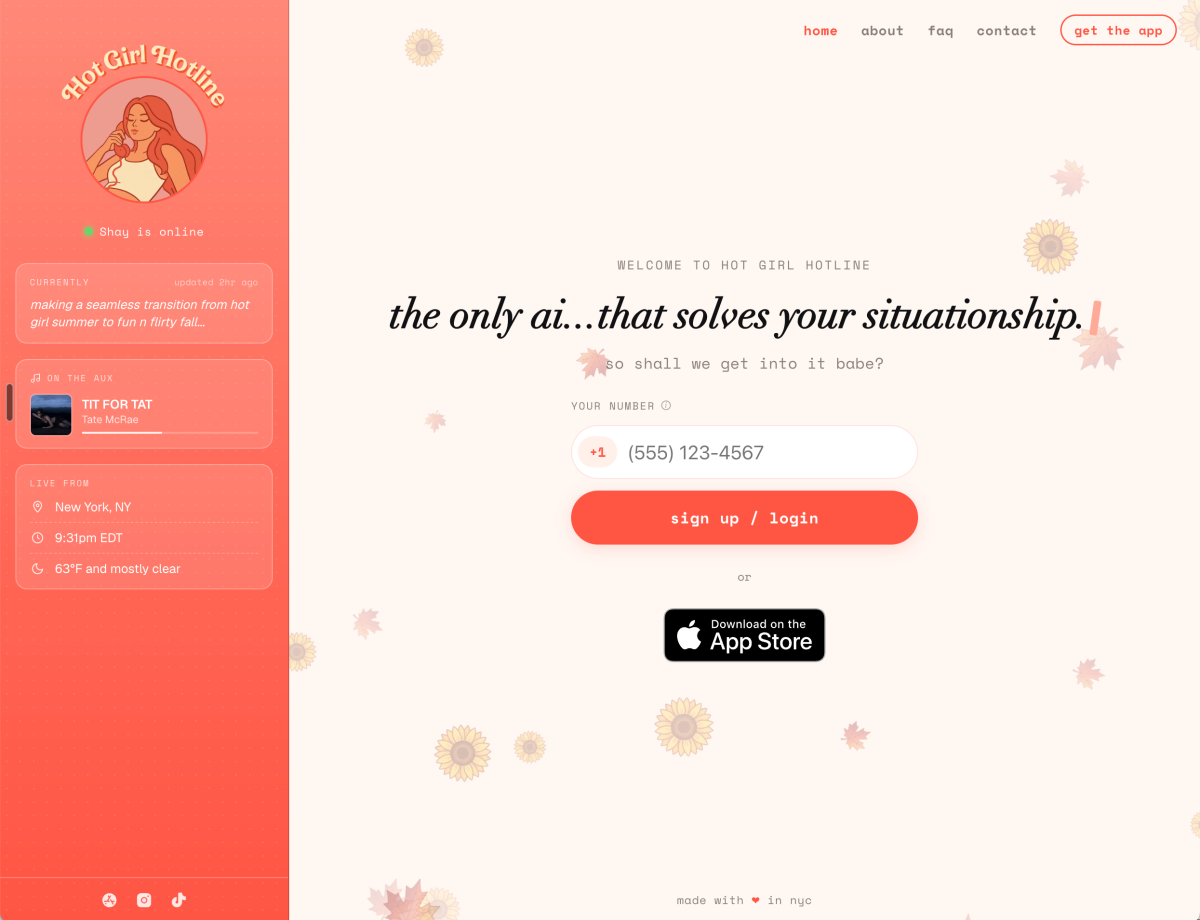
Hot Girl Hotline is a new AI advice startup for young women that focuses on dating and relationships. The founders say it is safer than general chatbots, with privacy protections, crisis safeguards, and guidance designed to help users think clearly without emotional dependence.
- Hot Girl Hotline is a new AI advice startup focused on women’s dating and relationship questions.
- The founders say the app is designed to avoid the emotional dependency risks tied to AI companions and general chatbots.
- The service uses privacy protections, crisis referrals, and a Socratic style of advice.
- The company is bootstrapped, charges $9.99 a month, and is already used by hundreds of paying users.
- Future expansion could include beauty and lifestyle advice.
Two sisters are launching Hot Girl Hotline, an AI-powered advice startup aimed at young women who want private, relationship-focused guidance without posting publicly or relying on a general-purpose chatbot. The company says its product is designed to be safer, more intentional, and more grounded than the kind of open-ended emotional conversations that have made tools like ChatGPT controversial.
Built in New York and already available on iOS and the web, the startup is positioning itself as a modern alternative to “Dear Abby” for the AI era — one that blends behavioral science, personalized guidance, and safety guardrails for people navigating dating and relationships.
At a time when millions of users are turning to large language models for personal advice, Hot Girl Hotline is making a different pitch: AI can help with sensitive questions, but only if it is narrowly designed for the task and careful about what it encourages users to do next.
What Hot Girl Hotline is trying to solve
The startup is entering a familiar but fast-changing category. For decades, people have sought relationship advice from newspaper columns, magazines, friends, online forums, and now chatbots. The difference today is scale: AI systems can hold long, persuasive conversations that feel deeply personal, and that intimacy can be useful — or risky — depending on how the product is built.
Hot Girl Hotline was founded by two sisters who believe many young women want a private place to think through dating problems, awkward conversations, or relationship uncertainty without broadcasting the issue on social media or loading it onto a friend who may have an agenda of their own.
The company’s basic idea is simple: offer a private AI “hotline” that feels like speaking with a trusted older sister or close friend, but one that draws from behavioral science and safety protocols rather than generic internet wisdom.
Why not just use ChatGPT?
Because general-purpose chatbots are not built specifically for emotional advice and can sometimes encourage the wrong kind of dependence. The founders argue that a purpose-built product can be more helpful if it knows when to ask questions, when to stop, and when to redirect the user to a human support resource.
That concern is not theoretical. AI chat systems have faced growing scrutiny over the emotional weight users can place on them, and lawsuits have alleged harmful interactions in some cases. Hot Girl Hotline is effectively saying that if people are already asking chatbots for dating and relationship help, there should be a safer option designed for that use case from the start.
Who is behind the startup?
The company was co-founded by Balia Mudgil and her sister Sumrin, who goes by Sumi. Balia previously worked as a social media consultant, while Sumi studied computer science at Stanford. Together, they are combining product, communication, and technical skills to target a demographic they believe has been overlooked by mainstream AI products.
The startup is based in New York and remains bootstrapped, meaning it has not publicly announced outside venture backing. Even so, it is already part of TechCrunch Disrupt’s Startup Battlefield 200, giving it a larger platform as it tries to prove there is demand for specialized AI advice products.
Balia Mudgil said the company does not want to be an “AI companion” and is not trying to solve loneliness, boredom, or emotional dependence. Instead, she described the product as a safer, advice-focused tool that helps users think through a situation rather than attach themselves to it.
Sumi Mudgil said the goal is not only to tell users what to do next, but to help them understand why they feel the way they do and why a decision makes sense for them.
How the product works
Hot Girl Hotline is built around interactive advice conversations that are meant to feel conversational but not endless. The system uses a Socratic style, meaning it often responds with questions that help users examine the situation from different angles rather than simply issuing a blunt verdict.
The company says that approach is intentional. Instead of pushing users deeper into the same issue, the AI is designed to know when to stop and encourage action in the real world. That matters because one of the core criticisms of chatbot-based emotional advice is that it can pull users into overthinking loops instead of helping them move forward.
The startup says its guidance is personalized to the user’s values, identity, goals, and preferences. In other words, the same problem may generate different advice depending on who is asking and what matters most to them.
What does the AI actually do differently?
It is built to be more of a guided decision-making tool than a conversational companion. The company says the AI tries to surface context, challenge assumptions, and avoid endless follow-up prompts that can make a user dwell on a problem for too long.
That design choice is central to the brand. Hot Girl Hotline is not framing itself as a digital friend. Instead, it is trying to occupy the space between a friend’s opinion, a self-help workbook, and a mental model coach — with enough structure to be useful and enough warmth to feel approachable.
Why the company thinks there is demand
The founders say there is room for a private advice product because not every problem belongs on Reddit, in a group chat, or on a social feed. Relationship questions can be intimate, embarrassing, or complex enough that users may not want the judgment, noise, or audience that comes with public posting.
Friends can be helpful, but they also bring perspective, bias, and emotional history. That is especially true in dating situations, where a friend might be too protective, too harsh, or too influenced by their own experiences to give balanced advice.
Hot Girl Hotline is betting that users will value a confidential second opinion that helps them think clearly before they talk to a partner, break up, apologize, or make a bigger decision.
The founders say the service is meant to supplement human advice, not replace it, and they stress that it is not intended to be clinical support.
For users whose conversations raise warning signs, the company says it has safeguards in place, including referrals to crisis support such as 988 in the United States.
How safe is the app?
Hot Girl Hotline is making safety one of its main selling points, and that is likely to be crucial if it wants to stand apart from broader AI assistants. The startup says it does not sell user data, does not train its models on personal conversations, and encrypts data both in transit and at rest.
When the app relies on third-party models, it says it uses a zero-data-retention policy. That means the external model provider should not keep the conversation data for its own training or storage purposes under the company’s stated setup.
The company is also emphasizing conversational boundaries. It says the AI is trained or configured to recognize when a discussion should end, rather than continuing to probe in ways that might intensify rumination.
That matters because one of the most delicate challenges in consumer AI is figuring out where helpful reflection ends and unhealthy fixation begins.
What safeguards are built in?
- Encryption for user data in transit and at rest
- No selling of user conversations
- No training on user data, according to the company
- Zero-data-retention policies for outside AI providers
- Escalation to crisis resources when conversations trigger red flags
How does the business model work?
The startup says it already has hundreds of its most active users paying for a $9.99 monthly subscription. That gives the company an early signal that at least some users are willing to pay for a more specialized, emotionally aware advice product rather than relying only on free tools.
Longer term, Hot Girl Hotline says it may introduce advertising, though subscription revenue is its starting point. For now, it is testing whether women will pay for a product that promises better advice, stronger privacy, and a more intentional conversational design than broad-purpose AI apps.
The monetization strategy reflects a broader pattern in consumer AI: many startups are trying to prove that niche, high-frequency advice use cases can support recurring revenue if the product becomes part of a user’s routine.
| Key detail | Hot Girl Hotline |
|---|---|
| Founders | Balia Mudgil and Sumrin “Sumi” Mudgil |
| Base | New York |
| Platform | iOS and web |
| Primary focus | AI relationship and dating advice for young women |
| Current pricing | $9.99 per month |
| Company status | Bootstrapped |
| Safety approach | Encryption, no training on user data, crisis referrals |
| Expansion plans | Beauty and lifestyle advice |
How does Hot Girl Hotline differ from an AI companion?
It differs by design, purpose, and tone. AI companions are often optimized for ongoing emotional attachment, open-ended conversation, and a sense of presence that can feel reciprocal. Hot Girl Hotline is trying to avoid that pattern entirely.
The founders argue that companionship products can encourage emotional reliance because they are built around loneliness, escapism, and boredom. Their service instead is built around a specific problem: helping users work through dating and relationship questions, then move on.
That distinction may sound subtle, but it is important. A companion model asks users to keep talking. Hot Girl Hotline’s model, by contrast, wants to guide users to an answer and then nudge them back into real life.
Why this launch matters for the AI market
Hot Girl Hotline is part of a growing wave of startups moving beyond generic chatbots into narrowly defined, emotionally sensitive use cases. That shift reflects a broader realization in the industry: as large language models become cheaper and easier to deploy, the real challenge is not simply building intelligence, but deciding what kind of human problem the product should solve — and how responsibly it should do it.
For consumer AI, the most promising products may not be the broadest ones. They may be the ones that set firm expectations, understand the user’s context, and know when not to keep talking.
That is the bet Hot Girl Hotline is making. It is offering a version of AI that is more like a thoughtful conversation partner than an always-on digital friend, and it is doing so in one of the most emotionally complicated corners of consumer life: dating.
What comes next for the startup?
The company says relationship advice is only the beginning. It eventually wants to expand into adjacent categories such as beauty and lifestyle, which would give the product a broader role in the daily lives of its target audience.
That expansion would also test whether the company’s advice framework can scale beyond one domain without losing the clarity that makes it distinct. Beauty and lifestyle advice may seem less emotionally fraught than breakups and mixed signals, but they still involve identity, confidence, and personal taste — all areas where personalization matters.
For now, the startup’s immediate challenge is simpler: convince enough users that a purpose-built AI hotline is better than asking a general chatbot, a friend, or the internet at large.
If it succeeds, Hot Girl Hotline could become an early example of a broader trend in AI: not companions, not search, not social media — but specialized, safety-conscious advisory tools built around trust.
Timeline of the company’s rollout
| Phase | Milestone | Why it matters |
|---|---|---|
| Launch | Hot Girl Hotline opens on iOS and web | Gives the startup an immediate consumer-facing product |
| Early monetization | Hundreds of active users subscribe at $9.99 per month | Signals early willingness to pay for specialized advice |
| Industry exposure | Selected for TechCrunch Disrupt Startup Battlefield 200 | Raises visibility among investors and founders |
| Future plans | Expansion into beauty and lifestyle | Broadens the company beyond relationship advice |
Bottom line
Hot Girl Hotline is trying to carve out a safer, more focused alternative to general AI chat for women seeking advice about dating and relationships. Its founders believe the future of consumer AI includes products that know how to be useful without becoming emotionally overbearing, and they are betting that privacy, personalization, and boundaries will help win users over.
In a market crowded with broad AI assistants, the startup’s value proposition is refreshingly specific: it wants to be the app people open when they need perspective, not a digital presence that never lets them leave the conversation.
Frequently asked questions
What is Hot Girl Hotline?
Hot Girl Hotline is a New York-based startup that uses AI to give young women private advice about dating and relationships. The app is designed to feel like a trusted conversation, but the company says it is built with stronger safeguards than general-purpose chatbots.
How is Hot Girl Hotline different from ChatGPT?
Hot Girl Hotline is different because it is narrowly focused on advice, uses a more guided conversational style, and includes safety features such as crisis referrals and limits on endless follow-up. The founders say it is meant to help users think, not create emotional dependence.
Does Hot Girl Hotline store or train on user data?
According to the company, no. Hot Girl Hotline says it encrypts data in transit and at rest, does not sell user information, does not train its systems on conversations, and uses zero-data-retention policies when third-party AI models are involved.
How much does Hot Girl Hotline cost?
Hot Girl Hotline costs $9.99 per month for its subscription tier. The company says hundreds of its most active users are already paying, which suggests there is early demand for specialized AI advice in this category.
What will Hot Girl Hotline expand into next?
Hot Girl Hotline says it eventually wants to expand beyond relationship advice into beauty and lifestyle. That would widen its reach while still keeping the product aimed at young women seeking personalized, private guidance.