In short
Wabi is pivoting from a prompt-based app builder to an AI messenger called Wabi 2.0. The startup wants to combine chat, task execution, and on-demand app creation as demand grows for consumer AI agents.
- Wabi 2.0 shifts the startup from app-building tool to AI messenger.
- The new product is designed to create interfaces on demand for specific tasks.
- Founder Eugenia Kuyda says chat-only agents become harder to use over time.
- Wabi is positioning itself against the broader rise of consumer AI agents.
- Access to Wabi 2.0 is currently invite-only.
Wabi, the startup that let people build apps from prompts, is repositioning itself around an AI messenger experience as interest surges in agent-style products. The company’s new direction, called Wabi 2.0, is designed to combine chat, task execution, and on-demand interfaces in a single consumer product.
The shift matters because it places Wabi in the middle of one of the fastest-moving debates in artificial intelligence: whether the next big consumer interface will be a chat window alone, or a hybrid system that can both talk and act. Founder Eugenia Kuyda says Wabi’s answer is the latter.
What is Wabi 2.0?
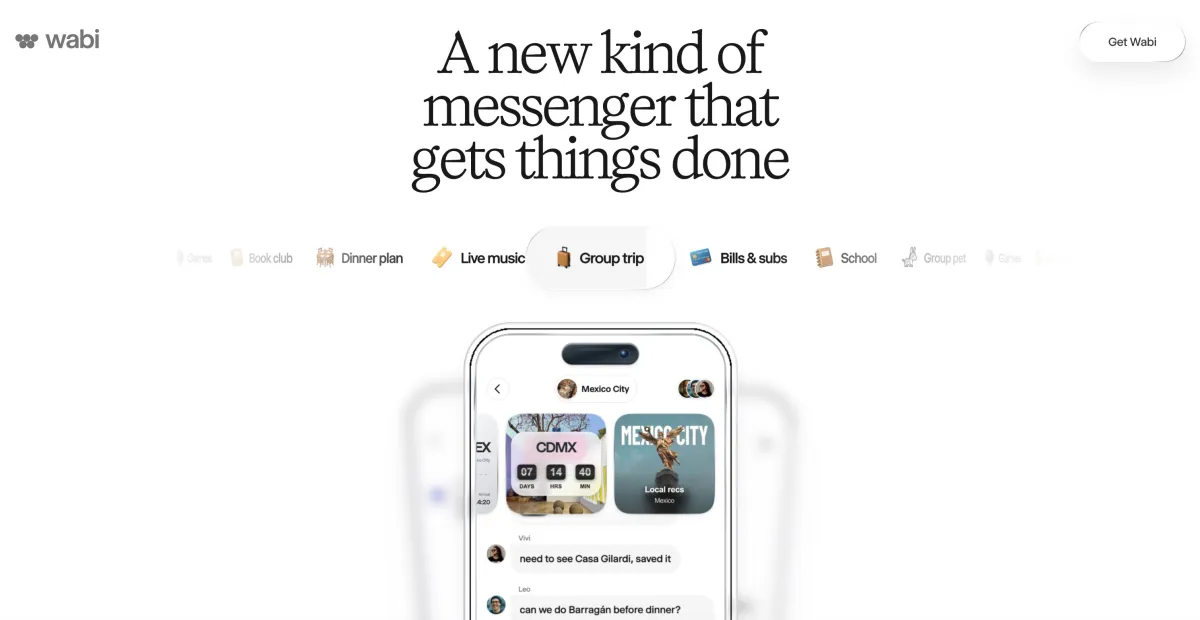
Wabi 2.0 is an invite-only product that the company describes as a new kind of messenger for the “agentic era.” In practical terms, it is meant to behave like a personal AI agent that can do work for users while also building the interface needed to finish that work.
That means the product is no longer presented as just a prompt-to-app tool, but as a conversation layer that can generate useful app-like experiences on demand. Wabi says the system is built to adapt to the task at hand rather than force users into a single, endless chat thread.
How is it different from the original Wabi?
The original Wabi was centered on helping anyone create software through prompts, putting it closer to the broader vibe-coding movement. Wabi 2.0 keeps that capability, but changes the user experience so the software is encountered inside a messaging environment rather than through a standalone app-building workflow.
Instead of competing mainly with tools that turn text into code, Wabi now wants to compete with AI agents that blend conversation, automation, and user interface creation. That puts it in a more crowded but potentially larger market, where consumer expectations are being shaped by new products from major AI companies and startups alike.
Why is Wabi changing course now?
Wabi’s pivot reflects a broader trend in consumer AI: users want systems that can do more than answer questions. They want tools that remember context, complete tasks, and present information in ways that are easier to navigate than a simple chat log.
Kuyda argues that chat-only agents eventually become unwieldy as histories grow and tasks pile up. In her view, a product that keeps everything in one long scroll can be useful at first, but becomes less practical as users try to manage ongoing activities over time.
“The more you use a chat-only agent, the worse the experience gets,” Kuyda wrote, arguing that users want to tap, scroll, and look as well as type.
Her broader point is that people may appreciate what agents can accomplish, but they still prefer interfaces that feel like software, not just conversation. Wabi’s answer is to merge those two experiences.
How does the new interface work?
Wabi 2.0 is meant to generate a user interface when the agent needs one. If a user asks for help with a recurring task, the system could create a lightweight app-like view to organize the work instead of forcing the user to keep everything inside one chat thread.
That approach is intended to make the product feel more concrete and usable for everyday life. Rather than relying only on text responses, Wabi wants to surface buttons, lists, dashboards, calendars, and other visual elements whenever they make the task easier to complete.
Examples Wabi says fit the model
Kuyda has pointed to consumer scenarios where a personal agent could generate a tailored interface quickly. In one example, she suggested health tracking tools such as calorie logs, workout records, and weight tracking. In another, she described family-oriented utilities such as children’s activity calendars, language-learning tools, and apps that track local events for kids.
The common thread is that these are not one-time prompts. They are ongoing parts of daily life, which makes them a good fit for a product that can maintain context and create a reusable interface around repeated tasks.
- Health tracking apps for calories, exercise, and weight
- Family calendars for children’s schedules and activities
- Language-learning tools built around a user’s routine
- Local event trackers for kid-friendly outings
- Household and parenting helpers that persist over time
How does Wabi fit into the wider AI race?
Wabi’s move comes as major AI companies increasingly treat apps as something that should live inside agentic interfaces, not only outside them. The industry is moving toward chatbots that can host third-party experiences, manage tasks, and keep users inside one general-purpose environment for longer periods.
OpenAI’s latest Dev Day announcements are one example of that direction. The company said it is updating its ChatGPT plugin approach so apps can provide interactive experiences inside ChatGPT itself, with app names placed more prominently in the sidebar. That is a sign that the app layer inside AI products is becoming strategically important.
Wabi is not trying to outspend those giants. Instead, it is trying to define a more consumer-friendly version of the same trend: a messenger that is not only conversational, but also operational.
What is the strategic bet behind the pivot?
The bet is that the most valuable consumer AI product will not be the one with the best chatbot alone. It will be the one that can combine conversation, persistent workflows, and app-like controls in a single place.
Wabi’s founder frames that idea as a response to the limits of current agent products. If the agent can create the right interface at the right moment, users should be able to move from asking to doing with less friction. That could make AI feel less like a novelty and more like an operating layer for everyday life.
Kuyda has said Wabi’s goal is to be “the OS for the agentic era,” a place where software changes around the user’s needs instead of the other way around.
That framing is ambitious, but it reflects a real shift in product design across the industry. The question is no longer just whether AI can respond intelligently. It is whether AI can organize work in a way people actually want to use repeatedly.
Why the consumer angle matters
Consumer adoption often depends on usability more than technical novelty. A chatbot that can answer questions may impress first-time users, but a system that helps manage family life, health routines, and personal organization has a better chance of becoming habitual.
Wabi’s emphasis on taps, scrolling, and visual interfaces suggests it is aiming for a broader audience than power users and developers. That could make the product easier to understand for mainstream consumers who want benefits without learning a prompt-heavy workflow.
It also positions the startup in a different commercial lane. If it succeeds, Wabi could become less of a tool for making apps and more of a layer for making personal software feel immediate and disposable—created when needed, then adjusted as life changes.
What is the current status of Wabi 2.0?
Wabi 2.0 is still limited to invite-only access. The company is distributing invite codes through X, making the rollout intentionally small and social while it tests the new experience.
That controlled launch suggests Wabi is still refining product-market fit. It is also a common move in the current AI startup cycle, where early access can build attention, gather feedback, and create a sense of exclusivity before a wider release.
Timeline of Wabi’s pivot
| Period | Product direction | What changed |
|---|---|---|
| Original Wabi | Prompt-to-app builder | Users could create apps by describing what they wanted |
| AI agent boom | Market pressure | Growing demand for tools that combine conversation and action |
| Wabi 2.0 | AI messenger with app creation | Messenger-style interface that can build task-specific tools on demand |
| Current rollout | Invite-only testing | Access is limited while the company distributes invite codes on X |
Who is Eugenia Kuyda?
Eugenia Kuyda is the founder of Wabi and previously founded Replika, the AI companion company known for exploring emotionally responsive conversational software. Her background gives her a long history in consumer-facing AI and in thinking about how people interact with machines in everyday contexts.
That experience helps explain why Wabi’s new direction is so focused on human habits, not just technical capability. The product is being shaped around how people actually manage routines, relationships, and recurring needs.
What happens next?
Wabi will need to prove that its messenger-plus-app approach is more useful than a standard chat interface and more approachable than a conventional app builder. If it can do that, it may carve out a meaningful niche as AI agents evolve from novelty assistants into everyday tools.
The broader market is moving in the same direction, which makes execution especially important. As more companies fold apps into chat environments, the winners are likely to be the products that make the experience feel natural, efficient, and personal.
For now, Wabi is making a clear statement about where it believes consumer AI is headed: not toward a single chat bubble, but toward a flexible system that can talk, build, and act in one place.
Key facts at a glance
| Item | Details |
|---|---|
| Company | Wabi |
| Founder | Eugenia Kuyda |
| New product | Wabi 2.0 |
| Core concept | AI messenger that can create task-specific apps |
| Availability | Invite-only |
| Main market shift | From app builder to agentic consumer interface |
Frequently asked questions
What is Wabi 2.0?
Wabi 2.0 is an invite-only AI messenger from the startup Wabi that can also generate app-like interfaces to help users complete tasks. The company says it is built for the agentic era, where software adapts to the user instead of forcing the user into a fixed workflow.
Why is Wabi pivoting away from its original app builder?
Wabi is pivoting because demand is growing for AI agents that combine conversation and action in one product. Founder Eugenia Kuyda argues that chat-only experiences become harder to manage over time, while a hybrid interface can feel more useful for everyday tasks.
How does Wabi 2.0 work?
Wabi 2.0 works by letting a user ask for help, then creating a tailored interface to complete the job. That could mean generating tools like trackers, calendars, or other simple apps so the user can tap and scroll rather than rely only on text chat.
Is Wabi 2.0 available to everyone?
No, Wabi 2.0 is not broadly available yet. The product is currently invite-only, and the company is distributing invite codes through X while it tests the new experience.