In short
Crusoe has ended a $1.25 billion plan to use Boom Supersonic’s turbines at AI data centers, saying the equipment no longer fits its near-term power mix. The move is a setback for Boom’s new stationary power business and underscores how quickly AI infrastructure energy plans are changing.
- Crusoe canceled a $1.25 billion turbine deal with Boom Supersonic.
- The turbines were intended for AI data centers, including Crusoe’s Abilene campus.
- Boom loses its planned launch customer for the Superpower product.
- Crusoe says it will keep using a flexible mix of power sources.
- The breakup highlights shifting economics in AI infrastructure power.
Crusoe has dropped plans to buy $1.25 billion worth of Boom Supersonic’s stationary turbines for its AI data centers, ending a high-profile launch partnership that had been expected to power new campuses beginning in 2027. The split matters because it removes a marquee customer from Boom’s energy business and highlights how quickly AI infrastructure companies are rethinking their power mixes.
The Denver-based startup, which has grown from a bitcoin-mining venture into a major builder of AI data centers, confirmed that it is no longer moving ahead with the deal. Boom, also based in Denver, had been counting on Crusoe to become the first buyer of its new Superpower turbine line, a product derived from the company’s work on its planned supersonic jet, Overture.
What had looked like a cornerstone contract now appears to have unraveled because Crusoe’s near-term power needs changed. According to Boom CEO Blake Scholl, turbines are no longer central to Crusoe’s immediate plans for its Abilene, Texas, campus and related projects.
What happened between Crusoe and Boom?
Crusoe and Boom had agreed on a major energy partnership that would have seen Crusoe purchase 29 of Boom’s 42-megawatt Superpower turbines. Those units were expected to arrive starting in 2027 and would have given Crusoe a new source of onsite natural gas-fired power for its AI data centers.
Instead, the companies have now walked away from the arrangement. Boom’s chief executive said in a post on X that the “launch partnership” no longer made sense because turbines are not part of Crusoe’s near-term primary power strategy. Crusoe later confirmed the breakup to TechCrunch.
The canceled agreement had a headline value of $1.25 billion, making it one of the clearest early validation points for Boom’s new stationary power business. Losing that customer is a setback for a company trying to turn aerospace engineering into a commercial power product.
Why the deal mattered for Boom
The partnership was more than a standard equipment sale. For Boom, it was supposed to prove that the Superpower turbine could attract serious demand from a company building electricity-hungry AI infrastructure.
Boom has framed its stationary power business as a way to generate cash while it advances Overture, the supersonic passenger aircraft it still hopes to bring to market. In that sense, Crusoe was not only a customer but also a launchpad for Boom’s larger business model.
Without Crusoe as the first anchor buyer, Boom loses an early public showcase for a product that is still moving toward broader commercialization. The company has said other customers remain in the pipeline, but the Crusoe agreement had carried particular weight because of its size and visibility.
How Crusoe’s power strategy is changing
Crusoe says it is now taking a more flexible approach to energy sourcing across its expanding portfolio of AI campuses. That shift helps explain why a turbine-heavy deal no longer fit the company’s plans.
The startup said it still expects to use a mix of energy options, including turbines, wind, solar, batteries and grid power, depending on what each site requires. The company described that strategy as part of its broader effort to build “AI factories from the power up.”
In practical terms, that means Crusoe is optimizing for speed, reliability and site-specific economics rather than relying on one marquee technology. For a company growing quickly across the country, that flexibility can be more valuable than a single long-term equipment commitment.
“As our portfolio grows, we stay flexible, choosing the energy solutions that are right for each site as its needs evolve,” Crusoe spokesperson Andrew Schmitt said in an email. “While Boom has been a great partner, the partnership isn’t the right fit today.”
Why Abilene is central to the story
Crusoe’s giant campus in Abilene, Texas, has become one of the most closely watched AI infrastructure projects in the country because it supplies computing power to OpenAI. The project sits at the intersection of two fast-growing industries: artificial intelligence and large-scale power development.
That makes any change in how the site is powered more than a routine procurement update. It can reshape how suppliers, investors and other data center developers think about energy contracts for AI buildouts.
When Crusoe originally lined up Boom’s turbines, the deal appeared to signal that behind-the-meter natural gas generation could be a meaningful part of the AI data center boom. Its collapse suggests that those assumptions are still in flux.
Who are Crusoe and Boom?
Crusoe began in 2018 as a bitcoin mining company that used excess natural gas from oil fields. It has since repositioned itself as a builder of large-scale AI data centers and has emerged as one of the most prominent infrastructure players in the sector.
Earlier this year, the company raised $3.9 billion, a war chest that underscores how aggressively it is expanding. That funding has helped Crusoe move beyond its origins and into the far more capital-intensive world of AI compute campuses.
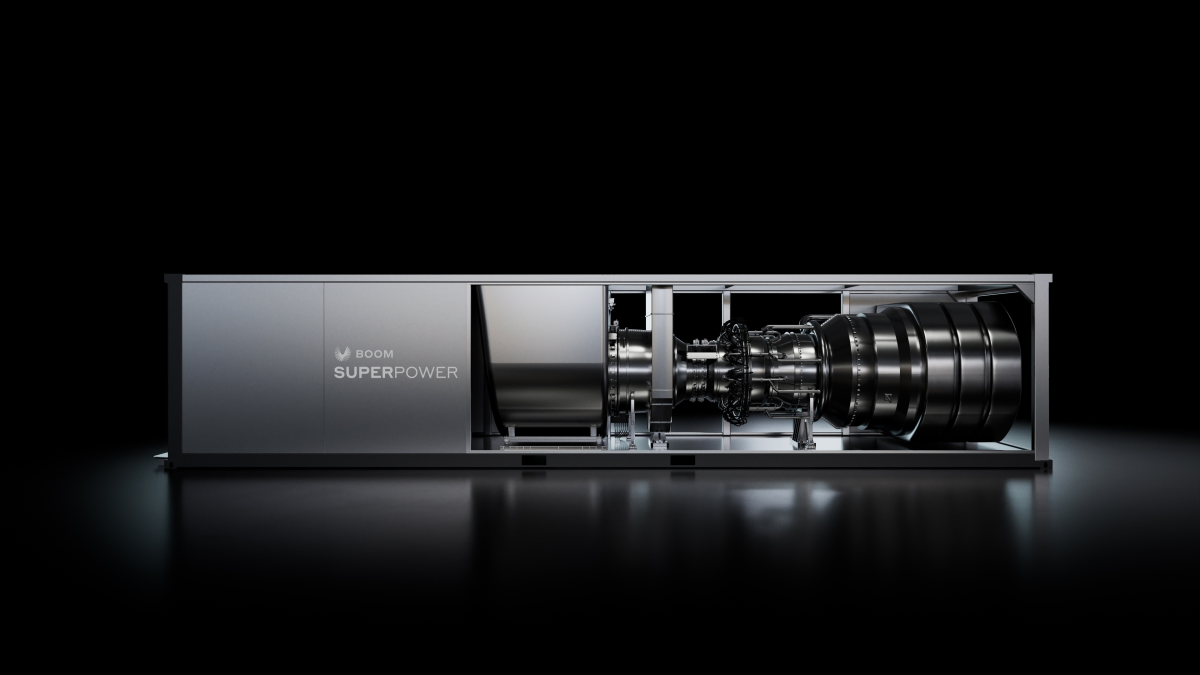
Boom Supersonic, meanwhile, is best known for developing Overture, a planned supersonic passenger aircraft. Its new stationary power venture is an attempt to monetize technology developed for the plane by repackaging the engine as a natural gas-fired turbine for land-based use.
The two companies share more than geography. Both have positioned themselves as ambitious, engineering-heavy startups trying to use technical differentiation to carve out major markets in industries dominated by incumbents.
How Boom’s Superpower turbines are supposed to work
Boom says the Superpower turbine shares about 80% of its parts with the Symphony engine designed for Overture. That common architecture is intended to lower production costs and accelerate commercialization.
The concept is straightforward: instead of relying only on aircraft sales, Boom can sell a stationary power product that leverages similar manufacturing, design and supply-chain capabilities. If successful, that could provide recurring revenue while the jet program continues to develop.
For AI data centers, the attraction is equally clear. New campuses need large amounts of reliable electricity, and some operators are exploring dedicated generation to speed deployment and reduce dependence on existing grid constraints.
| Key element | Crusoe plan | Status after the change |
|---|---|---|
| Deal value | $1.25 billion | No longer moving forward |
| Equipment | 29 Boom Superpower turbines | Order canceled |
| Power capacity per unit | 42 megawatts | Not expected to be deployed at Crusoe sites |
| First deliveries | Expected in 2027 | Plan abandoned |
| Primary site mentioned | Abilene, Texas | Power mix shifting to other options |
Why did the partnership fall apart?
The companies have not described a dramatic dispute or a legal fight. Instead, the deal seems to have collapsed because the underlying business case changed.
Boom’s chief executive said Crusoe’s near-term power mix no longer made turbines a natural fit for the launch deal. That suggests the breakup was driven less by performance problems and more by shifting operational priorities.
In fast-growing infrastructure markets, that kind of change is common. A startup that is scaling campuses across multiple regions may initially pursue one energy source, then pivot as local grid conditions, regulatory constraints, financing options or site economics evolve.
Crusoe’s statement reinforces that point. The company said it wants to remain open to different technologies at different locations rather than lock itself into one approach too early.
What this means for AI data center power
The collapse of the deal is a reminder that powering AI infrastructure is still an unsettled problem. Demand for compute is rising rapidly, but the most efficient way to supply energy remains highly site-dependent.
Some operators are leaning on grid connections, while others are experimenting with onsite generation, renewable energy, batteries and hybrid systems. The best answer often depends on speed to market, transmission availability and the scale of the campus.
That uncertainty creates opportunities for energy startups, but it also means large contracts can be fragile. A solution that looks ideal for one site may no longer fit once the developer revises its portfolio.
What comes next for Boom?
Boom says it still has demand for its turbine business and expects deliveries to other customers next year. Scholl said in his post that the company is targeting roughly 250 megawatts of Superpower deliveries in 2027 and 1 gigawatt in 2028.
Those numbers indicate that Boom is still pursuing a meaningful commercial rollout, even without Crusoe. But the company will need to prove that the product can win customers beyond the launch partner it once highlighted as a cornerstone.
That matters because the stationary power business was presented as a funding bridge for the aircraft program. If sales ramp more slowly than planned, the company may have less financial cushion to support Overture’s development.
For now, Boom is portraying the loss of Crusoe as a postponement of sorts rather than a permanent breakup. Scholl said the companies could still team up later if turbines become part of Crusoe’s future power mix.
Scholl said Boom remains grateful for Crusoe’s role in helping shape the Superpower product and suggested there could be future collaboration if the startup’s energy needs change again.
How does this affect Crusoe’s broader expansion?
Crusoe’s decision does not appear to signal any slowdown in its growth. On the contrary, the company is using its recent financing and expanding project pipeline to choose energy systems site by site.
That approach may make Crusoe more adaptable as AI demand rises, especially if the company continues to build large campuses in markets with different power constraints. It also lets Crusoe avoid overcommitting to a single technology before each site’s requirements are fully known.
The company’s flexibility may also help it negotiate better economics. By keeping multiple options open, Crusoe can compare turbines, renewable energy, storage and grid access before deciding what makes sense for a particular campus.
For now, the company is sending a clear message: reliability and fit matter more than being the first customer for a novel technology.
The bigger industry takeaway
The end of the Crusoe-Boom deal illustrates a broader truth about the AI buildout: infrastructure is moving faster than some of the energy products designed to support it.
Investors and suppliers have been eager to find scalable ways to power data centers, especially as demand from AI model training and inference climbs. But the market is still sorting out which technologies can deliver quickly, economically and at scale.
In that environment, a promising pilot can still turn into a canceled launch. That does not necessarily mean the underlying technology lacks value. It does, however, show how quickly customer needs can shift in a market defined by enormous capital spending and rapid iteration.
Crusoe’s withdrawal may push Boom to demonstrate that its turbines can win business on their own merit. It also reinforces the idea that AI infrastructure companies will keep shopping for the best power combinations as they expand.
Timeline of the Boom-Crusoe partnership
Here is a simplified timeline of how the relationship developed and changed.
| Date | Event | Why it mattered |
|---|---|---|
| 2018 | Crusoe is founded as a bitcoin mining company using excess natural gas | Established the company’s energy-first origins |
| Last year | Boom launches its stationary power business and raises $300 million | Set up the Superpower turbine as a commercial product |
| Before 2026 | Crusoe signs on as first customer for 29 turbines worth $1.25 billion | Gave Boom a major launch partner |
| 2026 | Crusoe raises $3.9 billion and continues expanding data center campuses | Signaled stronger balance sheet and a broader site portfolio |
| September 2026 | The partnership ends | Leaves Boom to seek other customers for Superpower |
What happens now?
For Crusoe, the immediate effect is simple: it will source power for its data centers through a more varied mix of solutions rather than through a single turbine program. For Boom, the task is to convert its pipeline into actual orders and prove that Superpower can succeed outside the deal that once anchored its commercial launch.
The two companies may yet work together again, but not on the timetable originally envisioned. In the meantime, the breakup highlights how fluid the AI infrastructure market remains — and how much of the sector’s future still depends on solving the power problem in real time.
TechCrunch said it would update the story if Boom responds further. For now, the message is clear: even billion-dollar plans can shift quickly when the economics of AI data center power change.
Frequently asked questions
Why did Crusoe cancel the Boom turbine deal?
Crusoe canceled the deal because Boom’s turbines no longer fit its near-term power strategy. The company said its current and upcoming sites need a more flexible mix of energy solutions, so the launch partnership with Boom was no longer the right match.
How much was the Crusoe-Boom agreement worth?
The Crusoe-Boom agreement was worth $1.25 billion. It covered 29 of Boom’s 42-megawatt Superpower turbines and was expected to begin deliveries in 2027 before the partnership was abandoned.
What is Boom Supersonic’s Superpower turbine?
Boom’s Superpower turbine is a stationary natural gas-fired power plant based on technology developed for its Overture supersonic jet. Boom says the unit shares about 80% of its parts with the aircraft engine, Symphony.
What does this mean for Boom’s energy business?
The loss of Crusoe is a setback because the startup was meant to be the first customer for Boom’s new power product. Boom says other customers are still in its pipeline, but it must now prove demand without the launch deal that gave the business early credibility.
Is Crusoe still expanding its AI data centers?
Yes. Crusoe says it is still building new AI campuses across the country and will choose the power sources that fit each site, including turbines, wind, solar, batteries and grid connections.