In short
Benchmark is bringing all five of its general partners to TechCrunch Disrupt 2026 for a rare main-stage discussion about where the next breakout startup will come from. The appearance comes as the firm raises about $2 billion and the AI boom concentrates venture capital into fewer, larger bets.
- All five current Benchmark general partners will appear together at TechCrunch Disrupt 2026 for the first time.
- The firm has raised about $2 billion this year, including a $750 million flagship fund and a $1.25 billion growth fund.
- AI has dominated venture capital, with 61% of global VC investment in 2025 flowing to AI companies, according to OECD data cited in the source.
- The panel will focus on what founders are misreading and where defensibility really comes from in a crowded market.
- Benchmark’s Cerebras investment is a reminder that the best opportunities can look unconventional at first.
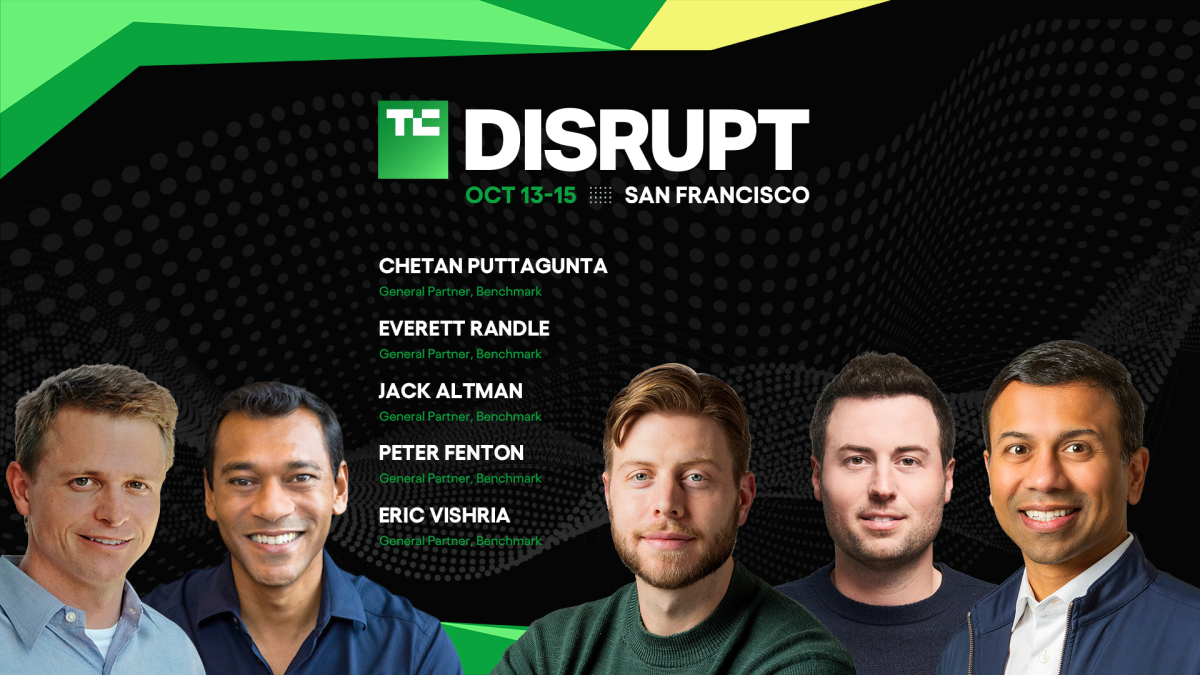
Benchmark is bringing all five of its current general partners to the main stage at TechCrunch Disrupt 2026 in San Francisco, giving founders a rare chance to hear one of Silicon Valley’s most influential venture firms explain where it thinks the next breakout companies will come from and what today’s founders are getting wrong.
The session matters because Benchmark has just reshaped its own strategy with about $2 billion in new capital, including a $750 million flagship fund and its first $1.25 billion growth fund, signaling how even elite early-stage investors are adapting to a market transformed by AI, larger financings and fiercer competition for durable startups.
At a time when capital is abundant but conviction is scarce, the panel is designed to answer a deceptively simple question: what kinds of companies still deserve backing when software can be built faster than ever, valuations are lopsided, and the biggest AI winners are already absorbing most of the money?
The discussion, titled “What We Believe Now,” will mark the first time Benchmark’s full current partnership appears together on the Disrupt stage. The lineup includes Jack Altman, Peter Fenton, Chetan Puttagunta, Everett Randle and Eric Vishria — a group whose backgrounds span founder experience, enterprise software, frontier technology and IPO-scale exits.
For attendees, the session is more than a recruiting pitch for a conference pass. It is a window into how one of venture capital’s most disciplined firms is rethinking its own edge in a market where AI has accelerated startup creation, but not necessarily made investor decisions any easier.
Why Benchmark’s Disrupt appearance stands out
Benchmark’s appearance stands out because the firm is unusual even by venture standards: it is known for concentrated early-stage bets, tightly held partnerships and a willingness to back companies before the market fully understands them. That approach has helped make it one of the most watched firms in the industry, and it gives any public discussion from its partners outsized relevance for founders and investors alike.
This year also marks a notable inflection point for the firm itself. By raising roughly $2 billion across two vehicles, Benchmark expanded beyond the narrow early-stage focus it has long been associated with. The addition of a growth fund suggests the firm is positioning itself to stay involved deeper into a company’s life cycle, especially as AI-native startups raise bigger rounds earlier than previous generations of software companies.
That shift reflects a broader market reality. Venture capital remains flush with money, but the center of gravity has moved toward a smaller set of companies that can plausibly become category leaders. For founders, that means the bar is not simply shipping a product quickly. It is proving that the business can defend itself, scale efficiently and matter in a crowded field where dozens of competitors may look nearly identical at launch.
How has AI changed venture capital?
AI has changed venture capital by concentrating both attention and dollars into a smaller number of companies, while making it harder for investors to know which opportunities will last. The pace of startup creation has increased, but so has the speed at which investors cluster around the same trends.
Benchmark’s stage conversation lands in a year when AI investment has become the defining force in global venture markets. According to OECD data cited in the source material, AI companies captured 61% of global venture investment in 2025, equal to $258.7 billion out of $427.1 billion in total venture dollars. But the funding was unevenly distributed: deals above $100 million accounted for roughly 73% of the total value invested into AI.
That concentration creates a paradox. There is more capital available than ever for AI-related startups, yet it is harder for founders outside the top tier to stand out. The market can look exuberant from a distance and selective up close. Investors are hungry for the next generational company, but they are increasingly focused on a relatively small group of teams, technologies and business models they believe can justify massive checks.
For founders, the practical implications are significant:
- They need sharper differentiation at the product and distribution level.
- They may need to prove defensibility before traditional scale has arrived.
- They face pressure to show why their company deserves attention in a market crowded with AI applications.
- They must explain whether the moat lives in the model, the infrastructure, the data or the customer relationship.
Those are exactly the kinds of questions Benchmark’s partners are expected to debate onstage.
What Benchmark’s partners bring to the conversation
Benchmark’s partnership brings together complementary backgrounds that should produce a nuanced, and likely contentious, discussion rather than a single firm line. Each partner arrives with a distinct lens on what makes a company investable and how startups should be judged in the current market.
Jack Altman: founder-first perspective
Jack Altman joined Benchmark this year after founding Lattice and later building Alt Capital. Before joining Benchmark, his firm had raised $425 million across its early-stage activity. His route into the partnership gives him a perspective shaped directly by operating a startup, raising capital and then investing in founders from the other side of the table.
That background matters because many of the most important venture judgments begin with empathy: understanding what founders actually experience while trying to recruit talent, build product and survive fundraising cycles. Altman’s presence suggests the panel may spend less time on abstract market narratives and more time on how founders should think about their own businesses.
Peter Fenton: longevity and public-market experience
Peter Fenton is one of the most established investors in the firm and in the industry more broadly. His portfolio spans consumer and enterprise companies, including AI names such as Sierra, Digits and Sema4.ai. He has also served as a board director through seven successful IPOs, among them Twitter, Elastic, New Relic, Zendesk and Yelp.
That track record gives Fenton a long view on how companies evolve from young startups into public businesses. He has seen waves of technology enthusiasm before, and that may make him particularly useful in a conversation about what remains durable once hype fades.
Chetan Puttagunta: enterprise software specialist
Chetan Puttagunta focuses on early-stage enterprise software and has backed companies including MongoDB, MuleSoft, Elastic, Modern Treasury, Legora and Stytch. His portfolio suggests a steady interest in infrastructure-like businesses and developer-facing tools rather than consumer fads.
That matters in today’s AI market because many of the strongest opportunities are hiding in the plumbing: systems that help companies manage data, automate workflows, secure infrastructure or integrate new capabilities into existing operations. Puttagunta’s lens is likely to center on whether the technology produces lasting business value, not just impressive demos.
Everett Randle: breadth across categories
Everett Randle has invested across stages and sectors, with bets including Anthropic, SpaceX, Rippling, Flock Safety, Gumloop and Chainguard. That mix suggests a willingness to back both frontier technology and software businesses with strong operational leverage.
Randle’s portfolio also hints at one of the central venture questions of the moment: should investors focus on companies building the underlying intelligence layer, or on businesses that apply that intelligence to specific workflows and industries? In practice, the best answer may be both, and Randle is well positioned to speak to the trade-offs.
Eric Vishria: infrastructure, enterprise and hard-earned conviction
Eric Vishria concentrates on early-stage infrastructure and enterprise software, with investments including Amplitude, Confluent, Fireworks.ai and Cerebras Systems. Before becoming an investor, he co-founded RockMelt, a startup that was later acquired by Yahoo, giving him direct experience as a founder navigating the full life cycle of a technology company.
Vishria’s history is especially relevant because it illustrates the value of being willing to revise a thesis. He recently described how he nearly passed on Cerebras in 2016 because hardware sat outside Benchmark’s comfort zone and the company’s ambitions appeared unusually difficult. By the third slide, however, his view changed, and Benchmark eventually co-led Cerebras’ $25 million Series A.
Vishria’s example underscores a familiar venture lesson: the best startups often look awkward or improbable early on, and investors who change their minds for the right reasons may outperform those who never budge.
Benchmark later held a 9.5% stake at Cerebras’ public listing, a reminder that backing a company before the rest of the market understands it can pay off substantially — if the original judgment proves right.
What will the panel likely debate?
The panel will likely debate where defensibility really lives in a world of fast product cycles, cheap code and relentless AI competition. That means the conversation could move beyond hype and into the harder questions founders actually need answered.
Among the most relevant issues:
- Whether the application layer is already overcrowded.
- Whether proprietary data matters more than model access.
- Whether distribution is now the most important moat.
- Whether infrastructure remains the best place to build lasting value.
- How founders should think about scale when early revenues can arrive faster than before.
The source material suggests that Benchmark’s partners may not even agree with one another on every answer. That is part of the appeal. Founders frequently see venture firms as monolithic, but in reality the best partnerships are usually collections of investors with overlapping values and different instincts. Hearing those instincts debated openly can be more useful than hearing a polished consensus.
Why founders should pay attention
Founders should pay attention because investor frameworks shape who gets funded, on what terms and with which expectations. Understanding those frameworks can help startups sharpen their pitches and test whether their own assumptions are credible.
In a market where capital is abundant but selective, the most successful founders are often those who can explain not just what they are building, but why it can win. That requires more than enthusiasm about AI. It requires a convincing story about customer pain, distribution, switching costs and the long-term structure of the market.
Benchmark’s discussion should also be useful for founders already deep into building. Hearing how experienced investors update their views can reveal whether a startup is aligned with the way capital is likely to flow over the next several years. It may also expose blind spots: assumptions about market size, urgency, or product usefulness that sound reasonable internally but fail to survive external scrutiny.
For operators inside larger companies, the session can offer a glimpse into which technology shifts investors see as durable. For students and aspiring founders, it is an opportunity to understand why some ideas attract immediate enthusiasm while others, even if compelling, need more time to mature.
How does this fit into TechCrunch Disrupt 2026?
This fits into TechCrunch Disrupt 2026 as one of the event’s flagship main-stage sessions, combining investor insight, founder relevance and market context. Disrupt returns to Moscone West in San Francisco from October 13 to 15, with more than 10,000 founders, investors, operators and innovators expected to attend.
The conference will span six stages, roundtables, breakout sessions, Startup Battlefield, the Expo Hall and other programming. Benchmark’s panel is positioned as one of the marquee conversations because it sits at the intersection of venture strategy and startup building — two subjects that remain especially important as AI continues to reshape the industry.
The timing also matters. Registration incentives are tied to an early deadline, with savings available before prices rise on September 25 at 11:59 p.m. PT. The source material also notes a group discount for parties of four or more, which is a common conference tactic but one that may appeal to startup teams, investment firms and corporate innovation groups attending together.
| Key item | Details |
|---|---|
| Session title | “What We Believe Now” |
| Speakers | Jack Altman, Peter Fenton, Chetan Puttagunta, Everett Randle, Eric Vishria |
| Event | TechCrunch Disrupt 2026 |
| Location | Moscone West, San Francisco |
| Dates | October 13–15, 2026 |
| Benchmark capital raised in 2026 | About $2 billion total |
| Fund breakdown | $750 million flagship fund; $1.25 billion growth fund |
| Early registration deadline | September 25, 11:59 p.m. PT |
Why the Cerebras story still matters
The Cerebras story still matters because it captures the kind of investment judgment venture firms prize: the ability to recognize value before it becomes obvious. It also shows why venture investors repeatedly say they are not just buying what exists today, but what may become inevitable later.
In Vishria’s account, Benchmark almost passed on the company because the opportunity did not fit the firm’s normal comfort zone. The startup’s hardware focus and ambitious technical goals made it easy to hesitate. But the story changed quickly once the team and technology made their case more clearly.
That arc is common in venture capital. Great companies often present as difficult, incomplete or even inconvenient early on. Investors who wait for perfect certainty may miss them. Investors who move too early may overpay for noise. The skill is knowing when the discomfort is a signal to step back and when it is the very reason to lean in.
Cerebras later reached the public markets, turning an early conviction call into a long-term win. For Disrupt attendees, that example may prove useful as a lens for evaluating the next generation of startups now pitching ideas that look unfinished, unusual or hard to categorize.
What does this say about the market right now?
It says the market is still searching for clarity in a period of rapid change. AI has multiplied the number of possible startup directions, but it has not eliminated the need for judgment. If anything, it has made judgment more important.
The largest themes in venture today are familiar: infrastructure, applications, data, distribution and platform shifts. What has changed is the speed with which those themes become crowded. A promising category can attract attention almost immediately, and the distance between “interesting” and “overfunded” is shorter than before.
That is why a conversation among Benchmark’s partners is timely. The firm has historically made its name by seeing around corners, backing concentrated bets and staying disciplined when markets become noisy. If the partners are willing to explain where they think conviction is still justified, founders and investors may gain a more realistic sense of where the next durable opportunities could emerge.
In that sense, the panel is not just about Benchmark. It is about the venture market’s bigger question: when the easy money is gone, what actually separates a breakout company from a merely well-funded one?
How to read the session as a founder or investor
The best way to read this session is as a test of assumptions rather than a prediction market. The goal is not to treat Benchmark’s view as gospel, but to understand the logic behind it.
- Listen for the moats. Are the partners emphasizing data, distribution, product velocity, infrastructure or brand?
- Watch for disagreement. Differences between partners can reveal how sophisticated investors break ties in uncertain markets.
- Notice the time horizon. Are they thinking in terms of the next round, the next exit or the next decade?
- Compare against your own startup. If you are a founder, ask whether your company would still look attractive under their framework.
For those attending Disrupt, the value will not come only from hearing who Benchmark wants to fund. It will come from hearing how the firm reasons about the market at a moment when that reasoning is being tested by one of the fastest technological transitions in startup history.
And for everyone else watching from outside the conference hall, the broader signal is clear: even the most established venture firms are reexamining what they believe. In 2026, that may be the most important story in tech investing.
Register before September 25 if you want to attend the session and save up to $200, with an additional group discount available for four or more passes.
| Benchmark partner | Core focus | Notable examples |
|---|---|---|
| Jack Altman | Founder-led investing and early-stage insight | Lattice, Alt Capital |
| Peter Fenton | Consumer, enterprise and public-company experience | Twitter, Elastic, New Relic, Zendesk, Yelp |
| Chetan Puttagunta | Enterprise software | MongoDB, MuleSoft, Elastic, Modern Treasury, Stytch |
| Everett Randle | Cross-stage, cross-category investing | Anthropic, SpaceX, Rippling, Flock Safety, Gumloop |
| Eric Vishria | Infrastructure and enterprise software | Amplitude, Confluent, Fireworks.ai, Cerebras Systems |
Frequently asked questions
What is Benchmark doing at TechCrunch Disrupt 2026?
Benchmark is putting all five of its current general partners on the main stage for a session called “What We Believe Now.” The discussion will focus on where the next breakout startups are likely to come from and what founders may be getting wrong in today’s market.
Why is Benchmark’s Disrupt appearance important?
Benchmark’s Disrupt appearance is important because it comes after the firm raised about $2 billion and expanded into growth investing. That gives its partners a timely platform to explain how one of Silicon Valley’s most selective firms is adapting to AI-driven venture markets.
Who will speak on the Benchmark panel?
The panel will feature Jack Altman, Peter Fenton, Chetan Puttagunta, Everett Randle and Eric Vishria. Together, they bring founder experience, enterprise software expertise, infrastructure investing and public-company board experience to the conversation.
When and where is TechCrunch Disrupt 2026?
TechCrunch Disrupt 2026 will take place at Moscone West in San Francisco from October 13 to 15, 2026. The event is expected to draw more than 10,000 founders, investors, operators and innovators across multiple stages and programs.
What are the main topics Benchmark is expected to address?
Benchmark is expected to address where startup defensibility now lives, whether the AI application layer is overcrowded, and how founders can stand out when so much capital is chasing similar themes. The panel may also explore infrastructure, data and distribution as potential moats.