In short
Apple has redesigned its Health app to use Apple Intelligence for new wellness features, including a readiness score, a Health Age estimate and a longevity tab. The update will launch later this year in U.S. English and is meant to turn health data into more useful coaching.
- Apple’s Health app is getting a major AI-driven redesign.
- New features include an Insights tab, readiness score and Health Age estimate.
- Apple is adding a longevity tab and incorporating lab data through a Quest partnership.
- The update is scheduled to roll out later this year, starting in U.S. English.
Apple on Wednesday unveiled a redesigned Health app that uses Apple Intelligence to turn raw wellness data into more actionable guidance, including a new readiness score, a “Health Age” estimate, and an expanded Insights tab. The update matters because it pushes Apple’s health platform further from data collection and toward day-to-day coaching, with the rollout set to begin later this year in U.S. English.
The revamped app arrives alongside the Apple Watch Series 12 and Apple Watch Ultra 4, reinforcing Apple’s strategy of tying watch, phone, and software together into a more proactive health ecosystem. Rather than simply showing charts and trends, the new experience aims to tell users what their data may mean, how it changes over time, and what they can do next.
What Apple announced
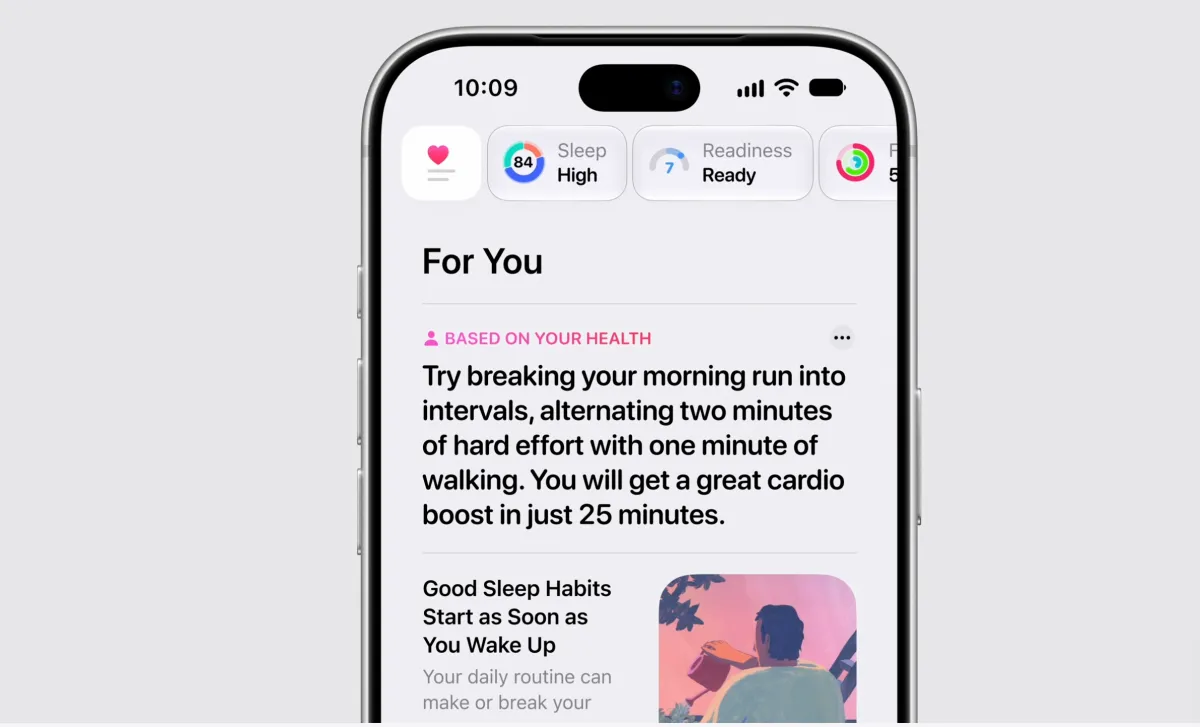
Apple’s updated Health app introduces a set of features designed to interpret health metrics more intelligently. At the center is a new Insights tab, which surfaces the most timely and relevant information from a user’s health data, then adds personalized context and suggestions.
Among the headline additions are:
- a readiness score that attempts to measure how prepared the body is for activity or recovery;
- a “Health Age” calculation that compares certain metrics to a person’s actual age;
- a new longevity tab that looks across sleep, movement, heart health, and other signals;
- deeper assessments of mobility and physical function;
- more AI-driven recommendations based on patterns in the data.
The company is positioning the app as a smarter layer on top of the information already gathered by Apple Watch and iPhone. Instead of asking users to interpret every trend themselves, the software will increasingly act as a guide.
How does the new Health app use Apple Intelligence?
Apple Intelligence helps the Health app synthesize multiple signals into easier-to-read summaries and advice. In practical terms, that means the app can pull together workout history, sleep patterns, cardiovascular data, and other inputs before producing a recommendation or an assessment.
For example, if the system detects that a user’s cardio-related metrics could improve, it may suggest adding interval work to a morning run. Apple says the updated app will also expand its coverage of fitness and heart health, using intelligence features to make the information more useful instead of merely more detailed.
This is a notable change in tone for Apple’s health software. Traditionally, the app has served as a dashboard for data gathered from the Apple Watch and connected services. The redesign appears to move it closer to a personal wellness coach that can explain what the data means in plain language.
Why the “Health Age” feature stands out
The “Health Age” feature is one of the most attention-grabbing additions because it translates a collection of biometrics into a single comparative metric. Apple says the calculation draws on data such as VO2 max, sleep, and blood-related biomarkers, then estimates how those factors stack up against a person’s chronological age.
That type of framing could be especially compelling for users who want a simple benchmark for long-term wellness. It also mirrors a broader consumer-health trend: companies are increasingly packaging complex metrics into easy-to-understand scores, even when the underlying data remains highly nuanced.
What is the readiness score?
The readiness score is Apple’s attempt to express how prepared a person may be for activity, recovery, or training on a given day. It uses health and fitness signals already available to the company’s devices, then condenses them into an assessment that can guide everyday decisions.
Readiness scores are not new to the wearables market, but Apple’s version could matter because of the company’s scale and its tightly integrated hardware. A feature like this is likely to be seen by millions of users who already rely on Apple Watch data, making it one of the company’s clearest steps into more opinionated health coaching.
| Feature | What it does | Data it uses | Why it matters |
|---|---|---|---|
| Insights tab | Highlights the most relevant current health information | Health and activity trends | Makes the app easier to scan at a glance |
| Readiness score | Estimates how prepared a user may be for effort or recovery | Sleep, movement, heart and fitness signals | Turns scattered metrics into a daily benchmark |
| Health Age | Compares health metrics with a person’s real age | VO2 max, sleep, blood biomarkers, and more | Provides a simple long-term wellness snapshot |
| Longevity tab | Tracks health across multiple wellness categories | Sleep, movement, heart health, lab results | Broadens the app from fitness into longer-term health |
| Mobility assessments | Measures how well the body moves | Movement and physical function tests | Useful for aging users or people recovering from injury |
Why Apple is expanding into longevity and lab data
Apple is broadening the app because it wants its health platform to cover more than exercise and step counts. By adding a longevity tab and integrating laboratory information, the company is moving toward a more holistic view of wellness that includes sleep quality, movement, heart health, and test-based biomarkers.
That expansion also reflects a larger product ambition: making the Health app a central place where users can understand not just how active they are, but how their habits may affect long-term health outcomes.
To help with that goal, Apple announced a partnership with Quest around a 50-biomarker panel priced at $119. The panel gives users access to lab-derived data that cannot be measured by a smartwatch alone. Apple is using that outside information to make the app’s recommendations more complete.
Apple said the updated app can combine data from devices and lab testing to give users a fuller picture of their health, rather than relying on a single source of information.
How the Quest partnership fits in
The Quest collaboration is important because it extends Apple’s health strategy beyond consumer wearables and into laboratory analysis. Blood biomarkers can reveal patterns that everyday sensors do not capture, and Apple appears to want those results to feed into the same ecosystem as watch-based metrics.
For users, that could mean more context around issues like sleep, recovery, and cardiovascular health. For Apple, it strengthens the case that its health products are not just fitness accessories, but tools for ongoing personal health management.
How the new assessments could help users
The redesigned app also includes in-depth movement assessments that can be useful for people who are aging or returning from injury. Apple said trainers can demonstrate movements for users to mirror during the assessment, creating a guided experience that is meant to feel closer to working with a coach.
This part of the update may be less flashy than the Health Age feature, but it could be one of the most practical. Mobility and movement quality are often central concerns for people whose health needs go beyond general fitness, and a guided digital assessment could make those measurements easier to access at home.
The company’s framing suggests it sees the Health app as more than a passive record. It wants the product to help people identify limitations, monitor progress, and make better decisions with less effort.
What changes for Apple Watch and iPhone users?
The update deepens the link between Apple Watch and iPhone by making their combined data more useful. Watch sensors provide much of the underlying information, while the iPhone app becomes the place where those signals are interpreted and organized.
That relationship has been central to Apple’s health strategy for years, but the new version of the app may make the software feel much more substantial. Users are no longer just viewing trends; they are getting evaluations, suggestions, and comparisons that could influence behavior in real time.
The release also highlights how Apple is leaning on software intelligence to justify its hardware ecosystem. If the watch collects the data and the app translates it into personalized guidance, the value of owning both devices increases.
Timeline of the Health app rollout
Apple said the updated Health app will arrive later this year, with the initial launch limited to U.S. English. That staged rollout suggests the company is taking a cautious approach, likely to refine language, assessments, and localization before a wider release.
| Milestone | Details |
|---|---|
| Wednesday announcement | Apple unveiled the redesigned Health app alongside new Apple Watch models |
| Later this year | The updated app is scheduled to roll out to users |
| Initial language support | U.S. English only at launch |
| Future expansion | Apple may broaden availability and functionality after the first release |
Why this matters for the health-tech market
Apple’s move matters because it raises the bar for what consumers expect from mainstream health software. A growing number of wearables already offer recovery scores or fitness readiness ratings, but Apple’s scale and brand reach could make these ideas feel standard rather than niche.
It also shows how major technology companies are increasingly using AI to interpret personal data rather than simply collect it. That shift is important across the broader health-tech market, where users may soon expect devices to produce conclusions instead of just dashboards.
Apple is not only competing on sensors and device design. It is competing on interpretation, framing, and trust.
What users should watch for next
Users will want to see how transparent Apple is about the factors behind each score and recommendation. Health tools are most useful when they are understandable, consistent, and medically cautious.
Key questions include:
- How much detail will Apple provide about the readiness score?
- Will the Health Age estimate be easy to explain and compare over time?
- How will lab data be integrated with device data in everyday use?
- Will the coaching suggestions feel genuinely helpful or overly generic?
Those answers will shape whether the redesign feels like a meaningful step forward or just a more polished version of an existing health dashboard.
The bigger picture for Apple Intelligence
The Health app update is also a useful example of how Apple Intelligence may be applied beyond writing tools or general assistant features. Here, AI is being used to process personal data and convert it into language that ordinary users can act on.
That may prove to be one of the most commercially important uses of Apple Intelligence. Health is a category where AI can be genuinely valuable if it improves clarity, reduces friction, and encourages better habits without overwhelming users with technical details.
Still, the company will need to balance ambition with restraint. Health is a sensitive category, and consumers are likely to expect accuracy, caution, and strong privacy protections as Apple expands the role of software-generated assessments.
For now, the company is betting that more context will make its health platform more useful. If the rollout lands well, the redesigned app could become one of the clearest examples of Apple’s vision for AI: not a chatbot, but a quietly powerful guide built into everyday tools.
Key facts at a glance
- Apple introduced a redesigned Health app on Wednesday.
- The app uses Apple Intelligence to summarize and interpret health data.
- New features include an Insights tab, readiness score, Health Age, and longevity tab.
- Apple announced a Quest partnership for a 50-biomarker lab panel priced at $119.
- The update will roll out later this year, starting in U.S. English.
Frequently asked questions
What is Apple’s new Health Age feature?
Apple’s Health Age feature is a score that compares selected health metrics with a user’s actual age. It uses signals such as VO2 max, sleep data and blood biomarkers to estimate how a person’s health profile stacks up against their chronological age.
What does the readiness score in Apple Health do?
The readiness score is designed to estimate how prepared a user may be for exercise or recovery on a given day. Apple says it combines multiple health signals into a simple assessment that can help guide training and wellness decisions.
When will the redesigned Apple Health app be available?
The redesigned Apple Health app will roll out later this year. Apple said the first release will begin in U.S. English, suggesting the company plans a staged launch before expanding more broadly.
How does Apple Intelligence improve the Health app?
Apple Intelligence helps the Health app analyze data and turn it into clearer guidance. Instead of only showing charts, the app can now generate summaries, readiness assessments and personalized suggestions based on sleep, movement, heart health and other signals.
Why is Apple working with Quest on health data?
Apple is working with Quest to give users access to a 50-biomarker panel for $119. The partnership adds lab-based information that can supplement smartwatch data, giving the Health app a more complete view of a user’s health.