In short
Apple’s new CEO John Ternus said the iPhone is already the company’s best AI device, using his first major public remarks to frame Apple’s AI strategy around privacy and on-device intelligence. The company is signaling that it wants the iPhone to remain the center of personal AI instead of launching a standalone AI gadget.
- Apple CEO John Ternus says the iPhone is already the best fit for personal AI.
- Apple is emphasizing privacy and on-device processing as its key AI differentiators.
- The company’s AI strategy centers on turning the iPhone into an intelligent personal hub.
- Apple is signaling continuity rather than a new hardware category for AI.
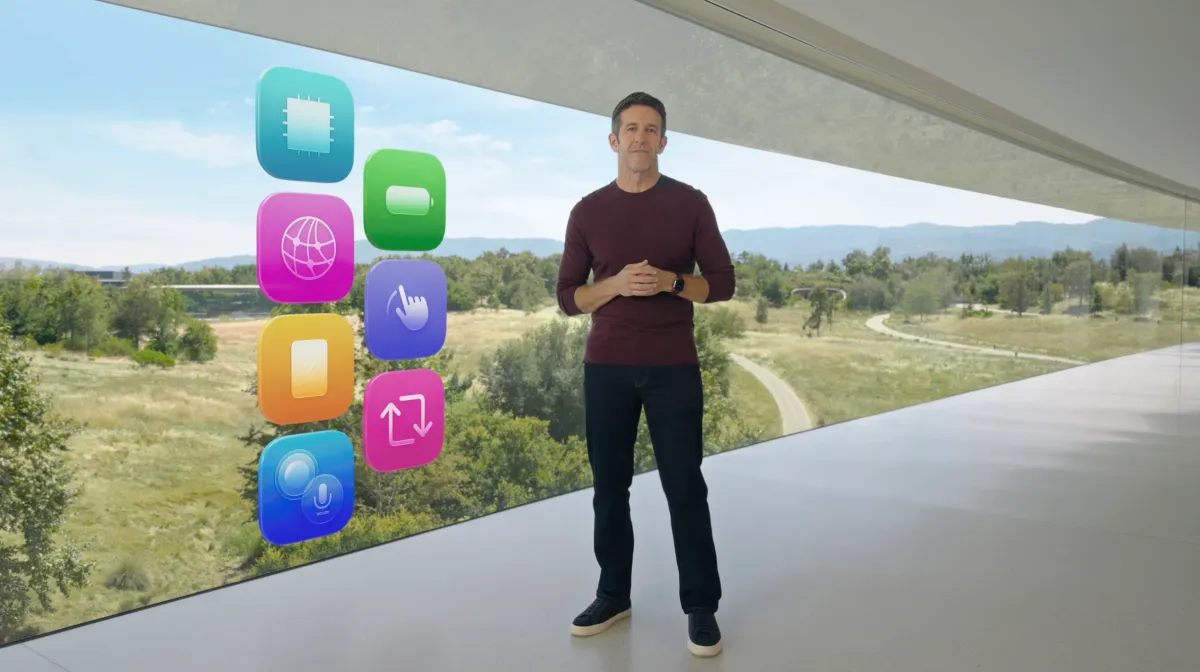
Apple’s new chief executive, John Ternus, used his first major public moment in the role to argue that the iPhone is already Apple’s strongest artificial intelligence device. The message, delivered at the company’s Surprise and Shine event on Wednesday, also made clear that Apple intends to keep privacy at the center of its AI pitch as it competes with rivals racing to build more data-hungry systems.
The comments matter because they outline how Apple plans to approach the AI era under new leadership: not by introducing a brand-new gadget, but by making the iPhone the primary gateway for personal AI features. Ternus’ remarks suggest continuity with Apple’s long-standing hardware strategy, while sharpening the company’s differentiation from competitors that rely more heavily on cloud processing and user data collection.
Tim Cook, who has stepped into the role of executive chairman, handed the stage to Ternus as Apple signaled the start of a new chapter. What followed was less a product reveal than a statement of philosophy: Apple believes the most useful AI experience is not a separate device at all, but one already in people’s pockets.
What Apple’s new chief was really saying
Apple’s message was straightforward: the iPhone already fits the company’s definition of an ideal AI companion better than any new product could. Ternus described that ideal as an “intelligent personal hub” — a device that understands personal context, stays with the user throughout the day, and can handle AI tasks both locally and through cloud access when needed.
By framing the iPhone in those terms, Apple is positioning its most important product as the center of the company’s AI future. That approach is consistent with Apple’s broader model of making advanced technology feel invisible and integrated rather than experimental and standalone.
Ternus said such a device would need several qualities at once: a capable chip for on-device models, internet connectivity for cloud-based intelligence, a large screen, strong cameras and microphones, long battery life and easy usability. It should also connect smoothly with the user’s broader ecosystem of devices, apps and services.
His conclusion was unmistakable. In Apple’s view, the product already on the market that best matches that description is the iPhone.
Apple’s new CEO said the ideal AI companion would understand a person’s context, be present all day, run models locally when possible, and work seamlessly across apps and devices — then argued that the iPhone already does all of that better than anything else.
Why the iPhone matters to Apple’s AI strategy
The iPhone matters because it gives Apple something many AI competitors do not have: a mature, massively distributed device that already serves as the center of users’ digital lives. Rather than convincing consumers to buy a new AI-focused gadget, Apple can build AI features into hardware people already use for communication, photography, navigation, payments and media.
That matters in a market where several technology companies are trying to define the next phase of personal computing. Some are working on dedicated AI assistants, while others are embedding generative AI into existing software and cloud services. Apple’s answer is that the future does not require a new form factor if the current one already serves as an always-on personal companion.
The company’s logic is also practical. The iPhone has a built-in screen, always-connected communication tools, high-end sensors, a powerful processor and a large installed base. Those features make it a natural platform for hybrid AI systems that split work between the device and remote servers.
In that context, Apple’s claim is not merely marketing. It is a strategic statement that the phone remains the most commercially viable and user-friendly place to deliver AI to consumers at scale.
How Apple is defining “AI device” differently
Apple is defining an AI device as a general-purpose personal hub, not as a novelty machine designed only for generative prompts or chatbot interactions. That broader definition allows the company to argue that the best AI hardware already exists in the form of a smartphone that people carry everywhere.
Under that definition, usefulness is more important than spectacle. A device should be aware of context, responsive across different situations and capable of drawing on both local processing and cloud intelligence without forcing the user to learn a new interface.
- Context awareness: the device should understand a user’s personal information and routine.
- Always available: it should travel with the user throughout the day.
- Hybrid processing: some tasks should run on the device, others in the cloud.
- Rich sensors: cameras and microphones should help the device interpret the world.
- Ease of use: the AI should feel familiar rather than technical.
- Ecosystem integration: it should work smoothly with other Apple products and services.
That framework favors the iPhone because it is already built around personal usage, not enterprise compute or standalone AI experimentation.
Privacy as Apple’s main competitive weapon
Privacy is central to Apple’s pitch because it is the company’s most durable contrast with many AI rivals. Ternus drew a line between Apple’s model and what he described as competitors’ tendency to treat user information as an asset to gather and retain.
Apple’s point is that AI becomes more valuable when it knows a user well, but that knowledge creates trust problems if the underlying data is centralized, stored indefinitely or used beyond the user’s control. By stressing on-device processing, Apple is promising a system in which sensitive information stays closer to the user whenever possible.
That message is likely aimed at consumers who are increasingly aware of the trade-offs behind modern AI products. Many of the most capable systems today depend on large-scale data collection, cloud inference and persistent account-based memory. Apple is trying to reframe that trade-off as unnecessary.
In Ternus’ telling, trust is not built by asking users to accept ever broader data access. It is built by reducing how often data leaves the device in the first place.
According to Ternus, Apple believes others in the AI race see personal information as something to gather and store, while Apple’s approach is to run Apple Intelligence on device whenever it can.
Why privacy resonates in the AI era
Privacy resonates because AI systems increasingly depend on the details of people’s lives. The more an assistant knows about messages, photos, calendars, locations, habits and preferences, the more useful it can become — but also the more invasive it can feel.
Apple’s hardware-and-software control gives it an advantage in managing that tension. It can decide which features run locally, which require remote access and how much user data should be exposed to outside systems. That level of control is harder for companies that rely on open platforms or advertising-driven services.
The company has long benefited from a brand identity built around security, premium design and user trust. In the AI era, Apple appears to believe that same identity can become a competitive edge against systems that appear more powerful but less private.
How Ternus described the ideal intelligent personal hub
Ternus laid out a detailed description of the kind of device he believes best serves as an AI assistant for everyday life. The description mixed technical requirements with design principles, suggesting Apple sees AI as a feature set that must be both capable and invisible.
At a minimum, the ideal device would need a strong processor for on-device inference and an internet connection for more demanding tasks. It would also need enough display space to make interactions practical, along with cameras and microphones to understand the user’s environment.
Battery life is equally important, because an AI device that runs out of power quickly would fail as a personal hub. Apple also emphasized simplicity — a reminder that consumer AI must remain approachable if it is to be adopted widely.
Finally, the device should work in a broader ecosystem. In Apple’s view, the best AI experience is not isolated. It spans the phone, the watch, the tablet, the laptop, services and third-party apps.
| Feature | Why it matters for AI | How Apple frames the iPhone |
|---|---|---|
| Personal context | Improves relevance and helps the AI anticipate needs | Already embedded in a user’s daily life |
| On-device processing | Supports faster, more private AI tasks | Apple Intelligence runs locally when possible |
| Cloud access | Enables larger models and more complex requests | Used as a complement, not a replacement |
| Camera and microphone access | Helps the device interpret the world around the user | Already a core strength of the iPhone |
| Battery life | Essential for all-day AI use | Aligned with Apple’s hardware design priorities |
| Ease of use | Determines whether AI becomes mainstream | Apple argues iPhone users already understand the interface |
What this means for the broader AI hardware race
Apple’s remarks reveal a belief that the next phase of consumer AI will be won by integration, not by invention for its own sake. While some companies are chasing dedicated AI devices or voice-first companions, Apple appears convinced that the best strategy is to graft AI onto an already indispensable platform.
That is a notable contrast with the broader industry narrative. Much of the AI market has been shaped by the idea that new technology requires new behavior: new interfaces, new usage patterns and sometimes entirely new products. Apple is pushing the opposite argument.
The company is effectively saying that the future of AI should feel like an upgrade to the phone most users already carry, not a disruption that forces them to change habits. If Apple is right, it can deliver AI at scale faster than a startup trying to persuade consumers to adopt a separate device.
This also helps explain why Apple tends to focus its AI messaging on practical features rather than breakthrough showpieces. The company’s goal is not to win the loudest demo. It is to build the most dependable daily experience.
Why Apple may avoid a standalone AI gadget
Apple may avoid a standalone AI gadget because the company already has the platform most consumers use constantly. Creating a new device would introduce adoption risk, unclear use cases and another hardware category to support.
There is also a strategic advantage to keeping AI tied to the iPhone: it preserves Apple’s ecosystem lock-in while reducing the chance that a new category could cannibalize the phone. If the iPhone remains the primary AI hub, Apple keeps the center of gravity where it has always been — on the device that drives much of its hardware, services and software revenue.
That does not mean Apple will never experiment with other forms of AI hardware. But based on Ternus’ comments, the company sees no need to replace the iPhone when it believes the iPhone already satisfies the requirements of a modern AI companion.
How Apple’s new leadership shapes the message
Ternus’ remarks are important not only because of what they said, but because of when he said them. As Apple’s new CEO, he is now responsible for presenting the company’s long-term vision at a time when AI has become a defining battleground in tech.
The shift from Tim Cook to Ternus also matters symbolically. Cook’s tenure helped turn Apple into one of the world’s most valuable companies by refining its ecosystem, expanding services and reinforcing premium hardware. Ternus’ early messaging suggests he intends to preserve that formula while adapting it to the AI era.
That continuity could reassure investors and customers who want to know that Apple will not suddenly chase every AI trend. At the same time, Ternus appears ready to make a more forceful argument about the company’s privacy-first identity and the iPhone’s role in that vision.
His presentation was not just a technical explanation. It was a statement of brand values under new leadership.
What users can infer about Apple Intelligence
Users can infer that Apple Intelligence will continue to be designed around selective on-device processing, with the iPhone acting as the main environment for those features. Apple is signaling that it wants AI tools to feel native to the phone rather than bolted on as a separate layer.
That means consumers should expect a continued emphasis on performance, efficiency and privacy rather than only raw model size or headline-grabbing AI demos. Apple seems determined to make AI appear as part of the operating system experience, not an external service users must constantly manage.
It also suggests that the company will likely keep explaining AI through the lens of everyday utility. The winning use cases, in Apple’s view, will be those that make communication, content capture, organization and device interaction easier without demanding much from the user.
That approach could appeal to people who want AI features without feeling like they are entering a high-friction experimental product category.
The bigger business and consumer stakes
Apple’s framing has major implications for both its business and the consumer AI market. For Apple, making the iPhone the center of AI preserves the value of its core product line while creating new reasons for users to stay inside its ecosystem.
For consumers, the argument is equally consequential. If Apple is right, the best AI experience is not about buying a new gadget or learning a new platform. It is about getting more intelligence out of a device people already know how to use.
That promise may prove attractive in a market where many AI tools still feel fragmented, unstable or difficult to trust. Apple is betting that people will prefer a familiar system with fewer data trade-offs over a more powerful but less contained one.
The real test will be whether Apple can translate that philosophy into features people use every day. But at least for now, the company’s public stance is clear: the iPhone is not just part of Apple’s AI strategy. It is the strategy.
Timeline: Apple’s AI messaging around the leadership change
The company’s latest statements fit into a broader sequence of events that show how Apple is organizing its AI narrative under new leadership.
| Date | Event | Why it matters |
|---|---|---|
| Wednesday, Sept. 9, 2026 | Apple holds its Surprise and Shine event in Cupertino | Ternus makes his first major public AI comments as CEO |
| Same event | Ternus describes the ideal AI device as an intelligent personal hub | Apple defines the qualities it thinks matter most in consumer AI hardware |
| Same event | Ternus says the iPhone is already the best fit for that role | Apple doubles down on the phone as the center of its AI future |
| Same event | Ternus contrasts Apple’s privacy approach with rivals | Apple sharpens its differentiation in a crowded AI market |
How rivals may respond
Rivals are likely to respond by emphasizing capabilities Apple still does not fully match in the AI race, especially scale, openness or the speed of model deployment. Some competitors will continue to push cloud-first systems that can update quickly and offer deeper conversational power.
Others may argue that a smartphone alone cannot deliver the most advanced AI experience, especially if future assistants become more autonomous or multimodal. Apple’s challenge is to prove that convenience, privacy and integration are not secondary advantages but the main reasons consumers will choose one AI ecosystem over another.
That contest will likely play out not only in product announcements, but in how consumers decide what they want AI to do for them. Do they want the most powerful model, or the most trusted one? Do they want a separate AI companion, or intelligence embedded in a device they already carry?
Apple has made its bet. It believes the answer is already in people’s pockets.
Bottom line
Ternus’ first major AI message as Apple CEO is a clear expression of continuity and conviction. Apple is not positioning itself as the company that will reinvent hardware for AI. It is positioning itself as the company that will make AI feel natural inside the iPhone.
By combining on-device intelligence, cloud access, rich sensors and a privacy-first pitch, Apple is arguing that the iPhone is already the best personal AI hub in the market. Whether consumers accept that argument will shape not just Apple’s product roadmap, but the next phase of the broader AI competition.
Frequently asked questions
What did Apple’s new CEO say about the iPhone and AI?
Apple’s new CEO said the iPhone is already the best device for AI, describing it as the closest thing to an intelligent personal hub. He argued that the phone combines context, sensors, connectivity and ease of use better than any new AI-specific gadget.
Why is Apple focusing on the iPhone instead of a new AI device?
Apple is focusing on the iPhone because it already has the screen, processor, cameras, microphones and user base needed for AI at scale. That lets Apple add intelligence without forcing customers to buy a separate device or learn a new interface.
How does Apple say its AI approach is different from rivals?
Apple says its AI approach is different because it prioritizes privacy and on-device processing. The company argues that other firms often treat user data as something to collect and store, while Apple tries to keep more information on the device whenever possible.
What is an intelligent personal hub in Apple’s view?
An intelligent personal hub is Apple’s description of a device that understands a user’s context, stays with them throughout the day and can access both local and cloud AI models. Apple says the iPhone already fits that description better than any competing product.