Updated September 9, 2026 9:55 pm
In short
Apple’s iPhone 18 Pro now pairs a new photo-authenticity tool with a major camera overhaul, including a variable-aperture 48-megapixel main lens.
- Apple unveiled Apple Reference Image to help verify whether iPhone 18 Pro photos are authentic.
- The system uses signed sensor data and Private Cloud Compute to create an unchangeable reference version.
- Apple is also adding support for SynthID to help identify AI-created or AI-altered images.
- The feature is aimed especially at photojournalists, photographers, and other users who need image provenance.
Update — September 9, 2026 9:55 pm
Apple also said the iPhone 18 Pro’s camera system is getting a major upgrade beyond the new authenticity feature. The company says the phone will include its biggest camera improvement in years, led by a variable-aperture 48-megapixel main camera.
Apple says the adjustable aperture should give users more control over exposure and improve results in low light. It added that the lens uses six laser-cut blades, a new rotor mechanism and a custom lens design.
Apple is rolling out a new authenticity feature for the iPhone 18 Pro that it says can help prove whether a photo is real or has been altered, a move aimed squarely at a time when AI-generated and AI-edited images are eroding trust in digital media. The company announced the tool at its Surprise and Shine event on Wednesday, positioning it as a safeguard for journalists, photographers, and anyone who needs to verify the origin of an image.
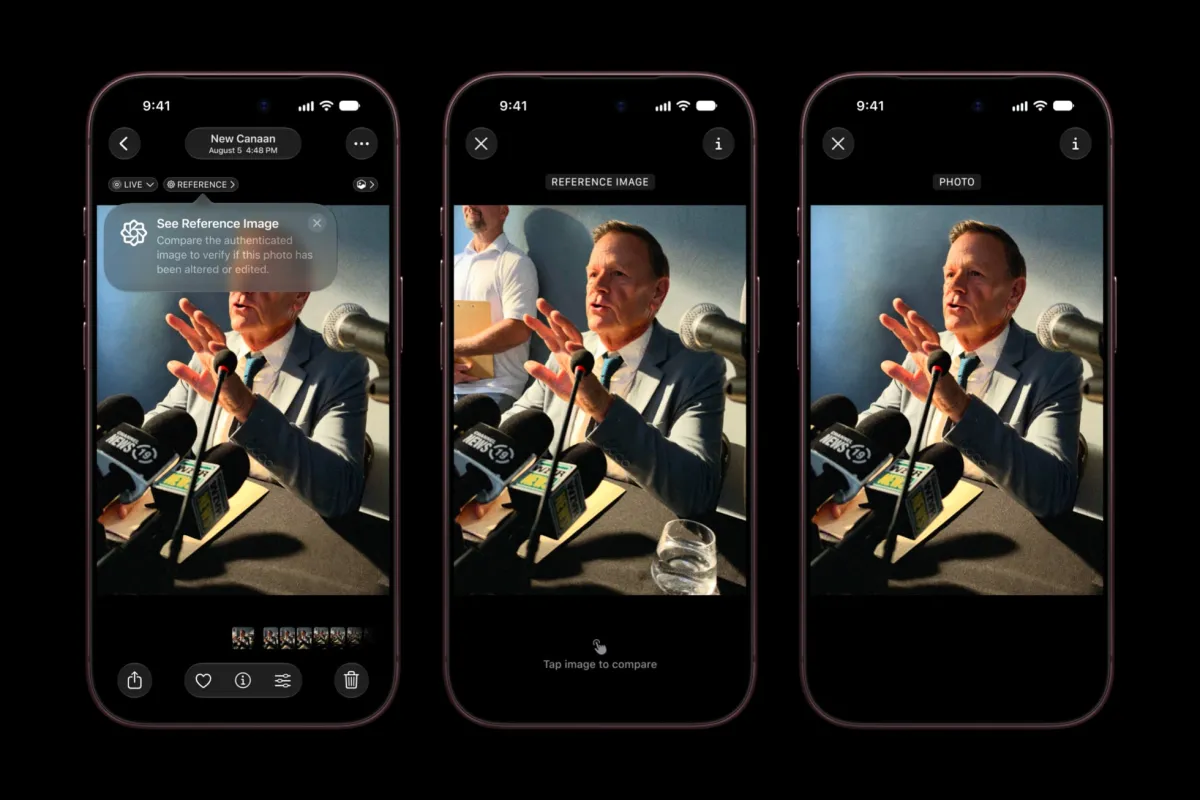
The feature, called Apple Reference Image, captures signed sensor data at the moment a photo is taken and converts that information through Apple’s Private Cloud Compute system into an unchangeable reference version that can be inspected in the Photos app. Apple says that reference can be compared with other versions of the same image to detect later modifications, giving users a kind of digital proof of authenticity.
For Apple, the launch is both a product update and a response to a broader crisis of confidence in images. As synthetic content becomes easier to create and more difficult to spot, the company is trying to offer a standard that does not rely on visual judgment alone.
What Apple is launching
Apple Reference Image is a new verification layer built into the iPhone 18 Pro camera pipeline. The company says the system records signed sensor information at capture time and then preserves a reference version that cannot be altered after the fact.
Apple is describing that reference version as a “digital negative,” a comparison point that can be checked against the image a user sees later. If someone edits a photo, re-exports it, or presents a manipulated version, the reference image is meant to show the discrepancy.
The feature is designed around trust, but it also reflects the technical reality of modern image workflows. In a media environment where photographs may pass through editing apps, cloud services, social platforms, and generative AI tools, proving an image’s origin has become harder than ever.
How does Apple Reference Image work?
It works by capturing signed sensor data the moment the camera shutter is used, then processing that data via Apple’s Private Cloud Compute service into an immutable reference image viewable in the Photos app.
In practical terms, that means the device does more than save a picture file. It stores a verifiable record of what the sensor saw at capture time, which Apple says can be used to confirm whether the image has remained unchanged.
Apple has not said the feature eliminates all forms of manipulation, nor has it suggested that casual users will need to review raw authenticity data themselves. Instead, the feature appears intended to be a built-in trust signal that app developers and professionals can use when needed.
| Feature | What it does | Why it matters |
|---|---|---|
| Apple Reference Image | Creates a signed, immutable reference version of an iPhone photo | Helps verify whether the image has been altered |
| Photos app viewing | Lets users inspect the reference image in Apple’s Photos app | Makes authenticity checks accessible inside Apple’s ecosystem |
| Developer APIs | Allows third-party apps to support the feature | Extends verification beyond Apple’s own software |
| SynthID support | Helps identify images made or changed by AI | Adds another layer for spotting synthetic content |
Why Apple says this matters now
Apple is entering this space because image authenticity has become a high-stakes issue far beyond ordinary photo editing. The company specifically highlighted photojournalists and photographers, two groups whose work depends on public confidence that an image accurately reflects what happened in front of the lens.
That concern is increasingly relevant for newsrooms, courts, researchers, election monitors, insurance claims, and social media users trying to determine whether a picture is evidence or fabrication. The rise of “AI slop” has made the visual record less dependable, and the consequences can be serious when false images circulate faster than corrections.
Apple framed the feature as especially important for photojournalists and photographers, signaling that the company sees image verification as a professional necessity rather than a niche technical add-on.
The new tool also suggests Apple is trying to stay ahead of the trust problem before it becomes a reputational issue for the iPhone itself. Smartphones remain the most common capture device for everyday photography, and if consumers begin to doubt whether a phone photo is real, the value of the platform changes.
How is Apple trying to set a standard?
Apple is trying to make authenticity portable by pairing its own verification system with developer access and broader AI-image detection support. Rather than keeping the feature locked inside one app, the company is making APIs available so other developers can build it into their own products.
That matters because image verification only becomes useful if it travels with the image across platforms. A photo that can be checked in Apple’s ecosystem but loses its authentication metadata elsewhere would have limited value.
Developer access and ecosystem strategy
By offering APIs, Apple is signaling that Reference Image is meant to be part of a wider workflow. Third-party apps could potentially use the reference data to display authenticity indicators, flag edits, or support newsroom and archival systems that need strong provenance controls.
This approach also helps Apple avoid the impression that it is building a walled-garden feature with little practical use outside its own software. If adoption grows, the feature could become a de facto standard for authenticating images captured on iPhones.
Apple also said it will support the SynthID standard, which is designed to help people identify content created or modified by artificial intelligence. That is notable because it aligns Apple with the broader effort to label synthetic media rather than pretending users can reliably detect it on sight.
What is SynthID, and why does Apple support it?
SynthID is a content-identification standard intended to help mark AI-generated or AI-altered images. Apple’s support suggests the company wants its authenticity framework to work in parallel with existing industry efforts rather than replacing them.
This is important because the AI content problem has no single fix. Some tools focus on watermarking generation models, others on metadata, others on provenance chains. Apple’s move implies that the company sees a layered defense as the only realistic option.
In that sense, Apple Reference Image is not just about proving that a photo came from an iPhone camera. It is also about helping users tell the difference between a captured image and something synthesized, altered, or repackaged by a machine.
Why this is significant for journalists and photographers
Journalists and photographers rely on the credibility of images in ways most users do not. A tampered photo can mislead readers, undermine reporting, and damage the reputation of the person or organization that published it.
Apple’s emphasis on these users suggests the company understands that trust is not just a consumer feature; it is a professional requirement. In a newsroom, provenance can be as important as resolution or dynamic range.
The reference-image concept could become especially useful in workflows that involve:
- breaking news photography
- court and legal documentation
- field reporting and evidence collection
- archival storage and historical preservation
- fact-checking and media verification
For those users, being able to show that an image matches an original sensor-derived record may be more valuable than any visual filter or editing tool.
How this fits into the wider AI authenticity fight
Apple’s move is part of a larger industry scramble to restore confidence in digital media. As generative AI tools improve, identifying whether an image was captured by a camera or created in a model has become harder, even for trained observers.
That has pushed tech companies toward provenance systems, metadata tracking, and watermarking standards. The challenge is not only technical but also behavioral: people often share images before they think to question them.
In that environment, the most useful tools are the ones that make verification automatic or nearly automatic. Apple appears to be betting that a built-in system tied to the camera itself is more reliable than after-the-fact detection tools.
What problem is Apple trying to solve?
Apple is trying to solve the trust gap created by easy image manipulation and fast-moving AI generation tools.
That gap matters because a photo used to carry an assumption of authenticity. Today, the same image can be edited invisibly, generated from scratch, or altered by multiple AI tools before it is seen. Apple’s new feature is an attempt to restore a chain of custody.
Timeline: Apple’s announcement in context
The company unveiled the feature at its Surprise and Shine event on Wednesday, alongside broader product and software updates. The timing matters because Apple is clearly introducing the tool as part of the next generation of iPhone imaging rather than as an afterthought or a standalone privacy experiment.
| Date | Event | Significance |
|---|---|---|
| Wednesday, Sept. 9, 2026 | Apple announces Apple Reference Image | Introduces native photo authenticity checks for iPhone 18 Pro |
| At launch | Reference image viewable in Photos | Lets users inspect authenticity inside Apple’s own app |
| After launch | Developer APIs released | Enables integration in third-party apps and workflows |
| Ongoing | SynthID support added | Helps identify images created or modified by AI |
What Apple is not saying
Apple has not claimed that Reference Image is a perfect anti-deepfake system. The company’s announcement describes a way to prove whether an image has changed, not a universal method for judging every photo on the internet.
That distinction is important. Authenticity systems can only work when the original capture is trusted and the verification chain remains intact. If a screenshot or exported image loses provenance data, the usefulness of the method can diminish.
Apple also has not detailed every edge case, including how the system handles heavy editing, cropped images, screenshots, transfers to non-compatible devices, or photos that leave the Photos app ecosystem. Those questions will matter as developers and users begin testing the feature in practice.
How might users actually experience it?
For most iPhone owners, the feature will likely feel invisible unless they need to verify a picture. The reference data is generated in the background, and Apple says the result can be inspected in Photos if a user wants to check the image’s status.
That design choice is consistent with Apple’s usual approach: complex systems operating quietly unless the user needs to interact with them. In this case, the benefit is that authenticity does not depend on extra steps at capture time.
For professionals, the feature may eventually appear inside editing suites, newsroom tools, or archival platforms through Apple’s APIs. If adoption grows, it could become part of standard image-handling practice in the same way metadata and file signatures already are in other fields.
What happens next?
The real test will be whether other apps, platforms, and organizations adopt Apple’s verification tools in meaningful ways. A feature like this only becomes powerful if it is recognized outside one company’s ecosystem.
There is also a larger industry question: whether consumers will care enough about authenticity to check it before sharing images. If Apple can make verification simple and visible, it could help normalize the habit. If not, the feature may remain a niche tool for professionals.
Still, the direction is clear. As generative AI makes it cheaper to fabricate images and harder to prove origin, device makers are being pushed to build trust mechanisms directly into the hardware and software stack. Apple’s announcement is one of the most explicit signs yet that provenance is becoming a core part of modern photography.
Bottom line
Apple is trying to give iPhone photos a verifiable paper trail at a moment when visual evidence is increasingly easy to fake. With Apple Reference Image, the company is betting that a camera can do more than capture a scene — it can also prove that the scene was real.
Frequently asked questions
What is Apple Reference Image?
Apple Reference Image is Apple’s new iPhone photo authenticity feature. It creates a signed, immutable reference version of a captured image so users and developers can compare it with later versions and detect whether the photo has been changed.
How does Apple prove an iPhone photo is real?
Apple proves an iPhone photo is real by capturing signed sensor data when the image is taken and turning it into a reference image through Private Cloud Compute. That reference acts like a digital negative and can be checked against edited or redistributed copies.
Who is Apple’s new photo authenticity tool for?
Apple’s new photo authenticity tool is aimed especially at photojournalists, photographers, and other professionals who need trustworthy image provenance. It is also useful for any user who wants to verify whether a photo was altered after capture.
Does Apple support AI image detection standards?
Yes. Apple says it will support SynthID, a standard designed to help identify images created or modified by AI. That gives the company’s authenticity approach an extra layer for spotting synthetic or manipulated visuals.
Will third-party apps be able to use the feature?
Yes. Apple says it is providing APIs so developers can integrate the reference-image system into their own apps. That should help extend the authenticity check beyond Apple’s Photos app and into third-party workflows.