Updated August 31, 2026 10:25 pm
In short
Instagram is tightening disclosure rules for AI-generated profiles and limiting undisclosed synthetic accounts, while Meta is also moving to add broader teen safety controls after an $18 billion states settlement.
- Instagram is renaming its AI label to “AI-generated profile” for clearer disclosure.
- Accounts that fail to label synthetic personas may see reduced reach.
- The policy does not apply to ordinary AI-assisted edits like caption polishing or photo touch-ups.
- The move comes amid rising concern over AI influencers, wellness personas and deceptive synthetic accounts.
- Meta is under broader pressure after a major settlement and new teen-safety requirements.
Update — August 31, 2026 10:25 pm
Instagram’s new policy also comes as Meta faces fresh pressure over youth safety. Last week, the company reached an $18 billion settlement with U.S. states tied to allegations about the effects of Facebook and Instagram on children and teenagers.
As part of that agreement, Meta said it will add a default two-hour daily limit for teens on Facebook and Instagram, a nighttime mode that blocks use, and muted notifications during school hours, among other restrictions.
Instagram is rolling out tougher limits on AI-generated profiles that are not clearly disclosed, a move designed to curb synthetic accounts that can look like real people while misleading users. The company says creators who fail to label AI-made personas may see their distribution reduced, a significant step as AI influencers and fabricated personas become more common across social media.
The change matters because Instagram is no longer treating undisclosed AI avatars as a minor labeling issue. Instead, it is signaling that transparency around synthetic identities will now affect whether a profile can reliably reach an audience at all.
What Instagram is changing
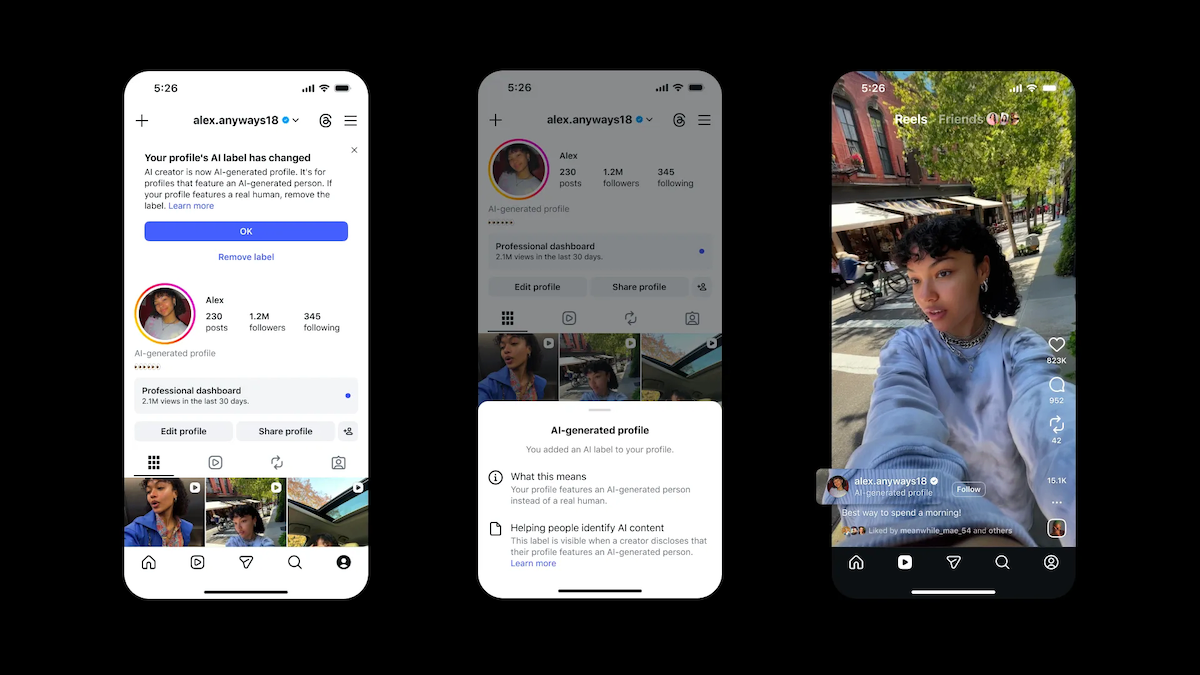
Instagram said it is renaming its existing “AI creator” disclosure to “AI-generated profile,” a wording shift meant to make the warning more straightforward for users. The new label is intended to make clear that the person shown on the profile was generated by AI or substantially built with AI tools.
That sounds subtle, but the platform is trying to solve a specific user-experience problem: many people encounter a seemingly ordinary account and only later discover that the profile subject does not exist in real life. Instagram’s new language is meant to reduce that confusion by making the synthetic nature of the account obvious at a glance.
Instagram said users increasingly want to know when a profile features an AI-generated person, especially when the account initially appears human and authentic.
The company also made an important distinction about the scope of the rule. The label is not meant to apply to every use of artificial intelligence. If a creator uses AI to touch up images, refine captions, generate graphics, or make other creative edits, Instagram says that does not automatically require an AI-generated profile disclosure.
Why the reach penalty matters
The most consequential part of the policy is the enforcement mechanism. Instagram says accounts that do not properly label AI-generated profiles could have their reach limited, meaning the platform may reduce how widely their posts are recommended or surfaced.
That gives the new label more teeth than a cosmetic warning. It turns disclosure into a platform-enforced requirement, not just a suggestion, and it could influence how creators, marketers and AI studios present synthetic personalities going forward.
Creators who do follow the rule, however, will not be penalized simply for featuring an AI-generated person. In other words, Instagram is not banning synthetic personas outright. It is drawing a line around deception and undisclosed identity construction.
How the new Instagram AI label works
The policy is designed to distinguish between ordinary AI-assisted content and fully or mostly synthetic identity profiles. Instagram’s position is that people should still be able to use generative tools creatively, but they should not pass off an AI-made person as a real human being without clarity.
What needs to be labeled?
According to Instagram, the disclosure is meant for profiles where the featured person is generated by AI or substantially created with AI. That includes accounts built around entirely synthetic characters as well as hybrid personas whose faces, bodies or identities have been heavily assembled by generative systems.
What does not need the label?
Instagram says users do not need to apply the label for routine AI-assisted editing. Examples include beautifying photos, improving copy, making design assets, or using AI tools to support standard creative work without fabricating the identity of the person on the profile.
- AI-generated person featured on the profile: label required
- Substantially AI-created profile subject: label required
- Light photo editing or caption refinement: label not required
- Graphics, polish and other creative tweaks: label not required
Why Instagram is acting now
The timing reflects a wider backlash against synthetic content that looks increasingly human. AI influencers have moved from novelty to recurring presence across social platforms, and the line between entertainment, advertising and impersonation has become harder for users to spot.
Instagram’s announcement also comes after the company has faced criticism over its handling of AI tools more broadly. The platform previously drew backlash for a feature that let users create images using other people’s likenesses. Users objected to the possibility that their public content could be reused without a clear opt-in, and Meta ultimately removed the feature.
That controversy likely sharpened attention on how AI identity tools can be abused. When synthetic media starts to resemble real people too closely, the problem is no longer only one of style or novelty; it becomes a question of consent, trust and platform integrity.
How big is the AI influencer problem?
The scale of the issue is growing quickly enough that regulators, watchdogs and journalists are paying attention. One reason Instagram may be moving now is that synthetic personas are increasingly being used not just for entertainment, but for marketing, persuasion and direct outreach.
Recent reporting has pointed to multiple examples of AI-generated personalities being used in ways that blur ethical lines. Some appear to function as promotional vehicles, while others may be designed to exploit trust by mimicking the style of authentic influencers.
Examples that raised alarm
Earlier this year, a report examined a cluster of apparently AI-generated male influencers on Instagram that were used to promote a gay dating app. The accounts reportedly engaged users directly and helped steer sign-ups, showing how synthetic profiles can be deployed as a growth tactic rather than a gimmick.
Health content has been another area of concern. A separate report found hundreds of AI-generated doctors, wellness figures and alternative-health personalities circulating across social media, often pushing supplements or making medical-sounding claims. That kind of content is especially sensitive because users may act on it as though it came from a qualified real person.
| Issue | Instagram response | Why it matters |
|---|---|---|
| Undisclosed AI personas | New “AI-generated profile” label | Helps users know when a profile subject is synthetic |
| Misleading accounts | Reach may be reduced | Creates a penalty for failing to disclose |
| AI-assisted editing | No label required | Avoids punishing ordinary creative workflows |
| Public trust | More explicit disclosure | Reduces confusion between real and synthetic identities |
Who stands to be affected?
The new policy could affect a wide range of users, from solo creators experimenting with AI avatars to agencies building synthetic brand ambassadors. It may also influence the businesses behind AI-generated influencer networks, which have increasingly used social media to simulate scale, trust and community.
For legitimate creators, the policy may simply mean a new compliance step. For accounts that rely on ambiguity, however, the change could be disruptive. Lower reach can have an immediate effect on follower growth, sponsor interest and engagement, especially on a platform where visibility is the core currency.
Creators and marketers
Influencer marketers may need to rethink how AI is used in campaigns. If a campaign features an AI-made person as the face of an account, that account is now more likely to need a clear disclosure and could face distribution limits if it is not labeled properly.
Platform users
For everyday users, the benefit is simpler: less guesswork. Instagram is attempting to make it easier to tell when a profile is synthetic so users can decide whether they want to follow, trust or engage with it.
Wellness and sensitive-content audiences
People searching for health advice, beauty tips or wellness guidance may be the most exposed to misleading synthetic personalities. In those areas, a convincing profile can carry disproportionate influence, especially if it appears to offer expertise or personal testimony.
What Meta’s broader pressure has to do with it
Instagram’s policy shift arrives during a wider period of scrutiny for Meta, the parent company that also owns Facebook. The company recently agreed to an $18 billion settlement with U.S. states over allegations tied to the impact of Facebook and Instagram on children and teenagers.
As part of that settlement, Meta is expected to add a default two-hour daily usage cap for teens on Facebook and Instagram, along with a Night Mode restriction, muted notifications during school hours and other controls. While that agreement is separate from the AI profile change, it adds to the sense that Meta is under intense pressure to make its platforms safer and more accountable.
Seen together, the teen-safety measures and the AI-disclosure crackdown suggest a common theme: Meta is trying to respond to criticisms that its apps can amplify harmful or misleading experiences faster than users can recognize them.
Timeline of the latest changes
The policy shift did not happen in isolation. It follows a series of events that made the problem of synthetic identity harder for Instagram to ignore.
| When | Event | Relevance |
|---|---|---|
| Earlier this year | Reports identified AI influencers promoting products and apps on Instagram | Showed synthetic profiles being used for marketing and outreach |
| July | Reporting highlighted hundreds of AI-generated health and wellness personalities | Raised concerns about misinformation and persuasion |
| Before Monday’s announcement | Instagram faced backlash over AI likeness-generation tools | Exposed user concerns about consent and misuse of public content |
| Monday | Instagram announced the new “AI-generated profile” label and reach limits | Introduced stronger disclosure rules and enforcement |
| Last week | Meta settled with U.S. states and agreed to teen-safety restrictions | Added more regulatory pressure on Meta’s platforms |
Why this policy could shape the next phase of social media
Instagram’s action may prove to be a bellwether for the rest of the industry. Social apps are likely to face increasing pressure to draw clearer lines between AI-assisted creativity and AI-generated identity, especially as synthetic profiles become cheaper and easier to produce.
If the platform actually enforces reach limits, it could become one of the first major social networks to link AI identity disclosure directly to distribution. That would give the company leverage over creators who rely on algorithmic visibility and could push the market toward more explicit labeling norms.
It may also force creators to make a strategic choice: build synthetic characters openly, with disclosure, or risk reduced exposure if they try to present them as real people. Either way, the days when a highly polished AI persona could circulate without clear labeling may be ending.
What happens next?
The practical test will be enforcement. The success of the policy will depend on how well Instagram detects undisclosed AI-generated profiles, how consistently it applies reach limits and whether users start to trust the label as a reliable sign that an account is synthetic.
There is also a broader question about user education. Labels alone may not be enough if people do not understand the difference between AI-assisted editing and a fully AI-generated persona. Instagram’s new wording appears designed to close that gap, but the real-world impact will depend on how clearly the company explains and enforces the rule over time.
For now, the message from Instagram is unambiguous: synthetic identities are allowed, but hiding them may carry a cost.
Frequently asked questions
What is Instagram’s new AI-generated profile label?
Instagram’s new AI-generated profile label is a disclosure meant to tell users when the person featured on an account was created by AI or substantially built with AI tools. The company says the new wording is clearer than its previous AI creator label.
Will Instagram reduce the reach of undisclosed AI profiles?
Yes. Instagram says accounts that do not properly label AI-generated profiles may have their reach reduced, which could limit how widely their posts are recommended or surfaced on the platform.
Does Instagram require the label for all AI use?
No. Instagram says the label is not needed for ordinary AI-assisted edits such as improving photos, refining captions, creating graphics or making other creative tweaks. The rule is aimed at profiles that feature a synthetic person.
Why is Instagram making this change now?
Instagram is making the change now because users and regulators are increasingly concerned about profiles that look human but are actually AI-generated. The company also faces broader scrutiny over synthetic media, teen safety and platform trust.
How does this affect AI influencers?
AI influencers can still exist on Instagram, but they are more likely to need clear disclosure if the profile subject is synthetic. Those that hide the fact that they are AI-generated may face reduced distribution and less visibility.