Updated August 5, 2026 10:23 pm
In short
Wrinkles is an AI-powered location app for iPhone and Android that surfaces stories about nearby places, and the company says it will stay free for users while monetizing through paid experiences and transaction fees from publishers and businesses.
- Wrinkles uses location data to turn nearby places into narrated stories and historical context.
- The app is available on iOS and Android and starts with 1.3 million points of interest across 177 countries.
- Founders David Stemler and Ryan Hansan say the product is meant for everyday curiosity, not just travel.
- Wrinkles plans to stay free for users and make money through partner content and transaction referrals.
- Users can also add personal memories, photos, and recordings to places on the map.
Update — August 5, 2026 10:23 pm
Wrinkles says it is sticking with a free app for users, and that most of its revenue will come from the organizations and companies publishing experiences on the platform.
The startup says museums, tourism boards, universities, hotels, creators and media partners can pay to create place-based guides, while businesses can also promote nearby locations and add booking, reservation or ticket links. Wrinkles said it will take a share of those transactions.
Hansan and Stemler also say the app is meant for more than vacations, including commutes, everyday outings, school trips and revisiting users’ own hometowns.
Update — August 4, 2026 11:54 pm
Wrinkles says it now plans to stay free for users, with most of its revenue coming from the businesses and institutions that build experiences on the platform.
The company says museums, tourism boards, universities, hotels, creators and media partners can pay to publish place-based guides, while businesses can also promote their locations and add booking or ticket links, with Wrinkles taking a cut of those transactions.
The founders also say the app is meant to be used well beyond trips, including on commutes, school visits, family outings and in users’ own hometowns.
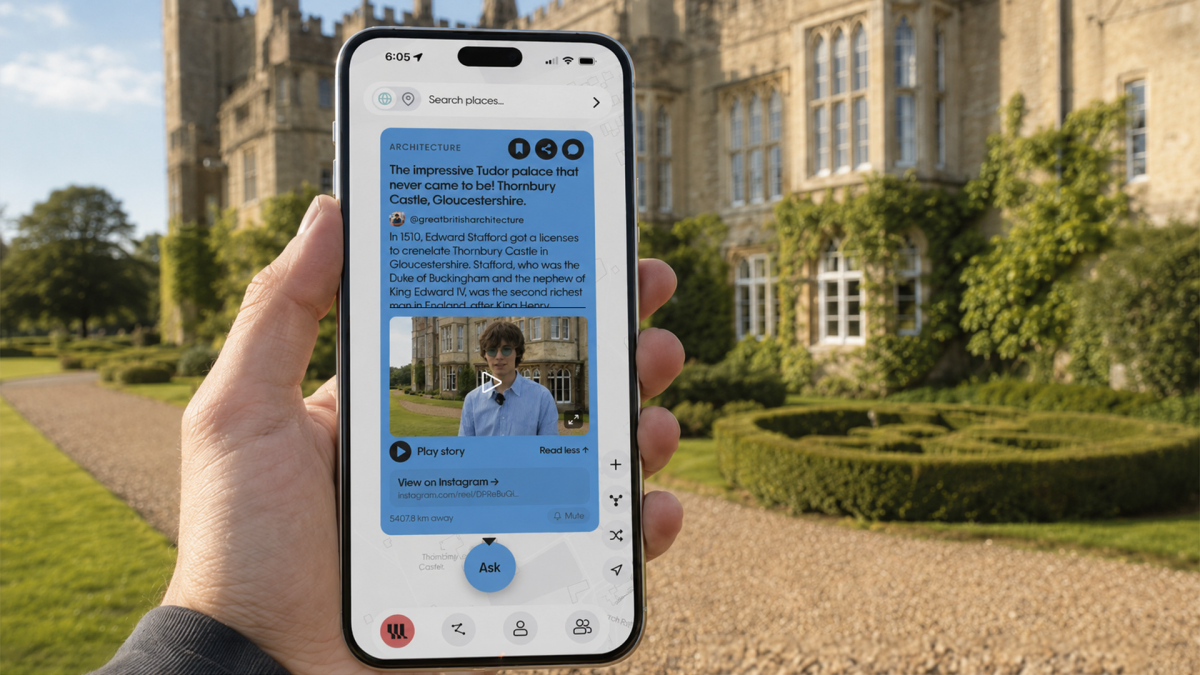
Wrinkles, a new AI-powered app for iPhone and Android, wants to turn ordinary walks, commutes, and trips into narrated experiences by automatically surfacing the history and hidden stories of the places around you. The startup says its location-aware platform can function like a hands-free audio tour guide, giving users a new way to learn about buildings, streets, museums, and landmarks without constantly looking down at a screen.
Founded by longtime friends David Stemler and Ryan Hansan, the app has launched with a global map of 1.3 million places across 177 countries and is positioning itself as both a consumer travel tool and a platform for institutions and creators to publish location-based experiences.
That combination puts Wrinkles in the middle of a growing wave of AI products trying to make smartphones feel less like distractions and more like interfaces that understand context. In this case, the context is geography: where you are, what is nearby, and what stories might be attached to the spot under your feet.
What is Wrinkles and how does it work?
Wrinkles is a location-based app that uses your position to bring nearby places to life through short narrated stories, historical context, and related facts. Instead of requiring users to search for a landmark or scan a QR code, the app is designed to surface information automatically as people move through a neighborhood, museum, park, campus, or city.
The product is available on both major mobile platforms and aims to behave more like an ambient guide than a traditional travel app. The company’s pitch is simple: the world itself becomes the interface, and the user’s phone acts as the voice that explains it.
How the experience is meant to feel
Wrinkles is built to reduce the need for constant device interaction. Rather than standing still and reading a dense screen full of directions, users can keep moving while the app provides narration about what they are passing.
That makes the service especially appealing for people who want context without losing the feeling of being present in a place. The app can describe a building’s origin, explain how a street evolved, or surface local lore that might not appear in a standard map listing.
The company says the goal is to create something closer to a modern tour guide than a static database of locations. In practical terms, that means the app can work in a planned sightseeing setting, but it is also intended for casual daily use.
Why did the founders build it?
The founders say Wrinkles grew out of a shared frustration with how mobile tour apps often work in real life. David Stemler, who spent years in advertising, said the inspiration came during a visit to the British Museum in London, where he used the museum’s official self-guided tour app.
Although he found the app functional, he felt the experience kept him focused on his device rather than the exhibits in front of him. That tension helped shape the central idea behind Wrinkles: location-aware technology should make the physical world easier to appreciate, not harder to notice.
Stemler said the museum visit left him staring at his phone and cross-checking numbers on the walls instead of taking in the building and the collection around him. He later asked a simple question from the airport: if a phone can tell where you are, why can’t the place itself “speak” back?
That idea became the basis for a product that tries to merge context, curiosity, and navigation into one experience. Rather than treating history as something users must go find, Wrinkles wants to reveal it in place.
Who are the founders?
Wrinkles was created by Stemler and Ryan Hansan, two entrepreneurs who have known each other since middle school. Their friendship has been shaped by travel, which they say has long influenced how they think about products and experiences.
The pair began taking trips abroad together as teenagers and continue to travel with their families today. Over time, they have repeatedly returned to the same pattern: a trip leads to a conversation, the conversation leads to a problem they think can be solved, and that problem becomes a startup idea.
Hansan previously founded ScratchDC, a meal delivery business, and TasteLab, a shared commercial kitchen that supported independent food businesses. Stemler came from advertising, giving the team a blend of consumer marketing and operator experience that may help them explain a somewhat unusual product to a broad audience.
What can users actually do inside the app?
Wrinkles is not just a one-way narration tool. The company says the app is meant to be interactive, social, and useful both on the move and from home.
Users can browse a global map of points of interest, discover stories in real time as they travel, or explore places remotely by searching the map. They can also ask questions while they are learning about a location, creating a more conversational experience than a standard audio guide.
Key features at a glance
- Automatic location-based storytelling
- Audio-tour style narration for landmarks and neighborhoods
- Searchable global map of points of interest
- Question-and-answer follow-up while exploring
- Social sharing and custom maps
- Personal memory layers attached to places
The company says the app can also support a more social model of exploration. Users may follow friends, family members, creators, and organizations, then save, share, and organize favorite locations into custom guides and maps.
That matters because it broadens the product beyond tourism. Wrinkles can be used to build a neighborhood guide, a family memory map, a campus tour, or even a themed list of places created by a museum or media company.
Can users add their own memories?
Yes. Wrinkles lets users attach their own photos, videos, recordings, and family memories to specific places. That turns the app into a kind of digital scrapbook anchored to geography.
For families, the feature could be especially meaningful. A childhood home, the site of a first date, a grandparents’ neighborhood, or a long-closed storefront can all become places where memories are preserved and shared across generations.
The company is framing this as a lasting personal archive, not just a travel utility. In its view, location is a container for memory, and the app can help people save what would otherwise be lost to time.
How big is Wrinkles’ map?
Wrinkles says it has built an initial global layer that includes 1.3 million points of interest in 177 countries. That gives the app enough scale to be useful well beyond a single city or region, while also giving the company a base it can expand with partner content.
The startup is not relying only on its own content. Historians, museums, creators, brands, and other organizations can add stories and experiences to the map, making the platform more like an open publishing layer for place-based media.
| Wrinkles snapshot | Details |
|---|---|
| Platforms | iOS and Android |
| Global coverage | 1.3 million points of interest |
| Geographic reach | 177 countries |
| Founders | David Stemler and Ryan Hansan |
| Main use case | Location-based audio storytelling and guided discovery |
That scale matters because most location-based storytelling products are narrow in scope. Some focus only on museums, some on one city, and some on a single institution. Wrinkles is trying to start with a much broader canvas.
Why is the company focusing on everyday use?
The founders say they do not want Wrinkles to be a one-off travel download that gets deleted after a vacation. Instead, they want it to become a habit-driven product that adds context to daily life.
That vision depends on a simple insight: people are often curious about the places they pass every day, but they rarely take the time to look them up. If an app can answer those questions automatically, the product becomes useful at home, on the commute, at a park, or while running errands.
Hansan said the product is meant to serve many situations, from family outings and museum visits to hometown discovery and international travel. In his view, the common factor is curiosity rather than tourism.
This is an important distinction from traditional travel apps. A trip-planning tool may be opened a few times a year. An app built around curiosity has the potential to be used repeatedly, because it applies to any place that has a story.
Where Wrinkles could fit in daily life
- Learning about a historic building on the way to work
- Hearing local stories during a neighborhood walk
- Exploring a botanical garden or zoo with children
- Building a family memory archive around meaningful places
- Planning a trip with a richer map of historical context
That broader use case may be one of the app’s strongest selling points. If it works as described, Wrinkles could sit somewhere between mapping software, audio guides, and personal storytelling tools.
How does Wrinkles plan to make money if users stay free?
Wrinkles says its consumer app will remain free, even though the company has tested freemium ideas. Instead of charging users, the startup is leaning on what it calls the supply side: museums, hotels, tourism boards, universities, brands, creators, and other organizations that want to publish experiences on the platform.
This model resembles a marketplace or publishing infrastructure rather than a direct-to-consumer subscription product. The company appears to believe that organizations will pay for distribution, content creation, and transactional value rather than for raw access to the app itself.
Who pays?
Partners can use Wrinkles to create location-based guides for visitors without building their own apps from scratch. That may be attractive to smaller institutions and businesses that want a richer digital presence but do not have the resources to develop and maintain a standalone product.
Wrinkles also says creators and media partners can make sponsored guides, while businesses can promote experiences tied to their physical locations. The app can include links that let users book tours, reserve tables, buy tickets, or visit businesses, and the startup takes a share of those transactions.
In other words, the company is not just selling storytelling. It is also selling conversion opportunities.
| Revenue stream | Who uses it | What it does |
|---|---|---|
| Sponsored guides | Creators and media partners | Publishes curated place-based content |
| Institutional experiences | Museums, universities, tourism boards | Creates guided location content without custom apps |
| Location promotion | Businesses | Highlights venues and nearby experiences |
| Transactional referrals | Tour operators, restaurants, ticket sellers | Lets users book, reserve, or purchase through the app |
That structure may help Wrinkles avoid the common consumer-app problem of asking users to pay before the product has become indispensable. It also gives the company more flexibility to build a large free audience while monetizing the ecosystem around it.
Why place-based AI is a growing idea
Wrinkles arrives as technology companies increasingly try to make AI useful in context, not just in chat windows. The value proposition is shifting from general conversation to specific real-world help: what is this thing, where am I, what should I know, and what should I do next?
In that sense, Wrinkles fits into a broader trend of software that understands location as a signal. Mapping, voice, search, and generative AI are converging into products that can respond to the physical environment in real time.
Unlike a basic map pin or static tour description, a contextual AI layer can adapt to where a user stands, what they ask, and who they are with. That makes the experience potentially more fluid, but it also raises the bar for accuracy, relevance, and trust.
What makes the concept appealing?
The appeal lies in removing friction from discovery. Most people do not enjoy pausing a walk to type in the history of every storefront. If a phone can automatically surface the relevant story and speak it aloud, the information becomes easier to absorb and less disruptive.
There is also an emotional dimension. Places often matter because of what happened there, not just because of their appearance. A tool that connects location to narrative can make a city feel more layered and human.
That may be especially true for travelers, but the founders are betting that the same effect can also deepen people’s relationship with their own neighborhoods.
How might museums, cities, and brands use it?
Wrinkles appears to be as much a platform for institutions as it is a consumer app. Museums, universities, tourism organizations, hotels, and brands can all build experiences that live inside the app rather than on separate websites or downloadable tour software.
For a museum, that could mean a self-guided tour with contextual commentary. For a city tourism office, it could mean a themed neighborhood walk. For a hotel, it might mean a guide to nearby restaurants, landmarks, or cultural stops.
Because users can search and browse remotely, these experiences are not limited to people already standing at the site. That could make the platform useful during planning as well as during the visit itself.
The company’s founders say they want Wrinkles to become a normal part of how people navigate places, whether they are visiting a new city, exploring a college campus, or trying to learn more about an area they have known for years.
That ambition suggests the startup sees itself less as a niche travel companion and more as a new layer for place-based media.
What are the biggest challenges ahead?
Wrinkles’ concept is compelling, but it will face familiar challenges for consumer AI and location products. The app needs to deliver accurate, timely, and genuinely interesting information without overwhelming the user.
It also has to navigate the practical issues of location awareness, battery use, permissions, and data quality. A story-rich map is only useful if the content is dependable and the experience feels seamless enough to keep people engaged.
There is also the matter of scale on the supply side. To keep the map fresh and credible, Wrinkles will need a steady flow of institutional partners, creators, and local experts who can add depth beyond the startup’s base dataset.
Potential advantages
- Clear consumer benefit for tourists and locals alike
- Large initial geographic coverage
- Flexible monetization through partners rather than users
- Strong emotional hook through family memory preservation
Potential risks
- Users may not keep location permissions enabled
- Content quality may vary across regions
- Competing apps could copy the concept
- Consumers may still treat it as a travel-only tool
The product’s long-term success may hinge on whether it can move from novelty to habit. Many apps can tell a story once. Fewer can become a daily companion.
The bigger picture for AI and location
Wrinkles is interesting not because it introduces a wholly new technical capability, but because it repackages existing ones in a more human way. Location services, audio, and AI-generated context are already common building blocks. What is new is the attempt to make them feel natural enough to blend into everyday life.
If the startup succeeds, it could help establish a category where the phone becomes a conversational guide to the physical world. That would be a shift from search-first interaction to environment-first interaction, with the app responding to place rather than user intent alone.
For now, Wrinkles is making a bid to be the kind of app people open because they are curious, not because they are planning. That may sound simple, but in consumer technology, turning curiosity into a repeatable behavior is often the hardest part.
Whether the product becomes a useful everyday companion or remains a clever idea for travelers will depend on execution. But its premise is clear: the world around you is already full of stories, and Wrinkles wants to be the voice that tells them.
| Milestone | What happened |
|---|---|
| Middle school | Stemler and Hansan became friends |
| Teen years | They began traveling together abroad |
| London visit | The museum-app frustration sparked the core idea |
| Launch | Wrinkles debuted on iOS and Android |
| Current phase | The company is expanding partner-driven content and monetization |
Frequently asked questions
What is Wrinkles?
Wrinkles is a location-based AI app that acts like an audio tour guide for the world around you. It automatically surfaces stories, history, and local context about nearby places on iOS and Android.
How does Wrinkles make money if the app is free?
Wrinkles makes money through the supply side rather than user subscriptions. Museums, tourism boards, universities, hotels, creators, and businesses can publish experiences, sponsor guides, and earn transaction-driven referrals through the platform.
Who founded Wrinkles?
Wrinkles was founded by David Stemler and Ryan Hansan. Stemler came from advertising, while Hansan previously founded ScratchDC and TasteLab, and the two have been friends since middle school.
Can users add their own memories to Wrinkles?
Yes. Users can attach photos, videos, audio recordings, and family memories to specific places, creating a personal archive tied to locations such as a childhood home, a first date spot, or a hometown landmark.
How many places does Wrinkles cover at launch?
Wrinkles says it begins with a global foundation of 1.3 million points of interest across 177 countries. The company also allows historians, museums, creators, and brands to add more stories to the map.