Updated August 4, 2026 10:25 am
In short
Voice AI drive-thrus are expanding again, with McDonald’s re-testing the technology, wider rollout plans at major chains, and industry adoption reaching about 6% of U.S. fast-food locations.
- AI drive-thru adoption is rising again after early public failures.
- Taco Bell, Dairy Queen, White Castle and McDonald’s are among the chains expanding tests or rollouts.
- Restaurants see benefits in speed, higher upselling and smoother shifts, while some customers prefer human service.
- The technology still raises concerns about accuracy, accessibility and the loss of human interaction.
Update — August 4, 2026 10:25 am
McDonald’s is back in the voice-AI drive-thru game. The chain is now testing automated ordering with Google at five U.S. locations, and the system can take orders in both English and Spanish.
The new reporting also says some technology investors are leaning back in after earlier pullbacks, with Branded Hospitality recently partnering with voice-AI company Arc on drive-thru work for brands including Jack’s and Pollo Campero.
Meanwhile, the latest data points to continued growth in adoption: roughly 6% of U.S. fast-food locations are now using voice AI in the drive-thru lane, up from 5% last year and about 4% in 2024.
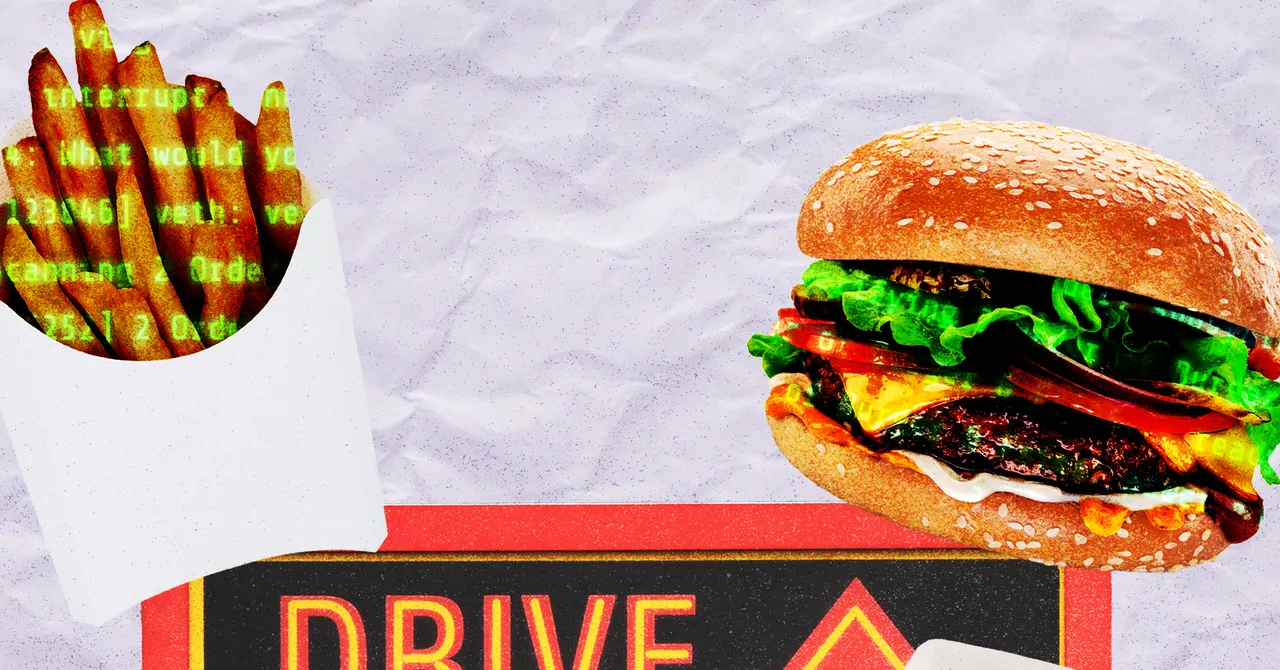
AI voice ordering is back in fast food, and this time it is spreading faster: US drive-thrus are moving from human headset operators to automated ordering systems as chains like Taco Bell, Dairy Queen, White Castle and McDonald’s expand tests and rollouts in 2026. The shift matters because the technology is no longer just a novelty or a viral punchline; it is becoming a real operating tool for an industry built on speed, upselling and labor efficiency.
What began as a shaky experiment, often mocked online for absurd ordering mistakes, is now entering a more mature phase. Restaurant chains say the systems are more reliable, more multilingual and better at handling volume, while critics argue the technology still risks awkward interactions, customer frustration and a thinning of the human experience that has long defined drive-thru service.
For fast food operators, the appeal is obvious: even small gains in speed, order value and employee workflow can add up across thousands of locations. For customers, the change can feel uncanny—pleasant, efficient and increasingly hard to avoid.
AI drive-thrus are moving from experiment to everyday service
Fast-food chains are deploying voice AI in drive-thrus at a pace that suggests the technology is leaving the testing stage behind. Industry research cited in the reporting shows that about 4 percent of US fast-food locations used voice AI ordering in 2024, rising to 5 percent last year and reaching roughly 6 percent in early estimates for 2026.
That may sound modest, but it represents a notable change in an industry where adoption often happens slowly and then scales quickly once a format proves workable. Taco Bell said in July that it had rolled out AI ordering at 890 drive-thru lanes, or more than 10 percent of its US footprint. White Castle says about 12 percent of its drive-thrus use an AI system named Julia, and new locations now open with the automated voice in place. Dairy Queen is expanding the technology across 25 states, with a broader rollout planned.
The renewed momentum suggests that the awkward first generation of voice ordering systems may have done less damage than it first appeared. Some chains backed away after public failures, but others kept improving the software, training and operational guardrails until the economics looked better.
Why did the first wave of AI ordering fail so visibly?
The first wave stumbled because early systems were often good enough to be impressive and bad enough to be embarrassing. In practice, they could misunderstand accents, struggle with multi-item orders and occasionally invent bizarre additions that customers never asked for.
Social media turned those breakdowns into spectacle. Viral clips showed McDonald’s systems adding hundreds of Chicken McNuggets to an order, inserting bacon into an ice cream request and producing other examples that made the technology seem ridiculous rather than revolutionary. One customer reportedly tried to confuse Taco Bell’s system by ordering thousands of cups of water, underscoring how fragile the early deployments could be under pressure.
Behind the jokes was a more serious operational problem. The ideal version of AI ordering is nearly invisible to the customer: just a fast, accurate voice that behaves like a competent employee. Early systems often needed human workers nearby to rescue conversations that went off the rails, which meant the supposed labor savings were limited and the frustration was still very real.
The technology’s early reputation was shaped by a mismatch between marketing promises and what customers actually experienced, with restaurants often spending more time fixing problems than benefiting from the automation.
That gap led some operators and investors to step back. Del Taco rolled back its test in 2024. McDonald’s sold McD Tech Labs to IBM and eventually ended the effort, at least in its original form. For a time, it looked as if the drive-thru AI hype cycle had peaked too early.
How are chains using voice AI differently now?
They are treating voice AI less like a fully autonomous replacement and more like a task-specific tool. That distinction matters. Instead of expecting an AI system to handle every complex order flawlessly on its own, many chains are using it to absorb routine traffic, support employees and improve consistency during busy periods.
White Castle is one of the clearest examples of this more pragmatic approach. Chief marketing officer Jamie Richardson says the system helps shifts run more smoothly and can improve speed. The company also keeps a human option available so customers can request a person at any point in the interaction.
Industry advocates argue that these systems have become more useful because both the software and the restaurant playbook around it have improved. Branded Hospitality cofounder Michael Schatzberg, whose firm has invested in food-service technology, says the latest generation of systems is no longer the clumsy AI-drive-thru version that failed earlier. In his view, the underlying technology and the companies deploying it have matured enough to solve many of the earlier problems.
That does not mean the old concerns have disappeared. It means companies are now trying to manage them more carefully.
What changed between AI drive-thru 1.0 and now?
The biggest change is operational discipline. Early rollouts often promised a near-autonomous future, but newer deployments are more selective, more supervised and more focused on specific outcomes such as order completion, upselling and service speed.
Chains have also learned that not every restaurant concept is equally suited to automation. A brand built on cheerful human service may resist automation on purpose, while a chain facing labor pressure or throughput challenges may see voice AI as a competitive advantage.
That explains why the industry is no longer moving in one direction. Some brands are expanding AI quickly; others are deliberately staying with human workers because that choice fits their identity and business model better.
| Chain | AI drive-thru status | Notable detail | Strategic takeaway |
|---|---|---|---|
| Taco Bell | Expanded rollout | AI at 890 drive-thru lanes | Using automation at scale after extended testing |
| Dairy Queen | Growing rollout | Implementation in 25 states | Planning broader adoption across restaurants |
| White Castle | Established use | About 12% of drive-thrus use “Julia” | Positions AI as a support tool, not a full replacement |
| McDonald’s | New testing phase | Testing with Google at five US locations | Re-entering the category after earlier setbacks |
| Chick-fil-A | No public AI rollout | Continues with human-first service | Prioritizes hospitality over automation |
What do restaurants gain from AI ordering?
The biggest benefits are speed, consistency and higher order value. Industry data cited in the reporting suggests that AI drive-thrus, on average, shave about 21 seconds from service times. That may seem small, but in a high-volume environment every second matters, especially during meal rushes and peak drive-thru traffic.
AI systems may also be better at one part of the job that restaurants care deeply about: suggestive selling. Intouch Insight’s survey found that automated ordering systems used upselling tactics 71 percent of the time, compared with an industry average of 58 percent. In other words, the machines are often more persistent than humans about asking customers to add fries, upgrade drinks or throw in a dessert.
That matters because the drive-thru is not only a convenience channel; it is a margin channel. A well-timed prompt for a larger drink or extra side can raise revenue without requiring a new menu item, a redesign of the kitchen or a major staffing increase.
For operators, the economics are especially attractive when automation can reduce pressure on overworked teams. Some companies say the systems help employees focus on food preparation or pickup rather than being tied up at the speaker box. Taco Bell has also said that locations using voice AI have higher employee retention, suggesting the tech may be functioning as a support layer rather than a direct labor substitute.
Why do some customers still dislike AI drive-thrus?
Some customers dislike them because they feel impersonal, unfamiliar and occasionally eerie. Even when the interaction works well technically, a synthetic voice can still be unsettling to people who expect a human to answer the speaker.
That reaction can be emotional as much as practical. One customer described expecting a person to take over when a robotic voice persisted at a Wendy’s drive-thru. The experience left him feeling confused and uneasy, and he worried about what society loses when more everyday interactions are filtered through machines instead of people.
That concern is not limited to nostalgia. For many customers, fast food is one of the last places where a brief, ordinary exchange with another person still happens. Some restaurants have built their brand identities around friendliness, warmth and a familiar face at the window, making automation harder to square with the customer promise.
Chick-fil-A is an example of a company that has so far resisted that path. Despite long lines, it continues to rank highly for drive-thru hospitality and has not publicly moved toward replacing its ordering staff with AI. Coffee chains such as Dutch Bros and 7Brew have also leaned into a human-centered model, arguing that service and connection are part of their appeal.
7Brew’s chief marketing officer, Nick Chavez, said the brand’s approach is based on genuine human connection, which the company believes its guests continue to value.
Are customers actually satisfied with AI ordering?
Yes, by many metrics they are, even if they do not always talk about it that way. Intouch Insight reported a 97 percent satisfaction rate for the technology, which helps explain why some chains are leaning back into expansion despite earlier mockery.
That satisfaction likely reflects a simple truth: when the system works, it can be fast, courteous and frictionless. Customers may not care whether the voice at the speaker box is human or machine if the order is correct, the pace is quick and the transaction is efficient.
Kristen Charpentier, who suspected she was speaking to AI at a Dairy Queen drive-thru in North Carolina, said the voice sounded unusually warm and polite. After confirming with the worker at the window that an AI had taken her order, she said the experience struck her as natural, if slightly too perfect. Her response reflects a common customer reaction: surprise first, acceptance later.
How does AI affect workers inside the restaurants?
In the short term, many chains say the technology is not reducing headcount in a dramatic way. Drive-thru crews often multitask already, and the industry’s labor model still relies heavily on people for food preparation, packing, kitchen coordination and problem-solving.
That is one reason the promise of fully replacing human workers has proved much harder to deliver than investors and technologists once suggested. A drive-thru order may sound simple, but in practice it can involve pauses, corrections, menu substitutions, timing issues, payment interruptions and customer preferences that do not fit neatly into a script.
White Castle says employment levels have remained stable during its rollout. Taco Bell has said AI-enabled sites show stronger employee retention. Those claims support a more cautious reading of the labor impact: the systems may be changing how staff work rather than eliminating large numbers of jobs outright.
At the same time, critics worry about a longer-term pattern in which automation gradually strips away the lower-wage human interaction that used to define the service. Even if the software does not immediately erase jobs, it can still reshape the role of workers and reduce the need for certain kinds of customer-facing labor over time.
What comes next for AI in fast food?
The next phase is likely to be broader, more personalized and more invisible. Chains and vendors are already talking about systems that can do more than just take an order. They may soon recognize a car as it pulls up, switch languages automatically and tailor offers based on previous purchases or probable buying habits.
That future is attractive to operators because it could make the drive-thru more efficient and more profitable at the same time. But it also raises a new question: how much personalization is too much? A system that seems helpful one day could feel invasive the next if it starts behaving like a digital sales agent that knows too much.
White Castle’s Richardson says the company wants to avoid that creep factor, a telling line in a sector where data-driven personalization is often praised until customers feel watched instead of served. The challenge for chains will be to make AI feel like a convenience, not a surveillance layer.
McDonald’s return to testing with Google at five US locations suggests even the biggest brands are unwilling to abandon the category entirely. That test supports the broader industry view that the first wave did not end the story; it only exposed the hard parts early.
What should readers watch for next?
Watch for three signs: wider multi-state rollouts, better multilingual support and more explicit human handoff options. Those developments would signal that AI drive-thrus are becoming a standard operational feature rather than a marketing experiment.
- Wider deployment: More chains may move from limited pilots to regional or national rollouts.
- Better accuracy: Systems will need fewer human interventions to justify the investment.
- Customer choice: The ability to switch to a human may become a standard feature.
- Smarter upselling: Chains will likely keep optimizing recommendations because that is where the money is.
The fast-food industry is betting that the second try will stick
The rebound in AI drive-thrus reveals a familiar pattern in technology adoption: early embarrassment does not always kill a useful product. Sometimes it just delays it until the software improves, the branding softens and the business case becomes harder to ignore.
That seems to be where fast food is now. The industry has moved past the phase when AI ordering was mostly a curiosity and into one where the technology is being judged on operational merit. The first round taught chains what not to do. The second is built around a more modest promise: help employees, move customers faster and quietly make the order a little bigger.
For supporters, that is enough. For skeptics, the real question is whether convenience is worth giving up one more ordinary human interaction. The answer will vary by brand, by location and by customer. But the direction of travel is clear: the drive-thru voice is getting less human, and fast food is betting that many customers will eventually stop minding.
That may be the most important lesson of all. AI did not have to become perfect to become useful. It only had to become good enough that fast-food chains, already addicted to speed and scale, decided the trade-offs were worth it.
Frequently asked questions
How widespread are AI drive-thrus in fast food right now?
AI drive-thrus are still a minority feature, but they are expanding quickly. Industry research cited in the story says about 6 percent of US fast-food locations use voice AI in the drive-thru lane, up from roughly 4 percent in 2024 and 5 percent last year.
Why are fast-food chains bringing back AI ordering after early failures?
Fast-food chains are bringing it back because the technology has improved and the business case remains strong. Operators want faster service, more consistent upselling and less pressure on staff, and they believe the latest systems are better at handling real-world orders.
What are the biggest problems with AI drive-thru systems?
The biggest problems are order errors, difficulty understanding accents or unusual requests, and customer discomfort with robotic interactions. Early versions also became viral jokes when they made bizarre mistakes, which made many chains more cautious about full deployment.
Are AI drive-thrus replacing workers?
Not broadly, according to the reporting. Chains such as White Castle and Taco Bell say employment has stayed stable or retention has improved, suggesting the systems are being used to support staff rather than eliminate large numbers of jobs right away.
Which chains are most committed to AI drive-thru ordering?
Taco Bell, Dairy Queen and White Castle are among the most active adopters. McDonald’s is also testing again with Google at five US locations, while brands like Chick-fil-A, Dutch Bros and 7Brew are choosing to keep humans at the center of service.