In short
AMD unveiled Helios, a new AI rack system aimed squarely at Nvidia’s dominance in data center infrastructure. The company says major customers including Microsoft, OpenAI, and Anthropic are already planning deployments.
- AMD introduced Helios, a rack-scale AI system built for large-model training and deployment.
- The company is positioning Helios as a rival to Nvidia’s integrated AI infrastructure products.
- Major customers named so far include Microsoft, OpenAI, Meta, Oracle, and Anthropic.
- AMD also unveiled Venice-X, a data center CPU expected in 2027.
- Lisa Su forecast a $1.4 trillion AI accelerator market by 2030.
AMD is moving directly at Nvidia’s strongest AI infrastructure business with Helios, a new rack-scale system designed for the largest AI labs and data center operators. The company unveiled the platform at its sold-out Advancing AI conference in San Francisco on Thursday, positioning Helios as a high-performance answer to Nvidia’s dominant rack systems and signaling a larger push into the booming market for AI compute.
The announcement matters because the fight for AI leadership is no longer just about individual chips. It is increasingly about full-stack systems that can train and run frontier models at enormous scale, and AMD is now trying to win customers by selling an integrated package of processors, networking, and data-center-ready hardware.
What AMD announced at Advancing AI
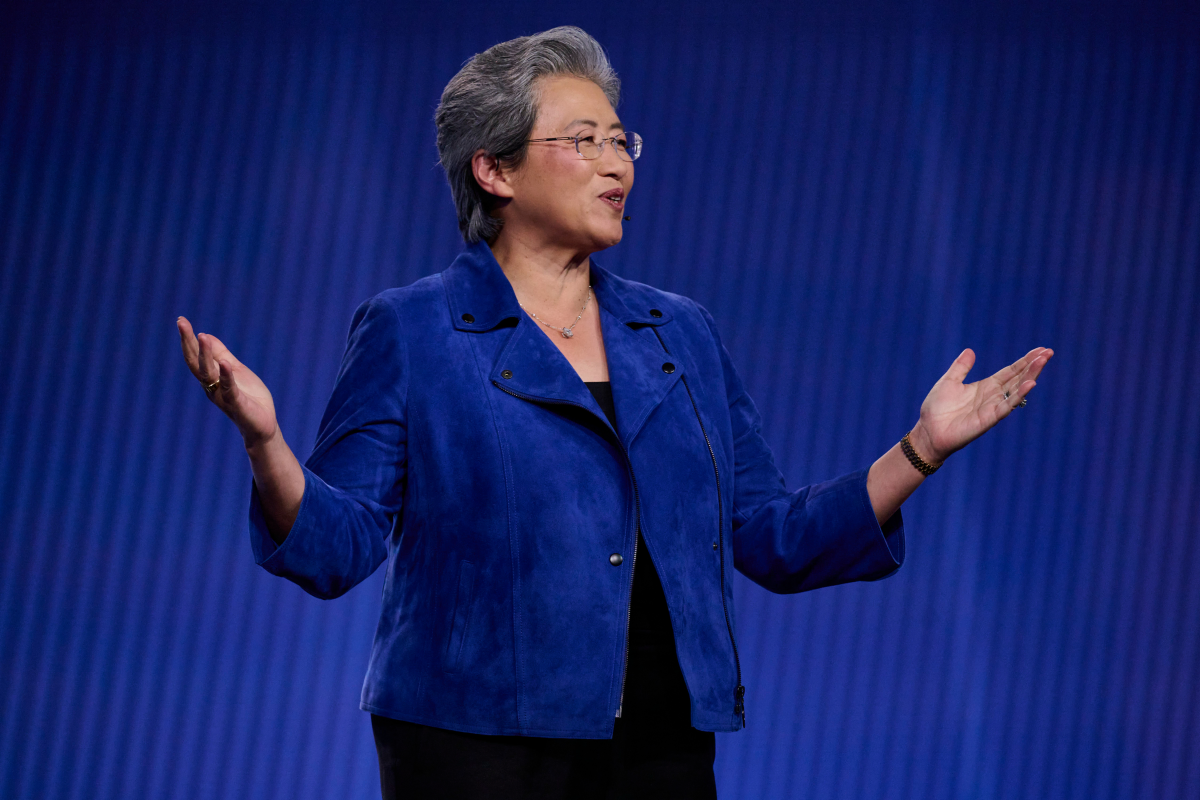
AMD used its annual showcase to promote Helios, its rack-scale AI system, along with a broader lineup of processors intended for high-demand computing environments. Chair and CEO Dr. Lisa Su framed the product as a top-tier infrastructure platform built for the next generation of large-scale model training and inference.
In simple terms, Helios is not a single chip. It is a densely engineered rack system that combines many processors into one large unit, making it suitable for hyperscale data centers where AI models are trained, deployed, and continuously updated. That design puts AMD into the same strategic lane that Nvidia has occupied for years.
Dr. Lisa Su described Helios as AMD’s highest-performance AI rack and said it was designed to train and run frontier models at massive scale.
The company said the system will be deployed by leading AI firms at gigawatt scale, underscoring how aggressively the industry is expanding its infrastructure footprint. AMD also said it expects Helios to ship later this year.
Why Helios is a direct challenge to Nvidia
Helios is AMD’s clearest attempt yet to compete head-to-head with Nvidia in the market for rack-scale AI systems. Nvidia has dominated this segment with its Grace Blackwell and Vera Rubin platforms, which bundle compute, memory, networking, and orchestration into integrated systems optimized for large AI workloads.
AMD is betting that buyers want more than a fast GPU. They want a complete, scalable architecture that can be deployed quickly and operate efficiently across huge clusters. That shift is important because the fastest-growing customers in AI are not consumer app developers but the companies building the digital backbone for model training and deployment.
According to reporting cited around the launch, Helios compares favorably on several performance measures against Nvidia’s Vera Rubin system. While the competitive claims will ultimately be judged by real-world deployments, the early message is clear: AMD wants to be seen not as a secondary supplier, but as a primary infrastructure partner for frontier AI.
What makes rack-scale systems so important?
Rack-scale systems are important because they allow many processors to be packaged and managed as one powerful computing environment. That matters for AI labs that need thousands of accelerators working together with low latency and high bandwidth.
These systems are especially relevant in data centers that train large language models, operate agentic AI products, or run heavy enterprise workloads. The more complex the model, the more valuable the system-level optimization becomes.
Who is already lined up to use Helios?
Several major names in AI and cloud computing are already associated with the system. AMD said customers include OpenAI, Meta, Oracle, Anthropic, and Microsoft, all of which have plans to deploy Helios.
That customer list matters for two reasons. First, it gives the system credibility in a market where procurement decisions are often guided by trust and ecosystem compatibility. Second, it suggests that some of the industry’s most important AI builders are willing to diversify beyond Nvidia’s hardware stack.
Microsoft has been especially visible in AMD’s narrative. Microsoft CEO Satya Nadella said earlier in the week that the company plans to expand its Azure infrastructure with Helios, a notable endorsement from one of the world’s largest cloud providers.
AMD and Anthropic also announced a strategic partnership on Wednesday to deploy up to two gigawatts of GPUs through the new rack system, a scale that illustrates just how energy-intensive and capital-heavy the AI boom has become.
How does AMD’s strategy reflect the wider AI compute boom?
AMD’s strategy reflects a broader shift in the AI market: compute is becoming the bottleneck, and the companies that control the infrastructure stand to benefit the most. Lisa Su argued that the growth of agentic AI is driving a step-change in demand for computing power.
Agentic AI systems do more than respond to prompts. They chain together multiple steps, call tools, retrieve data, reason through intermediate tasks, and repeat those loops until a problem is solved. That requires far more compute than a single-pass chatbot interaction.
Su said agentic systems can involve dozens of steps and repeated reasoning cycles, which means they need large numbers of GPUs to complete tasks.
That argument helps explain why AMD is talking less like a consumer chip company and more like an AI infrastructure provider. If the next wave of AI requires persistent, iterative workloads, then the winners will be the vendors that can supply huge volumes of accelerated compute with strong programmability.
Why are GPUs still central?
GPUs remain central because the software and model landscape is still evolving quickly. Su said the market still favors programmability, meaning the most flexible hardware is likely to remain in demand while algorithms mature.
That is one reason AMD is pressing ahead with both rack systems and general-purpose data center chips. The company is trying to make itself useful at multiple layers of the AI stack rather than relying on one product cycle.
What else did AMD announce?
Alongside Helios, AMD introduced its Venice-X CPU, a data center processor aimed at demanding computing workloads. The chip is expected to arrive in 2027.
The Venice-X announcement matters because AI infrastructure buyers often want balanced systems. They need GPUs for accelerators, but they also need CPUs to handle orchestration, data movement, coordination, and other non-accelerated tasks inside large clusters.
By pairing Helios with a new CPU roadmap, AMD is signaling that it wants to serve as a full infrastructure vendor rather than a point-solution supplier. That broader pitch could help the company win more of the enterprise and cloud budget that is flowing into AI.
How big could the AI accelerator market become?
AMD believes the market opportunity is enormous. Su said the AI accelerator market could reach about $1.4 trillion by 2030, a figure she compared with the size of the entire semiconductor market today.
If that estimate proves even directionally correct, the next five years will be defined by a massive reallocation of capital toward AI hardware. Data centers, cloud providers, foundation model developers, and enterprise AI adopters would all be competing for the same scarce compute resources.
The scale of that forecast helps explain why so many chipmakers are racing into the same space. The prize is not just sales of individual processors. It is long-term control over the systems that underpin the AI economy.
What does that mean for AMD’s long-term outlook?
It means AMD is trying to convert technical momentum into market share at exactly the moment the industry is reorganizing around AI infrastructure. The company has spent years building credibility in servers and data centers, and Helios gives it a more visible platform to challenge Nvidia at the rack level.
The opportunity is real, but so is the competition. Nvidia still has a massive software ecosystem, strong customer lock-in, and a proven track record in AI deployments. AMD will need more than a compelling product announcement to shift buying patterns at scale.
What the customer list says about the market
The customer list attached to Helios offers a useful snapshot of where AI infrastructure is heading. The names are not random. They are some of the biggest builders of foundation models, cloud platforms, and enterprise AI services in the world.
That suggests the market is moving toward a smaller number of very large buyers that want enormous amounts of power, efficiency, and supply certainty. For chipmakers, winning even one of those customers can translate into years of revenue. Winning several can reshape a product line.
| Item | What AMD announced | Why it matters |
|---|---|---|
| Helios rack system | New AI rack-scale platform for frontier-model training and inference | Direct challenge to Nvidia’s integrated AI systems |
| Named customers | OpenAI, Meta, Oracle, Anthropic, Microsoft | Signals early adoption from major AI and cloud players |
| Microsoft Azure | Expansion planned with Helios | Validates AMD’s system-level pitch in the cloud market |
| Anthropic partnership | Plan to deploy up to 2 gigawatts of GPUs | Shows the extreme scale of AI infrastructure demand |
| Venice-X CPU | New data-center processor expected in 2027 | Extends AMD’s roadmap beyond accelerators |
| Market forecast | $1.4 trillion AI accelerator market by 2030 | Highlights the size of the opportunity AMD is pursuing |
Timeline: How AMD’s Helios push developed
Helios did not appear overnight. AMD has been building toward this launch through a series of public unveilings and customer announcements over the past year and a half.
| Date | Milestone | Significance |
|---|---|---|
| 2025 | Helios first revealed | Introduced AMD’s rack-scale strategy to the market |
| January 2026 | Shown onstage at CES | Gave the system its first major public spotlight |
| July 2026 | Advancing AI conference in San Francisco | AMD highlighted customers, performance, and shipping plans |
| Later in 2026 | Expected shipment | Moves the product from announcement to deployment |
| 2027 | Venice-X CPU launch expected | Broadens AMD’s data center roadmap |
What the launch means for the AI hardware race
AMD’s Helios launch shows that the AI hardware race is widening beyond a single-chip contest. The market now rewards companies that can ship complete systems, support enormous deployments, and prove they can serve cloud and model-building customers at scale.
For AMD, the challenge is to turn promising technical claims into durable adoption. For Nvidia, the message is that the competitive field is getting more serious. And for AI buyers, the result may be more choice, more bargaining power, and more rapid innovation in the hardware that powers modern AI.
In the near term, Helios will be judged by its shipping performance, customer uptake, and real-world efficiency. But the broader story is already clear: the biggest battleground in AI is now the data center rack, and AMD intends to be in the fight.
Key facts at a glance
- AMD unveiled Helios, a rack-scale AI system, at its Advancing AI conference in San Francisco.
- The company says Helios is built for frontier-model training and deployment at massive scale.
- Named customers include OpenAI, Meta, Oracle, Anthropic, and Microsoft.
- AMD also introduced Venice-X, a data center CPU expected in 2027.
- Lisa Su projected a $1.4 trillion AI accelerator market by 2030.
Why readers should care
This launch is about more than a new piece of hardware. It is a sign that the AI industry is entering a phase where infrastructure scale, not just model quality, will shape competitive advantage. AMD is trying to claim a bigger role in that future, and Helios is its boldest move yet.
Frequently asked questions
What is AMD Helios?
AMD Helios is a rack-scale AI system designed to power large data center workloads, including training and running frontier AI models. It combines multiple processors into a single high-performance platform aimed at hyperscale customers.
How is Helios different from a regular GPU?
Helios is more than a GPU because it is a full rack-scale system, not just a chip. It integrates many components into one computing environment so AI labs and cloud providers can run massive workloads with better coordination and scale.
Which companies are planning to use Helios?
AMD says OpenAI, Meta, Oracle, Anthropic, and Microsoft are among the companies planning deployments. Microsoft has also said it will expand Azure infrastructure with Helios, while Anthropic has announced a major partnership with AMD.
Why is AMD targeting Nvidia now?
AMD is targeting Nvidia now because the AI market is shifting from isolated chips to full infrastructure systems. Nvidia still dominates that space, but AMD believes rising demand for AI compute gives it a chance to win larger deployments.
When will AMD Helios ship?
AMD says Helios is expected to ship later in 2026. The company first revealed the system in 2025 and showcased it publicly again in early 2026 before the latest conference announcement.