In short
Anthropic has upgraded Claude voice mode so it can use Opus, Sonnet and Haiku models and connect to apps like Gmail, Slack and Notion. The update makes Claude more useful for real work and intensifies competition with OpenAI.
- Claude voice mode now supports Opus, Sonnet and Haiku models.
- Anthropic added app integrations including Gmail, Google Calendar, Slack, Canva and Notion.
- Free users are limited to Haiku and one connected app.
- Anthropic is positioning Claude as a productivity tool, not just a voice chatbot.
- The update arrives as OpenAI and Anthropic compete more directly in AI assistants.
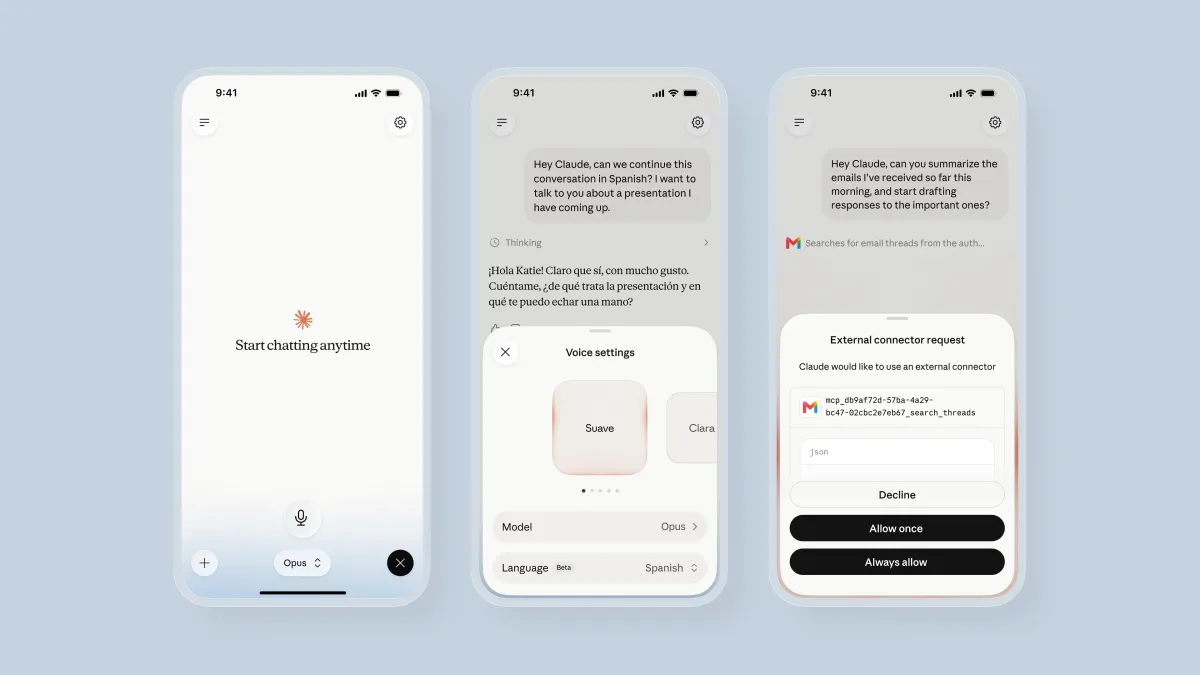
Anthropic has expanded Claude’s voice mode with access to its newer Opus, Sonnet and Haiku models, a move that makes the feature more capable for real work and puts fresh pressure on OpenAI’s own voice assistant efforts. The update, announced Thursday, also lets Claude connect to apps such as Gmail, Google Calendar, Slack, Canva and Notion, turning voice into a more practical productivity tool.
The change matters because voice interaction is quickly becoming one of the clearest battlegrounds in consumer AI. Anthropic is no longer treating voice as a lightweight convenience feature; it is positioning Claude as a hands-free assistant that can help users manage schedules, draft messages, prepare pitches and brainstorm ideas while connected to the services they already use.
What changed in Claude voice mode?
Anthropic has upgraded Claude’s voice mode so users can now choose among the company’s flagship model families rather than relying on a single lightweight option. That shift gives the feature more flexibility and, in Anthropic’s telling, makes it better suited to longer and more demanding conversations.
Until now, Claude’s voice feature had been powered by Haiku, Anthropic’s fastest and least resource-intensive model. It was responsive, but the trade-off was that it was not especially strong for more complex tasks. With the new update, Claude’s voice mode automatically uses the same model a user last selected in text chat, defaulting to the fastest version of that model.
In practical terms, that means someone who prefers Opus for more sophisticated reasoning in text can now continue that workflow by voice. Someone who wants quick, lightweight interactions can still lean on Haiku. Anthropic is trying to make voice feel less like a separate product and more like another entry point into the same assistant.
Why does this update matter for AI assistants?
This update matters because it pushes Claude closer to being an agentic assistant rather than a simple speaking interface. Voice is no longer just about asking a chatbot a question out loud; it is increasingly about using AI to get tasks done in the background while users speak naturally.
That distinction is important in a market where major AI companies are racing to define what the next-generation assistant should look like. The winner will not only sound more conversational, but also connect to calendars, email, documents and team collaboration tools in ways that save time.
Anthropic is also making a clear competitive statement. OpenAI has recently updated ChatGPT’s voice experience and introduced a new family of conversational models, but Claude now appears to have an edge in connected productivity workflows. Anthropic is betting that utility, not just natural speech, will determine which assistant people rely on most.
How does Claude voice mode work now?
Claude voice mode now follows the model selection used in the user’s text conversation. If a person was chatting with Claude using Sonnet, for example, voice mode can pick up that context and use the corresponding faster version by default. Anthropic says the update is meant to support longer and more useful exchanges.
The company says the new setup can help with tasks such as reviewing communication style, rehearsing a pitch to a client or exploring product-market fit ideas. Those examples suggest Anthropic wants Claude to be seen as a tool for professional work, not just casual dictation or simple Q&A.
Which apps can Claude connect to?
Claude can now connect to several widely used workplace apps, including Gmail, Google Calendar, Slack, Canva and Notion. That allows the assistant to go beyond talk and take action in services many users already depend on throughout the day.
With those integrations, a user can ask Claude to update a meeting time, draft an email or create a document in Notion. The feature turns voice into a command layer across common productivity software, which is exactly where consumer AI companies see the biggest opportunity for stickiness.
- Gmail: draft or help manage email tasks
- Google Calendar: adjust meeting slots and scheduling details
- Slack: support team communication workflows
- Canva: assist with content creation tasks
- Notion: create and update documents
How does this compare with OpenAI’s voice tools?
Anthropic’s approach is more ambitious in one key respect: it links voice mode directly to outside apps that can complete work. OpenAI’s voice mode has been improved in conversational style, but it still does not offer the same level of tool use for workplace tasks, according to Anthropic’s positioning.
That difference could matter for users who care less about lifelike conversation and more about what an assistant can do after they speak. If OpenAI is optimizing for natural, human-like interaction, Anthropic is emphasizing productivity and connected workflows.
Anthropic is framing the update as a way to make Claude useful for longer, more work-oriented conversations and to let users act across apps rather than just talk to a model.
What are the model options in Claude voice mode?
Anthropic says users can choose among three model families: Opus, Sonnet and Haiku. Those names matter because they represent different balances of capability, speed and cost, and users will likely experience them as different levels of assistance depending on the task.
The company did not announce changes to the underlying voice model itself. In other words, Anthropic upgraded which language models voice mode can use, but it did not detail whether the speech system received any major overhaul.
That leaves some uncertainty about how much the conversational experience has changed beyond intelligence and app integration. Users may see stronger reasoning and more helpful responses, but they should not necessarily expect dramatic improvements in voice interruption handling or speech flow, at least not based on what Anthropic disclosed.
| Feature | Before update | After update |
|---|---|---|
| Default model in voice mode | Haiku | Last used text-chat model, fastest version by default |
| Model choices | Limited | Opus, Sonnet and Haiku |
| App connections | Not highlighted in this release | Gmail, Google Calendar, Slack, Canva and Notion |
| Best use case | Fast, simple voice queries | Longer conversations and work tasks |
| Availability | Voice mode already available | Beta across platforms for all users |
Who gets access first?
Anthropic says the new voice mode is available in beta to all users across platforms. That broad rollout is notable because it gives the company an opportunity to gather feedback quickly while making the feature visible to a wide audience.
Free users, however, face tighter limits. Anthropic says they will be restricted to the Haiku model and will only be able to connect one app. Paid users get the fuller experience, including the more capable model choices and broader connectivity.
This kind of tiering is familiar in AI product strategy. Companies often reserve premium model access for paying customers while using free tiers to encourage adoption and test product-market fit at scale.
How good is Claude voice mode for multilingual use?
Claude voice mode already supports multiple languages, but users still need to specify which language they want to use. Anthropic added multilingual support in beta earlier this year, and the current list includes English, French, German, Hindi, Indonesian, Italian, Japanese, Korean, Portuguese and Spanish.
The language support suggests Anthropic is aiming at a global user base rather than only English-speaking professionals. That matters for a company competing in a market where AI assistants are increasingly judged on international usefulness as much as model quality.
Even so, the manual language selection requirement indicates that the experience may not yet be seamless. In other words, the feature is useful, but it is still a work in progress rather than a fully automatic, conversationally adaptive system.
Why the timing is significant
The timing of Anthropic’s move is strategic. It comes just weeks after OpenAI rolled out new conversational models and updated ChatGPT’s voice mode, which made voice one of the most visible front lines in the rivalry between the two AI companies.
That sequence suggests Anthropic is responding directly to pressure from a competitor that has historically moved quickly to define consumer expectations. Rather than trying to outdo OpenAI on social buzz alone, Anthropic appears to be focusing on usefulness in real workflows.
In the broader AI market, that may be a smarter long-term bet. Consumers and professionals alike are increasingly asking not whether a chatbot can talk, but whether it can save time, reduce friction and handle routine tasks across the apps they already use.
What this says about the direction of AI products
Voice features are evolving from novelty to interface layer. The most important question is no longer whether an assistant can understand spoken language, but whether it can sit on top of email, calendars and documents as a practical coordinator.
Anthropic’s release reflects that shift. By combining stronger model choices with app integrations, the company is turning Claude into something closer to a work companion than a speaking chatbot.
That may also help Anthropic differentiate its products in a market where raw model quality is increasingly hard for users to judge. Features that are visible and immediately useful — like drafting an email or moving a meeting — are easier to understand than benchmark scores.
What Anthropic did not say
Despite the breadth of the rollout, Anthropic left several important details unanswered. It did not explain how its voice stack works, and it did not specify whether the voice experience benefits from any new speech-processing architecture.
That omission matters because voice quality depends on more than just the text model. Users care about pause timing, interruption handling, turn-taking and natural responsiveness. Without updates to the voice layer, some of those features may remain unchanged even if the underlying intelligence is stronger.
Anthropic also did not spell out whether the connected app experience is deeply transactional or more limited in scope. For now, the company is clearly emphasizing capability, but the exact boundaries of what Claude can do inside each third-party app remain important for users to test.
How this could affect the AI assistant race
Anthropic’s update may not be the flashiest announcement in the consumer AI market, but it is the kind of product move that can influence user habits. Once people begin using an assistant to handle meetings, notes and messages by voice, switching costs rise quickly.
That is why app connectivity is so valuable. The more an AI system becomes embedded in daily workflows, the more likely users are to keep returning to it. If Claude can reliably connect voice to action, Anthropic could strengthen its position among professionals, teams and power users who want practical automation without leaving their existing tools.
For now, the update gives Anthropic a more credible answer to a basic question: what can Claude do that a normal chatbot cannot? The answer is increasingly that Claude can speak, reason and act across the software people use every day.
Timeline of recent Claude voice developments
Anthropic has moved steadily to make voice mode more useful over the past year, with Thursday’s update marking its most visible step yet.
| When | Development | Why it matters |
|---|---|---|
| Last year | Claude voice mode launched with Haiku | Gave Claude a fast but relatively lightweight speaking interface |
| Earlier this year | Multilingual support added in beta | Expanded the feature’s appeal beyond English-only users |
| Thursday | Voice mode upgraded to support Opus, Sonnet and Haiku, plus app connections | Made Claude more suitable for work tasks and cross-app productivity |
Bottom line
Anthropic’s latest Claude update is less about making the assistant sound nicer and more about making it more useful. By linking voice mode to stronger models and popular productivity apps, the company is trying to turn spoken prompts into real work output.
The move raises the pressure on OpenAI and highlights where the AI assistant market is heading next: not toward better small talk, but toward assistants that can listen, reason and act inside the tools people already trust.
Frequently asked questions
What is new in Anthropic’s Claude voice mode update?
Anthropic has added support for Opus, Sonnet and Haiku models in Claude voice mode, along with app integrations for tools such as Gmail, Google Calendar, Slack, Canva and Notion. The update is designed to make voice interactions more useful for work tasks and longer conversations.
Can Claude voice mode work with other apps now?
Yes. Claude voice mode can connect to several productivity apps, including Gmail, Google Calendar, Slack, Canva and Notion. That means users can ask Claude to help update schedules, draft emails or create documents without leaving the voice experience.
How is Claude voice mode different from ChatGPT voice mode?
Claude’s voice mode is more focused on tool use and productivity workflows. OpenAI’s voice mode has improved conversationally, but Anthropic says Claude can connect to external apps and take actions, which gives it a broader work-oriented feature set.
Who can use the new Claude voice mode features?
Anthropic says the update is in beta and available to all users across platforms. Free users get a more limited version, however, with access restricted to the Haiku model and only one connected app.
Does Claude voice mode support other languages?
Yes. Claude voice mode supports several languages, including English, French, German, Hindi, Indonesian, Italian, Japanese, Korean, Portuguese and Spanish. Users still need to manually specify the language they want to use.