In short
Sunrun is piloting a distributed AI compute program that would place small compute nodes in customers’ homes and sell the processing power to enterprise buyers. The move aims to sidestep resistance to new data centers by spreading infrastructure across residential properties.
- Sunrun is testing a distributed AI compute network in customer homes.
- Participants in the pilot will be compensated for hosting equipment.
- The company says it has already run a proof of concept and will evaluate the pilot over the coming months.
- The idea targets rising opposition to new data centers and their energy, noise and water demands.
- Sunrun’s 1.1 million customers could potentially join a waitlist if they have the right home energy setup.
Sunrun is testing a new way to power artificial intelligence: by installing small compute units inside customers’ homes and paying participants to host them. The solar and home battery company says the pilot could create a distributed AI compute network that sells processing power to enterprise buyers while avoiding the resistance that often greets new data centers.
The proposal matters because it pushes AI infrastructure into an unexpected place — the residential home — at a time when large centralized data centers are increasingly facing public opposition over energy use, noise, water demand, and land consumption.
Instead of building one massive facility, Sunrun wants to spread the workload across a nationwide network of homes already equipped with its solar and storage systems. The company says it has already completed a proof of concept and is now preparing a broader pilot, with customers able to join a waitlist if they are willing to host the equipment.
What Sunrun is trying to build
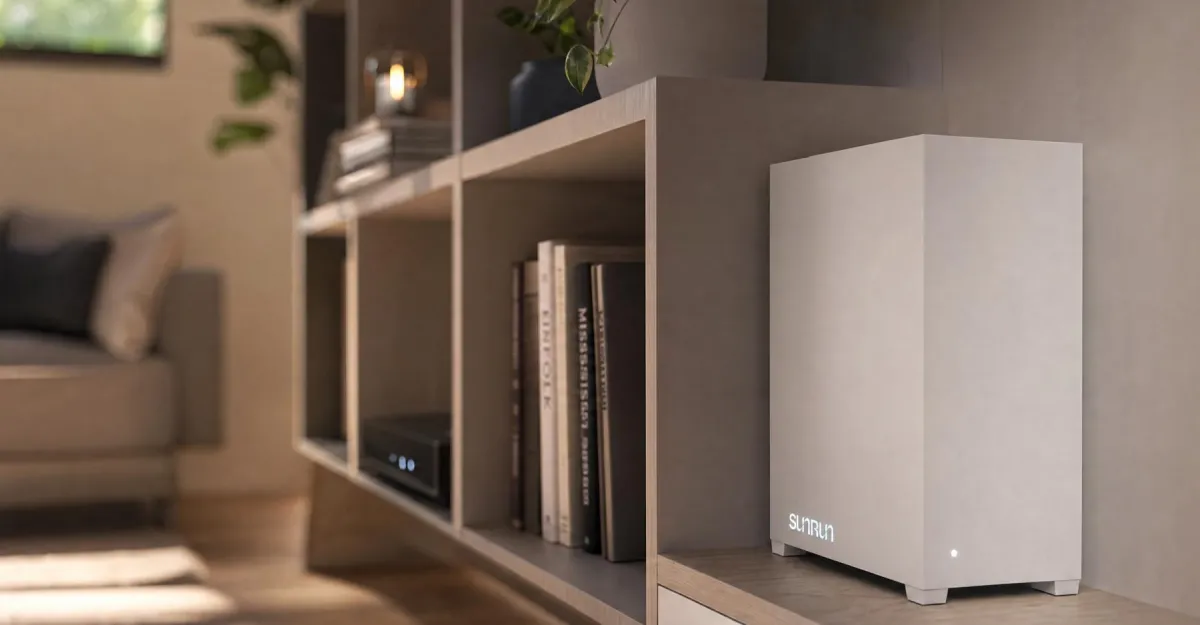
Sunrun’s plan is to place multiple small compute nodes in participating households and aggregate them into a larger AI infrastructure layer. In practical terms, that means the company would use spare space in homes — likely alongside existing solar and battery setups — to host hardware that contributes computing power remotely.
The setup is unusual for the AI industry, which has largely focused on ever-larger data centers clustered near cheap power and abundant land. Sunrun is proposing the opposite model: distributed infrastructure spread across the country and managed through a network rather than a single campus.
The company describes the initiative as a “distributed AI compute” program. Under the plan, Sunrun would sell the combined computing capacity to enterprise customers, such as AI companies that need more processing power for training or inference workloads.
Why Sunrun thinks homes can help solve AI infrastructure bottlenecks
Sunrun is betting that residential locations can offer a practical alternative as AI demand grows and communities push back on new data center construction. The logic is simple: if large projects are difficult to site, one workaround is to break the infrastructure into smaller pieces and place them where the political and physical friction is lower.
That strategy could be attractive in places where residents object to new hyperscale campuses. A recent survey cited by the company found that more than 70% of Americans oppose building new data centers in their area, often because of concerns about pollution, noise, and heavy use of power and water.
By leveraging homes that already have solar and battery storage, Sunrun appears to be trying to position the compute load as an extension of distributed energy infrastructure rather than a standalone industrial facility.
Sunrun says the pilot will place “numerous compute nodes” in homes that already use its solar panels and storage systems, and customers who participate will be compensated.
How the distributed AI compute program would work
The company has not yet released a full technical blueprint, but the concept suggests a network of compact compute nodes that operate inside participating homes and connect back to enterprise users through Sunrun’s orchestration layer.
Sunrun says customers will be paid for taking part in the pilot. That compensation could help offset the inconvenience of hosting additional equipment, though the company has not publicly detailed the payment structure, power usage model, or maintenance responsibilities.
The pilot is currently limited to customers who already have Sunrun solar and battery storage systems, which gives the company a controlled environment for testing reliability, connectivity, and operational performance.
Who can sign up?
Sunrun says its 1.1 million customers can join a waitlist if they are interested in participating in the pilot. For now, that means the pool is broad in theory but narrower in practice, since the distributed compute program is designed for homes already equipped with Sunrun energy systems.
The company says it expects to finish the pilot in the coming months and then evaluate the results before deciding whether to launch more widely. That timeline suggests the idea is still at an early stage and may change depending on technical, economic, and customer-response findings.
Why this matters for the AI data center debate
The AI industry’s appetite for compute has become a major infrastructure story. Large language models and other AI systems require enormous processing capacity, and the facilities that support them often consume significant electricity and place pressure on local grids and water systems.
That has led to growing resistance in many communities. Local governments and residents have challenged proposed campuses over everything from environmental impact to traffic, land use, and the visual footprint of giant warehouse-style buildings.
Sunrun’s approach does not eliminate those concerns entirely, but it changes where the debate happens. Rather than asking a town to host a sprawling industrial complex, the company is asking individual homeowners to participate in a smaller-scale version of the same underlying trend: the decentralization of compute.
If successful, the model could offer AI buyers another source of capacity while giving Sunrun a new revenue stream beyond residential solar and home storage. It could also create a template for other distributed infrastructure businesses looking to capitalize on the AI boom.
Why the idea is unusual for Sunrun
This is a significant expansion for Sunrun, which has historically concentrated on home energy storage, solar installation, and related residential power services. Hosting AI compute hardware is a very different business line, even if it builds on the company’s existing footprint inside customers’ homes.
The move also underscores how AI infrastructure is colliding with other sectors. Companies that once had little to do with cloud computing are now looking for ways to monetize energy systems, physical space, and network access as the demand for compute grows.
For Sunrun, the strategy could deepen customer relationships and add an entirely new category of recurring income. But it also introduces new operational, technical, and reputational risks if the hardware affects home comfort, reliability, or energy economics.
What we know so far — and what remains unclear
Sunrun has given a high-level outline, but many specifics remain unanswered. That leaves open questions about hardware design, electricity draw, cybersecurity, home impact, and how the company plans to manage a network distributed across residential properties.
The company has said it previously ran a successful proof of concept, but it has not shared metrics, customer feedback, or details about scale. It also has not explained how it will coordinate uptime, maintenance, or failover in a system spread across thousands of private homes.
Those are not minor issues. AI customers typically expect dependable, industrial-grade infrastructure, and residential environments are inherently more variable than purpose-built data centers. Temperature, connectivity, local outage patterns, and homeowner behavior could all affect performance.
Key facts about Sunrun’s distributed AI plan
| Item | Details |
|---|---|
| Company | Sunrun, a solar and home battery provider |
| New program | Distributed AI compute pilot using home-hosted nodes |
| Who can participate | Sunrun customers, especially those with solar and battery systems |
| Compensation | Participants will be paid, though terms have not been disclosed |
| Potential buyers | Enterprise AI customers and other compute purchasers |
| Status | Proof of concept completed; pilot expected over the coming months |
| Scale | Sunrun says it has about 1.1 million customers who could join the waitlist |
Timeline of the rollout
| Stage | What happened | What it means |
|---|---|---|
| Proof of concept | Sunrun says it already tested the idea successfully | The company believes the model is technically plausible |
| Pilot launch | Sunrun is opening a waitlist for eligible customers | Participation is limited and still experimental |
| Coming months | The pilot is expected to run and be evaluated | Sunrun will assess performance and customer response |
| Future rollout | No full launch date has been announced | Expansion depends on pilot results |
How does this compare with conventional data centers?
Conventional data centers consolidate servers into a few highly controlled buildings. Sunrun’s model would disperse similar computing tasks across many smaller locations, creating a network that is more like a utility system than a single industrial campus.
That difference could produce both advantages and complications. Distributed infrastructure may be easier to site politically and could spread demand across a wider geography. But it may also be harder to manage, harder to secure, and more expensive to maintain than a centralized facility.
- Centralized model: one site, large scale, easier to optimize for cooling and maintenance
- Distributed model: many small sites, lower local visibility, greater logistical complexity
- Community impact: less concentrated burden in one area, but more homes involved in infrastructure
- Business model: potentially new income for Sunrun and participating customers
What experts and policymakers are watching
Even without formal industry reaction in hand, the idea is likely to draw attention from energy regulators, local officials, and AI infrastructure planners. Any large-scale residential compute network would raise questions about utility coordination, grid stability, consumer protections, and data security.
If equipment is placed inside private homes, the company will also need to address issues such as installation standards, privacy, insurance, noise, and heat management. Residential customers may be comfortable hosting battery equipment, but AI hardware creates a different set of expectations and risks.
There is also a broader strategic question: if compute can be distributed through homes, what other types of infrastructure might follow? Sunrun’s experiment could be a one-off, or it could point toward a future in which AI capacity is woven into everyday physical spaces rather than isolated in remote campuses.
What happens next?
For now, the answer depends on the pilot. Sunrun says it will complete the test over the coming months, study the results, and decide whether to expand the program. That evaluation will likely determine whether the company can turn an unconventional concept into a real business.
If the pilot works, Sunrun could open a new frontier for both home energy providers and AI infrastructure vendors. If it fails, the experiment will still be notable as an early sign of how far companies are willing to go to secure compute in a crowded and controversial market.
Either way, the proposal highlights a new phase in the AI buildout. The debate is no longer just about where to place giant data centers. It is increasingly about who gets to host the machinery behind artificial intelligence — and whether that role might someday extend to ordinary homes.
FAQ
What is Sunrun’s new AI compute program?
Sunrun’s new AI compute program is a pilot that would install small compute nodes in selected customers’ homes and combine them into a distributed network. The company would then sell that aggregated processing power to enterprise AI buyers.
Would homeowners be paid to host the equipment?
Yes. Sunrun says customers taking part in the pilot will be compensated. The company has not yet disclosed the exact payment model, so it is still unclear how much participants could earn or how the compensation would be structured.
Why is Sunrun trying this instead of building a data center?
Sunrun is pursuing a distributed model because new data centers face growing local opposition. By spreading compute across many homes, the company hopes to avoid some of the community resistance tied to large, centralized AI campuses.
Who can join the pilot?
Sunrun says its existing customers can join a waitlist if they are willing to host a compute node. The pilot is focused on homes already equipped with Sunrun solar and battery storage systems, making it a narrower rollout than the company’s full customer base.
When will the pilot expand?
Sunrun says it expects to complete the pilot in the coming months and then assess the results before making a broader rollout decision. No public launch date has been set for a larger commercial version of the program.
Frequently asked questions
What is Sunrun’s new AI compute program?
Sunrun’s new AI compute program is a pilot that would install small compute nodes in selected customers’ homes and combine them into a distributed network. The company would then sell that aggregated processing power to enterprise AI buyers.
Would homeowners be paid to host the equipment?
Yes. Sunrun says customers taking part in the pilot will be compensated. The company has not yet disclosed the exact payment model, so it is still unclear how much participants could earn or how the compensation would be structured.
Why is Sunrun trying this instead of building a data center?
Sunrun is pursuing a distributed model because new data centers face growing local opposition. By spreading compute across many homes, the company hopes to avoid some of the community resistance tied to large, centralized AI campuses.
Who can join the pilot?
Sunrun says its existing customers can join a waitlist if they are willing to host a compute node. The pilot is focused on homes already equipped with Sunrun solar and battery storage systems, making it a narrower rollout than the company’s full customer base.
When will the pilot expand?
Sunrun says it expects to complete the pilot in the coming months and then assess the results before making a broader rollout decision. No public launch date has been set for a larger commercial version of the program.