In short
Google’s SynthID watermark helped fact-checkers debunk a viral fake image of Sen. Mitch McConnell, offering a rare public win for AI provenance tools. The case shows both the promise and the limits of watermarking as deepfakes spread online.
- Google’s SynthID watermark helped expose a viral fake image of Mitch McConnell.
- The system is designed to survive screenshots and reposting, making it useful for verification.
- Watermarking only works when image generators participate, limiting its reach.
- OpenAI has joined the program, while Anthropic has not.
- The case is a notable real-world test for AI provenance tools.
Google’s invisible watermarking technology has delivered one of its clearest public victories yet. A fabricated image claiming to show Kentucky Sen. Mitch McConnell in a hospital bed, surrounded by medical tubes and appearing gravely unwell, spread quickly across Reddit and X before being dismantled by fact-checkers who identified Google’s SynthID watermark embedded in the picture.
The episode is more than a single debunked hoax. It is a high-profile test case for an industry trying to build trust in an era when AI-generated images can be made in seconds, copied endlessly, and pushed across platforms faster than verification teams can keep up. In this instance, the watermark functioned as intended: it gave reviewers a technical way to determine that the image originated from an AI tool participating in Google’s provenance system.
That matters because the public debate around deepfakes has often centered on what can be faked. The McConnell image, by contrast, highlights what can still be verified when the right safeguards are built into generation tools from the start.
How the McConnell image unraveled
The image showed a dramatic and alarming scene that played into ongoing speculation about McConnell’s health. The senator’s hospital visit in mid-June had already fueled online chatter, and that uncertainty created fertile ground for false claims. But as the picture circulated, fact-checkers began examining it more closely.
Snopes, the well-known fact-checking outlet, reported that the image was not authentic and noted that it registered a SynthID watermark when analyzed with the appropriate tools. That watermark, developed by Google, is designed to mark AI-generated content in a way that is invisible to most people but detectable by verification systems.
Fact-checkers concluded that the picture was fabricated and that its underlying metadata and watermark signals pointed to AI generation rather than a real hospital photograph.
In practical terms, the watermark acted like a technical fingerprint. Even after the image was screenshot and reposted across platforms, the embedded signal remained detectable. That persistence is one of SynthID’s defining features and one of the reasons Google has framed it as a serious answer to the problem of manipulated media.
What SynthID is and why it matters
SynthID is Google’s attempt to make AI-generated content easier to identify without changing how it looks to human viewers. The system embeds an invisible signature into images produced by participating models. Unlike visible labels or simple metadata tags that can be stripped away, the watermark is built into the image itself.
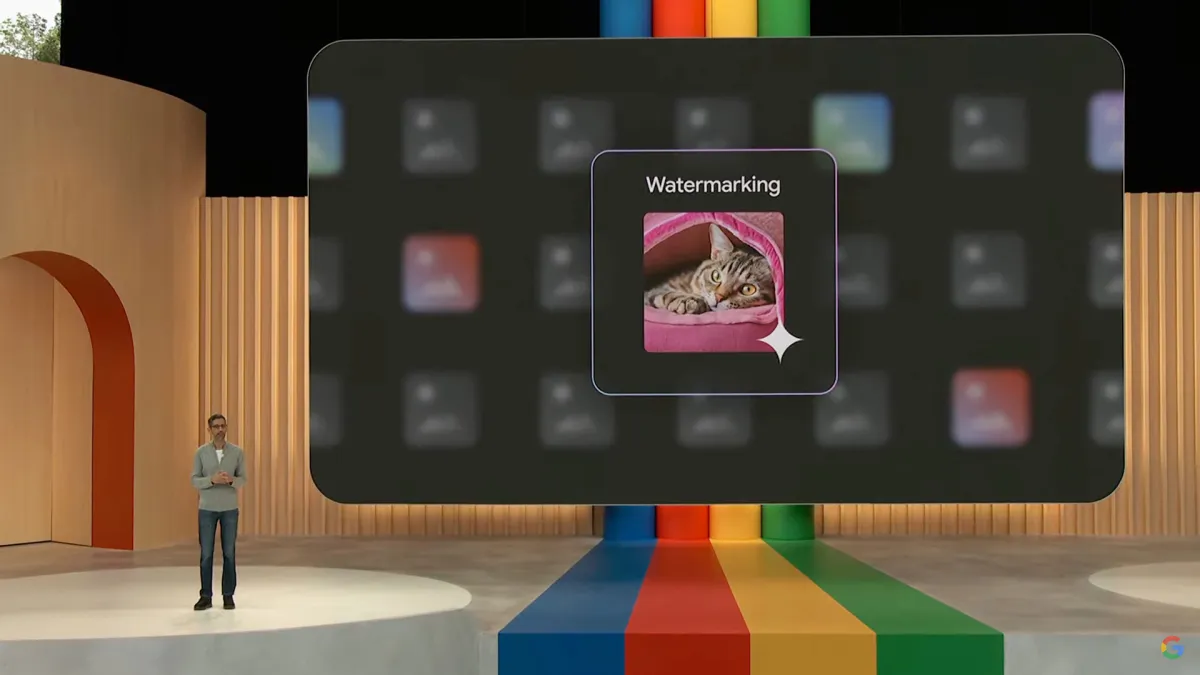
Google first introduced SynthID publicly at its I/O developer conference in 2025. Since then, the company has positioned it as part of a broader strategy to improve content provenance and reduce the damage caused by synthetic media. The idea is straightforward: if AI content can be reliably labeled at creation, then platforms, journalists, and users will have a much better chance of verifying what they are seeing.
The McConnell hoax offered a real-world example of that theory working in practice. Rather than relying only on visual clues or labor-intensive forensic analysis, investigators were able to check for the watermark and confirm that the image had been generated by an AI system in Google’s ecosystem.
Why this case stands out
AI watermarking systems are often discussed in abstract terms, but actual examples of them helping to debunk a viral hoax are still relatively rare. That is one reason this case drew attention: it gave one of the most prominent anti-deepfake tools in the market a public and memorable win.
The stakes were heightened by the subject matter. McConnell, a former Senate majority leader and one of the most recognizable figures in American politics, has been the focus of repeated online speculation about his health. When rumors attach themselves to a well-known political figure, they can travel quickly and become difficult to undo. A convincing fake image only accelerates that process.
In this case, however, the combination of fact-checking and watermark verification interrupted the spread of misinformation before the image could harden into a widely accepted false narrative.
The role of public uncertainty
One reason fabricated images like this can gain traction is that they often exploit real-world ambiguity. McConnell’s recent hospitalization created a credible-looking backdrop for falsehoods, even though the viral image itself was not genuine. Misinformation rarely needs to invent concern from scratch; it often takes advantage of uncertainty that already exists.
That is what makes provenance tools valuable. They do not prevent rumor from forming, but they can provide a quick and independent way to separate authentic media from synthetic material.
How Google’s system works
SynthID’s design addresses one of the biggest weaknesses of older authenticity systems: fragility. Watermarks or labels that exist only on the surface can be cropped out, edited away, or lost when files are compressed. Google says SynthID avoids that problem by embedding its signal in the image generation process itself.
Because the watermark is not visible to the naked eye, it does not interfere with the image’s appearance. Yet it is still readable by compatible detection tools. That means a picture can be downloaded, reposted, screenshotted, or shared across platforms and still retain enough of its identity for a verification system to recognize it.
This is especially important in the social media era, where images move between apps and services in compressed, altered forms. If a watermark vanishes with every resize or screenshot, it offers little practical value. SynthID’s ability to persist across common forms of resharing is one of the system’s most important selling points.
What the watermark can and cannot do
SynthID is not a universal detector for all AI images on the internet. It works only when the image was generated by a participating model that actively applied the watermark at creation. That makes it powerful, but not comprehensive.
There is a second limitation: if a model does not opt into the system, no SynthID signal exists to detect. That means the tool’s effectiveness depends heavily on industry participation and on whether major model providers decide to cooperate.
In other words, SynthID can prove that an image came from a participating generator. It cannot prove that every fake image on the web is synthetic, nor can it identify content generated outside the system.
| Key element | Details |
|---|---|
| Technology | Google SynthID invisible watermark |
| Public launch | Google I/O 2025 |
| Use in this case | Helped identify a fabricated McConnell hospital image |
| Persistence | Designed to survive screenshots and reposting |
| Main limitation | Only works with participating image generators |
| Current participants mentioned | Google Gemini; OpenAI joined in 2026 |
Industry participation is the real battleground
The McConnell hoax also underscores the strategic challenge facing watermarking efforts: technical design is only part of the problem. The other part is adoption.
At present, Google says Gemini models have included SynthID since the system’s launch. OpenAI added participation in May 2026 as part of a broader effort to reduce harmful image generation. Anthropic, by contrast, is not part of the program.
That split matters because watermarking becomes far more useful when more of the industry participates. If only a minority of generators mark content, bad actors may simply migrate to unmarked tools. For watermarking to become a meaningful anti-deepfake standard, it has to be both widespread and difficult to bypass.
Google’s win in the McConnell case will likely be cited by advocates of provenance systems as evidence that the model can work. But the broader market question remains whether leading AI companies will converge on shared standards or continue to pursue incompatible approaches.
Why OpenAI’s move mattered
OpenAI’s decision to join the program in 2026 was widely seen as an important signal. It suggested that the largest model providers were beginning to treat synthetic-media provenance as a serious industry obligation rather than a niche feature.
Still, one participant’s cooperation does not solve the larger issue. A durable solution will require interoperability, transparent verification tools, and enough coverage to make unmarked AI content the exception rather than the norm.
How users can check images
For ordinary users, the practical takeaway is that some AI-generated images can now be checked with publicly accessible tools. According to Google’s system design, users can verify images by asking a Gemini model or by using OpenAI’s public image-verification tool for supported content.
That accessibility is important because misinformation often spreads faster than professional fact-checkers can respond. If verification is locked behind specialized software or technical expertise, it is unlikely to help the average person deciding whether to trust an alarming image in a group chat or on a social feed.
By lowering the barrier to verification, Google and its partners are trying to shift some of the burden away from journalists and platform moderators and toward a more distributed verification ecosystem.
- Check whether the image was created by a participating AI model.
- Look for a watermark signal using supported verification tools.
- Compare the image against trusted reporting and original-source context.
- Be cautious with screenshots, reposts, and out-of-context claims.
The broader deepfake challenge
The McConnell image is only one example of a larger and more destabilizing trend. AI-generated pictures, audio, and video are now cheap enough to manufacture at scale. That lowers the cost of deception and raises the premium on trust.
Political disinformation is especially vulnerable to these tactics because it thrives on emotional reaction. A shocking image can spread before anyone has time to investigate. Even after debunking, the false impression may linger, especially among audiences that never see the correction.
That is why provenance systems like SynthID are increasingly important. They are not a complete solution, but they offer one of the few scalable tools available for tracing synthetic media back to its source.
Why this kind of verification is difficult
There is no perfect anti-deepfake defense. A strong system must work across multiple file formats, remain usable for creators, survive resharing, and be hard for malicious actors to remove. It also has to balance detection with privacy and avoid creating a world in which every image is heavily monitored.
Those tradeoffs explain why AI watermarking has been discussed for years without becoming universally adopted. The technical ambition is clear. The challenge is getting enough of the ecosystem to participate so that the system is useful at internet scale.
What this means for Google
For Google, the McConnell case is a useful demonstration that one of its AI safety efforts can produce an identifiable, real-world result. It does not resolve the misinformation crisis, but it gives the company evidence that SynthID is more than a theoretical safeguard.
That may matter as regulators, publishers, and platform operators look for practical ways to label AI-generated media. Companies building generative tools are under pressure not only to make better models, but also to make their outputs easier to audit.
The visibility of this episode could also help Google make the case for continued adoption by competitors. If a high-profile hoax can be traced and debunked because of a shared provenance standard, then the argument for broader participation becomes stronger.
Google’s watermarking approach was designed to make AI-generated images machine-readable without making them obviously marked to the human eye, and the McConnell hoax showed that the system can still be detected after heavy online circulation.
What to watch next
The most important question now is whether this case becomes a one-off success story or a sign of wider adoption. Watermarking systems tend to gain credibility when they are used repeatedly in consequential situations, not just in demos or pilot programs.
If SynthID continues to surface in other misinformation incidents, it could become a valuable piece of the trust infrastructure around AI content. If not, it risks remaining a useful but limited tool confined to a subset of the generative ecosystem.
For now, the McConnell hoax is a reminder that AI detection is no longer only about identifying synthetic media after the fact. In some cases, the tools built into the generation process itself can provide the answer.
Timeline of the hoax and response
| Date | Event |
|---|---|
| June 14 | McConnell was taken to the hospital after an emergency call, prompting online speculation |
| Early July 2026 | A fake hospital image of McConnell begins circulating on Reddit and X |
| July 8, 2026 | Snopes reports the image is fake and identifies a SynthID watermark |
| July 8, 2026 and after | The image is widely cited as a case study in AI watermarking and hoax detection |
The bottom line
The McConnell deepfake did what so many AI hoaxes are designed to do: it exploited ambiguity, spread quickly, and tried to look credible enough to outrun scrutiny. What made this case different was that Google’s SynthID system left a detectable trace that helped expose the fabrication.
That is a meaningful milestone for AI provenance technology. It will not end deepfakes, but it shows that when companies build verification into the generation process itself, they can give the public a better chance of fighting back.